A @ColleenChesebro Interview with Children’s Author Deanie Humphrys-Dunne @hollyssis


I have the best news! I would like to introduce you all to Deanie Humphrys Dunne, author of five children’s books: “Tails of Sweetbrier,” “Charlie the Horse,” “Charlene the Star,” “Charlene the Star and Hattie’s Heroes,” and “Charlene the Star and Bentley Bulldog.”

The Tails of Sweetbrier has won several awards.
It was the winner of the Silver Medal in the Feathered Quill Book Awards (2014) and was selected as a finalist for the CLIPPA book awards.

The other books written by Deanie are entertaining children’s tales told from the animals’ points of view. All of these books are filled with valuable life lessons. They are beautifully illustrated by her sister, Holly Humphrys-Bajaj.

When Deanie isn’t writing, she loves spending time with her family and their dog, Elliott. She enjoys watching equestrian competitions and figure skating shows.

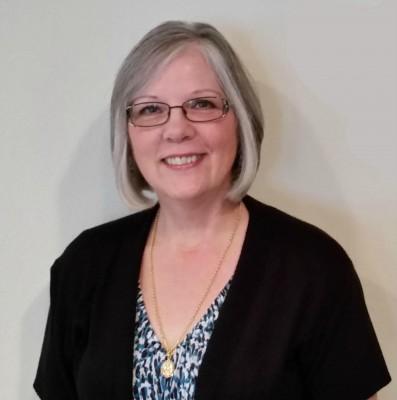
Author, Deanie Humphrys Dunne, photograph – courtesy of Bob Moseder

Colleen: So Deanie, tell me something about yourself. Where do you live? Are you a full-time writer?

Yes, I am a full-time writer, along with being a Mom and wife. We live in Connecticut.

Colleen: What inspired you to write children’s books?  Have you written other books?

My career as an author began rather unexpectedly. I had been anticipating employment as a medical coding specialist, but no one was interested in hiring me without experience. Silly, isn’t it?

One day I had a strong intuition to write a story about growing up on our family farm called Sweetbrier. Remembering my Dad’s advice to consider the worst thing that could happen when I was worried about a new venture, I figured if the story wasn’t published, I wouldn’t likely pass away.

Consequently, I wrote my first book, the award-winning “Tails of
Sweetbrier.” This story involves overcoming obstacles to realize your dreams, against the odds. It’s an autobiography of the journey I took with my Dad after he made a decision that changed my life. This book proves all things are possible if you persevere.

My other books, “Charlie the Horse,” “Charlene the Star,” “Charlene the Star and Hattie’s Heroes,” and “Charlene the
Star and Bentley Bulldog,” are fictional tales told by the animal characters. They’re all beautifully illustrated by my sister, Holly Humphrys-Bajaj. She is an incredible talent. She creates adorable illustrations, as well as book covers for our books. Nothing would be the same without her talents! All of my books are available on Kindle.

Find on Amazon

You can find a free chapter here. After you read it, make sure and tell Deanie what you think on her blog!

Find on Amazon

Find on Amazon

Find on Amazon

Find on Amazon

Colleen: What messages do you want your young readers to get from your writing?

My books are all filled with subtle life lessons that I hope will inspire and entertain children. For example, Charlie the Horse learns he must work hard and set goals if he wants to become a famous racehorse. Charlene the Star is a beautiful red horse who has different skills than anyone in her family. She proves it is okay to be an individual. She also shows it’s important to work hard to develop your natural talents.

Charlene the Star and Hattie’s Heroes is a humorous story about a group of animals who look for an exciting new career. They start their own business to help their friends overcome training problems. It highlights friendship and teamwork. Finally, my new book, Charlene the Star and Bentley
Bulldog, addresses bullying. It also shows you can change if you realize the need to do so. Readers learn about the animals’ comical thoughts and actions in these stories.

Colleen: Who is your favorite author and explain what really inspires you about their work.

If I’m reading romance novels, I like Danielle Steel because she is not predictable, and her books are always engaging, in my view. I have many children’s authors, whom I admire.

Janice Spina, Sarah Mazor, Yael Rosenberg, and Kathleen Andrews Davis are a few of my favorites. Their books are always entertaining and educational. They also highlight good character.

Colleen: Where do you get the ideas for your books from? What inspires you the most in your life?

Sometimes I get them from life experiences, as in Tails of Sweetbrier. But I would say most often, I decide what kind of theme I want and then craft a story around that.

Deanie Humphrys Dunne ancestral home – “Sweetbrier.” Photographer Unknown.

I would say my family is responsible for encouraging me. My parents used to tell me I should write books. Of course, I thought the idea was ridiculous. But once I started, it was fun. My sister, Holly, and my husband, Francis, always encourage me and give me new ideas when I need them, as do our sons.

***

I would like to thank Deanie for letting us get to know more about her and for sharing the information about these delightful books she writes for children. If you have young children or grandchildren you will enjoy reading these books together. The artwork is fabulous and the colors are inviting to kids.

Did you enjoy meeting Deanie? If so, here are some other places you can find her:

The Authors Show.com (contains an audio and video of another interview with Deanie)

deanieblog

Children’s Books with Life Lessons.com

Dhdunneblogspot.com

Facebook

Twitter


@ColleenChesebro

SilverThreading.com

We are what we eat…

We are what we eat…

A Diary of Writing Wisdom (and other nonsense)

#THREE

We are what we eat…

038-001

The Latin proverb simulac hoc, ergo propter hoc, which may be translated, “everything is the product of its environment,” is the basis for this writing theory.

According to this idea authors are like rivers. Rivers do not create water; they receive it from springs and streams. In the same way authors receive their ideas from the streams of thought that are flowing in the corner of the world in which they live. A middle-class Eastern author will receive middle-class Eastern ideas. A working-class Western author will receive working-class Western ideas.

To say it another way, authors “are what they eat.” This idea applies to minds as well as to bodies. It assumes that, just as my body is the product of red curry or pulled-pork BBQ (depending on my background), so also my mind is the product of French ideas or American ideas, liberal ideas or conservative ideas (depending on my background).

Growing authors, however, will realize this about themselves and seek out ways to “alternate” what they eat (every once in a while).

As a step toward becoming more aware of the kind of writer you now are. As a step toward becoming the kind of writer you someday wish to be—take time to consider not only how what you eat may be contributing to your writing, but how what you only eat may also be limiting your writing.

Variety adds spice . . . to writing life.

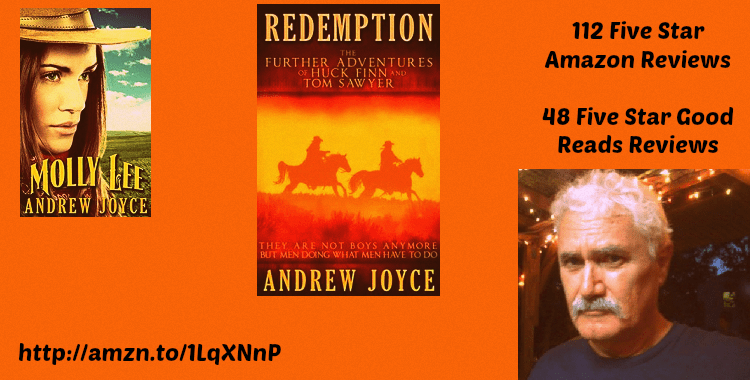
A @COLLEENCHESEBRO INTERVIEW WITH AUTHOR ANDREW JOYCE @HUCKFINN76

You are never going to believe this! I managed to get an interview with author, Andrew Joyce about his two novels and the characters he chose called, “Redemption” and “Molly Lee.”

Andrew Joyce lives on a boat in Fort Lauderdale, Florida with his dog Danny. “MOLLY LEE” is a follow-up novel to the best-selling “REDEMPTION: The Further Adventures of Huck Finn and Tom Sawyer.”


Here is the description of “Redemption,” from Amazon:

“Three men come together in the town of Redemption Colorado, each for his own purpose. Huck Finn is a famous lawman not afraid to use his gun to protect the weak. He has come to right a terrible wrong. After his wife’s death, Tom Sawyer does not want to live anymore; he has come to die. The third man, the Laramie Kid, a killer Huck and Tom befriended years earlier has come to kill a man. For these three men Death is a constant companion. For these three men it is their last chance for redemption.”

Here is the description of “Molly Lee,” from Amazon:

“Molly is about to set off on the quest of a lifetime . . . of two lifetimes. 

It’s 1861 and the Civil War has just started. Molly is an eighteen-year-old girl living on her family’s farm in Virginia when two deserters from the Southern Cause enter her life. One of them—a twenty-four-year-old Huck Finn—ends up saving her virtue, if not her life.

Molly is so enamored with Huck, she wants to run away with him. But Huck has other plans and is gone the next morning before she awakens. Thus starts a sequence of events that leads Molly into adventure after adventure; most of them not so nice.

We follow the travails of Molly Lee, starting when she is eighteen and ending when she is fifty-six. Even then Life has one more surprise in store for her.”

Click here to read my book review of “Molly Lee.”

Colleen: Andrew, what are the advantages and disadvantages of writing sequels to classics? How did you decide what the adult Tom and Huck would be like?

Andrew: In this case there was no disadvantage. I picked two beloved characters—the advantage was the same—everyone loves Tom and Huck.

This will probably not be believed, but I felt Sam Clemens standing behind me as I wrote this yarn. He wanted to write a sequel to Huck and Tom and I think he started to do so. However, he never finished it. Perhaps he used me as his instrument to get it off his chest, so to speak. In answer to your question, I don’t know how I decided to make Huck and Tom gunslingers in the Old West. The book wrote itself. But if you repeat that, I’ll deny it. After all, I’m the genius here!

Colleen: What is the single biggest challenge of creating the settings in your novels?

Andrew: I always write my settings from places I’ve been and experienced firsthand. So, that does not present a challenge for me. I don’t know about other writers, but I start a novel knowing the first sentence and the last paragraph. Then all I have to do is come up with 100,000 words to fill the space in between. That is the easiest part. I let my characters take me where they want to go. I may have something in mind for them, but when we get there, they may take me in a whole different direction in which I am more than happy to follow.

Colleen: O.K. Andrew, who would you most like to sit next to on an airplane?

Andrew: I don’t fly anymore. But if I did, I’d prefer an empty seat. If I couldn’t get that, then I reckon Jesus would do. I’m sure he would have some good stories.

Colleen: Who would play you in the movie?

Andrew: Depending on the day, either Matthew McConaughey or Jabba the Hut.

Colleen: What is the one thing you can’t live without?

Andrew: Oxygen.

Colleen: What’s the best writing advice you’ve ever heard?

Andrew: It’s not the best advice I’ve ever heard . . . it’s the best I’ve ever given. READ, READ, READ, and then READ some more. Read every book you can get your hands on. Read Steinbeck . . . “The Grapes of Wrath” and “Tortilla Flat.”

“The afternoon came down as imperceptibly as age comes to a happy man. A little gold entered into the sunlight. The bay became bluer and dimpled with shore-wind ripples. Those lonely fishermen who believe that the fish bite at high tide left their rocks and their places were taken by others, who were convinced that the fish bite at low tide.”— John Steinbeck, Tortilla Flat

That is some damn good writing. And when you read stuff like that you can’t help but become a better writer.

Colleen: What are you working on right now?

Andrew: Making a big, tall drink that is 90% vodka.

Thank you for this fabulous interview, Andrew. It was great learning about your novels and getting to know you better. I really enjoyed knowing your inspiration came from Mark Twain himself.

If you love historical fiction based in the American old west, you will love Andrew’s books!

Find Andrew on his blog: andrewjoyce.wordpress.com

In addition, you can find Andrew on:

Goodreads

Facebook

Twitter 

Colleen_Silver_Threading


@ColleenChesebro

SilverThreading.com

BOOK REVIEW BY @COLLEENCHESEBRO OF “MOLLY LEE” by ANDREW JOYCE @HUCKFINN76


Title: Molly Lee

Author: Andrew Joyce

ISBN: 1511402989

ISBN 13: 9781511402989

ASIN:  B00VEEJ97G

Published:  March 26th 2015 by Createspace Independent Publishing Platform

Pages: 428

Author website: Andrew Joyce

Genre: Western Fiction

*A copy of this book was provided by the author in exchange for an honest review, which follows.

The first time 18 year old Molly Lee meets “Lieutenant” Huck Finn and “Captain” Tom Sawyer it is 1861. The Civil War has just begun to rear its ugly head. Little does Molly know that this chance encounter with the two soldiers will change her life forever.

When a Yankee soldier attempts to commandeer Molly’s virtue and cause harm to her family, 24 year old Huck Finn comes to their rescue. Molly falls head over heels in love with the dashing Huck. She begs to be allowed to follow him when he leaves her family farm.

Huck strongly advises her not to come with him because, “He considers himself an honorable man, and honorable men don’t accept the hospitality of another man, and then ride off with the man’s daughter.”

Molly begs, and begs, finally wearing Huck down long enough to say that she can accompany him the next morning. When Molly awakens that fateful day, on July 23, 1861, it is to the realization that the two men have left without her. Not to have her love denied, Molly saddles a horse and sets forth on a trip of a lifetime to find the man she loves.

The adventures of Molly Lee take her from Virginia all the way to the Montana Territory. Spanning her life from 18 years to 56 years, this is her story. From whore houses to school rooms, Indians to cattle drives, Molly Lee pulls you into the saddle of the life adventures of a woman searching for the man she loves.

Author: Andrew Joyce

I loved the way Andrew Joyce portrayed Molly. She is a strong, independent woman, not afraid to say what she thinks. When Molly loses a lover in a catastrophic fire, I thought she had reached the end of her rope. Instead, she finds the courage to go on with her life, always searching for the elusive man of her dreams, Huck Finn.

The drive and ambition to find Huck Finn take Molly through many challenges and heartaches. To me, her ability to live by her own wits and survive, reminded me of the heroes from the old fashioned Western books I read as a young woman myself, written by Louis L’Amour.

Joyce writes in an easy, smooth, flowing manner. I especially enjoyed the portrayal of the cowboys and the cattle drive, as I experienced some of the same practices still in use today when I worked for a Montana cattle ranch some years ago. A few times, I know I felt the rush of the wind, and tasted the dust in my mouth, the descriptions were so perfect.

It should be noted that this book is a sequel to “Redemption,” also written by Joyce. However, not having read the first book, I felt this book stood alone in its own rights as an excellent read.

I enjoyed this rough ride through American western history, as seen through the eyes of a woman. Molly’s unique perspectives on life give credence to the belief that if you want something bad enough and keep working towards it, you will eventually get it. Oh, and there are whispers… Joyce is writing another book called, “Huck and Molly!” I can’t wait to read it!

RATINGS
Realistic Characterization: 4/5
Made Me Think: 3/5
Overall enjoyment: 4/5
Readability: 5/5
Recommended: 4/5
Overall Rating: 4.5

Buy it at: Amazon


Format & Pricing
Paperback: $16.99 US
Kindle: $3.99 US

Goodreads

(And guess who Colleen interviews this coming Friday here on LitWorldInterviews? You only get one guess.~Ronovan. No, not me, I just put my name so you knew I was the one typing this. I just had to jump in and mention the interview with that person you are supposed to be guessing.)


@ColleenChesebro

www.SilverThreading.com

Silence Can Be Golden by @JERoyle

Do you have adjective-itis?

A Diary of Writing Wisdom (and other nonsense)
#TWO

 Silence Can Be Golden

Gettysburg, PA ,

Most literary criticism is concerned with what authors write.  The idea of strategically using silence in your writing, by contrast, is concerned not so much with what authors write as it is with what they do not write.

When it comes to writing a book, here are a couple of questions every author should consider:  Is it sometimes better to leave things a little open ended?  Or should you absolutely, every single time, try your best to describe every tiny detail your vivid imagination can divulge?  Do you leave room for your reader’s imagination to have a life of it’s own?  Or are you, perhaps, limiting the imagination of your reader by over doing it?  Do you have adjective-itis?

 “The dog did nothing in the nighttime.”

“That was the curious thing,” remarked Sherlock Holmes.

The main weakness about this idea that silence can be golden, of course, is that it fails to take into account the way books are actually written—with adjectives.  But when is enough enough?  That’s the real question to consider.

Below is a six word story I recently entered in a contest:

The dawn.  The pilgrimage.  The dust.

What comes to mind when you think of the dawn?  Awakening?  A new day?  Who woke-up?  A teenager?  A married couple?   Whoever/whatever it was inspired a pilgrimage.  What kind of pilgrimage?  Spiritual?  Adventuresome?  Why dust?  You get the idea.

So the next time you want to include more because you feel a strong urge to tell your readers more about how Smith furrowed his brow and glared with genuine distrust at his shimmering spoonful of crimson colored magic tonic—NyQuil—force yourself to leave out the extra things you think you should include.

There will be plenty of opportunity in your book for you to write more—but sometimes less is the golden rule you should follow.

Jason Royle

Judas Hero Misunderstood


© Copyright-All rights reserved by litworldinterviews.wordpress.com 2015


#Interviews-in-translation. Today, @BlancaMiosi and Waldek

Hi all:

As you’ll remember I promised you last week that I’d bring you interviews with some well-known independent writers I’ve met in groups of writers who first and foremost write in Spanish. As some of them have had books translated to English in recent times, I thought it was a good opportunity for you to get to know not only the writer, but also their work.

Today, I’m  very pleased to bring you Blanca Miosi. Although she’ll tell you more about herself, I can tell you that she’s one of the authors that  many independent writers see as their mentor, as she has worked hard not only to share her knowledge with others but also to promote her colleagues and help them along in their careers.

Author Blanca Miosi
Author Blanca Miosi

Mini biography

Born in Lima (Perú) of a Japanese father and Peruvian mother, Blanca Miosi has been living for the last three decades in Venezuela. She is the author of Waldek, the boy who confronted the Nazis a novel based on the life of her husband, a survivor of the Auschwitz and Mauthausen camps. First published in its original Spanish as La Búsqueda (Editorial Roca) the work received international acclaim and won the 2007 Thriller Award. In 2009, Miosi published El Legado (Editorial Viceversa), a family saga based on Erik Hanussen, the notorious Berlin clairvoyant and personal counsel to Adolf Hitler. In 2011, and as an independent author with Amazon.com, Blanca Miosi published La búsqueda, El Legado, Dimitri Galunov, El Manuscrito I. El Secreto; El Manuscrito II El coleccionista and Amanda. Her novels occupy first ranking positions among Amazon’s best sold titles in Spanish. Her next launch : El rastreador.

How and when did you start writing?

I started writing in 2001, suddenly, about an idea that had been going round in my head for several days. I simply sat down and started to write. Since that day I’ve never stopped.

Describe your experience as an independent writer.

It is one of the best experiences in my life, much better than what happened to me when I published with publishing companies. From the moment I made that decision, my life as a writer took on a definite and momentous course. All my books are now published in Amazon, I control my earnings, the sales and can make the changes I choose.

What’s the moment you remember most fondly (until now) of your experience as a writer?

The amount of time my book ‘The Manuscript’ stayed in the first place in the rankings in Amazon.com and Amazon.es. I simply couldn’t believe it. It was the first time one of my books had reached so many people. Then, ‘La búsqueda’ (the Spanish original version of ‘Waldek’) was number one in all categories in Spanish for fourteen months. It will always be an unforgettable time for me.

What made you think about translating your work?

I had always wanted to enter the English market, as I believe my novels have international themes that could be of interest for the general public.

Do you have any advice for your fellow writers (and especially new writers):

My fellow writers are as knowledgeable as I am, as we started down this path together.

To new writers I would tell them not to publish before they have revised and edited the book well. One shouldn’t waste any opportunities, as they might not come around again. A badly written book will rarely have a second chance, even after being edited and reviewed.

Here is Blanca’s Amazon Page, in case you want to check more information:

http://www.amazon.com/Blanca-Miosi/e/B005C7603C/

I asked Blanca to share one of her books with us.

The book is called ‘Waldek. The Boy Who Defied the Nazis’ and tells the story of Blanca’s husband, Waldek Grodek, who was a concentration camp prisoner as a child and survived to tell the tale.

Waldek, by Blanca Miosi

Description:

Waldek, The Boy who Defied the Nazis (La Búsqueda in Spanish) chronicles the dramatic and heroic story of Waldek Grodek, who experienced first-hand and at a very young age the German occupation of his native Poland. Many decades later, while visiting the UN offices that granted compensation to the survivors of the Nazi concentration camps, Waldek reflects on the events that started when he was made prisoner and taken to Auschwitz and Mauthausen and, in the years following his liberation, subjected him to the whims of European and Latin American totalitarian regimes, international espionage and the Mossad. Waldek Grodek is a memorable character whose unique perspective and amazing life story deserves to be told.

After more than 154 weeks, Waldek, The Boy who Defied the Nazis (La búsqueda) still occupies the top 10 ranking on Amazon Spanish language. A thriller that is well worth reading.

Link:

http://rxe.me/1S2FOA

This is a review that I think might give you some idea about the opinions on this book:

“I feel so happy that Blanca Miosi’s first novel translated into English is “Waldek, the boy who defied the Nazis”, published in Spanish with the title La búsqueda (The Search).
I have read several Miosi’s novels. She is a great storyteller, but this one is her MASTERPIECE.
The novel begins with the story of a Polish Catholic child, her husband in real life, which was in the Nazi concentration camps. Anyone could say: Another sad and devastating history of concentration camps! But no, in this novel the story begins just after that. How to survive? What gives meaning to life? It is the search for meaning what defines the story.
“Waldek” is a heartbreaking and intense historical thriller.”

And, just in case, I’ve also read Waldek, and here is my own review:

Waldek by well-known (to the Spanish reading public) author Blanca Miosi is the chronicle (novelised) of a life. It is indeed a novel but based on a first-hand account by Waldek Grodek of his life. The volume I discuss is the translation of the author’s bestseller La búsqueda (The Search).

All lives are extraordinary but some (be by design, by good or bad luck or by fate) are more extraordinary than the great majority. This is one of them. Waldek was born in the wrong place at the wrong time (or maybe not, it depends on your point of view).

Being born in Poland and being a teenager at the time of Hitler’s invasion is not very lucky. His decision to be actively engaged in the resistance (however modest form it could take at such young age) could be seen as the first of many unwise (or at least detrimental to his own well-being) decisions he would take over his life. It lands him in a concentration camp (first Auschwitz and then Mauthausen). He manages to cope with his experience by focusing on survival at all costs and trying not to think too far back or ahead. This portion of the book is fascinating but hard to read, no matter how many books on the subject and personal accounts you have read before. Indeed it’s true that each person’s suffering is different to anybody else’s, and so are the defence mechanisms they use to survive.

I will not go into detail about all the adventures Waldek goes through in his life, but let me say he travels to South America, he sees success but also poverty, he is forced to live in circumstances not of his choosing more than once, but he survives.

One of the qualities of this book as that it succeeds in not turning the protagonist into a hero or a Saint. He remains a human being, who might not fully understand or like what he feels he has to do, who is not always consistent, and who loves and hates at times against his best interests and irrationally. He remains a complex and credible human being, even if not always a likeable one. Personally we might question some of his decisions, his expressed thoughts and ideas, and wonder how many of his sometimes surprising reactions and attachments might relate to his early traumatic experiences, although he never allows himself any excuses and pushes on.

Novels like this one, that take place in recognisable historical times and situation, make us question what would we do.  And if we’re honest with ourselves, we might not like the answers we get. Would we be more generous or less? Would we take more risks, or fewer? Would we be as naïve? Would be have pursued justice at all cost (even our own), or decided on forgiveness? Can we truly know?

This being a first-person narration it presents a very specific perspective on the events and we can’t but question how much the narrator tells us and how much he censures. I did feel that there were many things I didn’t know or heard about, and those will keep me thinking, and that’s something I appreciate in a book.

However accurate we might believe all the details are, the story is a page turner, and no matter what our personal feelings for the protagonist might be, we want to know what happens to him and try to solve his puzzle. Blanca Miosi writes fluidly, with enough detail to allow us to create a mental picture of the locations and people, and she is particularly skilled at making us hear Waldek as if he was sitting next to us telling us his story. I understand that the author tried at first to publish the story (of her now dead husband) as a personal account and was told by a publishing company that those did not sell very well and they would only be interested if it were a novel. Several years of hard work resulted in this book. The novel is not only Waldek’s journey through life, but also Blanca Miosi’s search for her literary voice, and it is a success in both accounts. If you dare to go on this journey with Waldek and the author, I’m sure you won’t regret it. See what you discover.

Thanks so much to Blanca for sharing her views and her work with us, thanks to you all for reading, and you know, please, like, share, comment and CLICK!

Olga Núñez Miret

@OlgaNM7

http://OlgaNM.wordpress.com

http://www.OlgaNM.com

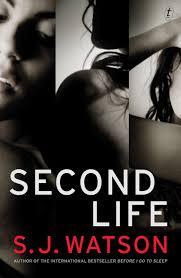
Book review by @FTThum – Second Life by @SJ_Watson

I read SJ Watson’s debut novel ‘Before I Go To Sleep’ when it was released in 2011, which was then made into a film in 2014 starring Nicole Kidman and Colin Firth.  I enjoyed the book tremendously so when his second book ‘Second Life’ was released in February this year, how could I possibly resist?


second life book coverTitle:               Second Life
Author:          SJ Watson
Publisher:    Doubleday (2015)
ISBN:             9781922079251 (paperback)
ASIN:             9781921961472 (ebook)
Website:       http://www.sjwatson-books.com/
Facebook:    https://www.facebook.com/S.J.Watson.Writer
Genre:          
Fiction, Psychological thriller


What’s it about?

How well do we truly know another?

When Julia Plummer’s sister, Kate, is found dead in Paris in suspicious circumstances, she sets out to uncover the truth. This takes her into the world of internet dating and hook-ups where her sister was known to traverse. All this at the risk of jeopardizing her relationship with her husband and the life of her son.  It is gradually revealed that Julia’s 14-year-old son, Connor is actually Kate’s child, the result of a fling with an unknown man.  Julia, now a professional photographer, appears to be a respectable middle-class woman, a dedicated mother. Then her past returns to haunt her – her alcoholism from her days in Berlin. Julia is trapped in her mind – constantly questioning her own motivations and desires; ignoring her intuition and burdened with baggage.

While Julia is filled with pathos (complete with baggage), there is a lack of depth in comparison for the other characters, particularly that of Lukas, the man Julia met online. The same for her long-suffering husband, Hugh who is 10-years older encountering problems of his own.

Watson’s attempt at eroticism through Julia’s ‘online dating’ seems forced, although his portrayal of the dark side of internet relationships is horrifying. The voice of Julia is less believable than the voice of Christine of Watson’s first book. The ending is for me dissatisfying – abrupt and utterly convenient.

Simply put, this second book of Watson’s did not live up to his first.   Nevertheless, it is entertaining.

Recommendation:

This book is a well paced and easy to read psychological thriller with enough suspense to carry it through, yet containing loop holes easily identifiable if one is to go looking. So don’t. Just read for near-mindless pleasure.

LWI Rating:

Realistic Characterization: 3/5
Made Me Think:                   3/5
Overall enjoyment:             3.5/5
Readability:                            4/5
Recommended:                    3/5

Overall Rating:                    3/5

Buy it at:

Amazon Hardback USD 19.88
  Paperback USD 19.88
  Kindle USD 9.99
Bookdepository Hardback Euro 19.47
  Paperback Euro 14.52
Booktopia Paperback AUD 25.50
  Ebook AUD 42.40


Happy reading!
– FlorenceT


@FTThum
MeaningsAndMusings

Florence 2

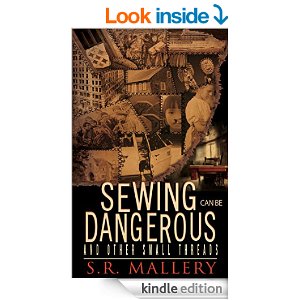
An @COLLEENCHESEBRO BOOK REVIEW OF “Sewing Can Be Dangerous and Other Small Threads” @SARAHMALLERY1

Sewing Can Be Dangerous and Other Small Threads

Title:  Sewing Can Be Dangerous and Other Small Threads

Author:  Sarah Mallery

Website: srmallery.com

ASIN:   B00VIEZ2QY

Pages:  276

Genre: Literature in Fiction, Historical Fiction, Short Stories

Take a step back into history, and follow the threads of eleven stories that feature mystery, romance, and suspense, woven into a tapestry quilt of events that will lead you through many genres; all with the theme of “sewing” interwoven into the collection.

From the nimble fingers of a slave stitching codes into her quilts to help runaway slaves obtain freedom, to a mystifying fire during the infamous Triangle Shirtwaist Factory fire, to a Haight-Asbury romantic interlude between a professor and a bewitching macramé designer; each story adds another quilt block to this duvet of skillfully intertwined tales.

One of my favorite stories in this collection is the yarn about a pioneer wife and mother who gets her first sewing machine. Anyone who is an avid sewing buff, or quilter will laugh at the competition between her family and her craft. Stitch by stitch, she is able to head off one of the worst Pioneer/Native American clashes that could have killed many on both sides.

I was so wrapped up in reading this particular story, I found myself laughing out loud, to the chagrin of my poor sleeping husband next to me, which made the story even funnier! I love when an author imprints their words on my heart.

Sarah Mallery

Author: Sarah Mallery

These tales were skillfully fashioned within each historical period concerned, and I found them to be unique and unusual. I was astounded at the originality of linking the tales with the idea of sewing becoming the underlying theme in each plot. Each story then becomes a cog, in the crazy quilt of design, with Sarah Mallery stitching a place in our hearts with her words.

Anyone who enjoys variety in their reading tastes will relish these stories. Just because there is a sewing premise in each story does not mean that men will not enjoy this assortment of short stories. There is enough history, murder, and excitement to keep you guessing all through the book.

I loved this assortment of short stories, and they left me wrapped in warmth, just like a quilt constructed from the hands of the author herself.

RATINGS
Realistic Characterization: 5/5
Made Me Think: 4/5
Overall enjoyment: 5/5
Readability: 5/5
Recommended: 5/5
Overall Rating: 5

Buy it at: Amazon
Format & Pricing
Paperback: $8.60 US
Kindle: $2.99 US

Goodreads

 Colleen_Silver_Threading


@ColleenChesebro

www.SilverThreading.com


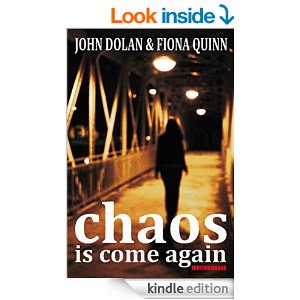
#Book #Review by @OlgaNM7 ‘Chaos Is Come Again’ by John Dolan and Fiona Quinn

Chaos Is Come Again by John Dolan and Fiona Quinn

Title:   Chaos Is Come Again
Author:   John Dolan and Fiona Quinn
Print Length: 350 pages
Publisher: Tention Publishing Limited (October 21, 2014)
Sold by: Amazon Digital Services, Inc.
Language: English
ASIN: B00OSP0AGW
Genre:  Thriller/romance/?
The publishing business, murders and madness

I have read and love the three books (so far) in the series Time, Blood and Karma by John Dolan. I know Fiona Quinn from her fantastic blog (I recommend it to anybody interested in writing thrillers. I had the pleasure of being one of her guests). And I was very intrigued by their collaboration. If any more encouragement were needed, the reviews were great too.

I had read interviews about the process involved in writing the novel and I wondered how it would have worked in reality, as it sounded fairly complicated.

Given all that I had been looking forward with trepidation to reading the novel and it did not disappoint.

The novel is seamless. I could not pick up parts that I fell were more likely to have been written by either author (I might have my theories, but nothing stood out), and once I got into the story that was no longer important.

The novel has two main protagonists: Sean, a young Englishman, a barista diagnosed with schizophrenia and with a violent incident in his past that weights heavy in his mind (although we’re never given any details), and Avery, an American woman, a literary agent burdened with a mother suffering from dementia, and whose difficulties provide at times light entertainment and at others add poignancy to the proceedings.

The two storylines: life in the literary world, a woman’s point of view, friends and chocolate cakes; and London’s gritty life, anxiety and self-doubt, together with a writer with a penchant for scandal (some would say blasphemous), an aspiring poet/singer and girlfriend with no evident redeeming qualities, and a mysterious serial killer, create as many plot threads as any eager reader would wish for (possibly even more).

Social media (Twitter in particular) helps bring them together and reels us into a thriller/romance, with a disquietingly open ending.

It’s dynamic, flows well although the rhythm varies according to whose point of view we’re seeing the story from, and with its mixture of characters and likable central duo it’s difficult not to find somebody to root for.

This is a book for readers who like to explore outside established genres and don’t mind open endings. I’m not sure die-hard thriller fans would approve but writers will have a chuckle. I did.

What the book is about: An American female literary agent, a British man struggling with a diagnosis of schizophrenia and concerned about a previous incident of violence, an irreverent author, a wannabe narcissist singer, who all come in contact with each other thanks to Twitter and the literary world. Ah, and a London serial killer.

 Book Highlights: The London atmosphere, seen both through the eyes of locals and through those of newcomers. The inner workings of a literary agency. The relationship between Avery and her friend Lolly that adds a touch of chick-lit to the proceedings.

 Challenges of the book: The book moves comfortably between the terrains of chick-lit, thriller, and accurately observed London life. The changes of registry, and the fragments of Travis’s novel might prove challenging to some readers, or at least not sit comfortably with everybody.

 What do you get from it: That the cooperation between writers can lead to great things. And, that where there is a will, there is a way.

 What I would have changed if anything: Being a psychiatrist I found it difficult not to diagnose and treat a few of the characters and I wonder how somebody with similar problems might react to some the way some of the characters are treated (Goose and his obsessive behaviours, for example) but it did reflect reality (it was probably fairly tolerant compared to reality).

 Who Would I recommend this book to?: This novel moves across a few genres. I’m convinced most writers will enjoy it, and those who love thrillers with a degree of quirkiness (rather than straight procedural or cosy mystery lovers).


Ratings:
Realistic Characterization: 4/5
Made Me Think: 4/5
Overall enjoyment: 4.5/5
Readability: 5/5
Recommended: 5/5
Overall Rating: 4.5/5
 

Buy it at:  
Format & Pricing:
Paperback:  $13.49 http://www.amazon.com/Chaos-Come-Again-John-Dolan/dp/0957325665/
Kindle:$ 4.45 http://www.amazon.com/Chaos-Come-Again-John-Dolan-ebook/dp/B00OSP0AGW/


Olga Núñez Miret

Olga_Núñez_Miret_author.jpg


@OlgaNM7

http://OlgaNM.wordpress.com

http://www.OlgaNM.com


Publishing Your First Book on Amazon for New Indies by @JoRobinson176

It’s a good idea to find out how to publish your first eBook on Amazon before, or while you’re writing it. Simplicity is the key, and if you have too many bells and whistles going on formatting wise, you might end up having to clear all formatting and start from scratch. If you use a word processor other than Microsoft Word you might have to pay for formatting, but using Word makes the process very easy. Here’s a quick overview for a standard work of fiction without images. (Click on the screenshots to view them larger)

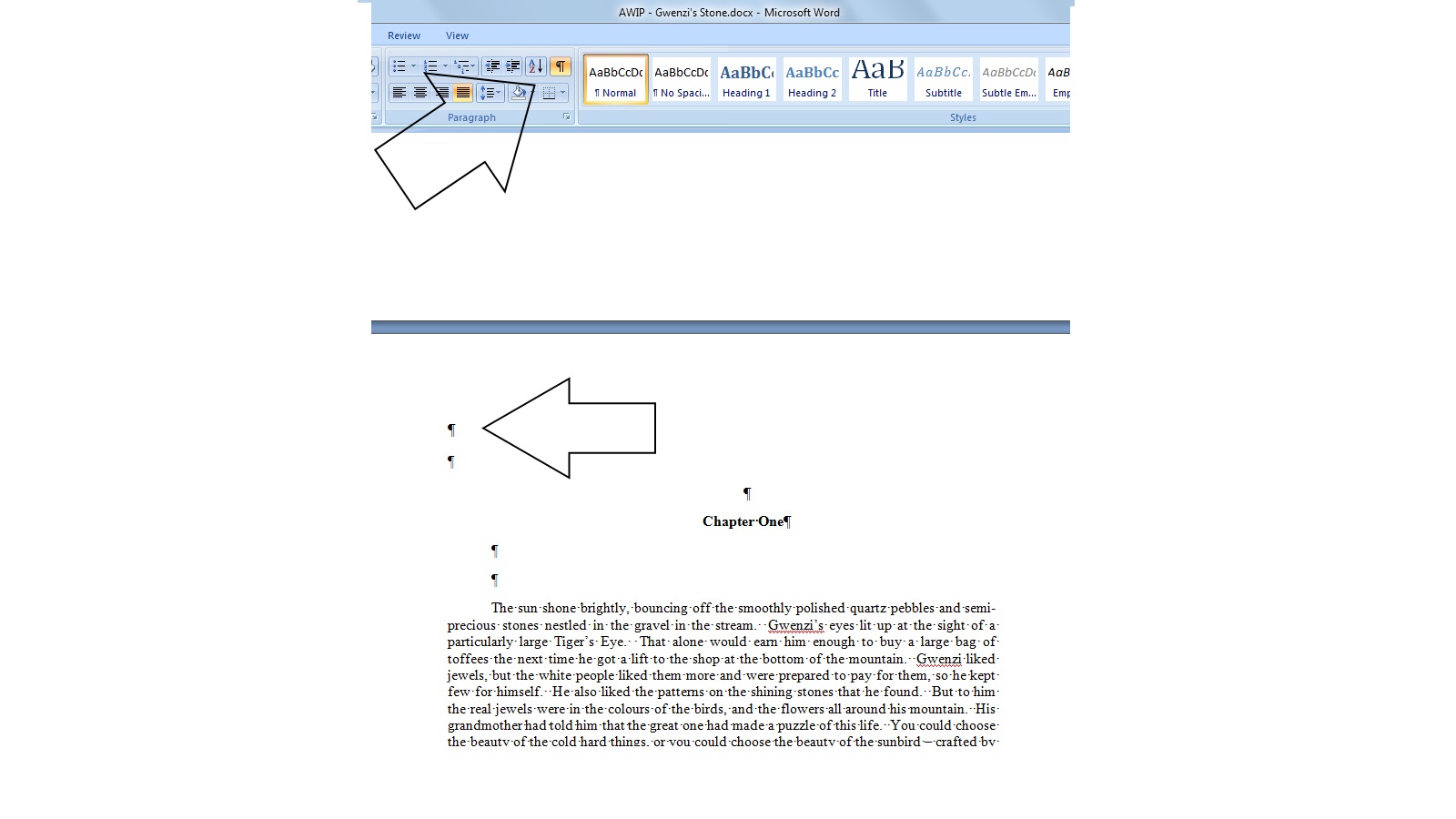
Don’t use lots of spaces or your tab key for indents. This could result in an ebook that’s a bit of an oops. Rather set up the whole document. You can do this from your first paragraph, or you can highlight the whole document and set it up. Do this from a clean document only after you’ve removed any indents, spaces and so on. Use the Show Hide feature to check.

p Show Hide

Go to your Page Layout tab in the top ribbon of your document, and then click on the little arrow to the right of the Paragraph selection. Select Indents and Spacing and change Special to First Line, and then change By to your preferred size of paragraph indent, and that will do your indents automatically for the entire manuscript from then on.

p Paragraph Settings

Then, in the same box, set your automatic spacing between paragraphs, so set your Spacing to your desired size, and set line spacing to Single.

p Paragraph Settings 2

While writing, insert Page Breaks before each chapter and don’t use headers and footers. Also no page numbers for your eBook. Kindle only uses seven basic fonts, and readers can change them according to their preference. They can also change the font size, so 12pt is probably the easiest size to choose. It’s best to use a simple font like Times New Roman or Garamond, but that’s entirely up to you.

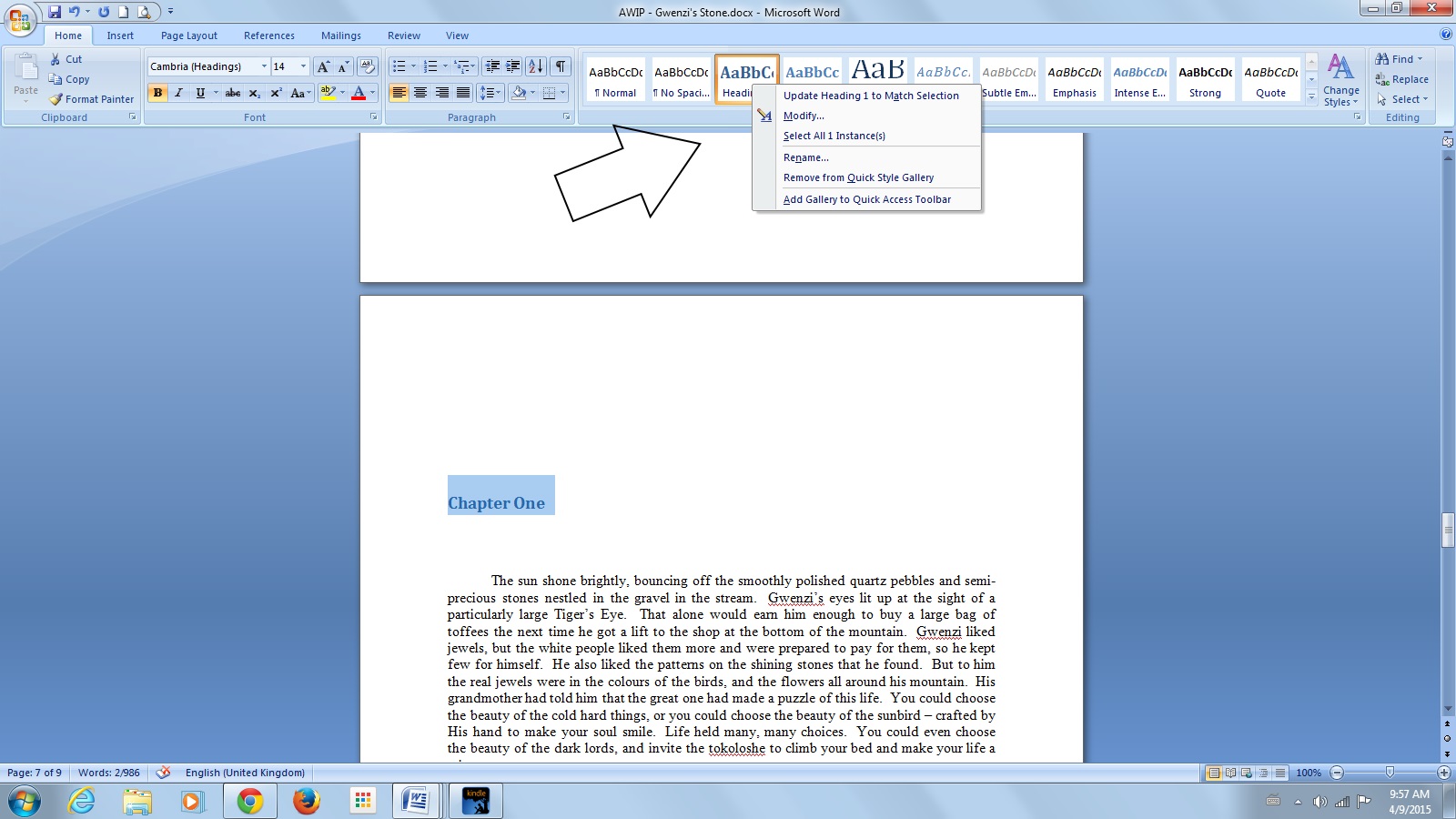
Then you decide if you want a table of contents for your book. If you do, from your Home ribbon, highlight your first chapter heading, and then click Heading 1. You can right click on the Heading 1 box to Modify Font, Size, and Justification for your chapter headings. Once you’ve modified to what you prefer, right click on the Heading 1 box again and click on Update Heading 1 to Match Selection. Then zoom through your book and highlight each chapter heading, click on Heading 1, and they’ll all be the same.

p TOC

Once you’ve done that head back to the front of your book where you’ll need a blank page. Type the words Table of Contents using left alignment, and press enter. Click on the References tab in your top ribbon, then Table of Contents > Insert Table of Contents. Uncheck Show Page Numbers, and set the Show Levels box to 1. Click OK, and voila! Your Table of Contents will magically appear. To test it, use Control > click over one of the chapters in your TOC and it should take you there.

p TOC 1

Now to bookmark this. Highlight only the words Table of Contents. Select Bookmark from the insert tab on your top ribbon. Type in toc and click Add in the box that pops open, and you’re done with the fiddly stuff.

p TOC 2

Assuming you’re done with your final proofing and edits, go over your manuscript, and check that your front matter is looking good. Insert page breaks between your title page, copyright page, and any other things you have there, such as a forward, prologue, dedication, or editorial reviews. One thing I haven’t done yet in all my eBooks is add a description in the front, although I’m going to. These days we have so many books on our Kindles that we forget what they were about, so a little blurb there is a nice idea.

Then check that all your links to your website or any other books are clickable, finally Save this document, and prepare for takeoff. After saving all your hard work, go to the Save As function in the top left corner and select Other Formats. Next, under the File Name select Web Page, Filtered in the Save As Type box. Click yes when the warning comes up. You’ll see that you now have your original document, and also a HTML document of the same name. The HTML is what you’ll be loading on to Amazon. (If you have images in your book, you will need to load a compressed file onto Amazon, so this is only for manuscripts without them)

p HTML

Have your cover ready separately as a jpeg or tiff image. I use nice quality high resolution images sized at 6.25 x 9.5. You’re ready to rock.

If you haven’t already, open your account at Amazon KDP, and fill everything in. If you don’t live in the USA you have a couple of tax options, including allowing Amazon to withhold tax until you get around to getting to the proper processes. You can still publish and earn royalties until you do, and any withheld taxes will be paid to you when the necessaries are done.

Go to your Bookshelf. Click on Add New Titles, and take your time filling in all the fields. Especially don’t rush through the Categories and Tags. These are important for your book’s visibility. Select your Royalty. This can change for each book you publish. Books $2.99 and up get 70%, and below that get 35%. Put your book blurb in Description, add yourself as the author in Contributors (and any other contributors that should be there), state your right to Copyright and not Public Domain, and now it’s time to upload.

Your book file and cover file get loaded separately, both very simple processes – you just upload straight from your computer, and wait to be told that each upload is successful. Click on Upload Book, browse, and select the HTML document to upload. As soon as you see Upload and Conversion Successful, you get various options to review. I always download the Mobi file to go through on my Kindle for PC, and also to check on my actual Kindle, as well as paging through the online reviewer. Once you’re happy, click Save and Publish. Your book will then be live on Amazon within the next 48 hours. Set up your Amazon Central page, and find and claim your book.

When you write your next book, you can make a copy of the formatted one, delete the words and retain the formatting, which is a thing that scribblers as forgetful as I am might find useful. Happy publishing Indies.

UPDATE: SEE OUR LATEST ON HOW TO Create NCX Table of Contents using Calibre

Make some noise with a Thunderclap. For me and @PSBartlett

LWI’s very own needs some support as she ventures into Indie Author territory. Her prequel is set to come out and she needs your help, and so do I. She and I are co-authoring a book related to the one coming out. Pre-order it. Thunderclap it. Help it hit #1 so I can see my first novel can get to your hands. I am so excited. I’m using this one as a test of how the new site AuthorsSupportingAuthors strategy works. What better guinea pig than one of LWI’s own, right?

Ronovan's avatarronovanwrites

Want to help Author PS Bartlett make some noise?

So you know who my upcoming novel that will be released is co-authored with?

Go the link below and click to help on the social media sites you want to help on. That’s all there is to it. You don’t do anything. On the day of the message to go out, it does it for you. No responsibility on you. Just click and forget it.

https://www.thunderclap.it/projects/24769-hoist-the-colors-mates

While you are at it also go and pre-order. Trust me on this one, you get a peak at what might be coming from me.

Is that a teaser? You betcha’!

By helping PS Bartlett today you are helping my co-authored book to be published in the maybe not to distant future.

http://www.amazon.com/Demons-Pearls-Razors-Adventures-Book-ebook/dp/B00VQQPOKS/ref=sr_1_1?s=books&ie=UTF8&qid=1428500252&sr=1-1&keywords=ps+bartlett

P.S. Bartlett Demons and Pearls Cover

View original post

I Love Anger the truth by @isaacdrowe The interview.

i-love-anger-header

RW: Where did the Isaac you describe in I Love Anger, that grew to love anger come from, that younger version of you, that world?

ISAAC: In the introduction and angry roots I describe how anger began to grow in my life from a youth to an adult. Living in a world of no hope and no light can be difficult to function in. It is not a world I would want anyone to experience.

RW: Though you went through a lot, and I mean a lot, growing up, you’ve obviously chosen to take your life in a different direction. The book obviously pulls from your experiences, I mean this is your story, but you also have experience in Anger Management. Would you tell our readers something about that?

ISAAC: I wanted this book to be a personal and clinical approach towards anger. I wanted the reader to understand through my pain so they could see the trials and triumphs through me. If I gave them anything less than that, I would probably rob them of a true self help experience. I didn’t want them to feel alone, in the book we walk through anger management together.

RW: Excellent, so you have the true story and life experiences COMBINED with the training to truly put it all together for us to share. Were you encouraged to share this story with others because of that combination? I mean only YOU could tell this story and the way to where you are now.

ISAAC: At first the book was for me, I began writing down my thoughts and to help me see what was inside me. It was therapy for me. As I continued to write I felt like this could help others so I turned it into a book. I wanted to give a real life, no joke approach but also give a clinical side for balance.

RW: I have to say, the story of you growing up, I can connect to some of it. My situation wasn’t quite like that but there were moments and a lot of my family members had lives kind of like that. One died in prison. Looking at his prison picture I could see the anger in him. What would you say to my relative, if he were alive and it was the day before he stole that last time that got him caught, what would you tell him that was in I Love Anger that could help him find his way out?

ISAAC: I would ask him “What’s up? Why are you really angry? There is a reason behind this behavior. This ain’t you! Keep telling yourself you good and that you straight but you and I both know that it’s something deeper than that! This lifestyle only ends up two places, dead or in prison wishing you was dead. But hear this from me! it’s not worth it! You are worth more than this! Its okay to feel how you feel right now, but how you react versus respond to how you feel kinfolk will destroy you. This is real talk, know that I care about you! Hear me, I Love YOU! If you think your mom, dad or nobody loves you, know that I love you unconditionally right where you are! I’m here with you, if you want to change, it can start right now! The choice is yours! It’s all on you!”

RW: You know, you nailed a few things there that I think would’ve helped. One thing our readers should know is, this book ain’t sugar coated to make everyone feel all warm and fuzzy about the end. You tell it like it was as you go along. What kept you focused on being certain your story was as it should be and not a motivational speaker book?

ISAAC: The reader needs something authentic and something they can relate to.

RW: Was there a moment where you were in a place of not going to finish this book, it’s too much, and I just want to forget all of this that’s happened?

ISAAC: Yes, I stopped for weeks but I got more and more insight for the book and at that point I knew that I had to complete it for my readers, it was much bigger than me.

RW: Where are you in your head these days and your heart?

ISAAC: My Faith in God, Family and Ministry.

RW: I knew that answer before I asked. It was a set up. You’re living it. Do you have a particular story of where your book has touched someone, helped them, where they’ve written to you or even come up to you and just shared what your words have helped them with?

ISAAC: I have had someone come up to me and tell me that if they went through what I went through they probably wouldn’t be alive. I realized at that moment, I am a survivor and I want people to turn their pain into purpose like I did.

RW: I like that. You keep getting out of what you’ve given to others. I see you do book signings and things of that nature in the Austin area and parts of Texas, are you open for speaking engagements, perhaps through Skype if anyone reading would be interested in your services? I mention Skype because I am sure it might be difficult to travel to Canada and back before work calls to find out where you are.

ISAAC: Yes I do book signings in my region and I am always open to speaking engagements because knowledge is power, if you know better you have an opportunity to do better. Yes, I currently provide online coaching and mentorship through Skype.

RW: How about for any other sites out there who would like to have you perhaps do a guest article for them, are you open to that and if so how would they go about contacting them? I mean your subject covers the world. There is no boundary that anger doesn’t cross and no person it doesn’t touch.

ISAAC: Yes, inquire at iloveangerbook@gmail.com

RW: Is there a way our readers could order a signed copy of I Love Anger? I know how what I will call bookies love real paper and like to have that personal touch if they can. Yes, if people who love food can be called foodies, I can call people who love books bookies.

ISAAC: Yes, inquire at iloveangerbook@gmail.com

RW: Okay, we’ve been serious. Now let’s go into the areas I like to go to in order to find out about who you are. What ice cold drink do you like with your meal? And for that matter, tell us what your favorite meal is, and your wife is watching, so the Queen will know.

ISAAC: Strawberry Lemonade, Ugali (African dish) white corn meal, greens and chicken.

I looked up Ugali, they call it the Kenyan Running Superfood. If it’s made of cornmeal it’s got to be good.

RW: I think you just described the perfect meal for a man that just got out of the hospital, that being me. You’re a Texan so, Spurs or Rockets, and why not go ahead and choose Cowboys or Texans?

ISAAC: I support all Texas TEAMS but Spurs and Cowboys for sure!

RW: If you could go to one place in the world, where would it be and why? And we’ll say the Queen isn’t looking, but remember she’s going with you.

ISAAC: Africa because I want to connect with my roots and learn from the people.

RW: What book are you reading now?

ISAAC: The Principle of Fatherhood by Myles Munroe

RW: What book OTHER THAN YOUR OWN, would you recommend to people to read?

ISAAC: Making of a Leader by Bishop L.A. Wilkerson, 15 Invaluable Laws of Growth by John Maxwell

RW: I’ve mentioned the Queen several times now; tell us about her highness, the glory of your life.

ISAAC: Read the dedication in my book!

I would tell all of you what the dedication says, but he said go read it, so I think you need to get the book and go read it.

RW: Finally, what’s your favorite word and why?

ISAAC: Authentic. When you know who you are, it resonates. You’re free of anything that’s not what you want or who you want to be . . . original. I don’t want to die not being myself or living a lie.

Isaac RoweGet the Book at Amazon: I even put the full link below.

http://www.amazon.com/I-Love-Anger-Isaac-Rowe/dp/150270062X/ref=sr_1_1?ie=UTF8&qid=1428327774&sr=8-1&keywords=isaac+rowe

To get connect with Isaac, visit his websites at www.iloveanger.com and www.themaninme.org. You can also join him on one of his Twitter accounts or facebook.

Facebook at www.Facebook.com/isaacdrowe

Twitter 


Let’s Connect.

Ron_LWI


https://twitter.com/RonovanWrites

https://www.facebook.com/pages/Ronovan-Writes/630347477034132

https://plus.google.com/u/0/+RonovanWrites/about


Enter your email address to subscribe to this blog and receive notifications of new posts by email.

© Copyright-All rights reserved by litworldinterviews.wordpress.com 2015


The Novel: Doing the Research by @DanMcNeil888

When I first got the notion to put a book idea that had germinated in my head for close to twenty years on paper, I had no idea what was in store for me. Literally…not a clue.

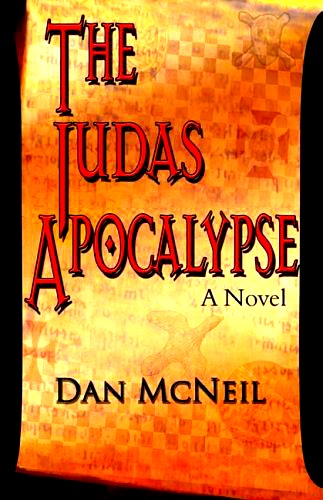
The-Judas-Apocalypse-cover-DMThe Judas Apocalypse was born out of an immense love for history and adventure. It gnawed at me for years. I always thought it was a really cool and original premise and it was my kind of book. I wanted to put in everything I loved about an adventure novel – an ancient secret, a long lost treasure, action and tons of twists. After vacillating for a few years, I finally decided I would give writing it a shot.

Penning a novel…how hard could it be, right? Although I had never done anything at all like it before, I did recall banging off a three page short story for a creative writing class I took when I was about 15. Got an A for it. So yeah, I figured I could do this. Piece of cake.

So I sat down at the computer and started to write the first chapter. It played out in my head like a movie. I could see the little girl, the crowd, the agonizing trek to the Hill of Skulls, the inevitable end that marked the beginning of the story. Not a problem – let’s do this!

I had the first chapter done in about an hour. Then I was faced with the next chapter and I realized to my horror, to continue this tale and hopefully turn it into a gripping and page turning historical voyage that would ultimately take place over a two thousand year span, I would have to do some research. Some real, serious historical and (yikes!) theological research.

Suddenly it was like I was back in high school. Any idea how I felt about high school? Does anyone ever really enjoy his or her experience there? I know some people do but I sure didn’t. And just like in high school, I knew the research was going to be a pretty massive undertaking. But I knew in order to make the story believable, I needed the historical accuracy. It was the only way to make the story really come alive.

Thank God things had changed somewhat since those days. No more scouring the library for four, five hundred page tomes that would have sunk me faster than Quintus Arrius’ trireme in Ben Hur (see – I had to research that.) I now had the power of the internet before me. Information was at the tips of my fingers.

A ton of information, that is…and a lot of garbage too. Man oh man, what to use? What to ignore? Wading through it all was going to take a while. Oh, and by “a while” I mean about four years. Honestly, if I knew beforehand it would take me four years to research this beast, I would have gone back to writing mildly pleasant pop songs again.

What I did to tame this beast was to work out the basic plot in my head, then on paper. Seems obvious, right? Originally, I thought I would just start writing and see where it would lead me. But it became very apparent early on it would be absolutely necessary to at least plot out the basics because I would need to limit my searches to what was germane to the story. It is soooo easy to get lost on the ‘net. One minute I’m looking up the interior of a German U Boat from 1944 (an important plot point in the middle of the book – I needed to describe it as precisely as possible) and the next minute I’m hitting a link taking me to an article about, of all things, the Montgolfier brothers and their hot air balloons. I’m not kidding – then that particular link lead me to a Monty Python sketch called “The Golden Age of Ballooning” and then before I realized it, I was on a Monty Python YouTube page that lost me a full day’s writing.

The internet is a valuable resource, no doubt, but there sure are a lot of historical inaccuracies on it as well. Because my novel was a work of fiction (with historical elements) however, the inaccuracies were not such a huge issue for me. In fact, many times, the inaccuracies would spark an idea that proved to be, for the most part, useful or at the very least, interesting. The trick was to recognize the areas where accuracy was mandatory. That was key. There were times when the publisher and I went back and forth over a particular historical point, if incorrect, could tumble the precarious house of historical cards I had set up. What it came down to in the end was, certain events, certain locations, and even some historically real characters (for example, Otto Rahn, the famous Holy Grail archeologist makes an appearance) needed to be as factually accurate as possible. That meant finding numerous sources that bore out the information. If I found at least three, I felt I was in the ballpark. The online world also provided links to encyclopedia topics and relevant magazine articles of immeasurable help. Again, as long as I could find at least three agreeable sources, I went for it.

But historical detail only goes so far. The Judas Apocalypse and my second book, Can’t Buy Me Love (a Cant-Buy-Me-Love-cover-DMlittle shameless self promotion and plug!) are historical fiction after all. The accuracy goes to fostering the believability of the plot, but you can’t get mired down in all the archival veracity. Too much detail and the adventure can fall flat; not enough and it’s not believable. It’s a carefully mixed cocktail of detail and drama I hope keeps readers turning the pages and drunk with excitement.

Although it took literally years to research The Judas Apocalypse (Can’t Buy Me Love, by the way, took much less time as it was a quite a different book and, by now, I had a better idea what I was doing ), I must say the experience did soften my view of the process. It’s a tough slog, but well worth it in the end.

Maybe, by the time I’m ready for book number three, I’ll get my nose to that historical grindstone. If, that is, I can stay away from the Monty Python videos…

Can't buy me love The Judas ApocalypseDan McNeil is a Canadian author with two novels so far to his fame; The Judas Apocalypse and Can’t Buy Me Love. Both available on Amazon by clicking here to go to his Amazon Author Page. To find out more of the man visit his website, http://www.danmcneil.ca/ and follow him on Twitter @DanMcNeil888. Also read his Author Interview here on LWI by clicking here.

A @COLLEENCHESEBRO #BOOK #REVIEW “RIDING AT THE GATES OF SIXTY-VIRGINIA WOOLF” by @ALIENORATAYLOR

alienora-taylor-riding-gates-sixty-virgina-woolf


Title:  Riding at the Gates of Sixty – Virginia Woolf

Author:  Alienora Taylor

Website:  https://alienorabrowning.wordpress.com/

ASIN:  B00UJFIE6I

Published:  March 10, 2015

Pages:  153

Genre:  Fact-based Fiction, Drama

Virginia Woolf’s last days before her tragic suicide in March 1941, at the age of 59 years, is the setting for this partly true/fictional account told through the eyes of her family and friends.  This haunting novel is written much in the first person, and you get a firsthand account of the events from her husband, Virginia herself, and her friend, Vanessa Bell.  This in depth character study shows Virginia Woolf, as she truly was, a woman comprised of more than just the tragedy of her early demise.

Virginia Woolf was one of the most respected British writers of her time.  Self educated at home by her father, she developed a particular writing style that was intriguing in her ability to write dream like sequences within the orderly plot line of her stories.  This non-linear writing style allowed Virginia to be more creative, a form of writing that had never been done before by other authors.

In true form, Alienora Taylor employs the same non-linear writing style in her account of Virginia Woolf’s last days.  At times, I felt like the author must be channeling the memories and feelings of Virginia, the writing was so engaging.  Virginia came alive for me.  I like to think that I now better understand her depression and the demons that pursued her.  I got to know the real Virginia Woolf.

Alienora Taylor

Author, Alienora Taylor

The happenings in the book are based on fact.  The author studied in detail, letters belonging to Virginia Woolf in preparation for writing this novel.  The only speculation can be, as to what really existed in the minds of the characters.  I felt the author’s attempt to understand and empathize with Virginia’s consuming depression portrayed her, as a successful woman filled with many self doubts, much like modern women today.  Virginia seemed to have it all – success, a loving husband, family.  It just was not enough to help her in the end.

I loved this book.  I knew little about Virginia Woolf, other than that she was a successful author who committed suicide.  What I found reading this novel, was that Virginia Woolf was a strong determined soul, a creative genius, tortured by her madness.  I cannot wait to read her novels!

RATINGS
Realistic Characterization: 5/5
Made Me Think: 5/5
Overall enjoyment: 5/5
Readability: 4.5/5
Recommended: 5/5
Overall Rating: 5.0

Buy it at: Amazon
Format & Pricing:

Kindle: $2.99 US

Goodreads


 Colleen_Silver_Threading


@ColleenChesebro

www.SilverThreading.com


What’s in a Name? Amazon Author Pages and Nom de Plumes

Authors use nom de plumes for various reasons. Erotica writers for instance, who don’t want their families to find out how they’re earning their crusts. Fictionalised memoirs are also books that sometimes could cause major problems for their authors if the people in their lives that are also in their memoirs find out. Especially if they are painted in an unfavourable light. This can lead to legal action, apart from any other sort of revenge the “injured” party might think to take. Hugely successful authors, like Stephen King who wrote as Richard Bachman, have dipped their toes into these waters for various reasons. Sometimes to see if they would be as successful if readers didn’t know their books had been written by them (I knew with King and Bachman though – before the truth was told), and sometimes simply because they don’t want to anger readers of a certain genre they write in by publishing a totally different genre, thereby possibly incurring accidental purchases of genres that are not enjoyed.

If you write horror, romance, and also children’s books, you can publish them all under your own name, and have them all listed on your Amazon Central Author Page, comfortable that the very different covers and blurbs are sufficient for readers to be aware of the genres. Or you can use three nom de plumes, and still list them all on your one Author Page, preferring that all your writings are kept in the same place. Possibly horror and children’s books don’t belong on the same page though.

Amazon allows you to have three separate Author Pages using nom de plumes on your one Kindle account. Only you will ever know that the books listed on them are yours, unless you choose to market them using your own name and marketing avenues. This means that you still have your current fan base to share the books you publish under your new nom de plume, and you can even add your real name either on the cover or somewhere in the front matter of all your books, as well as list them all on your website. The choice is yours though. Sometimes totally incognito is the way to go, while still being able to sell your wares, in which case open websites, Twitter accounts and so on using your nom de plume. Here’s how you do it.

1. Publish your book as usual, using only your nom de plume as the author, then find it and claim it as yours.

2. When the box opens for you to stake your claim, you’ll see the following:

You are not listed as the author of this book.
Do you see your name below?
Do you have a pen name?
If you write under a different name, let us know.

3. Click on let us know in the final option.

4. When you get a confirmation email from Amazon, simply click to confirm that you are the actual author of the book, and Bob’s your uncle!

You can then easily toggle between your newly linked Author Pages on Author Central from a drop down menu right beside your name, where it helpfully says, Click here to switch pen names. Then zoom off to assume your third alter ego, close the curtains, lock the doors, and write anything at all that takes your fancy. Your privacy is assured.

If you have more than three alter egos, then you need to open a second Author Central account with a different email address, but I’m pretty sure that three should do you very nicely.

Don’t forget to do the same on all the Amazon sites that you sell your books from. Happy flying under the radar scribblers.


2014-07-07 10.38.05

The Legacy of Fear Q&A with Vanessa A. Ryan @vryan333

RW: I’m reading The Legacy of Fear now and enjoying it. The entire idea is right up my alley. How do you come up with the titles of your books?

VANESSA: Sometimes the title just comes to me. Other times, I ask my family, friends, the publisher, or even strangers I might see on the street to help me choose the best wording of a preliminary title. They’ll all haHorrorAtTheLakebooksve different opinions, and then the hard part is making the final decision.

RW: I am getting the whole the feel of, well, spooky, are you a sunshine weather writer or rainy day type?

VANESSA: I like overcast days. In fact, I love overcast weather. I feel more creative when the sky is gray and the atmosphere is a little foggy. Sunny days are just for enjoying the warmth of the sun, smiling a lot and not thinking much.

RW: Tell us about how writing regime, if you have one that is?

VANESSA: My writing schedule is to write at least a thousand words a day, seven days a week, for the first draft. Most of that happens late at night, when the phone is least likely to ring. I may stay up until two in the morning to get in those thousand words, especially when I’ve had a busy day doing something else. I know if I don’t persevere, I won’t get that first draft written. As for revisions and rewrites, I like those the best. The hard work is already done. Cutting, revising and adding is the fun part.

RW: Do you jump out of bed with coffee in hand or are you an afternoon writer?

I never jump out of bed for anything, unless the house is on fire––which has happened to me. I like coffee and breakfast in the morning, and reading the Los Angeles Times. Three days a week I read it online, and four days a week I get it delivered. It’s an important part of my daily routine. I never turn on the TV or radio for the news in the morning. I’m the type who wakes up slowly. I like to know what’s going on in the world, but without someone barking at me. If I can, I will write in the afternoon for a while. I might finish what I started writing in the afternoon later that night, if I didn’t get enough done.

RW: What do you have to avoid when writing a book?

VANESSA: I have to avoid too many other activities, or cut the time I devote to them. And since I’ve always got ideas in my head for new stories, I have to stop thinking of them so I can write the book I’ve already started.

RW: Do you ever get burned out?

VANESSA: Sure. Writing is work. It’s putting in the time. Since December, I have been taking a break. But the holidays are over, and tomorrow, I will begin looking at the edits of the last book in my trilogy, Horror At The Lake, A Vampire Tale. However, even when I’m not writing, I’m thinking of my next book or series of books.

RW: How do you start to write a book? What is the first step?V.Ryan

VANESSA: The first step is to decide which book floating around in my head I am going to commit to writing down. I usually know who the main character is and whether I’m going to write in the first person or in the third, but I will have to rough out the secondary characters. The next most important thing is to figure out the ending. The challenge then, is how to get from the beginning to the end. Sometimes I write plot points on three by five cards, and sometimes I just wing it and start writing. I try to write chapters that are about ten pages long, and I read over what I wrote yesterday, before I begin writing again.

RW: What books have most influenced your life most?

VANESSA: I think the books of Carlos Castaneda, Curt Vonnegut, Jerzy Kosinsky, and the mystery writers of the twentieth century, such Agatha Christie and Ross MacDonald. Also the noir writers, such as Cornell Woolrich, Charles Willeford and Dorothy B. Hughes. But one of the most important influences in my life was meeting Ray Bradbury after a lecture he gave. I had read Death Is A Lonely Business, and although not one of his most famous books, it is set in Venice, CA, where I once lived. It inspired me to write my paranormal novel A Blue Moon, which also takes place in Venice, CA. It was thrilling to meet the writer who inspired me to write the book.

RW: Recently one of our Team here on LWI wrote an article about being a writer versus being an author. Do you see writing as a career?

VANESSA: I do see writing as a career. Of course, every writer hopes to have a best seller, but regardless, I will keep at it as long as I have stories I feel impelled to write.

RW: Do you recall how your interest in writing first came to life?

VANESSA: I started writing in the third grade. My teacher allotted a portion of her lessons to creative writing every week. In the sixth grade, we put on a school play and I wrote the script.

RW: If you had to do it all over again, would you change anything in your latest book?

VANESSA: No. I’ll just write another book.

RW: What are you working on now?

palette-for-murderVANESSA: I am currently working on another traditional mystery, the second in the Lana Davis series, titled A Date For Murder. The first, A Palette For Murder, will be released this May by Five Star Publishing.

RW: How do you de-stress from those moments of word overload or word weary?

VANESSA: I don’t know that I get tired of looking at words, but I do need to take time off. I love walking in a park near my house, watching my favorite TV shows, traveling and socializing with friends.

RW: Book covers are more important than people think. I mean an author knows but I like how yours in a series almost brand the series. What’s the book cover process for you?

VANESSA: The publishers of my books have designers and they create covers from settings in the books that I describe to them.

RW: What was the hardest part of writing your book?

VANESSA: That first draft is always the hardest part.

RW: I agree with you there. Although my gazillionth draft seems to be hard too. Now what did you learn during the writing of The Legacy of Fear and really any book you write?

VANESSA: I have learned to be more forgiving. All my characters have flaws, some worse than others, but they have some redeeming or humanizing characteristics as well.

RW: What is one piece of advice you would give another writer?

VANESSA: Talk less and listen more. I get many of my ideas for stories from what people say.

RW: And now, what last thought for our friends today?

VANESSA: I hope you enjoy my books and the journeys they take you on.


Vanessa A. Ryan is the author of:

Horror At The Lake, A Vampire Tale (mystery trilogy):

Book 1, The Legacy Of Fear: http://vanessaaryan.com/TheLegacyOfFear.html#buy

Book 2, The Trail Of Terrorhttp://vanessaaryan.com/TheTrailofTerror.html#buy

Book 3, The Blood Of Redemptioncoming in April
A Palette For Murder pre-order now: http://vanessaaryan.com/APaletteForMurder.html#buycoming in April


Follow Vanessa A. Ryan at:
https://twitter.com/vryan333
http://vanessaryanwriter.blogspot.com
https://www.facebook.com/VanessaRyan33

http://www.amazon.com/author/vryan
http://www.imdb.com/name/nm2543030

 There you have readers. By the way, you’ve seen Vanessa before. You may not realize it but I know many of you have. Snoop around and you’ll discover from where. By her books. I’m enjoying The Legacy of Fear now.~@RonovanWrites


Enter your email address to subscribe to this blog and receive notifications of new posts by email.

© Copyright-All rights reserved by litworldinterviews.wordpress.com 2015

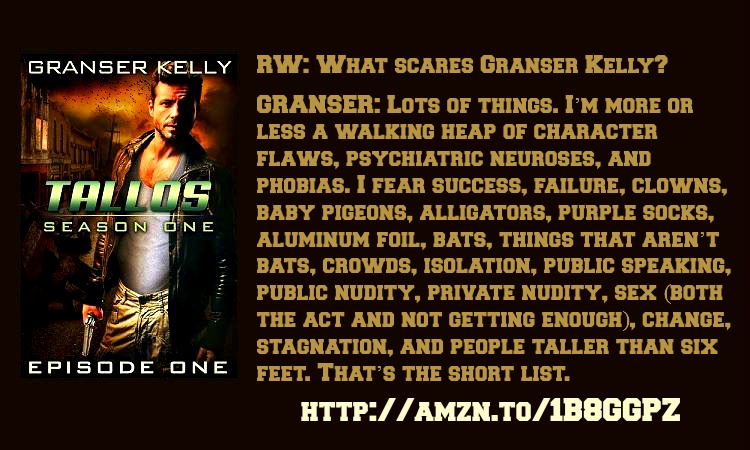
Tallos-Episode One (Season One) Interview with Granser Kelly.

RW: Tallos-Episode One (Season One) has some details very much set in the South here in the United States, is that from personal experience having lived in the area, why that area specifically, or will that give too much away of the future episodes?

GRANSER: I spent quite a bit of time there, actually. I wanted to begin the series in a familiar setting so to give it a sense of authenticity. The story as a whole will span the entire country and possibly other parts of the world. But I felt the southern states would be a good place for me to begin.

RW: What genre would you categorize Tallos?

GRANSER: I consider it Post-Apocalyptic Science Fiction. It’s also categorized in Action/Adventure, but that’s way too broad and vague, in my opinion.

RW: Where did the idea come from?

GRANSER: I was approached through a friend a while back to be part of a collaborative effort based on preset story guidelines. The rules for the world were already in place and all I had to do was come up with the particulars for my installment. It actually reminded me of writing fan fiction (not something I do).

Unfortunately, about the time I had the plot more or less mapped out, I had to withdraw due to other obligations. Later, once life calmed down a bit, I decided to revisit the story. I never did like the original world in which it was set, so I made some adjustments and brainstormed for a week or so. Once I had the basic concept in my head, the rest was easy.            

RW: For a post-apocalyptic story I think this is something that gives a different feel. Not that it’s my particular genre, but I am familiar enough with it to know what’s what. Did you set out to intentionally be different or did the story sort of lead itself in that direction? Were you the director or the guy typing what they characters told you to say?

GRANSER: It wasn’t intentional. Like you, I’m not what one would consider an expert in the Post-Apocalyptic genre. In fact, this is my first go at it. I think that in itself may lend to a more original feel, being that I’m not following any pre-prescribed guidelines.

Regarding my approach – I’m both. I try to be the character at times, but that’s not always practical, or even preferable, when you need to move a story along. You want to develop your cast of characters in a way that is believable, but you can’t allow it to bog you down and slow the progression of the plot.  

RW: Tell us about Jim Tallos? Who is he?

GRANSER: He’s an interesting mix of a selfish asshole and a brave hero. I didn’t want a “super soldier” protagonist with high morals and flawless character who can get out of any situation due to his Rambo-like kickassyness (yes, that’s a word) and MacGyver-like intelligence. But I needed him to be likeable too. I decided to use other characters to help me build his personality and develop him from situation to situation.

I can’t really say who he is exactly, as that is a major plot point.

RW: You somewhat touch on some social issues of today and how they are in the after-math. Again, was that something intentional?

GRANSER: Yes. Absolutely intentional. I loathe bigotry. Whether it’s homophobia, sexism, racism, or any other ism. I don’t intend to beat people over the head with my politics, but I do want to include that particular point in this story. I think that’s evident from the onset.

RW: Are there plans for, how can I put this, spinoffs? You’ve set it up in the first Episode where there could be other storylines pay out.

GRANSER: I haven’t thought about it. When I started Tallos, I decided to model it after a television series format. This is why I’ve divided it into seasons and episodes. Each episode leads into the next, but I try to leave out the cliffhanger aspect one might find in full-length novels. It also allows for episodes which focus on the characters rather than the plot. In other words, I can have a cool idea for an episode which doesn’t necessarily move the plot along very far, yet still fits into the story.  

RW: Reading the book I can tell what Tallos likes to drink to relax but what does Granser Kelly like to drink when facing demons?

GRANSER: Love me some Jack Daniel. Oh, yes I do. My wife hates it – the Jack, not me drinking it – so I rarely run out.

RW: What do you say to people who read books like this with some of the scenes you write and say “Are you completely freakin’ messed up in the head to think of this stuff?”

GRANSER: I’d say they’re right. But who isn’t? The difference is that I’ve learned to express my psychosis in words and use it to tell stories.

RW: One thing I like about the story you’ve created is we have no idea what the problem is. Do you know the end of it all or are you along for the ride as much as we are for the moment?

GRANSER: I know the story to the end – a least to an extent. That is to say I know the main plot points – the major twists and so forth. But I allow for new ideas to take things in different directions. It’s actually one of the advantages to the format I’ve adopted.

RW: What authors influenced you in this particular area of storytelling? I guess it would be horror and some psychological influences.

GRANSER: None really. Post-Apocalyptic Fiction wasn’t a genre in which I had much interest until recently. I’ve always enjoyed Science Fiction, however. Asimov was a favorite as a teen – though his approach is far more optimistic than mine. I also love Frank Herbert, Orson Scott Card, Ray Bradbury, and on the more whimsical side Douglas Adams. This is naturally only a few names on a long list of great writers.TallosGKS1E1

RW: How many seasons can we expect from Tallos?

GRANSER: I’m thinking three for now. But that may change should the need arise. I wouldn’t want to end the story prematurely. And as the story will become increasingly complex as time passes, I’ll need to allow enough space to tie up loose ends without it seeming rushed.

RW: Are any of the people in the story based on any of your friends and if so do they know it?

GRANSER: Not specifically, no. Though like any writer, I draw from my own experience. My characters are a combination of personalities I’ve encountered over the years. Occasionally, I will write someone I know in. But it’s almost always an insularly character with little bearing on the over-all plot.

RW: What scares Granser Kelly?

GRANSER: Lots of things. I’m more or less a walking heap of character flaws, psychiatric neuroses, and phobias. I fear success, failure, clowns, baby pigeons, alligators, purple socks, aluminum foil, bats, things that aren’t bats, crowds, isolation, public speaking, public nudity, private nudity, sex (both the act and not getting enough), change, stagnation, and people taller than six feet. That’s the short list.

RW: How good are you with a gun and if you are good what is your choice?

GRANSER: I love to shoot rifles, handguns…whatever. Sadly, there is nothing safer than what I’m trying to hit.

RW: Tell me you write these things in broad daylight, because if I wrote some of these scenes at night I would have some serious issues sleeping? Not that they were gory or anything. In fact they were much more psychological in nature to me.

GRANSER: I don’t mind it. I had night terrors as a child, so I learned to pull myself back into a semi-conscious state when it gets too bad. Besides, my various phobias don’t differentiate between day and night.

RW: What does your wife think of the mind that produces something like this and does it concern her at times?

GRANSER: Let me explain something about crazy. A person’s crazy is like water inside a big barrel. When they meet, some people choose to just kick it over and spill their crazy all over everything – including the other person. The advantage to this is that there are few surprises down the road. You know what you’re getting into. Of course, if your barrel of crazy is too big you can wash the other person away and be left there alone with nothing but you and your crazy.

The other option is to take a ladle, dip it in the barrel, and show the other person your crazy a little at a time. The upshot is that you might not scare the hell out of a potential mate, and possibly have a miniscule chance of getting them to have sex with you. If you’re lucky, they might mistake your crazy for quirkiness and depth. This turns some people on – especially if they think you’re an artist of some sort. The downside is that should you take it to the next level, that person begins to realize just how much crazy has yet to be discovered. Hopefully by then you would have tricked them into loving you, and forced them to overlook the big barrel of crazy that seems to have no bottom. That’s me and my wife.


And there you have, folks. As far as I know, the very first interview with Granser Kelly. I do encourage you to read the book. I enjoyed the story and the idea a lot. You get a familiar feel about it but originality as well. Comfort with creativity combined. Can’t complain about that, right?

Click http://amzn.to/1B8GGPZ and get it now. Read my Review there and click the it was helpful button for me. That is, if it was helpful.


Much Respect,

Ronovan

Ron_LWI


@RonovanWrites

Enter your email address to subscribe to this blog and receive notifications of new posts by email.

© Copyright-All rights reserved by litworldinterviews.wordpress.com 2015

#BookLaunch #Author Christy Sloat with Slumber TODAY! $.99

What happens when a princess murders her prince? This princess doesn’t get tiaras and ballgowns; she gets her own room at Spindle Ridge Asylum.

Christy Sloat has wowed us before with her YA Paranormal Romance, let her do it again with her first Fantasy Duology for teens. Slumber (book one) is a fractured fairy tale that will amaze you until the very last page.

Slumber book cover

Find out more about this book below:


Not all princesses get their happily ever after…

They tell me I killed my boyfriend Phillip in cold blood. I stabbed him twenty one times. I’m only seventeen years old, and I am serving life in Spindle Ridge Asylum for the Criminally Insane.

I don’t remember killing him, so it’s really hard to believe I’m capable of murder. In fact I don’t remember anything before I came to Spindle Ridge, not even my boyfriend.

I can only grasp onto my realistic dreams while the madness of the asylum threatens to pull me under.  I dream I’m a beautiful princess and there is an evil faerie named Maleficent who is bent on my destruction. The dreams are the closest thing I have to memories of my life, except they aren’t real.

I’m crazy. I’m not a princess.

They’re the mad illusions of an irrational teenage girl, right?

They’ve assigned me a new doctor, and she says I can trust her, and that she’ll help me see the truth of who I really am.

When she arrived she brought a new patient, Sawyer, who is everything Spindle Ridge isn’t: exciting, mysterious and beautiful. He promises he’s here to rescue me. Trusting either of them frightens me.

Could it be possible that my dreams are more than just the imaginings of a delusional girl? Could they be truth?


GET THE EBOOK FOR ONLY .99 FOR A LIMITED TIME! 

Amazon US- http://amzn.to/1GwpYi5
Amazon UK- http://amzn.to/1C9ns1W
Amazon CA- http://amzn.to/1HLuw5m
Smashwords- http://bit.ly/1Cauntm
iTunes-http://apple.co/1DaUGQ3

christy sloat


Christy Sloat can be stalked by clicking the links below

Website
Instagram
Facebook


Christy’s having a release party on her Facebook page for the release. March 16th 

She’d love for you to attend

Slumber Launch Event


#Book #Review by @RonovanWrites Tallos-Episode One by Granser Kelly Mad Max meets The Walking Dead.

tallos-season-one-granser-kelly

Title: Tallos-Episode One (Season One)
Author: Granser Kelly
Price: .99
File Size: 2214 KB
Print Length: 66 pages
Publisher: Longfire Press (March 9, 2015)
Sold by: Amazon Digital Services, Inc.
Language: English
Text-to-Speech: Enabled
X-Ray: Not Enabled
Word Wise: Not Enabled
Lending: Enabled
Available: Kindle here

Author Granser Kelly brings us what I like to call Mad Max with sanity meets The Walking Dead.

In Tallos-Season One-Episode One, former US Army soldier Jim Tallos is the protector of a small group of survivors about the float, a construct of a floating platform and sailboats. It’s the only way for them to stay safe from the cannibals and the Shadow People that now inhabit the southern US during this post apocalyptic world.

Tallos’ main goals are to survive and find his family. The problem is where to start and how to start. Straying too far from the float almost assures death or capture. Jim finds himself in a situation where he must leave and in so doing discovers information that changes everything he knows of the current state of things and his future.

The story has a good flow and keeps you wanting to know what happens next. You wonder who is who and what who is. Even when you think one thing you are very likely wrong. Even now as I write this I wonder about things. What more do you want from a book where there is a guaranteed next episode a month away? You want to know what happens next, right? Well, you have it in Tallos-Season One-Episode One by Granser Kelly.

Character Believability: 4.5granser kelly
Flow and Pace: 4
Reader Engagement: 4
Reader Enrichment: 4
Reader Enjoyment: 4.5
Overall Rate: 4.2

Get on Kindle Today. Click here to go to Amazon! Check out my Book Review there as well and click if it was helpful.

Ron_LWI


@RonovanWrites

at GoodReads

on Facebook

on Google+


Enter your email address to subscribe to this blog and receive notifications of new posts by email.

© Copyright-All rights reserved by litworldinterviews.wordpress.com 2015

Judas: Hero Misunderstood by @JERoyle

Jason Royle

Title: Judas: Hero Misunderstood
Author: Jason Royle
Paperback: 60 pages
Print Publisher: CreateSpace Independent Publishing Platform (August 18, 2014)
Language: English
ISBN-10: 1500884200
ISBN-13: 978-1500884208
File Size: 2035 KB
Print Length: 62 pages
Simultaneous Device Usage: Unlimited
Kindle Publisher: Jason E. Royle; 1 edition (August 17, 2014)
Sold by: Amazon Digital Services, Inc.
ASIN: B00MTCDRG6
Text-to-Speech: Enabled
X-Ray: Not Enabled
Word Wise: Not Enabled
Lending: Enabled


Judas: Hero Misunderstood is the story of a man out of history that is perhaps the least known about but one of the most significant disciples during the actual life of Jesus and what happened after that night in the garden, after the Judas kiss.

Jason Royle takes the reader on a journey of what if. Or maybe it really is a journey of what did happen. The style he chose to use is contemporary in the use of language and symbolism in order for anyone today to relate and connect to the story. Unlike many other takes that are similar to what Royle has done you don’t get a preachy style. At the very end, after the story is all done and over with, you receive a look at passages from the Bible to show you what may or may not bring credence to what Royle has written.

The story itself is a journey of what happens after Jesus has been taken away, what thoughts go through the mind of Judas, and what happens after his death. Where does he go? Who does he see? We see Judas, just like all others according to the Christian faith, answering for what he has done.

The manner in which Royle chose to do this is very interesting and relatable to today and I found the use of gender at times a surprise. For the Bible Belt the book should be something that doesn’t threaten what they believe, as if one studies their Bible perhaps they might come to similar conclusions as the author has for this book, or at list not so far off as to be offended.

The story is told to educate but in a ‘what if’ kind of manner. It is meant to get the reader to thinking.

I would recommend this book to anyone really. It’s an easy and quick read. I read it in one sitting and had little problem with flow or pace. I wanted to continue on. The beginning chapter or two were a little bit, I’m not certain if confusing it the right word. What the author wrote had to be written in order to set the stage for what was to come next, to get to what would really get us in the learning mode. The author had no idea I had agreed to review the book so there was no reason I had to read it as quickly as I did, it was simply that type of book. You just don’t realize you’ve done it.

Review Rating

1 being I would almost rather die than read the book and 5 being a superior book that truly excels to perfection.Judas Hero Misunderstood

Character Believability: 4
Flow and Pace: 4
Reader Engagement: 4
Reader Enrichment: 4
Reader Enjoyment: 4.5
Overall Rate: 4.1

Bio Back of Book Version:

Jason is the pastor of St. Paul’s United Church of Christ in Schaefferstown, Pennsylvania. A Social Worker before his call to full-time ministry, Jason received his Doctorate in Ministry from Sewanee: University of the South School of Theology and his Master’s from Johnson University. He and his wife, Heather, have two children (Katelyn and Nate) and one loyal but lazy dog (Rudy).

Ron_LWI


@RonovanWrites

on Facebook

on GoodReads

on Google+

Enter your email address to subscribe to this blog and receive notifications of new posts by email.

© Copyright-All rights reserved by litworldinterviews.wordpress.com 2015