Author Michael Kenneth Smith on Researching for Fantaisie.

Fantaisie by Michael Kenneth Smith is a historical novel set in the volatile years after World War II. Former Polish RAF pilot Jan Orlinski accepts a job flying cargo from Paris to the Belgian Congo, only to discover that his missions may involve more than he’s been told. Meanwhile, Sophie Gordon—banished from Britain due to her father’s past—takes on a covert role misleading Soviet spies, until she is captured and imprisoned.

Michael Kenneth Smith is the author of six historical novels, including The Postwoman, an international Amazon bestseller based on the true story of WWII resistance fighter Andrée De Jongh.

 Website | Facebook | X

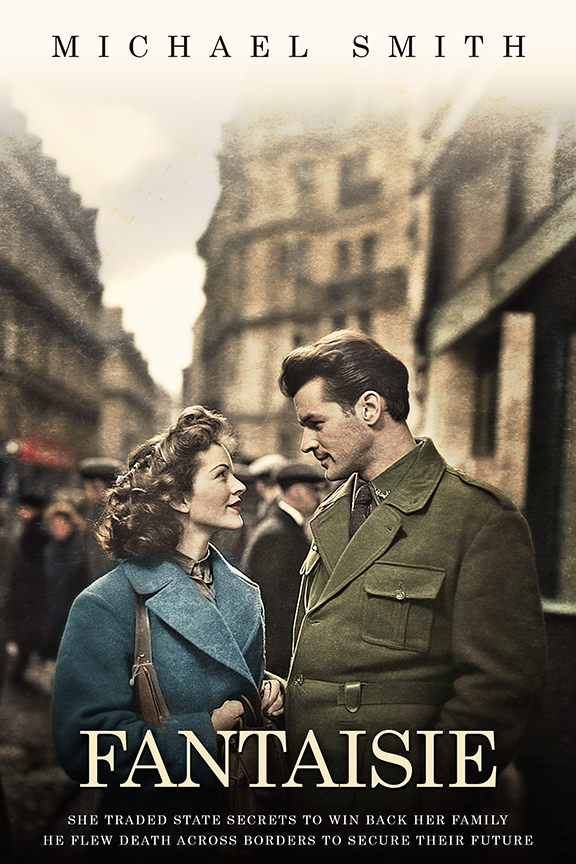
Fantaisie cover
Fantaisie

While researching for Fantaisie, I hit a roadblock trying to accurately portray the mechanics of the two-seater Messerschmitt Bf-109G-12 that plays such a crucial role in Jan and Sophie’s escape. Aviation forums and history books offered conflicting information, and I was struggling to visualize how a fighter pilot accustomed to a Hurricane would adapt to German controls.

My breakthrough came at a small aviation museum outside Paris where they had a partially restored cockpit section. The curator, noticing my intense interest, introduced me to an elderly aviation engineer who had worked on restoring various WWII aircraft. Though he’d never flown them in combat, he understood their mechanical differences intimately.

He spent an afternoon explaining the quirks of the Bf-109’s control systems, even sketching diagrams of the cockpit layout and explaining how the handling would differ from Allied planes. His technical knowledge paired with his storyteller’s ability to convey the sensory experience of these machines transformed what would have been generic flying scenes into something much more authentic.

When the book was nearly finished, I sent him the chapter featuring Jan’s escape flight. His note back simply said, “I could feel the wind through those bullet holes in the wing fabric.” That validation from someone who truly understood these machines meant everything.

amazon logo

Fantaisie-tour banner
Fantaisie Tour

© 2014- Ronovan Hester Copyright reserved. The author asserts his moral and legal rights over this work.

10 Questions with N.L. Holmes, author of Hani’s Daughter Mysteries.

Healing Hands, Sharp Minds, and Murders in Thebes

Welcome to ancient Thebes, where two women — Neferet and Bener-ib — are quietly changing their world one patient (and one murder investigation) at a time. In N.L. Holmes’s rich and addictive historical mystery series, a physician and her partner set out to run a neighborhood dispensary… only to be pulled into a series of bizarre and dangerous crimes that demand not just compassion, but cunning.

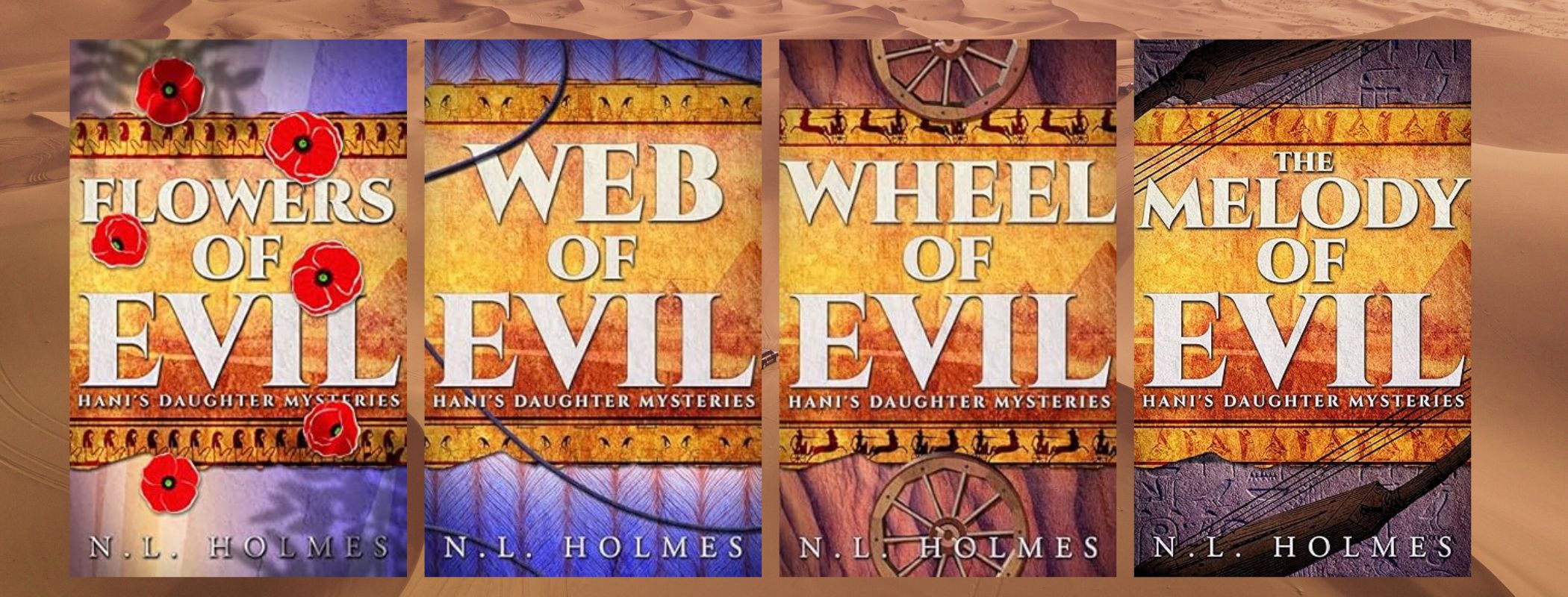
From Flowers of Evil’s cryptic last words of a dying florist, to Web of Evil’s tangled family secrets in a weaver’s village, Wheel of Evil’s deadly chariot investment scheme, and The Melody of Evil’s murdered musician at a family celebration — each book delivers a standalone mystery steeped in atmosphere and soul. It’s historical fiction with a sharp investigative edge.

 nlholmes.com |Instagram @n.l.holmes

Hani's Daughters Mysteries
Hani’s Daughter Mysteries

You can get the Hani’s Daugther Mysteries at Amazon.

If you were stuck on a deserted island, which 3 books would you want with you? 

Wind in the Willows and The Perelandra trilogy of C.S. Lewis  to take my mind away to a beautiful place, and Germinal by Zola to make me realize things could be worse.

Which authors inspired you to write? 

I couldn’t put names to them now, but all the wonderful books I read as a child made me think that writing was the coolest thing a person could do. What tipped me over the edge was the fact that my cousin published a young adult book. That seemed to make it sound doable.

How long have you been writing? 

I’ve been writing fiction for eleven or twelve years. Before that, it was just poetry and, of course, academic articles. Poetry really adds to one’s fiction chops, but I’m afraid academic writing has to be unlearned – it’s all about not having a distinctive voice. It does help in terms of using the language skillfully and knowing grammar.

What genre do you write and why? 

I write historical novels set in the Bronze Age, mostly Egypt or the Hittite Empire. As an archaeologist, that’s a no-brainer for me! For a long time, I’ve been concentrating on mysteries of one sort or another because I like to read them, and so do a lot of people who might not care about antiquity otherwise. I think a well-researched historical novel can teach readers a lot about the past while entertaining them.

How did you do research for your book? 

I had a lot of general background from teaching a class on Ancient Egypt, but I hit my library again for specific knowledge about various professions, etc. I find names from ancient manuscripts about village life or lists of tomb owners.

In your book you make a reference to ancient Egyptian medicine. How did you come up with this idea? What made you write a book about medicine? 

The Egyptians’ medical skills were world-renowned in their day. They had observed by trial and error over millennia and written down the results of their experiments, so that a young doctor like Neferet could look in a casebook and see what her elders had done to treat those symptoms. A lot of it was herbal, much like traditional medicine today. This was always one of the most popular lectures when I taught my Ancient Egypt class, and it gave me a certain forensic capability for my sleuths.

Where do you get inspiration for your stories? 

I began the Lord Hani Mysteries, from which this series is spun off, when I met the real Hani in a set of ancient documents called the Amarna Letters. There were references to a lot of diplomatic missions carried out by this man, so I took him as my protagonist and gave him a personality and a family. When Hani’s arc was completed, I zeroed in on his youngest daughter, a headstrong, unconventional girl who seemed likely to follow in her father’s footsteps.

There are many books out there about ancient Egypt. What makes yours different? 

There are even a lot of mysteries set in Egypt, but this series has a female protagonist who is a physician, so she’s automatically privy to a lot of mayhem. Her father is a diplomat, and that draws into her orbit various foreigners as well. Plus, for those who like cozy mysteries, this is one, with the addition of Egyptian “tea time” vibes and heroic pet animals.

What is your next project? 

I’m working on another Neferet mystery that features the world of cooks (each of these books deals with a different profession). I also have in mind a prequel to the Lord Hani Mysteries, because there’s one more real historical adventure of Hani to make use of.


You can get the Hani’s Daugther Mysteries at Amazon.

N.L. Holmes
N.L. Holmes

Author Bio:

N.L. Holmes is an award-winning novelist and former archaeologist with a Ph.D. in Classical and Near Eastern Archaeology. She spent years excavating in Greece and Israel, teaching ancient history, and bringing the past to life. Her firsthand experience with ancient cultures adds a rare level of authenticity to her work — transporting readers deep into the heart of ancient Egypt with rich historical detail and compelling storytelling.


Hani's Daughter Tour
Hani’s Daughter Tour

© 2025-  Ronovan Hester Copyright reserved. The author asserts his moral and legal rights over this work.

10 Questions with Barbara Southard, author of Unruly Human Hearts.

Synopsis

Elizabeth Tilton, a devout housewife, shares liberal ideals with her journalist husband, Theodore, and her pastor, Reverend Henry Ward Beecher, both influential reformers of the Reconstruction era. She is torn between admiration for her husband’s stand on women’s rights and resentment of his dominating ways. When Theodore justifies his extramarital affairs in terms of the “free love” doctrine that marriage should not restrict other genuine loves, she finds the courage to express her feelings for Reverend Beecher. The three partners in this triangle struggle with love, desire, jealousy, fear of public exposure, and legal battles. Once passion for her pastor undermines the moral certainties of her generation, Elizabeth enters uncharted territory. Telling the truth may cost her everything. Can a woman accustomed to following the lead of men find her own path and define her own truth?

unruly human hearts cover
Unruly Human Hearts

You can pre-order Unruly Human Hearts at Amazon. (January 28, 2025)

What drew you to become a professor of history?

My parents moved from New York to Hawaii when I was a teenager and I was fascinated with the multicultural society of the 50th state, including people of Hawaiian ancestry, descendants of white missionaries as well as people whose ancestors came from China or Japan to name only a few. When I entered the University of Hawaii, I was already very interested in Asian cultures, and the study of history seemed to be an ideal avenue to gaining an understanding of cultures so different from my own. I applied for an East-West Center scholarship for graduate work, which covered a year of research in India.

How did you end up teaching at the University of Puerto Rico?

My husband, who is an economist, was offered a job at the University of Puerto Rico. I had finished my course work at the University of Hawaii, but I was just starting to write my dissertation on the nationalist movement in India. After finishing my PhD, the Social Sciences Department at the University of Puerto Rico invited me to teach courses on Asia. Eventually I was offered a position as an Assistant Professor in the History Department.

Tell us more about your career as a historian and your work to highlight women’s struggles in both the United States and India.

At the University of Puerto Rico where I taught courses on both Asia and the United States with an emphasis on social history, it was a challenge to become fluent in Spanish and to interpret not only Asian culture but also American culture to my students. Although my dissertation was on the nationalist movement, my later research centered on the women’s movement in India. After receiving a Smithsonian Institute grant for research in India, I was able to complete my book on the struggle for women’s social and political rights in northeastern India titled The Women’s Movement and Colonial Politics in Bengal, 1921-1936. In addition to many academic articles on social themes in Indian history, I published a study of the impact of the gospel of love on the position of women in the United States as seen in the case of Elizabeth Tilton. I also wrote short stories exploring social conflicts set in India, the United States and Puerto Rico, mostly written from the perspectives of women and girls.

How did the views expressed by students in a graduate seminar you taught on the social history of the United States influence your decision to explore the Beecher-Tilton scandal more deeply?

At first my students didn’t seem interested in the famous 1875 trial, but once I mentioned the scandal had similarities to Bill Clinton’s impeachment for the alleged cover-up of sexual intimacies with Monica Lewinsky, they began to participate actively in the discussion. A young man pointed out that both the president and the reverend survived the scandal. Yeah, said a young woman but what about Monica and Elizabeth? My student’s suggestion that Elizabeth may have fared worse than her male lover inspired me to delve deeper into the social context of the scandal. As I immersed myself in the sources to understand the challenges Elizabeth faced because of gender inequality, I found that my own multicultural experiences, during the many years spent in Hawaii and Puerto Rico as well as the year doing research in India, were very helpful, enabling me to imagine how Elizabeth felt in an epoch with values very different from the present day.

What was the research process like to bring Elizabeth Tilton’s side of the story to life? I know that during the civil trial that she wasn’t allowed to speak, being that she was viewed as the damaged property of her husband in the case.

Many of the historical studies of the Beecher-Tilton scandal picture Elizabeth as a weak personality, a woman who gave in to both her husband and her lover and couldn’t keep her story straight. As I read more about the Victorian code of conduct for women, I felt that this version of her character was simplistic if not misogynistic. I attempted to come to grips with the challenges Elizabeth faced because of gender inequality in an article I wrote for a history journal, but I finally decided that the best way to do her justice would be to write a novel telling the story of the scandal from her perspective. Although Elizabeth was not called to the stand during the 1875 trial, there are three important primary sources that reveal her point of view: her personal letters, which her husband published in the press without her permission, her testimony at the church investigation, and the testimony of those who spoke of her at the trial. Once I decided to write a novel, I had to immerse myself once again in the historical sources. This second time, I was concentrating not only on understanding the social issues, but also submerging myself in the feelings and thoughts of Elizabeth and her two lovers, imagining scenes in which the main characters interacted.

Unruly Human Hearts is a work of fiction but based on a true story. How much of what we find in the book can be considered fact, or as fact as can be, considering the era and limited sources of coverage of events?

The novel covers the period from 1866, when Elizabeth, then in her early thirties, first developed romantic feelings for Henry until her death in 1897. There are many primary sources for the period from 1866 through the trial of 1875, including personal letters, trial records, and the press. The events and the people whose actions and personalities are revealed in these records function as the framework for my novel. However, the sources do not consistently tell the same story. The public testimony of the protagonists often provides conflicting narrations of what happened in what order, as well as conflicting interpretation of the motivations of those involved. Historians who have written books involving the Beecher-Tilton scandal also have different interpretations. As a writer of historical fiction, I had to make judgment calls. Elizabeth’s life after the 1875 trial, covered briefly in the final pages of the novel, was more difficult to envision. Although several historical sources are available, including obituaries and her letter of confession published in 1878, writing about her final years required greater creative effort.

Free love is somewhat of a key factor of the Beecher-Tilton scandal, a scandal perhaps in part because of Victoria Woodhull’s being the one to put it to print making it of greater public knowledge. Can you perhaps give our readers a little idea of what “free love” means in the context of the book and the movement at the time?

The basic idea of free love in the Reconstruction era was the freedom to choose whom to love and to express true love in a sexual relationship outside of marriage. Those who espoused free love believed that government should not interfere in matters of the heart, because the question of who loves whom cannot be legislated. Some feminist leaders supported free love because they believed that marriage and divorce laws unfavorable to women often imprisoned them in injurious abusive relationships. The radical feminist, Victoria Woodhull, denounced the hypocrisy of male leaders (including Reverend Beecher) who indulge in sexual affairs while publicly advocating conventional morality. Most supporters of free love in the nineteenth century did not advocate promiscuity; they couched their beliefs in terms of individual freedom to express true love. The concept of free love was similar in some respects to the concept of open marriage in the latter half of the twentieth century in which one’s spouse was viewed as the primary partner, but married couples were free to express love for others. Elizabeth viewed her husband, Theodore, as her primary partner, and Reverend Beecher as another love that enriched her life and deepened her love for her husband.

Each of the characters in the triangle’s relationship to free love comes from a different angle. We have the first prominent preacher in America, a newspaper editor and abolitionist, and an American suffragist. How did each reconcile the doctrine of free love with their religious beliefs and perhaps positions in society?

Reverend Beecher’s experiences as a young child, when his father instilled in him the fear of being a sinner predestined to go to hell, encouraged him to advocate replacing the Calvinist doctrine of retribution with the gospel of love. The gospel of love inspired him to preach against slavery and in favor of guiding children through love not corporal punishment. Henry’s sermons comparing God’s love with the tender care of a mother inspired Elizabeth and helped her see the feminine role as crucial not only within the family but also in building a better society. Her motivation to join the suffrage movement was the belief that women would vote to help those in need. Although the gospel of love and the concept of free love had separate origins, Henry and Elizabeth saw a connection between the two. True love of one human being for another could not be sinful. Whereas Elizabeth and Henry emphasized Love as the guiding spiritual and ethical principle, for Theodore, it was Truth. Conventional moral teachings restricting love outside of marriage led to lies and concealment that poisoned personal relations. Theodore believed that non-interference of the government in personal love lives was a necessary social reform, and thus advocated free love as well as suffrage for women and former slaves.

Elizabeth was involved in the suffrage movement, as was her husband, what did the scandal do for/to the movement?

The women’s suffrage movement was going through a difficult period in the eighteen seventies. Many suffragists had hoped that that the fifteenth amendment would include voting rights for women and former slaves, but the amendment only awarded suffrage to freedmen. The movement had to regroup and form new alliances. Initially Susan B. Anthony and Elizabeth Cady Stanton, both of whom were friends of Theodore and Elizabeth, were enthused when Victoria Woodhull, a charming and charismatic young woman of working-class origins, brought new energy into the suffrage movement. However, they later realized that her advocacy of radical social issues, including free love, was alienating supporters. Victoria had a key role in the exposure of the Beecher-Tilton scandal. She denounced Beecher as an ardent supporter of free love who concealed his true beliefs so as not to endanger his career and social position. Public fascination with the role played by prominent men with progressive views on women’s rights in the Beecher-Tilton scandal, was fodder for conservatives who painted the campaign for women’s suffrage as a movement associated with dangerous radicals whose aim was to destroy the social order.

Any good book based on historical facts can and should teach you something that has some relevance to current times. How is Unruly Human Hearts relevant today?

The story of Elizabeth is relevant to concerns about individual freedom and social ethics in modern times. The emergence of creeds of sexual liberation and open marriage in the second half of the twentieth century raised questions about whether free love is liberating for women. Many women were economically dependent on men, which made it difficult for them to insist that men grant their partners the same sexual freedom that they claimed for themselves. The MeToo movement that emerged in the early twenty-first century points to the problems implicit in a sexual relationship in which one partner enjoys the advantage of power and position. Elizabeth insisted that her tie with Reverend Beecher was based on true love, but her husband saw it as a pastor taking advantage of a deeply loyal member of his flock. On the other hand, Theodore was oblivious of the power dynamic in his marriage to Elizabeth. He justified his own extramarital affairs as a legitimate expression of free love but applied the double standard to his wife. If our society continues to make progress toward gender equality, we can hope that women involved in open marriages or polyamorous relationships do not undergo the same heartbreak that Elizabeth experienced.

What is your next project about?

I am reworking a historical novel set in New York in the roaring twenties, a period in which women enjoyed new freedom to pursue romance as well as a career of their own. The heroine, a young aspiring poet, suffers violent mood swings, which make it difficult for her to comprehend the new limits of acceptable behavior for women. Aggressive psychiatric treatments compound her problems. The transition from adolescence to adulthood appears to be a maze to the young protagonist who must make her way through a looking glass world in her struggle to achieve autonomy and commitment.

You can pre-order Unruly Human Hearts at Amazon. (January 28, 2025)

Barbara Southard
Barbara Southard

Author Bio:

Barbara Southard grew up in New York, earned a PhD from the University of Hawaii, and served as professor in the History Department of the University of Puerto Rico. In addition to academic publications on women’s history, she is the author of The Pinch of the Crab, a short story collection set in Puerto Rico, exploring social conflicts of island life, mostly from the perspective of women and girls. In her debut novel Unruly Human Hearts, Barbara once again explores social conflict from the point of view of the woman involved in a different place and epoch. She has also been active in raising funds for the Shonali Choudhury Fund of the Community Foundation of Puerto Rico, helping local community organizations working to protect women from domestic violence.

Find out more: https://www.barbarasouthard.com/

Facebook: https://www.facebook.com/BarbaraSouthardAuthor

Instagram: @barbara.southard45

© 2025-    Ronovan Hester Copyright reserved. The author asserts his moral and legal rights over this work.

10 Questions with Francine Falk-Allen, author of A Wolff in the Family.

Frank and Naomi Wolff were happily married in 1908. She was a Kansas farmgirl; he was a railroad engineer. She was excited to embark upon her role as wife and mother with a hardworking man, and in their early years together they made a life in thriving Ogden, Utah. Despite Frank’s almost-constant absence for his job riding the rails, which left pretty Naomi to raise their children virtually alone, their romantic relationship begat fourteen offspring in eighteen years. Like other lower-middle-class women, Naomi’s life was consumed with caring for her brood, who became helpers as soon as they could fold a diaper—and who, by and by, were required to attend the school of hard knocks as much as public schools. Affection and struggle endured within the family, crowded into a humble house. Despite the respite of occasional family train trips across the plains, the marriage ultimately faced exceptional challenges, just before the Depression era began.

Based on a true story, A Wolff in the Family is a riveting saga of prejudice, passion, and revenge, perfect for fans of Kristin Hannah’s The Four Winds. What mysterious scandals led a father to abandon the youngest of his children—and for the elder siblings to keep their shame secret for eighty years?

“A Wolff in the Family is immediately immersive, and readers will be drawn into the hardships and small joys of the Wolff family. Falk-Allen’s vivid prose and realistic characters tell an intriguing story about social norms, gender roles, and ultimately, love. Fast and absorbing, it will keep you up long into the night.”—Michelle Cox, author of The Fallen Woman’s Daughter and the Inspector Howard series

A WOLFF IN THE FAMILY
A Wolff in the Family

Get A Wolff in the Family at Amazon.

You have only a few moments to tell someone what your book is about, in two sentences tell them what your book is about and make them want to read it?

This is a historical novel of passion, prejudice, revenge and forgiveness, based on actual scandals in my mother’s family of origin, taking place in western states in the early 1900’s.

Why did you need to write this story?

When I heard the few basic facts of the story from an aunt, my jaw dropped. I thought later in that week, this is a story that has to be told, and over several years I researched the story and the time in which it happened, and eventually began fleshing it out with conjectured scenes and conversations.

With A Wolff in the Family being so personal, were there ever moments of hesitation in what to and what not to share?

To some extent, yes, I had to pause and think how I wanted to portray some of my aunts and uncles, and how my cousins might view my interpretation of their parents. I left out some things that are controversial, partly because one aunt told me they happened to my grandmother and a cousin told me they actually happened to one of my aunts! I knew that this was a hot button issue, with some relatives insisting it couldn’t even be true, and it wasn’t germane to the essence of the story I wanted to tell. I also decided not to use the family’s real surname, but I did use many actual first names and some that were similar, so that I wouldn’t confuse myself. This was a huge family so there are a lot of names to keep straight (never fear; there’s a list of characters and what family position they have in the front of the book). There is also another family that was involved, and I changed their last name so that if any of that family reads the book, they will not feel threatened by what they might consider slander. It’s not, of course, partly because I know some of what I’ve said is factual, but also because I made up so much of it—nearly all the scenarios and conversations—so that it truly is fiction.

What will connect the reader to the story and make them want to keep reading the story?

I hope that they will sympathize with the difficulties women faced in their domestic and married lives in the early twentieth century; that they will be fond of some of the characters and want to know what transpires with them, and that they will not be expecting some of what happens and even be shocked at some people’s actions, and read on to find out how it all resolves! Additionally, I think knowing the novel is based on a true story will have readers want to follow the characters throughout the saga of about thirty years of experiences and challenges.

I’ve done and still do research into my own family ancestry and I know such research brings with it some surprises. What good surprises have you come across? (One example from my own research is that my 7th great-grandfather donated the land that Princeton and its first buildings were built on.)

Related to A Wolff in the Family, I learned that one of my aunts was somewhat of a hero to her siblings; I spoke with her about circumstances in her family of origin when she was in her 90’s and near the end of her life, and she didn’t mention the very defiant and heroic thing she did. On my dad’s side, one of my great-great-great grandfathers started a military academy in Kentucky. Although this wasn’t something I necessarily felt “puffed up” about, the fact that he had done something so prominent made it easy to find information about his/my family and what happened in their lives before and after this event. I also learned that although he was in the Confederacy in the Civil War, his sister’s husband financed the Union side! And the family still kept in touch although were on two sides of the Mason-Dixon line, both geographically and philosophically. Then, the southerners moved back to the north after the War, and they aided the slaves they formerly had held by assisting them in procuring and owning their own homes. That salved the wound of knowing my dad’s ancestors held slaves a little bit, that my ancestors did get the deeds to property set up for the former slaves, so that there could not be disputed titles. So that was good news amidst regrettable and shameful knowledge.

How long did it take to complete A Wolff in the Family? (I ask because I know when writing and researching for historical fiction and you want it to be as period accurate as possible you can fall into rabbit holes for hours learning about things that will never end up in the book.)

Ha ha! Oh yes, that is so true about researching. Gosh, I started doing the family research in the early 2000’s, but I had two other books I wanted to write, so I put off the historical research and things like census records and the details of what life was like in Utah, Wyoming, Missouri, Kansas and Oklahoma from 1918 through the 1940’s until about 2022. Then I delved into it full force and finished the very last final, copy edited, proofread (both of those processes several times over!) in July of 2024. So I suppose you could say it took me two and a half years to actually write it, including the detailed research. I do not write every single day, however. I have a life, and I’m a polio survivor, so I have to take care of myself and avoid fatigue as much as I can.

Did you have difficulty deciding your book was ready to publish?

Interesting question. I think most authors would work on each book until they die and have never published it if they could be supported while doing so. I’m kind of kidding, but there are always things you wish you’d added or taken out.

I found an old letter yesterday that an aunt wrote to me in 2007 which had some details in it I could have used, and I had an “oh darn” moment. But those things would have led the story in a different direction… and I’m not sure her memory was accurate any longer when she was ninety. I was also motivated by my age: I’m seventy-six, and I wanted this book to be out in the world well before I was eighty. Deadlines, promotion and marketing are not the easy part of writing a book, and can sometimes be stressful (even though much of that can also be fun), and I didn’t want to be worrying about deadlines at eighty!

By the time I got through perhaps the tenth or twelfth read-through and proofread, I accepted that it was as good as it was gonna get, and I am 99% satisfied with it! I’m sure when I am reading through it again, I’ll have those “shoulda” thoughts. It’s like a child, it will never be perfect, but it’s your best effort at guiding, and you love her for what she is. Art is allowed to have a flaw here and there; it’s created by humans. All that said, I think it’s a very good story and that it reads well. Some people have been blown away by it and I find that people who’ve read it sometimes come back to me with questions about the characters in real life. That’s one of the signs of a good book!

What has the family reaction been to your book? (Whenever I write something and I use elements of the family in it, which we all kind of do if we want to make our characters authentic, I do wonder what will happen when/if they read it.)

I can’t answer that yet! None of them have read it! And you can bet I’m a little nervous about that.

My husband has read it and he thinks it’s terrific, but it’s not about his family, of course. One of my cousins’ wives has ordered it and I know she’s anticipating getting the skinny on his father’s family, except that she does know it is just based on a true story and full of my conjecture.

My cousin had told me that he didn’t know much at all about this story when I told him the basics. He said he’d only been told that his dad didn’t like to talk about it and felt critical of his mother.

Some of the siblings sided with their father, and some with their mother. They both made controversial choices which affected the whole family! My mother kept all of it a secret and hadn’t told either myself or my sister about any of the scandals before she died. I always say she should have worked for the CIA.

So we’ll see. I may get some praise, and I may get some blowback.

What advice would you give to someone wanting to convert family history to fiction?

I found it to be easier to have a structure and set up a chronological outline based on what I knew were facts, and then fill in what I thought could have happened to substantiate the outcomes. Some people like to just start writing and see where their imagination takes them. It depends upon whether you have a lot of facts, as I did (and whether you choose to use them, since you’re writing fiction, after all) or whether you just have a snippet of a story that inspires you to create something bigger out of it.

When I was working on this book, I would ask myself, “Why would she have done this? What would she have been likely to say when he did that? What would it look like to others when this character made this choice?” As a woman, I know how I’d feel if my husband behaved the way I know my grandfather did. So I drew on my own emotional experience to some degree. I may have idealized “Naomi,” but I felt that if she had lived fifty years later, her choices would have been more acceptable to society, and conversely, my grandfather’s choices would have been considered terrible if not even illegal two generations later.

There is one vignette where my mother tied a flannel around her head to try to flatten a bump on her nose. That really happened. She had told me that a friend came by to walk to school with her, which was serendipitous, because she couldn’t get the flannel off her head! I imagined all that would have happened, including her siblings making fun of her; it was a clear image in my mind, like a movie. So if a writer can imagine how something could possibly have happened and see it as if it were happening on a screen in front of them, I think they can write up a family history piece in a creative way which turns it into fiction.

I feel that in my case, the facts were so stunning that I didn’t have to over-dramatize to make it a riveting story.

Oh, I think it’s also very important that you set things up in a way that the reader will be as surprised, inspired or motivated as you were when you heard the story. That can mean starting slow and developing the characters as I did, or using a teaser early on to make people wonder what’s going to happen. I started in the middle of the story with the first chapter, when my grandfather had just taken his youngest children to an orphanage. Then in the next chapter I tell the reader we’re going back eleven years to explain why this happened, with subsequent chapters following a straight chronology. There are lots of ways to set up a story so that you’re leading the reader toward the surprise, the humor, the inspiring point you want to make or whatever is the bundle of juiciness at the center of your story.

What is your next project idea?

After the dust settles with launching this book and I get through the whirlwind of the holidays, I want to write a series of short stories about my father’s ancestors, starting with when the four Allen brothers left Ireland in 1793 to sail to the US and start a new life here, up in Maryland. I’ve been to the home they owned, in southeastern Ireland, for two hundred years (some of the family stayed there until the early 1900’s) so I have some visual background for this story, plus I know they grew flax and that people came from around the countryside to use their mill. So that’s enough to get started. I know that this sounds suspiciously like a book, but I’m telling myself that writing a series of short stories will be less ambitious than a book! It will also be challenging to make a complete story in a shorter length, so I look forward to learning to do that.

Get A Wolff in the Family at Amazon.

Francine Falk Allen
Francine Falk-Allen

Author Bio:

FRANCINE FALK-ALLEN: was born in Los Angeles and has lived nearly all of her life in northern California. She had polio in 1951, and has lived her life as a disabled person making an effort to be a “normie.”

Falk-Allen was originally an art major and later completed her BA in Managerial Accounting, running her own business for over thirty years. She has always sought creative outlets, such as painting, singing, and writing. She began doing extensive family genealogy research in 1999, and has traced both her maternal and paternal ancestors back to the 1600s.

Her first book, “Not a Poster Child: Living Well with a Disability,” won gold and silver awards and was on several best books lists in 2018 and 2019, including Kirkus Reviews’ Best Books of 2018, PopSugar and BuzzFeed, and was nominated to 25 Women Making a Difference in 2019 by Conversations Magazine.

Her second book, “No Spring Chicken: Stories and Advice from a Wild Handicapper,” received a Kirkus star, given to “books of exceptional merit” by Kirkus Reviews, and was named to Kirkus Reviews’ Best Books of August 2021. “No Spring Chicken” was also a finalist in Foreword Reviews’ Indie Awards in 2021.

Her third book, “A Wolff in the Family” is a riveting early twentieth century saga set in the western United States and based on scandalous family history.

Francine spends a significant amount of time managing the effects of post-polio. She facilitates a polio survivors’ group as well as a writing group, and volunteers on her town’s Americans with Disabilities Act Accessibility Committee. She loves the outdoors, swimming, gardening, movies, well-written literature, being with friends and sharing British tea and a little champagne now and then. She resides in San Rafael, California, with her husband. Learn more at: https://francinefalk-allen.com

Facebook: https://www.facebook.com/FrancineFalkAllenAuthor


© 2014-2024- Ronovan Hester Copyright reserved. The author asserts his moral and legal rights over this work.

10 Questions with Ann Lowry, author of The Blue Trunk.

Rachel Jackson’s idyllic life takes a dramatic turn when she discovers a woman’s scarf in her politician husband’s computer bag. But in an election year, seeking answers to questions of infidelity is not an option. When her mother gives her a family heirloom, a travel trunk owned by an ancestor, she finds a distraction. As she immerses herself in its contents, she discovers a woman whose life is vastly different from her own. Or is it? Determined to dispel the notion that her ancestor Marit was insane, Rachel sets out to unveil her unknown story. In the interwoven narratives of these two women, who are bound by blood and a shared struggle, The Blue Trunk is a poignant exploration of identity, love, and unwavering strength.

The Blue Trunk
The Blue Trunk

Get The Blue Trunk at Amazon.

Imagine you have only a brief minute to tell someone what your book is about. Can you tell us, in two sentences, what your book is about and make us want to read it?

“The Blue Trunk” follows the lives of two resilient women, separated by a century but connected by blood, as they each navigate abandonment and betrayal. This novel takes readers on a poignant exploration of identity, family drama, and love as a privileged politician’s wife uncovers what happened to her supposedly insane great-great aunt.

Why did you need to write this story?

My mother was in possession of a blue travel trunk that had been used by my great-great aunt when she immigrated from Norway to Eau Claire, Wisconsin. Marit’s name was written in perfect calligraphy on the trunk. I always loved the name so when my daughter was born, I mentioned to my mother that I planned to name her “Marit.” My mother responded with horror: “No, you can’t do that. She was insane.” While I should have been dissuaded, the insanity label only increased my interest in this woman. Years later, I joined a genealogy website to research her, but couldn’t find any information (but for her birth in Norway). It was odd because I found quite a bit of information on my great-great grandmother who had immigrated with her. I also had an autograph book Marit signed in 1889 in Blair, WI, so I knew she did indeed arrive in Wisconsin.

I then decided to research insane asylums to see if I could find any records of her. Again, I hit a dead end. I discovered while asylum populations were counted in the census, individual patients weren’t necessarily identified. In fact, I couldn’t find any archival records of the asylum I expect she would have been in residence. I also was unable to find a death certificate for her.

Then I discovered the asylum cemetery in my hometown. I spent my first 18 years living in that town and never knew of the existence of the Old Orchard Cemetery, aka the Cemetery of the unknown. The cemetery is now nestled in the middle of a subdivision, a plaque greets anyone who visits: “This cemetery is the final place for residents of the former Eau Claire County Asylum, County Home and County Poor Farm. . . As you walk among these unassuming gravestones, you will see that some only have names, no birth or death dates, and some are unknown. Many of the older gravestones memorialize persons who spent their entire adult lives in the county asylum.”

Unable to find my great-great aunt’s name, I sadly concluded that she likely spent her entire life in the asylum and is probably buried in an unknown grave.

It was then that I knew I had to write a book to reclaim Marit’s life.

With “The Blue Trunk” being so personal, were there ever moments of hesitation in what to and what not to share?

Interestingly, I didn’t hesitate when I was writing it. I guess that was because only a few trusted people in my writing group were reading my work. But as I finished and realized I was going to actually put this out into the world, I did face moments of fear (translate–terror).

I’m not certain, since this is only my first novel, but it seems to me that all writing, fiction and otherwise, is personal. Writers have a personal slant on what they are writing just as readers have a personal spin on what they read. A lot of Rachel’s story is personal to me and writing that was both healing and hard.

In some ways, I threw my ancestors under the bus for what they did to their sister, but that is what was done in those times (unfortunately). I was too young, obviously, to know Marit’s siblings, but I knew her nieces and nephews and they were a pretentious lot, filled with a desire to impress others. I expect the existence of a troubled family member (whatever her trouble might have been) was simply not acceptable. I’ve read a bit about generational trauma and I hope that writing a book about some of the things that might have been done to Marit will help stop that cycle.

What will connect the reader to the story and make them want to keep reading it?

My goal was to have some kind of tension/suspense in each chapter. I hope that the reader becomes engaged in the story as it unfolds dramatically.

I also hope they connect with the characters. Marit and Rachel are, I think, interesting in their own right and face challenges many women (and perhaps men) can relate to. Marit’s struggles keep us hanging in there cheering for her to finally find some peace. Rachel’s dilemma is one many current day women can understand–being torn between personal identity and commitments to partner and family.

There are other characters in the book I grew to love: Blake, James, Rose, and a minor character Aiden. All of them are human and each one has some quirks that make them even more human and relatable.

I’ve read that Blake became a different character than you intended. How was it letting the character dictate where he wanted to go and what he wanted to be?

I just loved what happened to Blake. I’m not entirely sure how it happened, but at some point I knew I didn’t want him to be a stereotypic toxic male. His life situation was complicated as well and he was, to a certain extent, a victim of that. I was joyful (can’t think of a better word) when I realized how I could approach him and write about his coming to terms with his identity. I loved writing the sometimes sweet interactions between him and Rachel and how she later begins to open up to a different Blake than she had previously known.

With gender identity being at the forefront of many societal issues, what steps did you take to represent the characters in the book in authentic ways?

I play a bit with gender identity throughout the book, but I identify as she/her which has been consistent my entire life. However, I am a member of the LGBTQ+ community, and I have known some of the struggles.

I thought long and hard about whether or not writing a trans character was wise. I didn’t want to appropriate someone else’s story. I ultimately decided to err on the side of taking the risk because I believe strongly that misunderstandings are prevalent when it comes to gender identity. Without spoiling anything, I’ll say that I wanted people to like, perhaps love, my character before they find that they are trans. I wanted to create some cognitive dissonance in readers so that they might be more open to revisiting preconceived notions.

In terms of research, I did some interviews to ensure that my details were accurate. I also spoke with an expert on the marginalization of less represented groups. I interviewed a trans couple who remained married after one partner transitioned. I am hopeful that I handled the issue sensitively and accurately.

Did you have difficulty deciding your book was ready to publish?

Yes, is it done yet? I’m actually a bit terrified to pick it up again because I know I’ll start re-writing it as I read.

Ultimately, the editor told me it was done. It’s good to have an outsider impose boundaries on a project.

What was your go-to escape when you needed to be reenergized during the writing process for “The Blue Trunk”?

Walk my dog. Swim laps. Bake cookies. Be in nature. All clear the clutter so I can tap into my creative self again.

What has writing “The Blue Trunk” done for you on a personal level?

I still have a bit of imposter syndrome hanging in the background. When people are impressed that I wrote a novel, I’m like “ya, well,” even though I do know it is an accomplishment.

As I mentioned before, writing Rachel’s story was healing for me. I lost my sister when I was six and never had a chance to completely resolve the issue with my mother as Rachel is able to do with Rose. The scene on the hike in Sedona was very healing for me as I wished I could have had that conversation with my mother.

I now know I can write a novel and that is exciting. I was not a good creative writer when I started, but I’ve improved (thanks to a lot of help from my writing colleagues and my teacher at the Loft Literary Center in Minneapolis).

I also discovered I love, love, love writing fiction. Crafting the story, creating characters, putting words on paper. I love all of it. I’m even starting to love editing!

Most of all, I am happy to have reclaimed Marit’s life. It is mostly fiction, of course, but those who read my book will now know that a century ago there was a woman named Marit Sletmo.

What is your next project idea?

I have two ideas.

I plan to write about my aunt who was in the Women’s Air Corp during WWII. The WACs were amazing women and their story needs to be told.

I also want to write about Molly Brown, socialite, philanthropist, feminist, politician. She spent her adult life in Colorado, where I live, and so I am close to the many adventures she had here. She frequented the Stanley Hotel in Estes Park (The Shining), so I may have to read more Steven King and experiment with some psychological suspense.

I’ll write both. I’m just not sure which one will be first.

Get The Blue Trunk at Amazon.

Ann Lowry
Ann Lowry

Author Bio:

Ann E. Lowry’s journey into the realm of storytelling was foretold by a Sedona psychic in 2001. That prophecy became a reality two decades later when Ann discovered a family heirloom, a travel trunk from Norway, which sparked the genesis of her debut novel, “The Blue Trunk.

A writer her entire life, Ann holds a Ph.D. in Communication from the University of Minnesota.  Her career has been dedicated to teaching and helping others navigate communication and resolve conflicts. Ann is fascinated by the dynamics of relationships, discord, and the intricacies of the human condition.  Ann successfully completed the Loft Literary Center’s Novel Writing Intensive course in 2022.

Alongside her passion for fiction, she has contributed to academic journals, penned thought-provoking opinion pieces, crafted engaging content for online platforms, and provided insights on the federal management of disasters.

When Ann isn’t immersed in the world of writing, she finds solace in the pool or the lake. She cherishes playful moments with her rescue-turned-therapy dog, Loki, and also enjoys reading, golfing, and indulging in the art of cookie and bread baking. Fly fishing is her newest hobby. Most of all, she savors precious time with her family.

Ann and her spouse, Karen, and fur child, Loki, live in Timnath, Colorado, where they enjoy the beauty of nature daily. Learn more about Ann at: www.annlowry.com

Goodreads: https://www.goodreads.com/book/show/215804380-the-blue-trunk?ac=1&from_search=true&qid=yUJM1W1Zlz&rank=2

© 2014-2024- Ronovan Hester Copyright reserved. The author asserts his moral and legal rights over this work.

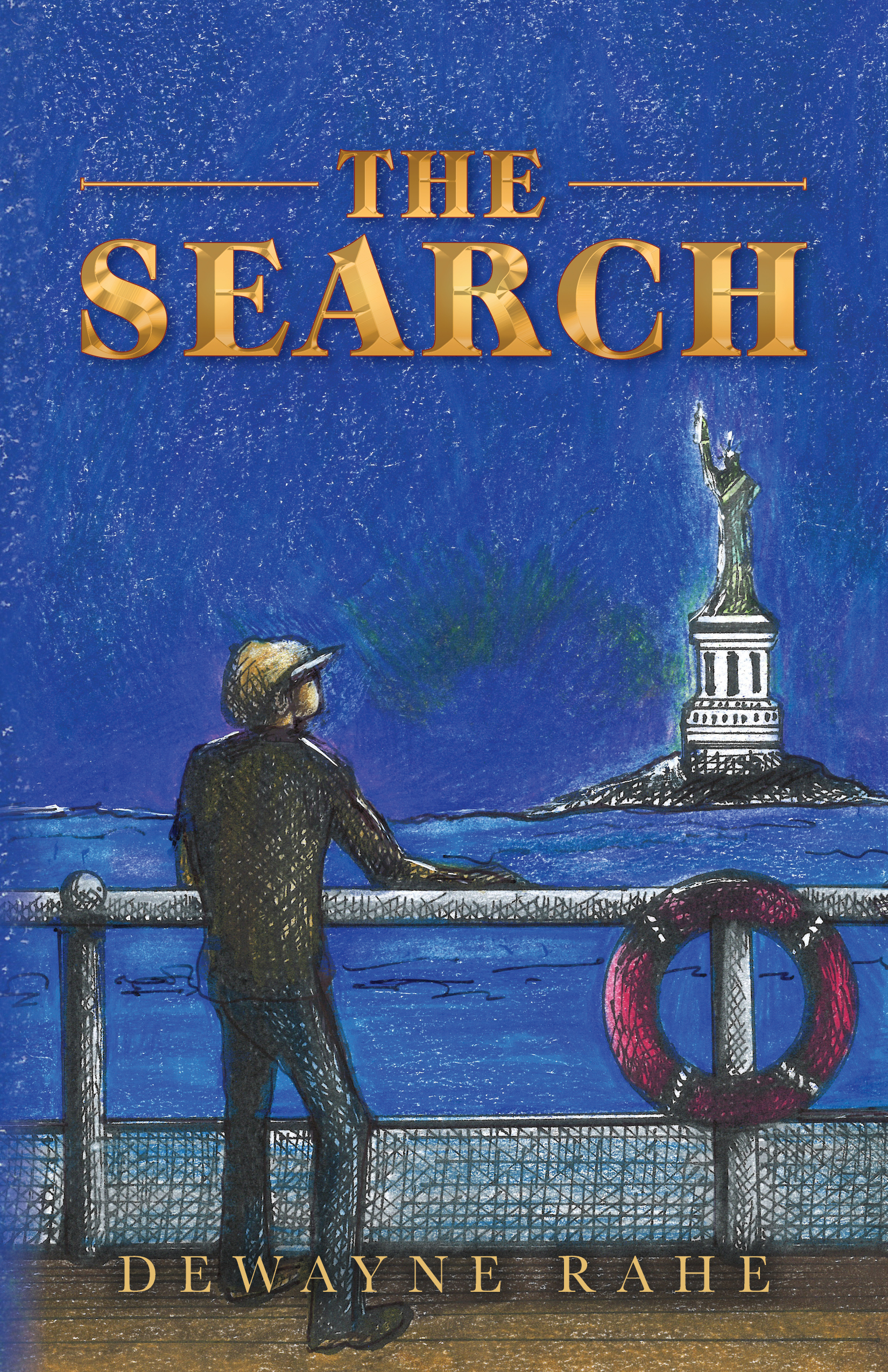
The Search by Dewayne Rahe.

The Search by Dewayne Rahe

In rural Iowa, 1910, Fred Schmidt faces life’s pivotal question: How should he live his life? This compelling historical fiction transports readers into a world bursting with real and mystical characters. Teamed up with Artie Holberg, the ambitious son of a renowned horse trader, Fred embarks on an enthralling adventure-from a daring scheme in Minnesota to a treacherous escapade in pre-World War I Europe. Encounters with enigmatic figures like Count Von Drathen and the beautifully captivating Baroness Van Essen weave a tapestry of suspense, mystery, and revelation.

Journey with Fred as he navigates the intricate map of destiny, love, and intrigue. Will the mystical voice guiding him reveal the truth he seeks? Dive in to uncover the thrilling conclusion.


Dewayne Rahe brings the next generation of the family from The Last Wild to life as Fred Schimidt becomes his own man in a changing world.

Armed with a knowledge of horses and a spattering grasp of German, Fred heads for Europe to find good breeding stock for his business in America. Along the way his adventures take him in directions he wasn’t expecting and leads to meeting characters not to be believed.

What type of man does this time in Europe and America make? It’s only a few years before WWI, what is Mid American young man, here and over there?

Fred might be searching for horses, but what does he really end up discovering?

Knowledgeable and entertaining, you’ll want to check this one out as a good summer read.

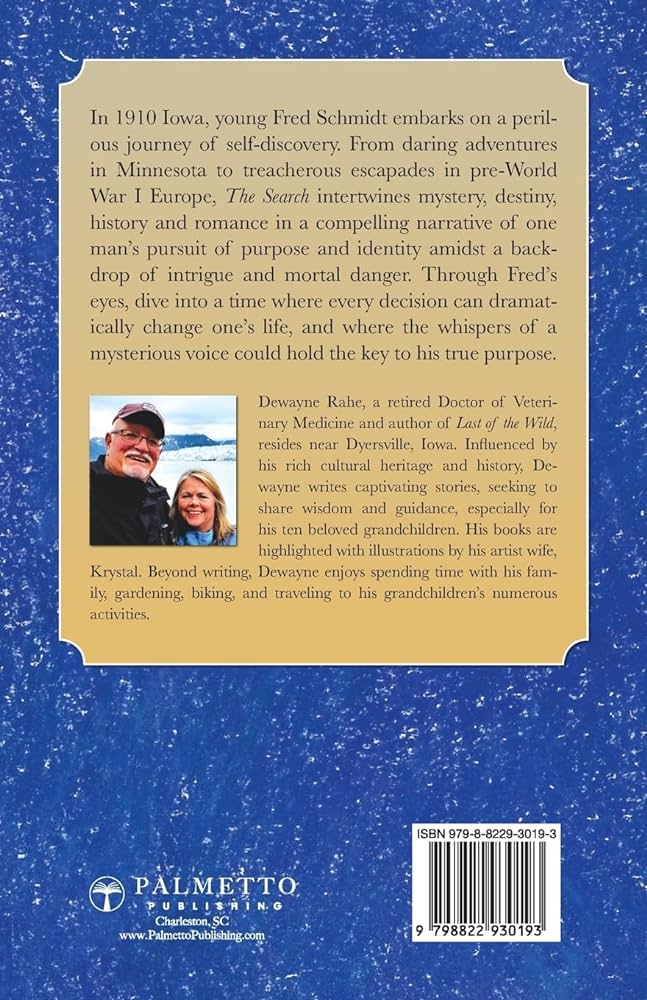
Back Cover of The Search

Rahe is a great storyteller. In the book, The Search, he intertwines the role of an individual’s fate with the challenges of their time.” – James Epstien

Rahe is a great storyteller. In the book, The Search, he intertwines the role of an individual’s fate with the challenges of their time.” – Doris Brown


Dewayne Rahe
Dewayne Rahe

I am a retired large animal veterinarian having graduated from Iowa State University in May of 1970. My wife Krystal and I were married on June 18, 1970 and presently live on our farm near Dyersville, Iowa not far from the famous “Field of Dreams” movie site. Our four children and their families have followed their careers to various parts of the United States, so much of our time is spent traveling to visit them, their spouses and our ten wonderful grandchildren. Krystal and I decided to use our time during the Covid pandemic to pursue our creative interests; incorporating her art and my writing to tell the untold story of the pioneers that settled northeast Iowa. The result was our first book, “Last of the Wild”, the response to which surprised and overwhelmed us. We have just published the second in the series,”The Search”. This narrative extends the families’ story to the next generation and details their struggles as they try to establish their place in the new land. We felt it was important to tell this story and hope our readers continue to enjoy it.


Amazon: https://www.amazon.com/Search-Dewayne-Rahe-ebook/dp/B0CV84MJN4/ref=tmm_kin_swatch_0?_encoding=UTF8&qid=&sr=

© 2014-2024- Ronovan Hester Copyright reserved. The author asserts his moral and legal rights over this work.

10 Questions with John Amos, author of The Cleopatra Caper.

“I want to present Cleopatra to the World,” Lady Stanhope sighed and reached for her purse. Two very young and inexperienced detectives, Flinders Petrie and Thomas Pettigrew, were unexpectedly presented with the case of a lifetime. Flinders and Pettigrew, recent graduates of Oxford and rivals of Sherlock Holmes and John Watson, suddenly find themselves confronted with the task of finding Cleopatra’s tomb. The tomb’s location, as they quickly discovered, was protected by the adherents of an ancient cult. Their quest leads them to Cairo and Alexandria. They meet a mysterious woman, who is possibly the descendant of Cleopatra. Their story weaves between the ‘City of the Dead’ in Cairo and the ‘Mound of Shards’ in Alexandria. They discover that becoming a detective is more difficult than they imagined as students. Set against the background of the River War in the Sudan and written by an expert in archeology and Middle East history, readers will find this story a worthy successor to the Conan Doyle legacy. “Find me Cleopatra, and I will pay for all this….”


The Cleopatra Caper
The Cleopatra Caper

Find The Cleopatra Caper at  Amazon.

What would be your one sentence elevator pitch of what your book is about to get someone to want to read it?

Two quirky young detectives are hired to find Cleopatra’s tomb, they grow up quick, but almost get killed during the chase.

Why choose the detective fiction genre for your book?

I read the Adventure of the Speckled Band as a kid. It scared the wits out of me. Ever since, I’ve wanted to write a detective story.

What research did you do to ensure you were historically accurate in setting, language and the like?

For the Middle East, no problem, I taught Middle Eastern politics for 25 years, and lived in Cairo for a year studying at the American University. (I also wrote a couple of books on Middle East politics). For everything else: Wikipedia, online publications, academic theses, and Bing AI (AI is really neat, if you know what to ask).

I know for my own book it was a real process to get things just right.
Coming up with character names is more difficult than people might think, how did you go about picking yours?

They are from historical characters: Flinders Petrie is the nephew of Sir Flinders Petrie, the great archeologist. Thomas Pettigrew is the grandson of Thomas Pettigrew, the British anatomist and mummy exhibitor. E A Walis Budge is himself. Lady Hestor is herself. Lord Cromer is himself. Inji was second in command of ‘Social Affairs’ in Cairo, and a very scary lady, indeed. (The first description of Inji is exactly the person I met in Cairo). Other names are from lists of Greek and Egyptian baby names.

How has your world traveling impressed itself on your writing?

Traveling supplied the background ambience. Owen Lattimore, the China expert, once wrote something to this effect: “If you haven’t been there and don’t know that there are tapeworm segments in the bottom of outhouses, you’re not an expert.” He was right. I lived on the economy in Cairo for a year and had to learn Arabic. I saw a lot of stuff a tourist would not see. My daughter is an amateur archeologist who worked on the digs at Pompeii, so I had an bona fide archeological source.

What will connect the reader to the story and make them keep reading to the end?

There are multiple levels, I think.  Obviously, there is the Sherlock Holmes nostalgia. But beyond that, the story of a couple of self-entitled kids being forced to grow up in a hostile world is the same theme that you have in the US today: A lot of readers are experiencing the same trauma. And, of course, there is the lost love theme which is a pretty universal experience.
Probably everybody can relate to Flinders and Petrie, they are a very likeable and funny pair: reviewers seem to like them.


Did you have difficulty deciding your book was ready to publish?

I hadn’t a clue. I ran the manuscript by several literary agents who weren’t interested and then shipped it off to the same hybrid I used for the Student. A mistake. I have revised it to take out the clinkers and add material since I now have the advantage of hindsight.

What age(s) of reader do you think would enjoy The Cleopatra Caper?

I wrote another book and the developmental editor said that I write for eleven year olds. Maybe so. I like to think that I write for anyone who has the imagination to be scared by the Speckled Band.

What’s your next project idea?

The Stolen Goddess will be out in April. Flinders and Petrie meet TE Lawrence and Gertrude Bell. It’s set in Istanbul at the end of the Ottoman Empire. I have tried to portray the old empire in all its complexity. It has some truly villainous villains: the Veiled One is the Phantom of the Opera on steroids, and the Bulbul (the bulbul, “nightingale,” was the official executioner in the Ottoman Empire) is modeled after Charles Mansion (I represented one of the Manson family in a parole hearing). The theme is that of the arc of life, unlike Holmes and other fictional detectives, Flinders and Petrie age.
 
The Bones of the Apostle will probably be out later this year. This is a darker work set in 1915, the time of the Armenian genocide. (My late wife’s grandmother survived the death march). I’m still revising; I’m not sure I can do it justice. I have invented a new character, Gazelda Jones,  who is as quirky as the detectives and adds a love theme. She will be around to the end of the series.


There are other detective fiction novels set in times past, why should a reader choose The Cleopatra Caper?

It’s a detective story with all the fast action of the genre, but it’s also a story about growing up, about lost innocence, and about lost love. In a way it’s a ghost story, because the heroes are haunted by their experiences. Their character development is central: These guys are driven by wanderlust, by guilt, and by the loneliness of their newly chosen profession. I suppose you could say that it’s part Conan Doyle, part Lawrence Durrell, part Henry James, and a smidgen of the “Thin Man.”

Find The Cleopatra Caper at  Amazon.

John Amos
John Amos

Author Bio:

John Amos holds a PhD and a JD. He has taught at university level for 25 years. His academic publications include several books and multiple articles. His fiction works include The Student (2022), The Cleopatra Caper (2023), and The Case of the Stolen Goddess (2024). He has lived in the Middle East, most notably in Egypt, Lebanon, Libya, and Turkey. He currently practices Law.


© 2014-2024- Ronovan Hester Copyright reserved. The author asserts his moral and legal rights over this work.

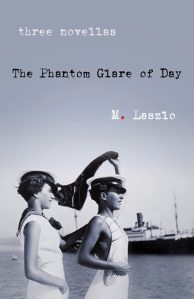
LitWorld’s 10 Questions with M. Laszlo, author of The Phantom Glare of Day.

 
The Phantom Glare of Day book cover.LitWorld’s 10 Questions
with
M. Laszlo

What would be your one sentence elevator pitch of what your book is about?
In this trio of novellas, three game young ladies enter into dangerous liaisons that test each one’s limits and force them to confront the most heartrending issues facing society in the early twentieth century. The Phantom Glare of Day is a compelling interrogation of who gets to decide what is right and what is wrong.

[The novellas are set during the height of WWI and post-WWI Europe.]

What book/author/movie/TV show/song might a potential reader compare your book to in order to get an idea of its feel and why?
The Phantom Glare of Day might best be described as traditional, twentieth-century melodrama suffused with the following: Goth youth culture, the film Nosferatu, lots of Germanic brooding, the poetry and symbolism of Nietzsche, and a ravishingly beautiful figure-skating ballet just for good measure.

Why did you choose this topic for your book?
This topic chose me. These novellas arise from a deeply held obsession with grasping the essential ethical issues that face society. By writing the book, it is my hope that the novellas may challenge readers to think about and to come to terms with those same heartrending questions.

What led to your choosing the setting for your book? In part your mention of steampunk as used in your book.
Having traveled to London, Paris, and Prague, and having kept travel diaries for those beautiful cities, there was no way to avoid my setting stories in those remarkable places. Interestingly, though, my impressions of Prague were always informed by the genre of steampunk. What I mean by that is that Prague is the city with which I’ve always associated the science-fiction play Rossum’s Universal Robots. Because of this, Prague inspired me to write about steampunk/primitive robotic technologies—as such, these peculiar technologies and themes and obsessions appear in that tale. With regard to Weimar, that’s the most peculiar question for me because I’ve never been there. Still, the history of das Bauhaus has always fascinated me—and because of this, there was no way to avoid the temptation to set a tale there.

How did you come up with the title of your book?
The Phantom Glare of Day comes from a line in “Butterflies”—a WW-era Siegfried Sassoon poem. The title seemed perfect to me because various world religions have always associated butterflies with the immortality of the soul. For me, that metaphysical idea resonates because these three novellas amount to a new kind of metaphysical storytelling.

How has your world traveling impressed itself on your writing?
Nothing has impressed my writing more than my travels to London, where I became fascinated by British colloquialism and phraseology. Nothing else makes British characters come to life more than giving them authentic voices as they engage one another in dialogue. In short, dialogue has to be real. Characters must talk the way people really talk. This comes down to the fact it is the vernacular that makes characters and their stories seem genuine. My travel diaries provided me with all kinds of descriptions of various places, of course; nevertheless, my travel diaries were most important to me in that they included many, many lists of those remarkable terms that only the Brits use.

What will connect the reader to the story?
These novellas tell of how people struggle with issues that anyone can find relatable: school bullying, abortion, euthanasia, political extremism, and homophobia. As such, any reader should be able to connect with the characters. At the same time, the narrator’s voice remains solemn and philosophical; moreover, the writing is suffused in objective correlative—symbols intended to resonate with the reader’s unconscious mind. If the reader really gives my work a chance, the reader can and will connect.
Remember, though, when you read The Phantom Glare of Day, you’ll quickly see that it’s like nothing you’ve ever read before. Perhaps that’s why the work is fated to get so many mixed reviews. This work is weird and revolutionary in its style.

Did you have difficulty deciding your book was ready to publish?
Yes and no. Leonardo Da Vinci said it best: “Art is never finished, only abandoned.”

What genre(s) and reader ages would your work fit best?
As for genre, there are different possibilities: coming of age, urban fantasy, historical fiction, metaphysical fiction, melodrama, and perhaps even magical realism. In truth, the work is trans-genre. Also, who cares what the genre is? It’s literature. And it’s meant for anyone mature enough to embrace the idea of freethinking and/or open-mindedness and/or freedom for the sake of freedom.

What’s your next project idea?
My next project promises to be a complete mind-scramble. In the coming book, it is my intention to take the reader on a journey alongside a figure who resolves the riddle of the universe—and in the final movement of the tale, the character will in fact explain the riddle of the universe. For that matter, too, the answer provided will be accurate. And that is my pledge.

Biography of M. Laszlo

M. Laszlo Author Photo M. Laszlo is the pseudonym of a reclusive author living in Bath, Ohio. According to rumor, he based the pen name on the name of the Paul Henreid character in Casablanca, Victor Laszlo.

He has lived and worked in New York City, East Jerusalem, and several other cities around the world. While living in the Middle East, he worked for Harvard University’s Semitic Museum. He holds a bachelor’s degree in English from Hiram College in Hiram, Ohio and an M.F.A. in poetry from Sarah Lawrence College in Bronxville, New York.

His next work is forthcoming from SparkPress in 2024. There are whispers that the work purports to be a genuine attempt at positing an explanation for the riddle of the universe and is based on journals and idea books made while completing his M.F.A at Sarah Lawrence College.

The Phantom Glare of Day is available at Amazon.

© 2014-2022- Ronovan Hester Copyright reserved. The author asserts his moral and legal rights over this work.

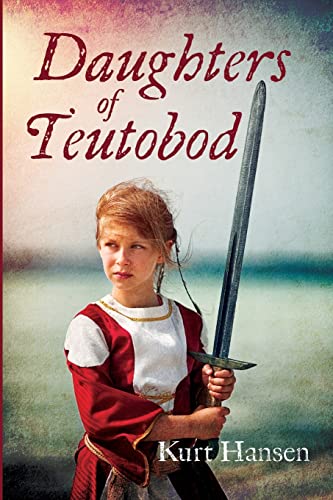
16 Questions with Kurt Hansen, author of Daughters of Teutobod.

Daughters of Teutobod is a story of love triumphing over hate, of persistence in the face of domination, and of the strength of women in the face of adversity.

Gudrun is the stolen wife of Teutobod, the leader of the Teutons in Gaul in 102 BCE. Her story culminates in a historic battle with the Roman army.

Susanna is a German American farm wife in Pennsylvania whose husband, Karl, has strong affinity for the Nazi party in Germany. Susanna’s story revolves around raising her three daughters and one son as World War II unfolds.

Finally, Gretel is the infant child of Susanna, now seventy-nine years old and a professor of women’s studies, a US senator and Nobel laureate for her World Women’s Initiative. She is heading to France to represent the United States at the seventy-fifth anniversary of the liberation of southern France, at the commemoration site where her older brother, who was killed in action nearby, is buried. The site is very near the location where the Romans defeated the Teutons.


Daughters of Teutobod Front Cover

How did you do research for your book?
Online searches for everything about the Teutons to pre-war Pennsylvania and the earliest training of American Rangers, Northern Ireland, Scotland, and modern-day sites in Paris and Southern France.

Which was the hardest character to write? The easiest?
Hardest? Ada.
Easiest? Gretel.

How long have you been writing?
After heart disease forced early retirement, I began attending the Iowa Summer Writer’s Festival in 2014. I began writing poetry, but soon began writing novels.

What is your next project?
A book entitled Chameleon, about a man in treatment for Borderline personality disorder.

What genre do you write and why?
I write character driven stories and historical fiction because those are what interest me.

What is the last great book you’ve read?
Chances Are by Richard Russo

If your book were made into a movie, who would star in the leading roles?
The only one I’ve had an instant intuition for is the elder Gretel, who would surely be portrayed nicely by Meryl Streep.

If your book were made into a movie, what songs would be on the soundtrack?
Not sure, but during closing credits, I could suggest Respect by Aretha Franklin.

What were the biggest rewards and challenges with writing your book?
Greatest reward is the coming together of the various story elements. Greatest challenge is slogging through the research and persisting through the dialogues.

In one sentence, what was the road to publishing like?
It was painful and frustrating.

Which authors inspired you to write?
Philip Roth, Harper Lee, Richard Russo, Flannery O’Connor, Charles Dickens, Michael Crighton, Dan Brown, Kurt Vonnegut, Amy Hassinger
 

Fun stuff:
Favorite travel spot?
Toledo, Spain.

Favorite dessert?
Sour cream raisin pie.

If you were stuck on a deserted island, which 3 books would you want with you?
To Kill a Mockingbird, A Tale of Two Cities, and the Bible.

Any hobbies? or Name a quirky thing you like to do.
I collect rock-n-roll memorabilia. Signed record albums and photos and so forth.

What is your theme song?
“You’ve Got a Friend” by James Taylor

Kurt Hansen HeadshotAuthor Bio:

Kurt Hansen is from Racine, Wisconsin, and has lived in Kansas, Texas, and Iowa. He has
experience in mental health and family systems as well as in parish ministry and administration.
He holds degrees in psychology, social work and divinity. Kurt now lives in Dubuque, Iowa with
his wife of 44 years, Dr. Susan Hansen, a professor emerita of international business. Kurt is
the author of Gathered (2019). Daughters of Teutobod is his second novel.

Website: https://www.authorkurthansen.com/
Facebook: https://www.facebook.com/revkurthansen
Amazon: Kurt Hansen Author Page
Goodreads:  Kurt Hansen

Kurt Hansen blog tour Image

© 2014-2022- Ronovan Hester Copyright reserved. The author asserts his moral and legal rights over this work.

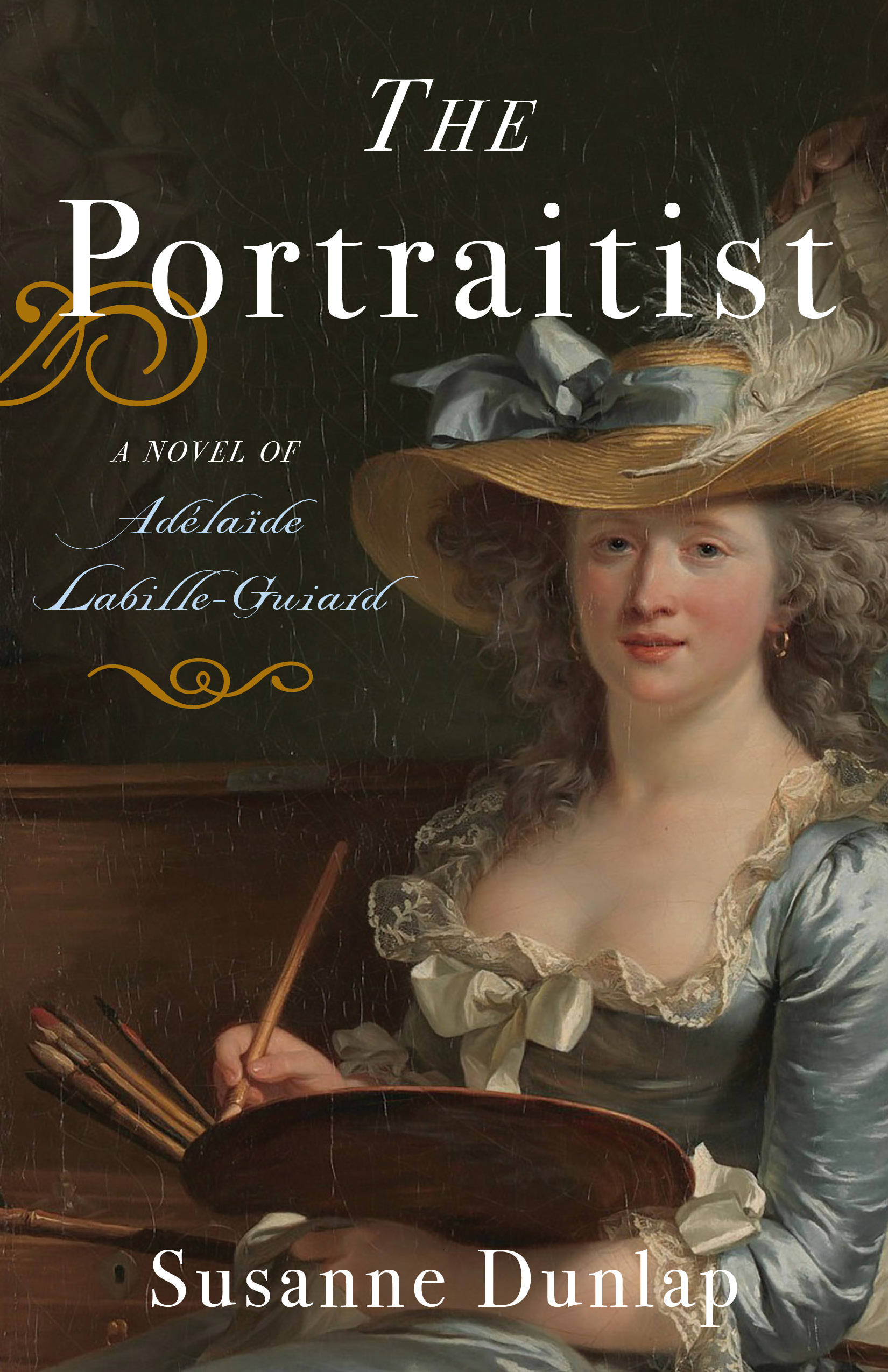
An excerpt from The Portraitist by Susanne Dunlap.

A special excerpt from The portraitist (Available Tuesday, august 30) by Susanne Dunlap.

Click here for Susanne’s interview.

The PortraitistParis, August 1774

Whenever sleep eluded her, Adélaïde would gaze out the window of the third-floor apartment she shared with her husband and think about colors. She’d stare hardly blinking for hours, noticing all the subtle variations of hue that, to a skilled eye, gave the sky as much movement and character as a living creature. Even as a child, she had understood that nothing was fixed, that light changed whatever it touched. Take the human face: Skin was not one color, but many, and never exactly the same from one moment to the next. She knew, for instance, that if Nicolas ever discovered what she was going to do that day, his face would take on one of the shades of thundercloud that had become more and more familiar to her as they drifted apart, and then she would be obliged to cajole him back to a placid pale pink.

He lay in the bed next to her, sprawled on his back, snoring open-mouthed and dripping saliva on his pillow. With a snort, he rolled away from her, and Adélaïde eased herself out from between the sheets, nudged her toes into her slippers, and stood.

“You’re up early,” Nicolas said, making her jump.

She pulled on her dressing gown as she walked into what served as kitchen and dining area. “I’ll wrap up some bread and cheese for you.”

Nicolas threw off the covers and shook himself from shoulders to toes before whisking his night shirt over his head and dressing for his job as secretary to the clergy. Adélaïde handed him the parcel of food as he strode by on his way out. He turned before leaving and stared at her. “You’ve stopped even making an effort to be attractive. You could at least put your hair up.” He let the door slam behind him and thumped down the stairs.

He’s right, Adélaïde thought. But she didn’t have time to worry about that now. As soon as she heard the heavy outer door of the building open and close, she hurried down to the courtyard, filled a basin of water from the fountain, and brought it up to the apartment so she could bathe. When she was finished, she put on her one good ensemble—the one she wore to church on Sundays with bodice and sleeves that had been trimmed with Mechlin lace in her father’s boutique. Her plan was to leave and come back without anyone noticing before Nicolas returned for dinner.

After waiting for two women who lived below her to finish their conversation in the stairwell, Adélaïde tiptoed out of the house and took a circuitous route to the Rue Neuve Saint-Merri and the Hôtel Jabach so no one might guess where she was going. She passed as swiftly as she could along the crowded thoroughfares with their boutiques and market stalls selling everything from leather goods to live chickens, picking her way around piles of dung and flattening herself against buildings as carriages clattered by. Such strange turns her life had taken, she thought. If she had waited—as her father begged her—until someone more worthy asked for her hand, she might have been the lady she’d just seen pressing a scented handkerchief to her nose as she flew past in a handsome calèche. But at the age of eighteen, her mother dead the year before and all seven of her siblings buried, Adélaïde had been desperate to get away from home, to leave the memories behind and start a new life. Enter the dashing Nicolas Guiard, who courted her passionately and made her feel wanted. Then, she couldn’t believe her good fortune. Now, she realized she’d made a terrible mistake.

It was only ten o’clock when she arrived at the iron gates that opened into the courtyard of the Hôtel Jabach. She stood for several seconds and stared, taking in everything, fixing the image of this moment in her memory. She, Adélaïde Labille-Guiard, was about to enter the first exhibition where she would not just be a spectator but a bona-fide, participating artist. Two of her pictures hung in one of the galleries within, her entries in the annual salon of the Académie de Saint-Luc—not the Académie Royale, but nearly as prestigious. Her teachers—François-Élie Vincent and Maurice-Quentin de la Tour—had put her up for membership years ago, before she married, and she would be one of only two women exhibiting that year. It was a bold step, a leap in fact, beyond the trite watercolor miniatures she sold in Monsieur Gallimard’s shop to make a little pocket money. Those were not art.

As she passed through the gates and crossed the courtyard to the entrance, sweat ran down her back under the layers of stays and bodice and petticoats, pooled at her waist, and trickled down her legs into the tops of her wool stockings. She took the printed catalogue the concierge handed her at the door and started fanning herself with it before she even opened it.

The murmur of polite commentary echoed around her. Smartly dressed men and women sauntered in twos and threes, facing the walls and pausing occasionally to admire what caught their eye, then turning to examine the portrait busts and figures that dotted the middle of the floor on pedestals at regular intervals. From her earliest childhood, Adélaïde had been to many exhibitions like this one, in rooms that had been stripped of some of their furnishings and given over to the contemplation of art. She wanted to savor it all and take her time to feast her eyes on everything, to give herself a chance to appreciate the honor of having her own work displayed alongside that of more established artists.

It was in the second of the main galleries that Adélaïde first noticed a small group comprising a slight, dapper man, an older woman who could still be called attractive, and two young ladies of startling beauty. One of them had a face of such exquisite proportions that Adélaïde wished she’d brought a sketch pad and a pencil so she could take her likeness then and there. The other one, although not quite as pretty, exuded sensuality and was clearly aware of the power she had over men in general and the gentleman in their party in particular. She cast her eyes down, her long lashes fluttering against cheeks rosy with what might have been embarrassment if they hadn’t been carefully painted with vermilion stain. That was when Adélaïde overheard the gentleman say, “No, I insist. Your allegories are perfection, Mademoiselle.”

Adélaïde froze. Her allegories? That lady had pictures hanging in the exhibition? The only other female member of the Saint-Luc she knew of was the elderly Mademoiselle Navarre, a pastellist and miniaturist who painted still lifes, not allegories. This lady, whoever she was, must have been elected very recently. No others were on the roster of exhibitors the last time Adélaïde had seen it. She held her breath, willing herself to blend into the crowd, standing sideways to the group and pretending to examine a rather voluptuous rendition of Leda and the Swan. Her ears tingled as she strained to hear the rest of the conversation despite the ebb and flow of casual comments as visitors moved through the gallery.

Click here for Susanne’s interview.

Susanne_Dunlap_social_media_image2

Book Description

Paris, 1774. After her separation from her abusive husband, Adélaïde Labille-Guiard is at last free to pursue her dream of becoming the premier woman portraitist in Paris. Free, that is, until she discovers at her first public exhibition that another woman artist is poised to claim that role — and she has more training and better connections in the tightly controlled art world.

To have a chance of competing, Adélaïde must first improve her skills in oil painting. But her love affair with her young teacher gives rise to suspicions that he touches up her work, and her decision to make much-needed money by executing erotic pastels threatens to create as many problems as it solves.

As her rival gains lucrative portrait commissions and an appointment as portraitist to Queen Marie Antoinette, Adélaïde continues to struggle, until at last she earns a royal appointment of her own, and, in 1789, receives a massive commission from a member of the royal family.

But the timing couldn’t be worse. Adélaïde’s world is turned upside down by political chaos and revolution. With danger around every corner of her beloved Paris, she must find a way to survive and adjust to the new order, starting all over again to carve out a life and a career—and stay alive in the process.

The Portraitist is based on the true story of one woman artist’s fight to take her rightful place in a man’s world — and the decisions she makes that lead her ultimately to the kind of fulfillment she never expected.

Susanne_Dunlap_social_media_Review image


Susanne Dunlap author photo.

Author Bio:

Susanne is the author of twelve works of historical fiction for adults and teens, as well as an Author Accelerator Certified Book Coach. Her love of historical fiction arose partly from her studies in music history at Yale University (PhD, 1999), partly from her lifelong interest in women in the arts as a pianist and non-profit performing arts executive. Her novel The Paris Affair won first place in its category in the CIBA Dante Rossetti awards for Young Adult Fiction. The Musician’s Daughter was a Junior Library Guild Selection and a Bank Street Children’s Book of the Year, and was nominated for the Utah Book Award and the Missouri Gateway Reader’s Prize. In the Shadow of the Lamp was an Eliot Rosewater Indiana High School Book Award nominee. Susanne earned her BA and an MA (musicology) from Smith College, and lives in Biddeford, ME, with her little dog Betty.

Website: https://susanne-dunlap.com

Click and Pre-Order  The Portraitist on Amazon.

Visit Amazon for Susanne’s Books:

Follow Susanne on social media:

Facebook: @SusanneDunlapAuthor

Twitter: @susanne_dunlap

Instagram: @susanne_dunlap

LinkedIn: @susannedunlap

Pinterest: @susanne_dunlap

© 2014-2022- Ronovan Hester Copyright reserved. The author asserts his moral and legal rights over this work.

9 Questions with Susanne Dunlap, author of The Portraitist.

“Impeccably researched, rich with period detail, Dunlap brings to life the little-known true story of Adelaide Labille-Guiard, who fought her husband and society to make a name for herself as a painter to the royal family, the very apex of success. A stunning story of determination, talent, and reversals of fortune. As a lifelong Elisabeth Vigée Le Brun fan, I am now questioning my allegiances!”

-Lauren Willig

Bestselling Author of THE SUMMER COUNTRY

The Portraitist9 Questions with Susanne Dunlap

What inspired you to write about Adélaïde Labille-Guiard?

I’ve always been interested in women in the arts, and the eighteenth century has a special place in my heart (my dissertation was about eighteenth-century opera). Also, Adélaïde’s self-portrait with her two students that hangs in the Metropolitan Museum of Art in NY is a huge favorite of mine. But originally, when I first conceived of the book, I thought of her in relation to her rival, Vigée Le Brun. Through research I began to know her in her own right, and to appreciate how different her life must have been from her rival’s, how much more stood in her way. I also love the difference in her painting style from Le Brun’s. It feels much more real, more present, less beautiful in a good way.

Why focus on Adélaïde instead of Élisabeth Vigée Le Brun?

Originally I thought I would write about Vigée Le Brun. But I love an underdog, and after discovering that they literally followed each other’s footsteps—but Le Brun doesn’t even mention her rival’s name in her three-volume memoir—I was intrigued.

Of course art plays an important role in this book. Are you an artist as well as a musician and writer?

Alas, I am no artist! I took a drawing class in college, but… no. I love art and have always gone to museums, and have done a lot of reading about art history and artists. As research for this book, I did read an 18th-century treatise on oil painting. However, as André Vincent says to Adélaïde before he starts to teach her, there’s a great deal of difference between reading a treatise and actually making art.

While the story is based on a true story, there are some characters that you’ve created. Which of the characters are real?

Most of the characters are, in fact, historical. The ones I’ve created are Adélaïde’s first student (the rest of the named students are historical), her father’s lover, and a few very minor, walk-on characters. However, I took major liberties with the characters of her father and her estranged husband to the point where I might as well have invented them, partly because there was very little available information about them. In those cases, the story comes first.

Did Adélaïde really do a portrait of Robespierre and get a huge commission from the Comte de Provence just as the revolution was starting?

Yep. All true. All the paintings mentioned in the book existed at one time or still exist. The two mentioned in this question are among those that were probably destroyed during the Revolution.

Did Adélaïde really sell erotic pastels?

Alas, no. At least, I could find no evidence of such a thing. However, erotic drawings were a lucrative trade in 18th-century Paris, and my cash-strapped heroine could easily have decided to capitalize on her talents in this way.

What were some of the struggles of women in 18th Century Paris faced, primarily those Adélaïde Labille-Guiard would have dealt with being a female artist?

The struggles had to do with lack of access for women to the infrastructure of success. Institutionalized misogyny, so to speak. Women couldn’t belong to guilds, and were only admitted to some academies in very restricted numbers. They also couldn’t attend classes at the Louvre, except with Briard, who was allowed to teach women. All the life drawing classes were closed to them of course, and even the best women artists couldn’t get the perks given to the men, namely free housing and studio space in the Louvre. That was something Adelaide fought for, and was finally awarded in 1795, after the Revolution, but before Napoleon’s time. Royal patronage was one of the few avenues in which they could compete, and both Adelaide and her rival benefited from that.

How important is Adélaïde Labille-Guiard to the art landscape of 18th Century Paris and perhaps beyond?

I think that because she was such an influential teacher as well as an artist, she probably had an impact on many young artists that we don’t even really know about, since she was pretty much ignored as a painter throughout the 19th century. But when she died, she was Madame Vincent, her identity completely bound up with her position as a married woman. I also think that by digging into these lesser-known women artists, we learn a lot more about the norm rather than the exceptions. Her work is beautiful, beyond a doubt, but so few examples survived her that it’s hard to accurately gauge her compared to other artists.

With the arts being such central influences in your literary work, what are some other works you’ve published that readers will enjoy?

This is the first time I’ve written about a female artist. I’m a music historian, so I’ve featured women musicians more often. My historical mystery series that takes place mostly in 18th-century Vienna features a young violinist whose godfather is Haydn. Those books are THE MUSICIAN’S DAUGHTER, THE MOZART CONSPIRACY, and THE PARIS AFFAIR. My first two novels also featured women musicians: ÉMILIE’S VOICE and LISZT’S KISS.


Susanne Dunlap author photo.Author Bio:

Susanne is the author of twelve works of historical fiction for adults and teens, as well as an Author Accelerator Certified Book Coach. Her love of historical fiction arose partly from her studies in music history at Yale University (PhD, 1999), partly from her lifelong interest in women in the arts as a pianist and non-profit performing arts executive. Her novel The Paris Affair won first place in its category in the CIBA Dante Rossetti awards for Young Adult Fiction. The Musician’s Daughter was a Junior Library Guild Selection and a Bank Street Children’s Book of the Year, and was nominated for the Utah Book Award and the Missouri Gateway Reader’s Prize. In the Shadow of the Lamp was an Eliot Rosewater Indiana High School Book Award nominee. Susanne earned her BA and an MA (musicology) from Smith College, and lives in Biddeford, ME, with her little dog Betty.

Website: https://susanne-dunlap.com

Click and Pre-Order  The Portraitist on Amazon.

Visit Amazon for Susanne’s Books:

Follow Susanne on social media:

Facebook: @SusanneDunlapAuthor

Twitter: @susanne_dunlap

Instagram: @susanne_dunlap

LinkedIn: @susannedunlap

Pinterest: @susanne_dunlap

© 2014-2022- Ronovan Hester Copyright reserved. The author asserts his moral and legal rights over this work.

BookReview of “Columbus and Caonabó: 1493-1498 Retold” by Andrew Rowen.

Book Cover of Columbus and Caonabo by Andrew RowenDESCRIPTION of Columbus and Caonabó: 1493-1498 Retold by Andrew Rowen.

Columbus and Caonabó: 1493–1498 Retold” dramatizes Columbus’s invasion of Española and the bitter resistance mounted by its Taíno peoples during the period and aftermath of Columbus’s second voyage. Based closely on primary sources, the story is told from both Taíno and European perspectives, including through the eyes of Caonabó—the conflict’s principal Taíno chieftain and leader—and Columbus.”

When you read a Historical Fiction novel you have a certain thought in mind of what to expect. Andrew Rowen gives you more than that, much more. The press release discusses the research he’s done through the years but many do the same. But I haven’t run across anyone who puts the detail of the people into their work as much as Rowen has. Given as much life to a people we know so little about but by the end know so much and gain a fuller Andrew Rowenpicture of a part of the American foundational background. I’ve taken U.S., European, and Latin American studies at the University level and not been given any of the detail given here, nor even heard of the vast majority of the people given in this work.

Being a history person I of course loved the specifics pertaining to the events of the past but even more I enjoyed Rowen’s interpretation of the people involved, especially the Taíno peoples. Also the conflict between the crew of Columbus left behind and moving forward. There was no simple black and white, right and wrong to the story. I suppose overall you would say there is one, but as far as the actions of both peoples the ideas made a lot more sense than what we learn in school.

Rowen shows the use of the Europeans and Taíno forming alliances whether they be real or merely for appearances, the use of Christianity as a subjugation strategy as well as a tool by the Taíno. The Taíno religion is also a major issue in the progress of negotiations and relations. (I don’t want to say too much here.) The actions of Columbus are laid bare, warts and all. Even coming to be questioned by Isabella and Ferdinand. The presence of Spanish settlers in the islands is devastating in more ways than the disease we’ve so often read about.

Ultimately you feel what is happening as it happens. The anguish of the Taíno peoples, the settlers, and even the soldiers who didn’t sign up for what happens. This along with 42 historic and newly drawn maps and illustrations bring life to a part of history glossed over by the victors.

I’m not an anti-Columbus or anti-Western Exploration person. I like history. I am a historian. I want as many of the facts as possible. Unfortunately those who are the victors tend to suppress the ugly parts they played to achieve their victory. “Columbus and Caonabó: 1493–1498 Retold” provides more facts while being entertaining at the same time.

The author includes an interesting final chapter titled Agonies and Fates. We learn about just what the title says, Agonies and Fates. Plus many definitions are given for the Taíno language.

RATING

A solid 4 out of 5 Stars. A 4 because of all the great information and the life given to the historical figures. Also a 4 and not a 5 because it is a bit of a heavy read. This is not a read in one or two sittings. You will likely want to do so but take  your time so you can absorb everything you’re being given.

I rate using:

Realistic Characters/Character Development based on genre,
World Building
Editing
Believability based on genre
Overall Enjoyment
Readability/Clarity
Flow

RECOMMEND?

I would read the previous book, Encounters Unforeseen: 1492 Retold, of which this book is the sequel.

504 pages with the reading portion ending with Agonies and Fates on page 417. The remaining pages are filled with great information for further understanding, including a Glossary.

Available 11/09/2021

$11.49 for Kindle.

$33.95 Hardcover at Amazon


Andrew RowenAbout the author

Andrew Rowen has devoted 10 years to researching the history leading to the first encounters between Europeans and the Caribbean’s Taíno peoples, including visiting sites where Columbus and Taíno chieftains lived, met, and fought. His first novel, “Encounters Unforeseen: 1492 Retold” (released 2017), portrays the life stories of the chieftains and Columbus from youth through their encounters in 1492. Its sequel, “Columbus and Caonabó: 1493–1498 Retold” (to be released November 9, 2021), depicts the same protagonists’ bitter conflict during the period of Columbus’s second voyage. Andrew is a graduate of U.C. Berkeley and Harvard Law School and has long been interested in the roots of religious intolerance.

https://www.amdrewrowen.com/
Facebook @andrewsrowen


© 2021- Ronovan Hester Copyright reserved. The author asserts his moral and legal rights over this work.

AUTHOR INTERVIEW WITH: SHERYL J. BIZE-BOUTTE TALKS ABOUT HER FIRST NOVEL:BETRAYAL ON THE BAYOU

AUTHOR INTERVIEW  WITH:

SHERYL J. BIZE-BOUTTE

TALKS ABOUT HER FIRST NOVEL: BETRAYAL ON THE BAYOU

I want to welcome author Sheryl J. Bize-Boutte who has graciously agreed to a FOUR question interview. And I have to say this is one of the best and most timely answers to questions I’ve experienced.

SHERYL J. BIZE-BOUTTESheryl is a Pushcart Prize nominee and an Oakland, California-based multidisciplinary writer. Her autobiographical and fictional short story collections, along with her lyrical and stunning poetry have been described as “rich in vivid imagery,” “incredible,” and “great contributions to literature.” She is also a popular literary reader, presenter, storyteller, curator, and emcee for local events. Her first novel, “Betrayal on the Bayou,” was published in June 2020.

As a Southern white man, born in Florida, but raised in Mississippi, then living my entire adult life in Georgia, I am looking forward to reading Shery’s book Betrayal on the Bayou. Her descriptions in the following give one a different way of looking at the issue of “…the killing abuses of power, racism, incest, sexism, classism…”

R: Thank you for this interview, Sheryl.

S: Thank you, Ronovan, for inviting me.

R: Let’s get right into it. What was your research/inspiration for the Betrayal on the Bayou?

S: Well, Betrayal on the Bayou is a work of historical fiction, so my research was a combination of known family history heavily sprinkled with factual events from the time period I chose, along with more than a bit of my ever-active imagination. My inspiration came from my desire to tell pieces of my family history while trying to capture, even if infinitesimally, the relentlessness of racism and colorism and how it affected the everyday lives of people depicted in the book and how that is still the case today. After a recent coffee meeting with a White female writing club president, and her fervent use of the false equivalency of her blonde hair to indicate her deep understanding of segregation and bias, writing Betrayal on the Bayou, became even more urgent for me. In the book, I use strong, graphically described examples to depict the scourge and impacts of separation, colorism and racism.

R: How can today’s readers take lessons from the book and use them for today?

S: First of all, I do believe that reading promotes empathy and understanding and that those two things can lead to the promotion and hopefully implementation of change and correction of ill treatment and marginalization of Black people and people of color. It is important that people of today realize this is not a new phenomenon. That it did not just crop up when George Floyd was murdered, and more White people decided to pay some attention to it. People need to know how baked-in these beliefs are; how much work was put into separation in every facet of life; and, how there have always been Black people who lived in very different ways. We are not a monolithic people, and we all suffer some deep form of discrimination on a daily basis even to this day. I also tackle the impacts and outcomes of gender bias, economics, and other areas of everyday living in the early 1850’ s ripe for betrayal in a closed society where almost anything can happen, and let readers know that many things they may think are new, are not.

R: What else would you like readers to know about Betrayal on the Bayou?

S: That it is not the usual historical fiction fare with the characters one may look for from the 1800’s Southern U.S. Oh, they are there of course, because they are fundamental to the place and time, but they are not the center of the story. Readers will be intrigued while trying to determine what is fact and what is fiction within a dystopian yet very possibly real, isolated town. I want readers to know that the setting and the people are unusual, that the things that happen are stark and substantive, and that betrayals as well as the inhumanity and humanity will stay on your mind long after you have read the epilogue.

R: I encourBetrayal on the Bayou coverage everyone to read Betrayal on the Bayou. I found it to be… It is available at Amazon, and other vendors. For a full list of the booksellers and their links for Betrayal on the Bayou, visit Goodreads. For more information on Sheryl and her writing, please go to www.sheryljbize-boutte.com. Thank you so much, Sheryl.

S: Thank you Ronovan, it has been my pleasure.


Be sure to get your copy of  Sheryl’s book Betrayal on the Bayou on Amazon.

And be certain to check out her selection of work on her Author Page.

amazon logo

www.sjbb-talkinginclass.blogspot.com

© 2020 Ronovan Hester Copyright reserved. The author asserts his moral and legal rights over this work.

Guest Post by Author Vali Benson

How Blood and Silver Came to Be
Guest Post by Author
Vali Benson

Vali Benson imageMy name is Vali Benson and I am a published author. That still feels funny to say. Sometimes I still don’t believe it, but I just published my first novel.  It has been a work in progress for over fifty years. Ever since I can remember, I have had a book in my hand. As a lifelong reader, I often thought, “I could do better than that”. So I decided to do something about it. People have asked me to explain the writing process but I can’t. I don’t think there is a right way or wrong way to write a book. As Doris Lessing once stated that “There are no laws for the novel. There never have been, nor can there ever be”. But I do know what works for me.

The first step is to come up with an idea. It must be something that interests you, or that you feel strongly about. No point in picking a subject that you know nothing about. You would have to do far too much research and it still would not sound like you know your subject.

Once when I had severe writer’s block, a great teacher told me, “Write about what’s in your own backyard.”  Before I forget, my advice regarding writer’s block is: don’t take it personally. Anyway, I took my teacher’s advice and turned in an award-winning essay. That was the inspiration in writing my book; a young adult historical fiction novel called Blood and Silver. The story takes place in Tombstone, Arizona. For thirty years, I have lived in Tucson, Arizona. Tombstone is only forty-five minutes down the road, practically in my backyard.

I have been to Tombstone countless times. People are fascinated with Tombstone (not so much after they visit!). Tombstone is not like other “Wild West” tourist towns, like Deadwood or Dodge City. Tombstone has only two blocks of “downtown”. People walk on the original boardwalk (with some repairs) along the main thoroughfare, Allen Street, which was, until recently, a dirt road.

The population of Tombstone today sits at about thirteen hundred. On the weekends, many of the residents dress up in western garb – as cowboys, sheriffs, frontier gamblers, proper matrons and saloon girls. At first glance, it seems as though this may be a retirement community designated for extras of John Ford films.

However, Tombstone does have one enduring claim to fame – the shoot out at the O.K. Corral.  It is called “the most famous thirty seconds in the history of the American west”. The legendary incident is a gunfight that occurred in 1881. The shoot out involved Doc Holiday, Wyatt Earp and two Earp brothers against a gang of outlaws called the Cowboys. Three men were killed, all of them Cowboys. The Earps and Doc Holiday were already famous in the old west.  The gunfight made them infamous.

The real reason people remember Tombstone is because of its enduring place in pop culture due to the twenty or so movies made about the fight. People show up from far and wide and pay a $10 admission fee to look at a dusty, dirty lot behind a run-down barn. At the actual site, people look at mannequins standing where their real-life versions stood during that fateful afternoon 139 years ago.

Once I knew the reality of Tombstone today, I wondered how it could have become so famous. I knew about the silver mines, of course, but I had no idea how massive the output was.  The profits were mind-boggling.   Millionaires were made overnight.  The silver created civilization where there was none.  At the end of 1877, one hundred inhabitants had found their way to the mines of Tombstone.  In 1884, it was a bustling city of fourteen thousand residents. The term “boomtown” was never so appropriate.

Tombstone was the largest city between St. Louis and San Francisco in 1884, with over 150 businesses, including 100 saloons, and a thriving red-light district. Apparently this arid little tourist trap, only forty-five miles from my hometown, was more important than I thought!  This information began to spin my inquisitive wheels.  I began to wonder what it would have been like to live in this obscure place in 1880. The first step was complete; I had a premise that sparked my interest.  Now, it was time for the part of the writing process that gives life to the story, research.

It is all about the research. One needs to look in unusual places, not just the top three Google hits. I love sourcing museums, libraries, newspaper archives, and even historical homes. Don’t rely on your computer only. Everyone can get that information. Not only is it not original, it is not interesting. One tip that I would like to emphasize to a burgeoning writer of historical fiction is to seek out the primary sources whenever possible. If you can work from the original source, it falls on you to interpret the story. This allows you to not have to depend on someone else’s version of the truth.

As I began to delve deeper into the true story of Tombstone, I also uncovered unexpected angles. The most prominent of which was the effect of the Chinese population. The result of this research led me to a real person whom I could never had made up, a woman named “China Mary”. This woman lived in Tombstone from 1879 – 1906 and essentially ran the town. In addition to operating a gambling hall behind her general store, she was also the preeminent broker for opium, laudanum and Chinese prostitutes. After I discovered the real-life splendor of China Mary, I made her one of my central characters and twisted my fictional story around her actual exploits. None of that could have been possible without an extensive research period.

As a writer of historical fiction, historical accuracy is the most important component of the piece to me. It is even more pivotal than the narrative. I cannot tell you how many times I have quit reading a book that claims to be factual because the information and events are incorrect. It really annoys me! It is also important to realize that research is never-ending because you can’t ever learn everything there is to know. At some point, you just have to make up your mind that you have enough to craft the story you want to write. Then start writing!  I begin writing using my research as a reference and don’t worry if I have a fully formed concept. I believe in the Jodi Picoult approach, “You can always edit a bad page. You can’t edit a blank page”.

Many writers believe in outlines as a method of organizing and categorizing their research. Outlines don’t work for me. I tend to be too specific.  I end up writing the whole story in my outline.  What works best for me is to simply write.  Just start, and see where it takes you.  I flesh out the characters first and I let them take me where they want to go.  I often go back and change them, but that’s the beauty of writing.  You can do whatever you want with your people, just be sure you wind it up so that it makes sense.

This is why research is so important, because if I can understand the times in which my characters live, I will shape their circumstances and attitudes into the narrative.

As far as my writing habits are concerned, I don’t have many. I just do it. I know that many professional writers say the best method is to treat writing like a regular job with set start and stop times. I’ve tried this and it never feels right. For one thing, when I get on a creative roll, it is nearly impossible for me to stop. Conversely, I cannot force an idea. When I don’t feel like it’s happening, I walk away.   I commit a lot of time thinking about my characters.   When inspiration strikes, I will sit down with my glass of sweet iced tea and see how my characters handle the new twist. I know that strong coffee is the traditional nectar of the working writer, but I need my sweet tea. The sweeter the better I say!

When your story is finished, it is time for my least favorite part of the writing process, editing. Editing is obviously extremely importanBlood and Silver by Vali Benson cover image.t but I find it terribly frustrating. Aside from the occasional grammatical error, most of my editing is about subtracting rather than addition. I choose to refer to my editing time as a tightening up period. This is when I can really focus on making my narrative flow the way that I want and make sure the story is always kept in perspective; the story that I want to tell. When is your story finished? It is finished when you think it is.  Before you begin, you will know where you will end up.  If you don’t, don’t start.  You need to have an idea where you are going.  Trust your characters to get you there.

With Blood and Silver, I put my characters through a lot and felt I told the story that I wanted to tell.   After all, I need them to rest up for the sequel.
valibenson.com
amazon logobarnes & noble logoamazon logo


Indigo Logokobo logosmashwords logo


© 2020 Ronovan Hester Copyright reserved. The author asserts his moral and legal rights over this work.

Into the world of #art – #interview with Drema Drudge, author of “Victorine”

Drema Drudge’s deep interest in art led her back to college and it brought her debut historical novel, Victorine, soon to be released on March 17, 2020.

In this interview, Drema provides insights into the life of a female artist in 19th century Paris.

To begin, who is Victorine? 

Victorine Meurent was Édouard  Manet’s self-professed favorite model. In all she sat for about 11 paintings for him. She also posed for artists Alfred Stevens, Edgar Degas, and more.

She came from a poor family, and not much is known about her beyond that she was born in 1844 and died in 1927. She lived with a woman named Marie DuFour for around the last twenty years of her life, presumably as her partner.

Indeed, she did go to art school. Her work was accepted by the Paris Salon on multiple occasions.

Much that history “remembers” of her is lies: that she supposedly died a young, financially ruined alcoholic prostitute. None of that is true. The few things we do know about her show that to be untrue.

An encounter with Olympia painted by Édouard Manet inspired you to write this book. Tell us a bit about this journey to finally writing Victorine

I was primed before encountering Olympia to see the story in paintings by a previous literature class I had taken called The Painted Word. I wrote a short story of Olga Meerson (who modeled for Henri Matisse) which was published by the Louisville Review. Then when I took yet another literature class with the same professor, he put up a slide of Olympia and I sensed that the painting, that is, the model in it, had more to say. I wanted to know what. A novel was born.

Do you paint? Do you have an education in art? 

I do paint a little, but a very little. I am finally allowing myself to learn a bit of technique. Previous to that I didn’t want to learn; I wanted to feel free to play and dabble without judging myself the way I judge my writing.

The only “formal” education I have in art is visiting art museums and reading about it. I get “hungry” for art if I’ve been away from the real deal for too long. But I’ve often wished I had an art history masters. I might get one, eventually.

What was it about Victorine Meurent that caught your fancy and kept your interest until you completed the book (and possibly beyond)? 

In my research on Olga Meerson, I discovered that Olga was a painter, and yet here all anyone remembered her for was her modeling. Imagine my surprise when I discovered that yet another painting was calling to me, and the model in it, Victorine,  was also a forgotten painter. I had to write about her.

The more I researched her, the more I realized there wasn’t much to go on. I couldn’t see how anyone could weave a tale with so little thread, and yet, as a novelist, I had that very thread at hand. If not me, who?

Can I presume that you undertook significant research to write Victorine? How much? Where did it take you? 

My research took me to Paris, first and foremost, its streets, museums, and cemeteries, I tried to imagine Victorine in the City of Lights.

But much of my research was necessarily completed via books, from following in the footsteps of those who had attempted to study her before. There was much rumor, little fact available. I knew that by the records of those who had attempted to find her before.

How long did this book take from the first encounter of Olympia to its publication? What challenges did you encounter? 

I encountered Victorine as Olympia in 2011, and my novel is just now being published in 2020. The first rough draft only took six months to write, but then it underwent some revisions, which slowed it down. When I found an agent, she shopped it for quite a while. In 2019 I was informed that it was finally going to be published, and I was more than ready.

What is the sociopolitical context of this story? Is it critical to this story you tell?

Oh my, yes. Women, and particularly poor woman, of the mid 1800’s in Paris weren’t considered much. And to aspire to be a painter in those circumstances? Almost impossible to achieve. That’s why I quickly realized Meurent must have had an indominable spirit, to have achieved what she did.

Then there was the birth of Impressionism and Modernism hand in hand. Both of these movements fought against the art establishment of their day. Enter Victorine as a stand-in for the art critics as Manet found his voice as a painter (and, most say, the Father of Modernism) as well. I wanted to explore the overlooked influence a model has on a work. As muse, yes, but the additions she makes that the artist cannot exclude, try as (in this case he) might.

How would you describe the relationship between Manet and Victorine Meurent? What attracted her to him, and vice versa? What was she to him, and vice versa?

Many believe they were lovers. I do not. I think they respected one another, eventually, professionally, although their artistic differences are thought to be what drove them apart in the end.

Meurent decided Manet was being too risky while seeking the approval of the Salon.  He refused to stay the expected course but also refused to totally embrace himself. He wouldn’t give up his need for acceptance, which he didn’t receive until just before he died and, of course, after. Meurent literally couldn’t afford to follow her fancy, painting more traditionally than Manet so she could sell her art.

As to what attracted him to her, she dared tell him the truth about his art. Other than the critics, no one dared. Manet was not a man who could handle criticism, and yet art cannot grow without it. I believe Meurent, as his model, managed to be that bridge for him: she was socially beneath him enough that he could disregard her criticism if he liked, and yet the honest artist part of him was able to embrace it. Or that’s my story. I have no way of knowing if that was true.

Meurent and Manet were fond of one another, essential to one another in ways they couldn’t articulate to themselves or others, I believe. You don’t have to see someone every day or every year to know how important you are to their purpose on the planet. I believe they were just that crucial to one another. It wasn’t love. It was something else, something I spent a large part of the novel trying to define.

What is, in your view, Meurent’s inner life?

Meurent’s narrative is a bit performative, so I’m not surprised by the question, and yet if she had been more inner directed aloud, the novel would have been in danger of tilting toward the maudlin. Neither she nor I wanted that!

She lived her inner life on the canvas and in her musings as she painted or was painted. Her life was a work of art, first by others, then by herself.

It wasn’t as if she hid her desires or her vulnerability from the reader. By pointing some things out, she was admitting, gingerly, what she wanted and needed. The main goal of the story, and her goal as narrator, was to bring herself back to history as a painter. It was to show that art can serve as lover.

She could receive and understand art and humanity with a generosity and intelligence that few have.

More than that, I think she’d prefer to keep to herself.

What degree of artistic license did you take with Victorine and the events in the book? 

I did what the book required. I strove to tell the truth, although often the factual truth wasn’t available, so I had to fabricate pieces of the story from the bits I had at hand.

You have chosen to begin the book with Manet and Meurent’s first meeting in 1862, and have tied her to Manet throughout the book until her acceptance into the Salon de Paris. Why? And why this period? 

I quickly realized in my research that Manet played an extremely important part in Meurent’s life. I first conceived her story not as a novel, but more as a series of linked stories (that being the trend at the time) with each story centering on a painting. Since Manet was the artist whose paintings of her were most known, that seemed the place to begin.

One of the many themes in this novel is breaking away from Bloom’s anxiety of influence; that is, learning who you are versus your mentors. Her formation as an artist sprang directly from being able to detach herself from Manet’s studio.

As I read Victorine, it seems Meurent is explaining herself or justifying her actions and motives in relation to Manet and on occasions, Alfred Stevens, instead of the reader (like myself) gaining access to her independent inner world of what drives her. Was there a particular reason for this? 

I don’t know that it was conscious on my part, but it makes sense. Meurent was the object of the male gaze from a child on, with first her father painting her. Part of her cycle of growth was breaking away from being the object. It was a process; she protected herself from them and from us as readers as she went along. I’ll allow it.

It was fascinating to see the maturing process of Victorine, young muse and aspiring artist, to Meurent, accomplished and confident.  I enjoy the triangulation of relationships. Did you decide to do this? Why? 

In some cases I was very aware of the triangulation, such as between her, Manet, and Berthe Morisot, and in other places, not as much. I supposed I am innately aware of the delicious tension inherent in triangulation.

If Meurent is unfair to anyone in the novel, if she has a blind spot, it’s that she underestimates Suzanne Manet. That’s her (professional) jealousy talking. Suzanne’s retribution is my way of showing the reader the truth.

If there is one thing you want the reader to take away from the book, what would it be?

My goal, first and foremost, is to return Victorine Meurent and her contributions to art herstory. If the reader thinks of Victorine not as just a nude on a canvas, but as a living, growing human being who did, in reality, go to art school and make contributions even to the prestigious Paris Salon, I will have done my job. If she lingers with the reader, that’s a bonus for which I surely hope.

Are you working on a new writing project now? And if so, what is it and does it involve art as well?

All of my books are likely to contain art, though I have a loosely connected concept for them: I want to eventually write about all of the arts. Next up, music. I juxtapose the worlds of country music and…Virginia Woolf!

How fascinating! I will be looking out for its release.  Finally, where and when can readers get their hands on Victorine

Victorine’s release is scheduled for March 17, 2020. It’s available for preorder on Amazon and Barnes & Noble. Once out, it will also be available on the Fleur-de-Lis website.

~ FlorenceT

@FTThum
MeaningsAndMusings

© 2020 LitWorldInterviews

 

Six Whole #Books for only $5.00? | She Must Be Nuts! @PSBartlett

This post originally appears on my co-authors PS Bartlett’s Blog. I am personally fond of Amber Wake: Gabriel Falling, yeah, that’s the one I co-authored with her.

PS Bartlett Author ImageAuthor PS Bartlett

If you love adventure, action, intrigue, romance and historical fiction, these are the books for you!

Good morning…afternoon…or evening, depending on where you are in this great big, beautiful world!

In one day, I’ll be practically giving away every book in The Razor’s Adventures series on Kindle!

That’s right! You’ll get all six books for $5.00!

Just click on the graphic to go to each book in the series! Save this page so that on Friday 10/11/19, you can get them all for $5.00!!!

Historical Accuracy Must Come First:  The Real History of The English Patient and Operation Condor

Samuel Marquis photoHistorical Accuracy Must Come First:  The Real History of The English Patient and Operation Condor

By Samuel Marquis

In May 1942, just before German General Erwin Rommel, the Desert Fox, launched his offensive to drive the British Eighth Army out of Egypt and take the Suez, the German Intelligence Service (Abwehr) sent a two-man espionage team to Cairo. Operation Condor, as it became known, proved to be the most legendary and historically misrepresented intelligence operation in the WWII North African campaign.

Lions of the Desert by Samuel MarquisIn Lions of the Desert: A True Story of WWII Heroes in North Africa, I tell the tale of the famous Operation Condor and 1941-1942 Desert War between Rommel’s Afrika Korps and Eighth Army, based on recently declassified British and U.S. Military Intelligence records. The romantic Condor story has been told many times before—most famously in Michael Ondaatje’s 1992 Booker Prize winning novel The English Patient and the 1996 Oscar-winning film of the same name—but until recently virtually every fictional and factual account has been historically inaccurate. That is precisely why I had to write my book.

The reason that the Condor story has been shrouded in mischaracterization and embellishment is simple: prior to the 2006 public declassification of large numbers of WWII government documents, the only historical records on the subject available to the general public were those written by the main protagonists, who had access to only limited information and were not privy to the larger military-intelligence picture. In addition, records have conclusively shown that these participants, despite laying down a solid foundation of verifiable facts, have in a number of critical places distorted and embroidered the Condor narrative to enhance their own role in history or embroider the story, making it difficult for subsequent researchers to separate fact from fiction. I had no idea of these shortcomings when I set out to write my book—but once I discovered them, the opportunity to set the record straight and tell the true Condor story became my raison d’être for penning my work.

The narrators of these early first-hand accounts included: Anwar el Sadat, the Egyptian Army officer, nationalist, and later President of Egypt (Revolt on the Nile, 1957); Lieutenant Johannes Eppler, the German spy in the Operation Condor affair (Rommel Ruft Cairo, 1960, later translated as Operation Condor: Rommel’s Spy, 1977); Leonard Mosley, a British war correspondent in Cairo at the time of Operation Condor, who conducted extensive interviews of Eppler prior to the German spy penning his own version of events (The Cat and the Mice, 1958); and Major A.W. Sansom, the head of British Field Security in Cairo who played a prominent role in the capture of Eppler and his espionage cohort Heinrich Gerd Sandstette (I Spied Spies, 1965). While accurate in many respects and unquestionably entertaining, these subjective first-hand accounts have one fatal flaw in common: they exaggerate the espionage accomplishments of several of the key players in the Condor story and, consequently, draw conclusions that are not supported by reliable historical documents.

Without access to the declassified materials and thus the bigger picture, subsequent writers on the subject—Anthony Cave Brown, Bodyguard of Lies (1976); David Mure, Practice to Deceive (1977) and Master of Deception (1980); Nigel West, MI6 (1983); and Richard Deacon, ‘C’: A Biography of Sir Maurice Oldfield (1985)—could not help but fall into the trap of relying heavily on the embellished accounts of the main protagonists. Following in a similar vein, the bestselling historical fiction novels by Ken Follett (The Key to Rebecca, 1980, made into a 1989 TV movie) and Len Deighton (The City of Gold, 1992) used both the original sources and the subsequent embellished works as the basis of their books, making for great entertainment but questionable historical accuracy with regard to the significant details of the North African campaign and Operation Condor.

As it turns out, the Condor story needs no embellishment. The real-life protagonists, while admittedly more prosaic than their highly fictionalized doppelgängers, are still fascinating in their own right. That became my overarching goal in Lions of the Desert: to tell the real story—a story that has captivated the minds of authors, historians, and filmmakers for the past three-quarters of a century but that, until quite recently, virtually no one has been able to get right due to lack of access to the full truth.

With that in mind, I told the story through the eyes of six of the main historical figures who lived through the larger-than-life events in Egypt and Libya in 1941-1942: Scottish Lieutenant Colonel David Stirling, founder and leader of the Special Air Service (SAS), a brigade of eccentric desert commandos that raided Axis aerodromes and supply lines; Rommel, who as commander of the legendary Afrika Korps very nearly succeeded in driving the British out of Egypt; Egyptian Hekmat Fahmy, the renowned belly dancer, regarded as a Mata-Hari-like German agent in previous accounts but in fact a far more intriguing and ambiguous character in real life; Colonel Bonner Fellers, the U.S. military attaché in Cairo, who was privy to critical Allied secrets in the North African theater and inadvertently played an important role in intelligence-gathering activities for both sides in the campaign; and Sansom and Eppler, who played a game of cat-and-mouse and whose real-life stories are finally told.

Of the above historical figures, Eppler, Sansom, and the Egyptian belly dancer Hekmat Fahmy have been the most grossly distorted in previous accounts—primarily because of Eppler’s and Mosley’s embellished stories that set the tone but also due in part to the security chief Sansom’s self-serving recording of history in his own book. History has shown that Eppler was not quite the master spy portrayed in his own imagination or in books and movies; Hekmat was no Mata Hari at all but was a legendary entertainer and important member of Cairene high society; and Sansom was not the Sam-Spade-like sleuth who solved the case but one of several diligent British intelligence officers who helped catch the two German spies. In fact, Operation Condor ultimately proved to be more comical farce than an intelligence success story; in the end, the German operatives that have been portrayed as virtuoso master spies in books and the silver screen for several decades emerge with little credit from the affair. But it is precisely the sloppily real and deeply flawed human element that makes the Condor story so engaging.

From my standpoint, therefore, it was critical to present Eppler and Fahmy not as the ruthless master German operatives and Sansom as the master British sleuth of previous highly fictionalized accounts, but as the people they truly were with warts and all. To accurately portray the historical figures in the book, I placed the characters where they actually were during a given recorded historical event and use, to the extent possible, their actual words based on recently declassified British and American case files, contemporary transcripts, trial documents, memoirs, and other quoted materials. Like Michael Shaara in his excellent historical novel about the Battle of Gettysburg, The Killer Angels, I did not “consciously change any fact” or “knowingly violate the action.” The interpretations of character and motivation were still ultimately a part of my overall imaginative landscape, but the scenes themselves and the historical figures were deliberately rendered as historically accurately as a non-fiction history book.

Why? Because truth in historical fiction is paramount and not something to be compromised. Because all the other important things in a novel—sympathetic characters, edge-of-your-seat suspense, and unexpected twists and turns—spring from portraying ones beloved heroes and villains in all their glory and infamy just like the real-world, flawed historical figures they were in life. The bottom line is that history itself provides plenty of conflict, tension, and drama, and does not need to be consciously changed to generate more excitement. For Lions of the Desert, I felt it was up to me as the author to select those scenes of historical significance and bring them back to life in vivid color, while filling in between known historical events with scenes that shed light on the historical figures’ true motivation and character as revealed from the recently declassified documents and latest research.

While recently declassified government files form the backbone of Lions of the Desert, the original eyewitness accounts of Sansom, Eppler, Mosley, and Sadat have still proved useful—but only where supported by other eyewitness accounts, government records, or wireless decrypts. As David Mure, author of Master of Deception, states, “The Condor story has been told many times, always with new dimensions and variations; it is a tangled web indeed.” Not anymore. With the relevant declassified WWII records now available, the true Condor story can now be told—and that is precisely what I have done. Because telling the truth and getting the story right matters in historical fiction.

In fact, nothing matters more.

Biography

The ninth great-grandson of legendary privateer Captain William Kidd, Samuel Marquis is the bestselling, award-winning author of a World War Two Series, the Nick Lassiter-Skyler International Espionage Series, and historical pirate fiction. His novels have been #1 Denver Post bestsellers, received multiple national book awards (Foreword Reviews Book of the Year, American Book Fest Best Book, USA Best Book, IPPY, Beverly Hills, Next Generation Indie, Colorado Book Awards), and garnered glowing reviews from #1 bestseller James Patterson, Kirkus, and Foreword Reviews (5 Stars). Book reviewers have compared Marquis’s WWII thrillers Bodyguard of Deception, Altar of Resistance, and Spies of the Midnight Sun to the epic historical novels of Tom Clancy, John le Carré, Ken Follett, Herman Wouk, Daniel Silva, Len Deighton, and Alan Furst. Mr. Marquis’s newest historical novel, Lions of the Desert is the true story of the WWII 1941-1942 Desert War in North Africa and Operation Condor based on recently declassified British Secret MI6 files and U.S. Military Intelligence records. His website is samuelmarquisbooks.com and for publicity inquiries, please contact JKS Communications at info@jkscommunications.com.
 

Love That Moves the Sun by @LindaCardillo a Review.

LTMTS Book Coverfive gold stars imageLove That Moves the Sun: Vittoria Colonna and Michelangelo Buonarroti

Linda Cardillo

Synopsis

He was the genius of his age; revered sculptor, painter, architect and poet; fiercely devoted friend; beleaguered artist to the popes; and a pilgrim in search of an elusive redemption.

She was a celebrated poet; dutiful daughter; adoring yet betrayed wife; powerful political voice; spiritual seeker; suspected heretic; and the only woman Michelangelo ever loved.

Review

LOVE THAT MOVES THE SUN is not a simple Historical Romance, or love story. Yes, you have a telling of the friendship that the poet and what I would call a religious/social activist, Vittoria Colonna and the great artist Michelangelo shared, albeit it in a somewhat different manner, but who is to say what is what.

This is a book for every person that wants to learn about strong and influential women in Europe in the 1500s. The well described settings, character development and emotional atmosphere of the day envelope you in perfection and you forget to come up for air until the hour is so late your eyes drop or your stomach growls in protest of your neglect.

Most people see Michelangelo as one thing, an artist, perhaps too some he is the greatest. But you see with the turning pages and through Colonna’s voice that he had other depths, another purpose.

If you are not a normal fan of the Romance genre, with LOVE THAT MOVES THE SUN you receive a thoroughly researched and well-presented historical lesson that is wrapped in the velvet glove of Romance, just to trick those Romance fans into becoming History fans.

I recommend to the aforementioned genre lovers Linda Cardillo’s latest offering, as well as to those who are wanting to test the waters of Historical Romance for the first time.

This is where I would tell you a little about the author, Linda Cardillo, The problem is, there is no way I can do a cliff notes version of her life. Visit her website http://lindacardillo.com/ to see how a love of writing and Harvard Business School produce an award-winning author.

You can purchase her book  at the following: (Indie Bound is the third logo in case some are not familiar with it.)

amazon logobarnes & noble logoIndie Bound Logo


Who’s the Real Criminal: Blackbeard the Pirate or Governor Spotswood Who Hunted Him Down?

Who’s the Real Criminal: Blackbeard the Pirate or Governor Spotswood Who Hunted Him Down?

By Samuel Marquis

In Blackbeard: The Birth of America, Historical Fiction Author Samuel Marquis, the ninth great-grandson of Captain William Kidd, chronicles the legendary Edward Thache—former British Navy seaman and notorious privateer-turned-pirate, who lorded over the Atlantic seaboard and Caribbean during the Golden Age of Piracy. A Robin-Hood-like American patriot and the most famous freebooter of all time, Blackbeard was illegally hunted down by Virginia Governor Alexander Spotswood, the British Crown’s man in Williamsburg obsessed with his capture. This year marks the 300th anniversary of Blackbeard’s death.

On February 14, 1719, Virginia Lieutenant Governor Spotswood wrote a letter to Lord Cartwright, a proprietor of North Carolina, in which he attempted to explain his justification for authorizing the invasion of his lordship’s colony and killing of Blackbeard the pirate and nine of his crew members at Ocracoke Island on November 22, 1718. The pirate, whose real name was Edward Thache of Spanish Town, Jamaica, and his men had recently been pardoned by Governor Eden of the colony, and Spotswood wanted to make sure that he was not accused of exceeding his authority and committing murder in North Carolina waters. His deliberately misleading letter was one of the British governor’s usual interminable fussy letters, and in it he falsely boasted to have rescued “the trade of North Carolina from the insults of pirates upon the earnest solicitations of the inhabitants there,” even though only one complaint involving a single minor incident had been filed. He further expressed his hope that his actions would “not be unacceptable to your lordships.” He admitted that he had not informed either the proprietors or Eden about his invasion plan, which was required by law, but chose not to mention that this was because he believed Eden to be conspiring with Blackbeard.

When Spotswood invaded the proprietary colony of North Carolina to the south, neither he nor the seventy Royal Navy officers and crew members he commanded to hunt down Blackbeard and his pirates had the authority to invade another colony. In the fall of 1718 at the time of the attack, Blackbeard was, legally speaking, a citizen who had broken no laws and was in good standing. He had been pardoned by Governor Eden for his previous piracies, had paid the appropriate fees to the governor and customs collector Tobias Knight in the form of casks of sugar, had applied for and received legal approval to salvage a French vessel captured near Bermuda from that same governor, and had yet to be indicted for any crime. Spotswood had, in effect, authorized the kidnapping or killing of the resident of another colony—depending on whether Blackbeard resisted or not.
But the governor was not bothered by the overt illegality of his scheme. He had already made up in his mind months earlier that he was going to go after Edward Thache without reservation, by taking action first and seeking approval from the British Board of Trade and lords proprietors later. He wanted the notorious Blackbeard—and Governor Eden and Tobias Knight too—so badly that he could taste it. He had long been intent on extending his control and influence over Virginia’s southern border, which he never considered to be far enough south, and he was intent on acquiring the fledgling proprietary colony and folding it into his own powerful royal colony of Virginia. By finding damning evidence that Eden and Blackbeard were in collusion and that Eden and Knight were receiving bribes for looking the other way, he hoped to make a Virginia takeover a reality.

The aggressive overreach of Spotswood begs the question: who is the criminal in this case, the lawfully pardoned and likely retired pirate or the colonial governor who knowingly broke the law to hunt him down, killed him and his crew, and then put the survivors on trial?

Between January 1716 and November 22, 1718, when he was killed at Ocracoke at the hands of Lieutenant Maynard and the Royal Navy, Edward Thache captured more than thirty merchant vessels along the Atlantic seaboard, Caribbean, and Spanish Main, and one 200-ton slaver, which he converted into his flagship, the Queen Anne’s Revenge. At the peak of his freebooting career in April 1718, he served as commodore of a 700-man, five-ship, 60-plus-gun pirate flotilla that rivaled the strength of any pirate fleet in history. According to one researcher, Blackbeard and the other pirates of his short-lived era had at their zenith “disrupted the trans-Atlantic commerce of three empires and even had the warships of the Royal Navy on the run.” And yet, during the course of his career, he never physically harmed anyone until the day he was battling for his life (he was reportedly shot five times and stabbed more than twenty times before he finally fell from being decapitated by a seaman’s cutlass). In fact, Thache typically showed his victims respect and let them down easily after taking their ships as prizes, giving them vessels in trade, food and provisions, and even receipts for merchandise.

In an age when violence was commonplace, he did no more harm to captured ship captains than to detain them for a brief period of time. As pirate historian Arne Bialuschewski states: “I haven’t seen one single piece of evidence that Blackbeard ever used violence against anyone.” Colin Woodard, author of The Republic of Pirates, echoes this sentiment: “Blackbeard was remarkably judicious in his use of force. In the dozens of eyewitness accounts of his victims, there is not a single instance in which he killed anyone prior to his final, fatal battle with the Royal Navy. “

The son of a wealthy plantation-owner from Jamaica and a former Royal Navy officer and privateer on behalf of the British Crown, by 1716 Thache became a no-holds-barred outlaw taking the vessels of all nations. But he and his men did not view themselves as outlaws, but rather as Robin-Hood-like figures and American patriots fighting against British domination and the Atlantic mercantile system that favored the 1% of their day. And that was how the American people largely viewed them, too. While the upper-middle-class Jamaican was portrayed as a “barbarous” monster by the pro-British newspapers, merchant elite, and Alexander Spotswood, he was known as a Robin-Hood-like folk hero defying the British Crown among his fellow American colonists. The image of Blackbeard as a cruel and ruthless villain imbued with almost supernatural powers was largely created by propagandist newspaper accounts of the era (particularly the pro-British Boston News-Letter) and Captain Charles Johnson’s (Nathanial Mist’s) A General History of the Robberies and Murders of the Most Notorious Pirates, first published in 1724 six years after Blackbeard’s death. As Bialuschewski states about the latter: “This book has been plundered by generations of historians, despite the fact that it is riddled with errors, exaggerations, and misunderstandings.” More than any published work, Captain Johnson’s propogandist tome created the notorious but unrealistic Blackbeard image that we know today and celebrate in movies like Pirates of the Caribbean and TV shows like Black Sails and Crossbones.

And what about Spotswood? While Blackbeard was playing out the role of Robin Hood of the high seas, the governor of Virginia was getting rich and fat at the colonists’ expense and showing open contempt for the colony’s lower house of elected representatives and the colonial democratic process. The governor’s many critics claimed he employed heavy-handed tactics to control tobacco exports through his Tobacco Inspection Act, rewarded his loyal friends with patronage positions, and acquired large tracts of valuable land through shady practices. With his Indian Trade Act, he granted the Virginia Indian Company that he created a twenty-year monopoly over American Indian trade, and charged the company with maintaining Fort Christanna, a settlement in the southern tidewater region for smaller Indian tribes. Establishing the company was Spotswood’s attempt to circumvent political opposition by shifting the financial burden of defense against Indians from the colonial government to private enterprise, but in doing so, he angered those who had invested in private trade. All in all, his policies were unpopular with Virginia tobacco planters, landholders, and commoners alike since all sought to maintain their independence from the British Crown. By 1722, he was toppled from government due to “an accumulation of grievances” from Virginia’s House of Burgesses and his own Governor’s Council, but by then Spotswood had made so much money from questionable land deals that his governorship had become immaterial. He would remain the wealthiest man in Virginia until his death in 1740.

One of his more disgraceful actions was to deny payment of the promised reward money to Lieutenant Maynard and the other Royal Navy seamen who had battled Thache at Ocracoke until four years after the battle—even though Spotswood had, by binding decree, promised prompt payment upon the capture of the pirate and his crew. After four years of delay, many of those who had fought valiantly and spilled blood upon the decks of the two naval sloops had died or retired from the service, and so never received a penny.

For Spotswood, the judgement of history has been severe, particularly when it comes to Blackbeard. He knowingly launched an illegal expedition in violation of the King’s and governor of North Carolina’s pardons to destroy the freebooter (who was likely retired from piracy) and his crew, all in an effort to gather evidence to be used to undermine Eden and his second-in-command and thereby further his own career and financial gain. In the eyes of history, it is Spotswood who is far more criminal, immoral, and unethical than Blackbeard, Eden, or Knight. Not only did he knowingly and illicitly violate the sovereignty of a neighboring colony, he conspired with and was closely associated with the ethically suspect Edward Moseley, Colonel Maurice Moore, and Captain Vail. In December 1718, the Moseley gang broke into the house of North Carolina Secretary John Lovick in an attempt to examine Council records for incriminating evidence against Eden and Knight. When Spotswood’s North Carolina conspirators Moseley and Moore were tried the following year, the event was a sensation and Moseley was fined and barred from public office for three years. Spotswood did his best to distance himself from Moseley and Moore, but his critics knew better.

In the end, he is remembered as a slave-owning British elitist, stodgy bureaucrat, hypocrite, and profiteer who used the governor’s office to lord over “the people” in the name of the Crown, promote his own self-interests at the public expense, and destroy his political enemies or those, like Blackbeard, that he disapproved of.

He will always be Inspector Javert to Blackbeard’s Jean Valjean from Victor Hugo’s Les Misérables.

Biography


The ninth great-grandson of legendary privateer Captain William Kidd, Samuel Marquis is the bestselling, award-winning author of historical pirate fiction, a World War Two Series, and the Nick Lassiter-Skyler International Espionage Series. His novels have been #1 Denver Post bestsellers, received multiple national book awards (Foreword Reviews Book of the Year, American Book Fest Best Book, USA Best Book, Beverly Hills, Next Generation Indie, Colorado Book Awards), and garnered glowing reviews from #1 bestseller James Patterson, Kirkus, and Foreword Reviews (5 Stars). Book reviewers have compared Marquis’s WWII thrillers Bodyguard of Deception and Altar of Resistance to the epic historical novels of Tom Clancy, John le Carré, Ken Follett, Herman Wouk, Daniel Silva, and Alan Furst. Mr. Marquis’s newest historical fiction novel, Blackbeard: The Birth of America, commemorates the 300th anniversary of Blackbeard’s death. His website is www.samuelmarquisbooks.com and for publicity inquiries, please contact JKS Communications at info@jkscommunications.com.

Mercer Street #bookreview @johnheldt

  • Title: Mercer Street
  • Author: John A. Heldt
  • Print Length: 431
  • Publication Date: October 21, 2015
  • Sold by Amazon Digital Services LLC
  • Language: English
  • Formats:  Kindle, audiobook
  • Goodreads
  • Genres: Historical Fiction, Romance

Mercer Street is the second book of John A, Heldt’s American Journey five-part series. Like the rest of the books, it’s not required to be read in order. I started off with the third novel, Class of ’69. I quickly became a fan of Heldt’s writing and couldn’t wait for more. I was glad this one didn’t disappoint.

Now that I’ve read all five, in this second book, I’ve noticed a lot of similarities with the other novels, such as repetition in the dialogue between characters, which made me begin skimming. Although it’s the second book in the series, it’s the fifth one I’ve read, and reading some of the dialogue became tedious. That said, I don’t plan on subtracting any points from the book because I truly enjoyed the story that was weaved together.

Professor Geoffrey Bell and his wife, Jeanette are the only characters that remain in each of the books. I like them, particularly Geoffrey. They aren’t present much, which is a shame but understandable. They are the keepers of a time traveling tunnel built by Bell’s distant relative, Percival Bell. Every so often, they choose people as a guinea pig of sorts to travel to certain parts of the past using this tunnel. The way the return is by use of a magnificent crystal.

In Mercer Street, Susan Peterson travels with her mother, Elizabeth, and daughter, Amanda, to the year 1938, to Princeton, New Jersey. There, the trio gets swept up in love, honor, and heartbreak as they embark on a journey of a lifetime.

As usual, the story line is intriguing and fun to read. Heldt does an amazing job with his research to make this story believable. Of course, with any story messing with events of the past, anything can happen. I’m sure if you had the opportunity to walk into yesteryear, you’d be tempted to make the most of it. You’d want to make new friends with amazing people, even fall in love….after all, the heart wants what the heart wants. And just like any story messing with events of the past, even the smallest change may have major consequences that could impact the current times.

I won’t say whether it did or didn’t in this book. That’s the fun part of turning the pages until you’ve reached the end. Mercer Street is a light, clean read, one that you can’t put down.

Overall rating: 5 out of 5 stars

*For more book reviews, click here.*

Biography

John A. Heldt

John A. Heldt is the author of the critically acclaimed Northwest Passage and American Journey series. The former reference librarian and award-winning sportswriter has loved getting subjects and verbs to agree since writing book reports on baseball heroes in grade school. A graduate of the University of Oregon and the University of Iowa, Heldt is an avid fisherman, sports fan, home brewer, and reader of thrillers and historical fiction. When not sending contemporary characters to the not-so-distant past, he weighs in on literature and life at johnheldt.blogspot.com.