Probing the Mind of the Villain

AngelaKaysBooks's avatarAngela Kay's Books

So my question is this: what makes you, as a lover of mystery, scared when it comes to villains? What makes you so afraid, that you can’t sleep at night, yet it’s hard putting the book down? Is it their method of crime? Their personality? Whatever it is, write it down in the comments. Explain what frightens you.

Mysteries are one of the most popular of genres. Particularly murder mysteries. It’s odd, isn’t it, how in real life, we hate the way the world works? We hate when we turn on the news and find out someone committed a senseless murder. Yet we turn to shows like CSI and Law and Order, read books, watch movies, anything to do with murder. It excites us in some strange, twisted way. A lot of us love the idea of being scared, getting into the mind of a killer, solving a crime.

View original post

Raven Cycle

The Raven Cycle


There are some stories that you just know are going to irrevocably change you. Stories that you get into and realize, belatedly, that they are unmaking and remaking parts of your sense of self, your reader’s soul, and you will never be the same. I was about 1/3 of the way through listening to The Raven Boys by Maggie Stiefvater when I was blasted with the realization that this was to be one of those books. I thought lightening probably wouldn’t strike twice, or at least not so sharply, and listened to Dream Thieves. Then I thought surely 3 times is too much to ask…Blue Lily, Lily Blue proved that thought a lie. So I bought the entire set. It wasn’t enough to listen to them, I had to have them in physical form on my shelf, within easy reach when I needed them… And Then The Raven King happened.

I don’t have the words or the emotional fortitude left to explain how it all worked on me. I can piece bits together…like the fact that when a certain someone speaks of being fully of the white fuzzy light, I felt it right along with them. When the fear and terrible hope for and because of a best friend lit through them all, I was there. Maggie’s writing drew me, a 31-year-old author and teacher, into the world of magic and high school so completely that I had to wrench myself back into reality with much more effort than it should ever have to take. At page 416, Chapter 65, of The Raven King I had to stop. I literally couldn’t take it anymore (in the best of ways) and HAD to go refill my coffee, take a potty break, check the laundry, and allow myself to sob uncontrollably for exactly 45 seconds. The things that we always knew would happen. That we learned of in the first chapter of the first book before any of us knew the characters that now inhabit our hearts and minds and souls…they hurt more for the fact that we can’t do anything but watch and ache with them. Like being the helpless bystander of a horrendous accident.

This book, this finale to a series much beloved, destroyed me, remade me, and then kicked my ass before telling me it loved me and stroking my hair as a cried and giggled. This devastated me in the best possible of ways. Maggie Stiefvater has said she may revisit this world when she’s lived another 20 or so years…I beg of you Maggie, don’t leave it that long.

Overarching Storyline for the Series – Is one of love, friendship, growth, discovery, and magic…always magic.

We spend 4 books in suspense, waiting to see if the first thing we’re told about two main characters will culminate into a truth that will destroy the lot of us, ripping our hearts out and stomping all over our emotions. We are not disappointed in any way. From the first book we are drawn in to Blue’s psychic family, we feel her frustration and distress at being an ‘amplifier’ with a terrible destiny…if she wants to ever date anyone, that is, and we are bowled over by her extremely intense beliefs. One such strong held belief is that the Raven Boys of Aglionby Academy are the worst sort…which is, of course, why her future revolves around and intertwines with that of 4 such boys. The different personalities, backstories, and paths of each character take the reader on a roller coaster across the The Raven Cycle and it is unlike any other, and well worth with the price of the ride.

I give this series 5 out of 5 dragons, 5 out of 5 stars, and all 4 sections of my heart…one for each of them.

Pretty Paragraphs – Inserting Drop Caps

The best place to look for information on how to publish your book for paper with CreateSpace is actually in your collection of traditionally published fiction and non-fiction. In their eBook, Building Your Book for Kindle, Amazon suggests both indenting the first sentence of paragraphs and also inserting empty space between paragraphs. A lot of Indies, myself included, made the mistake of using the same system for our paper books.

It’s not the end of the world, and doesn’t look terrible, but the way it’s usually done is either using indents with no spaces between paragraphs – apart from the first paragraphs of every chapter, which are not indented, or having the spaces between, but not indenting any of the paragraphs. Amazon recommend paragraph indents of 0.5” in Kindle books, and again, a lot of us carried that figure over when we formatted for our paper books. It also doesn’t look terrible, and most readers probably won’t notice, but if you look again at your fiction collection, you’ll see that they mostly use smaller paragraph indents. To set yours, click on the little arrow to the right of the Paragraph box, and adjust the settings for both the indentation and the spacing there. Remember to select the portion of your book where you want this to happen accordingly.

Indent and Spacing
You might also fancy having a drop cap in the first paragraph of every chapter. All you do in Word is highlight the paragraph and click on Insert, then select Drop Cap and choose the style you want.

Drop Cap 2

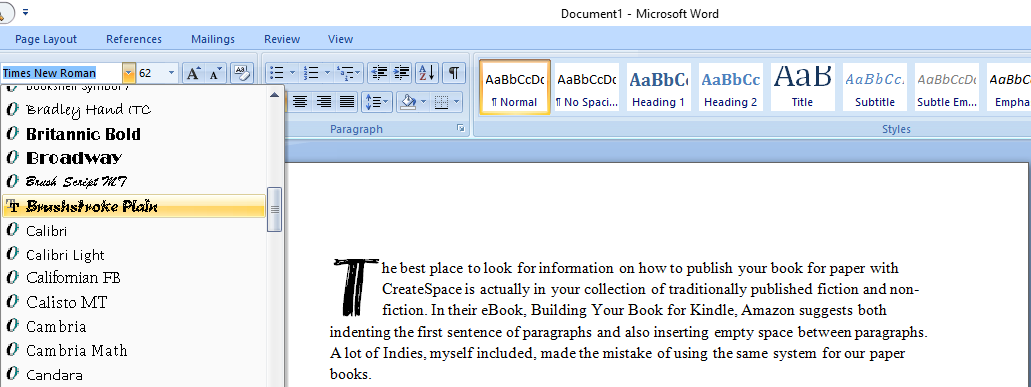
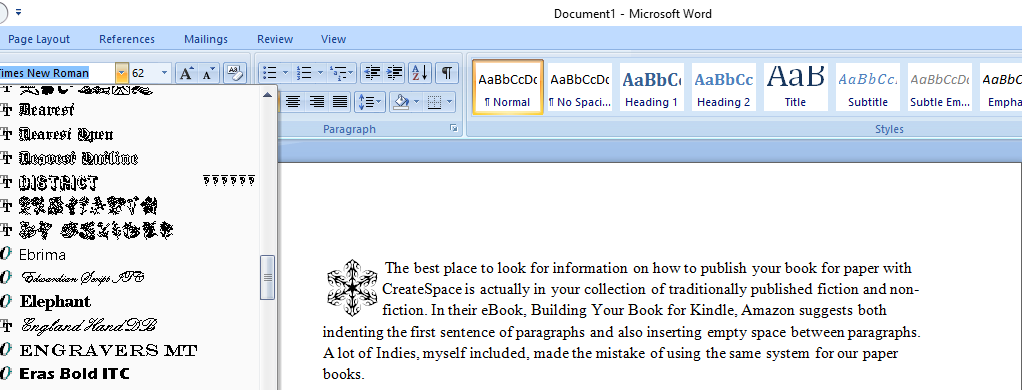
If you want to use a different font to the text for your drop cap, highlight only the first letter and select Drop Cap. Go back to your Home ribbon and open the font box. As you move down and hover over selections, you’ll see the end result appear on the page.

Drop Cap 3

If you’re looking for free and paid for new fonts, head over to Font Squirrel and download away. Always be very sure to read the licence terms for any free font, as some require attribution. Most of these fonts will embed nicely in your PDF file for uploading to CreateSpace, and if they don’t, just don’t use them. All of the standard fonts that come with Word will work great. You could also use Wingdings or other font illustrations as a drop cap with a space after it and begin the paragraph normally.

Drop Cap 4

Peace, Please!

Right now, I’m living with two people, two cats and a dog. As I’m sure you can imagine, it’s difficult as a writer to be focused on the story you’re trying to tell. The distractions are countless, and it’s irritating, especially when you’re mind is on fire, but then someone starts talking to you, or the dog barks, or heaven forbid, your cat jumps onto the computer desk and sits on the keyboard.

Maggie the Cat

As writers, we are in need of quiet time. And sometimes it gets tough to earn that quiet time. A lot of writers have children to care for or other demanding jobs. Right now, I’m searching for a job, so I have a lot of time on my hands. However, I don’t always get to have my quiet time because of the noise that  surrounds me. I sometimes get so frustrated  with a chapter, that I just want to scream, “please, give me a little peace!”

If I don’t find that peace, then it makes it even harder for me to find my “creativity” time. I found that lately for me, my creativity time is usually early in the morning, as soon as my step-father leaves for work. That’s around six thirty. I’m usually up by then, and the house is silent. I get up before I can think about what I’m doing, and hop onto the computer (kind of the way I treat exercising. Do it before your brain realizes it’s being forced to work). Then I write a few hours, and my mom wakes up. Sometimes she stays in her room to watch TV, other times she goes to the living room, where I’m working on my manuscript. Depending on the show she’s watching, I’m able to continue writing, but oftentimes, my concentration breaks. This primarily happens when I once again change where my story is going (I seem to do that often. Anyone else have that problem? It gets stressful and irritating.).

What I wouldn’t give to find a place where I can be alone, a place where I can get that creativity flowing in peace. But because there isn’t a place that I’ve thought of, I have to make due with what I’ve been given. In the morning, it seems to be easiest for me when no one is around, but sometimes, especially the weekends, I have to deal with distractions.

I found that listening to music helps  me. At first, I was trying to find good music that could be considered mysterious, in order to help me work on my mysteries. I soon found out that words tend to throw me off track. So I decided to opt for listening to instrumental like Dave Koz or Jim Brickman. Either one of those, particularly Jim Brickman is my go to music of choice when I decide to listen to music while writing. I can get lost in the music, at the same time get lost in the stories my characters are telling.

I’ve also been on the lookout for other good solitude places to write. But so far, I haven’t thought of anywhere. I tend to go straight to the computer in our living room each morning rather than anywhere else.

Where you write is just as important as writing during your best creativity time. Even if no one is around, there can be distractions, like the television. In my last apartment, I had an office where my laptop was, but there was no TV. I didn’t allow it because I knew that I’d  be distracted while trying to work on my book.

What are some of the ways  and places that allow you to write and shut out the crazy noises of the world?


Angela Kay

Enter your email address to subscribe to this blog and receive notifications of new posts by email.

 © Copyright-All rights reserved by LitWorldInterview.com 2016

#BOOK REVIEW BY @COLLEENCHESEBRO OF “WILLAKAVILLE,” BY AUTHOR BALD GUY @WILLAKAVILLE

Willakaville

  • Title:  Willakaville
  • Author: Mathew Heinecke (aka Bald Guy)
  • Product dimensions: 6 x 0.5 x 9 inches
  • Print Length: 216 pages
  • Page Numbers Source ISBN:
  •  Publisher: CreateSpace Independent Publishing Platform
  • Publication Date: January 7, 2015
  • Sold by: Amazon
  •  Language: English
  • ISBN-10: 1507585462
  • ISBN-13: 978-1507585467
  • Formats: Paperback
  • Goodreads
  • Genres: Children’s Books (ages 6 – 14), Literature, Fiction, Short Story Collections

**The author provided me with a copy of the book in exchange for an honest review which follows**

In the Author’s Words:

“Why is all the toilet paper disappearing? Will Kyle escape the banana warriors? Can Marty save everyone from the mushroom zombies? Find the answers inside Willakaville: Amazing Adventures of Astronomical Awesomeness. Follow intelligent children as they solve supernatural issues and find out about themselves along the way.  The book is full to the brim with time machines, magic, mayhem, aliens, cats, mystery, secrets, strange lands, rockets, evil villains, and a pencil. If you are into action, adventure and awesomeness, this is the book for you!”

My Recommendation:

My secret is out! I love children’s books and this was one of the cutest kid’s books I have read in a long time. I only wish my own grandchildren were still young enough to enjoy this collection!

The stories are set in the mysterious town of Willakaville. Each tale is filled with humor and descriptions that will have your child hooting with laughter! (I did). While reading, I could imagine myself sitting with my own children and grandchildren on my lap as we read the stories out loud together. I really got the sense the book was meant to be shared as a family. I know it would encourage many family discussions. Anytime you can get your children to talk to you and read at the same time is a plus in my book!

Mathew Heinecke has struck the mother lode in children’s storytelling by writing with a combination of imagination and exciting life lessons skillfully woven into each yarn. I really liked the idea that there was a problem presented within each storyline and the characters had to figure out how to solve the issue. This is a great way to introduce problem-solving skills to young children.

I especially loved the inclusion of numerous poems that I thought would be fun and entertaining to read to a younger child. What a great way to encourage the love of poetry at an early age.

Since the release of the first volume of Willakaville, Mathew Heinecke has written Willakaville: Baffling Ballads of Boisterous Braveness (Volume 2) and Willakaville: Cataclysmic Chronicles of Caustic Calamity (Volume 3).

Now, if I can figure out some children to buy these books for…

bitmoji-20160519142508

My Rating:

Character Believability: 5
Flow and Pace: 4
Reader Engagement: 5
Reader Enrichment: 5
Reader Enjoyment: 5
Overall Rate: 4.5 out of 5 stars

4.5 stars

Mathew Heinecke

About Mathew Heinecke:

Mathew Heinecke is an emerging author of children’s books. He enjoys making up wacky science fiction stories and poems for his children. His Willakaville series books have put these in print for others to enjoy with the goal of tackling the many different issues children will face. (He wants to ensure he is using the full spectrum of his imagination)

As a graduate of the University of Utah with a Bachelor’s of Science degree in Mechanical Engineering, he has worked for many years as a mechanical engineer in both the aerospace and transportation industries. This coincides with his passion for learning about new technologies and innovations. (He really wants to be a galactic space fighter)

Mathew grew up in Salt Lake City, Utah where he enjoyed visiting the nearby Rocky Mountains and the colorful landscapes of southern Utah. As a child, he played several sports such as; football, soccer, rugby, basketball, snowboarding, skiing, hiking, fishing mountain biking, golf, and tennis. Now he just plays a little golf and tennis (and has a small protrusion of his belly to show for it) He continues to enjoy sports and time outdoors with his wife, children, and friends.

Some of Mathew’s hobbies include illustration, painting, t-shirt and logo design, gardening, and movies. (He likes to keep busy) His favorite movies are Star Wars and The Lord of the Rings.

You can find Mathew (aka Bald Guy) at Willakaville Facebook, Willakaville Twitter, Willakaville Tumbler, and on his blog Willakaville Blog.

Book Review by @ColleenChesebro of silverthreading.com

Colleen 5.3.16

#INTERVIEW BY @LRWLEE OF YA FANTASY AUTHOR DANIELLE JENSEN (VIDEO)

Meet YA Fantasy author Danielle Jensen and watch as she reads from STOLEN SONGBIRD, Book one in the Malediction Trilogy. Then get to know her as she shares a favorite quote and poses a fun trivia question. Be sure to leave a comment to enter the giveaway for a signed paperback of any one of the three books in the Malediction Trilogy. Giveaway open to domestic & international entrants.

https://youtu.be/zt1TMA8JMKw

Summary: For five centuries, a witch’s curse has bound the trolls to their city beneath the ruins of Forsaken Mountain. Time enough for their dark and nefarious magic to fade from human memory and into myth. But a prophesy has been spoken of a union with the power to set the trolls free, and when Cécile de Troyes is kidnapped and taken beneath the mountain, she learns there is far more to the myth of the trolls than she could have imagined.

Cécile has only one thing on her mind after she is brought to Trollus: escape. Only the trolls are clever, fast, and inhumanly strong. She will have to bide her time, wait for the perfect opportunity.

But something unexpected happens while she’s waiting – she begins to fall for the enigmatic troll prince to whom she has been bonded and married. She begins to make friends. And she begins to see that she may be the only hope for the half-bloods – part troll, part human creatures who are slaves to the full-blooded trolls. There is a rebellion brewing. And her prince, Tristan, the future king, is its secret leader.

As Cécile becomes involved in the intricate political games of Trollus, she becomes more than a farmer’s daughter. She becomes a princess, the hope of a people, and a witch with magic powerful enough to change Trollus forever.

_________________________________________________________________

Book Nerd ParadiseInterview by Book Nerd Paradise
Twitter: @BookNerdParadis
FB: bit.ly/BookNerdParadiseFB

IF YOU ENJOYED THIS POST, be sure to leave a comment to let us know what you thought.

ALSO, BE SURE TO follow our host YA Fantasy author L. R. W Lee at:
Website: LRWLee.com
Twitter: @lrwlee
FB: LRWLee Author
Blog: blog.LRWLee.com

DOWNLOAD the FREE ebooks of the award winning Prequel andBook one in the Andy Smithson coming-of-age epic fantasy series.

#Bookreview Running on Emptiness by John Dolan (@JohnDolanAuthor) Revenge, death, family and an endings of sorts

Hi all:

Today I bring you a new(ish) book, the last one (so far) in John Dolan‘s Time, Blood and Karma series. I had read the other three books in the series, a shorter story related to it, and a collaboration between the author and Fiona Quinn (Chaos Is Come Again. See review here) and I was eager to read this one. When I reviewed the third novel in the series A Poison Tree in my own blog, I took the chance to share the previous reviews again too, so you can read it here. As I say in the review, it’s important that one reads all the books so don’t hesitate to read the review and the books. But without further ado, here is the review.

Running on Emptiness by John Dolan

Running on Emptiness (Time, Blood and Karma, Book 4) by John Dolan Revenge, death, family and an endings of sorts

“Today, there will be a reckoning.”

It is the summer of 2006. In Thailand, the army makes preparations to overthrow the elected government of Thaksin Shinawatra.

Against this backdrop of political turmoil, destinies are shaped as events ensnare a corrupt Police Chief and his dying wife, two warring drug lords, an embittered widow, and a vengeful gangster.

While dreams and obsessions play out on the streets of Bangkok, private detective David Braddock finds himself mired in guilt. The ghosts of his past misdeeds are coming home, and they are bringing devastation in their wake.

‘Running on Emptiness’ is the fourth volume in the ‘Time, Blood and Karma’ series.

The ‘Time, Blood and Karma’ series will appeal to lovers of the following book categories: mystery, thriller, crime, Thailand fiction, private investigators, British detectives, and amateur sleuths.


And here, my review:

I received a copy of this book in exchange for an honest review.

I’ve read all the novels in the Time, Blood and Karma series by John Dolan and have enjoyed them enormously. I read many genres, but I am quite partial to mystery/thrillers. And these ones have a very special protagonist, David Braddock, and amateur detective (or rather a not professionally recognised and trained detective, but he is pretty good and gets paid for his efforts) and again a non-professional therapist, a British man but who lives in Thailand, an amateur philosopher who regularly visits an old Buddhist monk (his best friend), who has interesting an complex relationships with many women and a past full of ghosts.

Whilst the third book in the series, A Poison Tree explored and explained David’s back history and his life in the UK, Running on Emptiness continues with the adventures of Hungry Ghosts where we, the readers, were privy to some information that left us hanging and waiting for disaster to strike. We have a gangster determined to avenge his brother’s death (the only meaningful thing he has left to do in life), a dying woman who before ending her life in her own terms (remaining in charge of her meaning) reveals a dangerous secret, another woman who after losing her job realises she’s been living a lie and tries and find meaning by coming clean, an old man who, disappointed by his children, decides to revisit a shady past he thought he’d left behind to do the right thing. Each chapter is told from a different point of view, and that includes the characters whom we might think of as the good guys (but nobody is blameless, honest and truthful in this novel, at least none of the characters whose points of view we follow), but also the gangsters, corrupt policemen and killers. The action takes place in England (we start with a wedding and we end with a funeral) and Thailand, we have political unrest, and there is also a murder case to solve with magic trickery thrown in, where Braddock (and Dolan) follow on Agatha Christie’s footsteps and pull off a brilliant piece of sleight-of-hand engineering.

The story is told at a good pace, the writing is impeccable and lyrical at times (particularly on the parts from David Braddock’s point of view. He is witty and forever quotable), I must confess I cheered at a point towards the end (but I’ll keep my lips sealed as I don’t want to spoil it for anybody), and in the end, although there are some questions and unresolved issues, I felt we’d reached the end of an era. The complex and alternative life Braddock had built for himself, in an attempt at escaping reality, comes crushing down around him, taking no prisoners. By the end, although Braddock might not know everything, he’s lost a lot and learned a fair deal about himself, about the people he cares about, about his friends, and about life itself.

I recommend this book to lovers of thrillers and mystery stories with great main characters, those who have a penchant for philosophy and reflections on the nature of life, particularly if you’re intrigued by Thailand, and in general those who love good and memorable writing. But, do read the whole series in the right order, because the sum of its parts is much greater than the individual novels. Congratulations to John Dolan on his epic series. I won’t forget Time, Blood and Karma any time soon. And I’ll be waiting eagerly for more of novels, in the same or other series.

Ratings:
Realistic Characterization: 4.5/5
Made Me Think: 4.5/5
Overall enjoyment: 5/5
Readability: 4/5
Recommended: 5/5
Overall Rating: 5/5
 

Buy it at:  
Format & Pricing:
Paperback:  $13.49
Kindle: $ 3.99

Olga Núñez Miret

@OlgaNM7

http://www.authortranslatorolga.com


Why Readers Stop Reading a Book.

Recently, we here at LitWorldInterviews.com conducted a survey, “Why do you put a book down?” and through the assistance of the writing community we had a very nice response of over 100 participants (I stopped counting.). Now it’s time to share what we found.

First, I want to say why the survey was conducted. We wanted to help writers by giving them the information they most need. If a reader takes the time to check out your book and don’t like it, they are unlikely to give you a second chance with your next work. First impressions mean a lot.

86.30% of those responding were Female, thus leaving the remaining 13.70% Male. Considering the majority of those reading novels are Female, although not quite this extreme, I’m comfortable with sharing what we found.

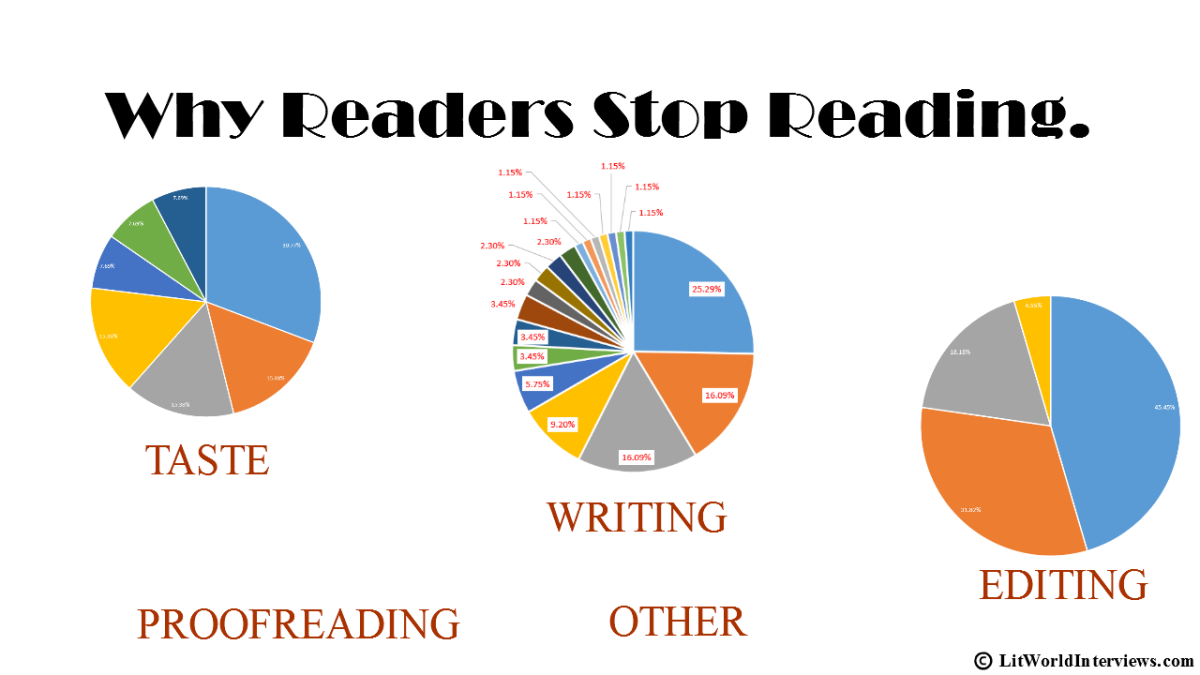
There were 34 sub-categories as a result of the survey. Those results were then placed into 5 main categories: Writing, Editing, Proofreading, Taste, and Other, with Writing providing the largest number of sub-categories and results.

68.49% of those responding noted some form of dissatisfaction with Writing as a reason for putting a book down.

26.03% gave Editing.

23.29% gave Proofreading.

17.81% was Taste.

2.74% was Other.

Let’s take a look at the Writing sub-categories first.

Click Image for larger view.

Writing Concerns of Readers Pie Chart

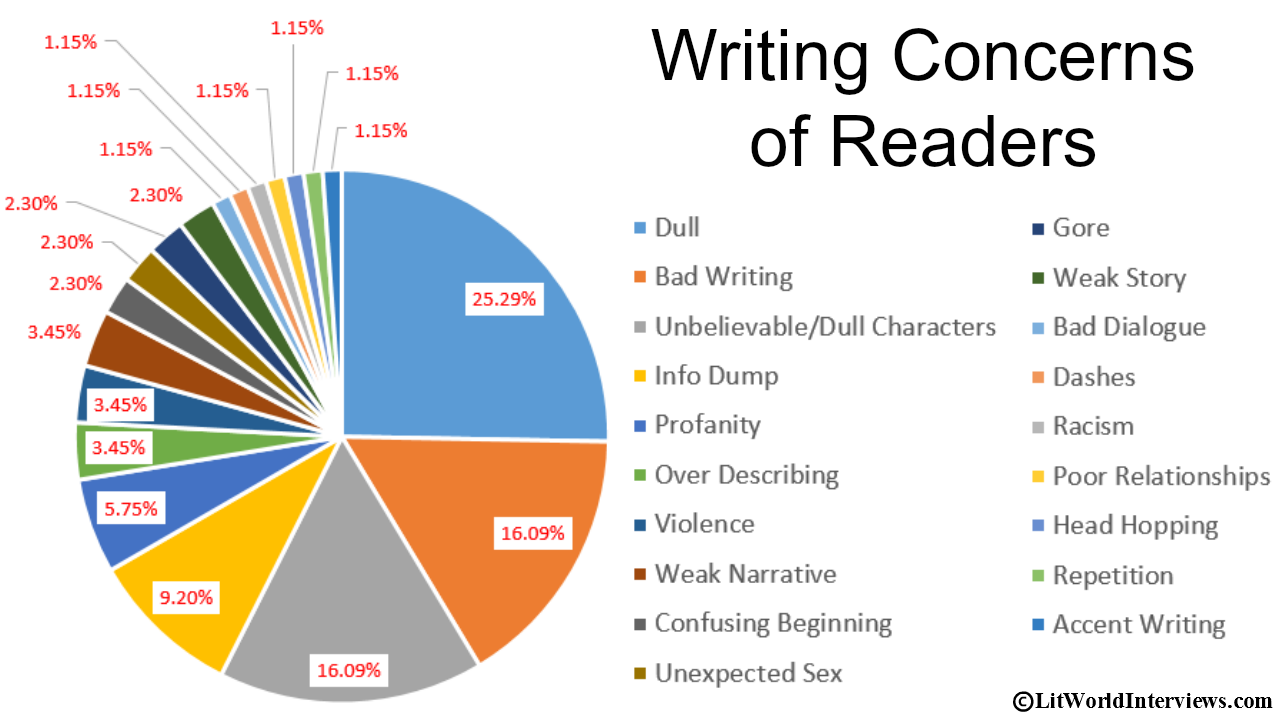
The above pie chart shows the concerns in descending order of greatest number of mentions. The story being Dull was the most frequently mentioned problem with 25.29% of the mentions of the Category. Followed by actual Bad Writing, then Dull or Unbelievable Characters, Info Dump, and uses  of Profanity.

Let me speak about Profanity for a moment, this along with Gore, Violence, and Sex were all mentioned in the context of being included in the story for no apparent reason. Most of those who noted it as a concern stated they know these things occur in books, and even have a place, but the problem arose when the author was using them as obvious crutches in an attempt to hide poor writing and plot.

The subcategories of Writing Concerns as identified by readers are as follows in descending order: Dull, Bad Writing, Unbelievable Characters, Info Dump, Profanity, Over Describing, Violence, Weak Narrative, Confusing Beginning, Unexpected Sex, Gore, Weak Story, Bad Dialogue, Dashes, Racism, Poor Relationships, Head Hopping, Repetition, and Writing with Dialect Accents.

What does this tell us? The first thing that jumps out to me is that we as authors aren’t putting out books with stories that are capturing the attention of the reader. With a book done with professional intent behind it, a dull story should be the reason our books are not read. That’s right, we are not read because we just didn’t do a good job of telling our story. Maybe we didn’t have the right beta readers. Maybe they were too nice. Maybe they just went through the motions. Maybe they just aren’t that good at the task. Or maybe we should recognize our work isn’t that good. How about all of the above?

Let’s look at Editing Concerns

There were four subcategories for Editing Concerns: Actual Bad Editing, Plot Holes, Sentence Structure, and No Scene Breaks for Time Lapses.

Click Image For Larger View
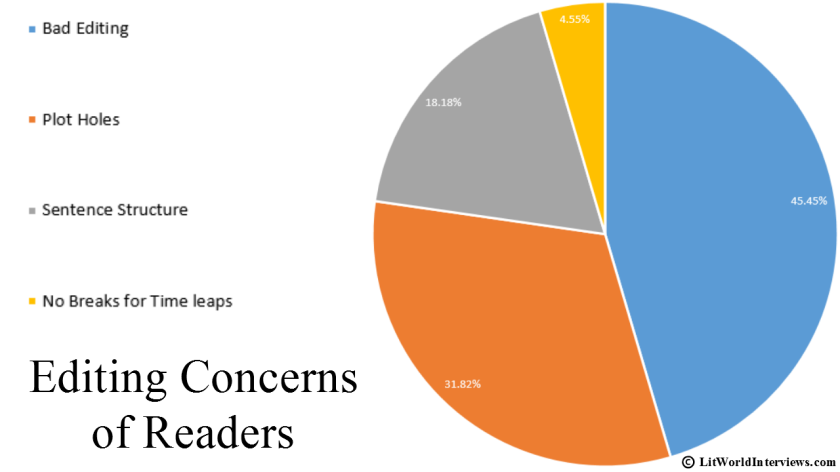
Editing Concerns of Readers Pie Chart

The bad thing about writing a novel is the author knows everything that is happening, even behind the scenes, the back story the reader never sees, and the in between scenes that happen. The problem this creates is hopefully caught during editing. A good editor can save a book from disaster. Fresh eyes see old mistakes that the author overlooks each time they’ve gone through each of the five drafts they’ve done.

An Editor is not responsible for rewriting a novel. I want to make that clear. They take what a writer gives them, looks for plot holes, sentence structure, weak story development, and things of that nature. They are not a Proofreader. I think people confuse the two, but having been associated with a professional Proofreader who has guest hosted here on the site, I know the difference.

If you pay an Editor they are to give you the tightest and most entertaining story they can from what you’ve given them. Of course you, as the author, can disregard everything, but that would be a foolish thing to do. I have a writing mentor who edits some things I give her at times. I take some of what she offers and disregard others because of the importance of what that means to the overall story, a story she isn’t fully aware of yet.

Notice I didn’t throw everything away, and I took into consideration what she said about the part I disregarded. I changed things to make that part seem more relevant to the story at that point, without giving anything away.

But what we get from this part of the survey is that readers notice editing of a book. The idea of not editing a book crosses the minds of Indie Authors. We’ve been through the book a dozen times. We know it’s just fine the way it is. Note the sarcasm I said those last couple of sentences with. I’m not saying it’s impossible to edit your own work, but you would have to be able to step away from the work long enough to see it with fresh eyes, several times. At least that’s my opinion. You also have to become slightly detached from this labor of love, in some cases.

Proofreading Concerns

There isn’t a need for a chart here. There were two sub-categories: Proofreading (66.66%), and Grammar (33.33%).

I have to say, this is an area I notice a lot in books. If there are proofreading problems in a book, they take me out of the story, out of the world created by the writer. Every book has a proofreading error, or perhaps a printing error, not so much on the printing these days with the modern printing methods, but back in the old days of typesetting, errors happened.

I’ve read several books for the purpose of reviews and I have put some down because of the proofreading problems. I honestly don’t think there was any proofreading conducted. You might get past the dull story, even some bad editing, but when you are constantly tripped up by spelling errors, punctuation, and all of that, you eventually become tired of it all.

Taste Concerns of the Reader

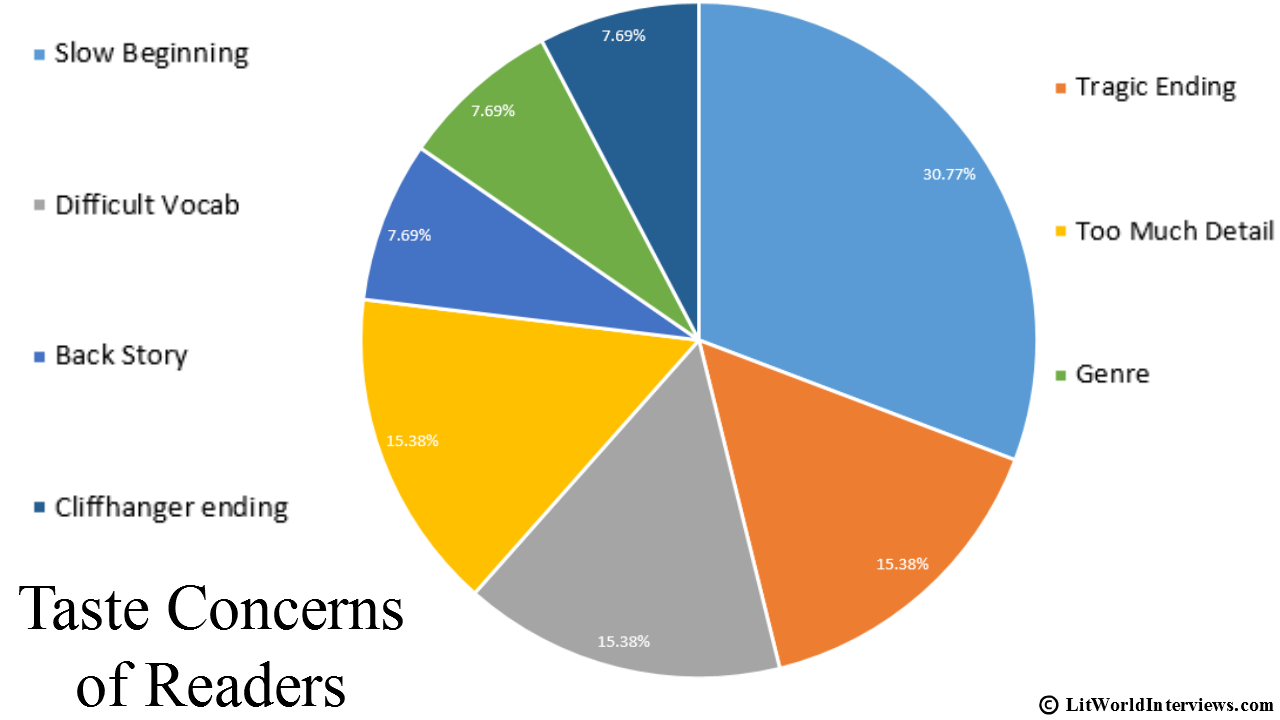
There were 7 different sub-categories placed under taste: Slow Beginning (30.77%), Tragic Ending (15.38%), Difficult Vocabulary (15.38%), Too Much Detail (15.38%), Back Story (7.69%), Genre (7.69%), and Cliffhanger Ending (7.69%).

Click Image for Larger View.
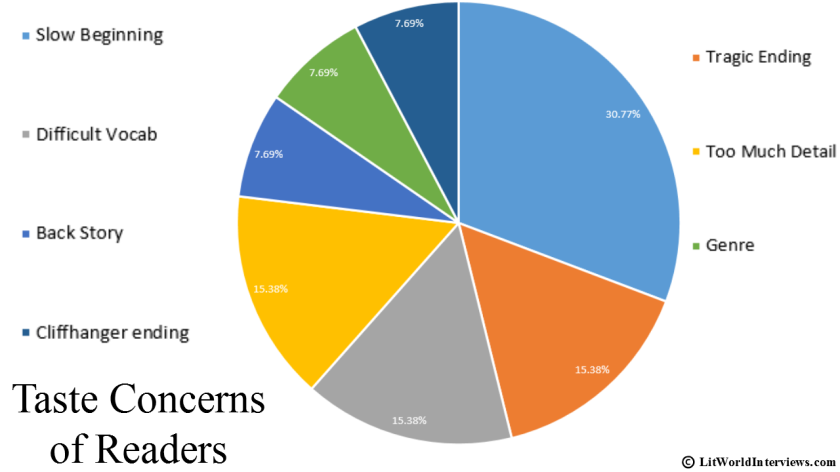
Taste Concerns of Readers Pie ChartYou won’t find two readers with exactly the same taste. They may have a discussion and it sounds like they are the same, but put five books in front of them and have them read them, I would be willing to bet you would get different opinions.

Some books, due to the nature of the story and world, may require a slow beginning. The trend is to jump right into action to capture the reader’s interest, but perhaps your story doesn’t fit that type of trend. Difficult vocabulary may be part of how a certain character speaks.

But I understand what the readers are saying. Sometimes the way things are done, they are not necessary. I think when it all makes sense, a reader is fine with it, but just as when people throw profanity or gore into a story, sometimes these tastes, other than perhaps genre, are signs of weak storytelling and plot.

Other

There were only two that fell into the Other category: Having the book available for Screen Readers, and Having a Misleading Book Description.

I think these are two very valid reasons to not read a book. As my eyesight fails I know it becomes more difficult to read. Some will say just get glasses, but this is due to medications I must take. Eventually I will likely not be able to see at all. But I love books. It would be a shame to not buy a book because it didn’t work with my screen reader.

As for a misleading book description? It may be the opinion of the reader as to the misleading nature or not. If it truly is misleading, I think the book needs removing or at least the description updated.

 Conclusion

What all did we learn from the survey? Good writing and story, with good editing and proofreading will make for a page turner.


by Ronovan Hester

Enter your email address to subscribe to this blog and receive notifications of new posts by email.

 © Copyright-All rights reserved by LitWorldInterview.com 2016

Crave For Me by @RebeccahChase. #BookReview

Crave for me by Rebecca Chase Image with link3 Gold Stars image


Crave For Me

by Rebecca Chase

Fiction: Erotica/Romance.  Says 139 Pages but my Kindle has it at 274 pages. Amazon Digital Services LLC (February 21, 2016) $2.99 or Free to Read on KindleUnlimited.

Author Biography

Rebecca Chase is an English rose with a taste for sex and romance.

Starting life as a superhero she found she liked stockings more than tights so writing erotic romance was the obvious next step. When she’s not busy going on amusing and passionate dates with sexy suitors, or whacking shuttle cocks in thrilling badminton games, she dances the night away in random clubs. Frequently she can be found enjoying the spectacle of rugby men battling with balls. Rebecca loves finding interesting story ideas in everyday life and can frequently be caught daydreaming in coffee shops, while trying to hide her writing from sneaky-eyed baristas.

Book Review

I received this book for an honest review.

Although books of the more erotic nature are not my usual cup of tea, I agree to read some books at times because I feel every author needs reviewed, even if not by me. I had the time for this one, with it being three short stories, so I agreed.

The three stories in the book, Crave For Me: three short tales of erotic romance, are Fight For Me, Work For Me, and Play For Me.

The first, Fight For Me finds two childhood friends reunited over a brother’s wedding. But more is going on inside each than the other knows. Juliet Scott has been in love with Joe Adams since she knew boys weren’t all that bad after all. He’s been gone in the Army but her desire hasn’t lessened for the bad boy she knew. What happens when the old friend who thinks of her as a baby sister comes home on leave?

This is the right one to start the book with. It is the best of the three, in my opinion. It has more depth and seems to me a lot was put into this one. There are supporting characters that are well done and there is a good plot. I would like to say this could have been a longer novella length book, but does well on its own in its current length. I don’t think the intimate scenes were overdone or to stereotypical. Except for some word play around the scenes were well done. The characters nicely developed. A good story overall.

Work For Me is about Alana, an office employee and the fix-it man, Nick. She’s older and in need, and he’s ready to fix her kitchen and maybe more. That’s what she fantasizes about. Not as good as the first story, shorter and more typical of the genre I think.

This one starts off with some phrasing that’s quite different from the first story and thus took me a while to grow accustomed to. I gave it a chance and enjoyed the parts after that, they were quite realistic, until the last half, which turns into a fantasy piece. You’ll see when you read it.

Play For Me: Teacher, Kate Benson ends up with a surprise when her elderly private piano teacher is replaced with her former high school piano teacher, Nat Chapman. The one she had to stop piano because of the feelings she had for him.

Another realism turns fantasy piece, but that’s what the genre is about. Creative in the construction of the intimate scene.

Get Crave For Me at:

amazon logo   

Visit Author Rebecca Chase at:

http://www.rebeccahchase.com/.

Connect with Rebecca Chase on:

facebook logo goodreads logoInstagram Logo with Link   twitter logo

How to Create Lines for Interactive Books

I’m working on a couple of projects that require lined pages for interactive paper books for CreateSpace publishing. Note that I’m not suggesting this method for Kindle books, mainly because I haven’t tried it there yet, and fancy formatting is not a good idea at all for Mobi, but also because a lined eBook isn’t going to do anyone much good. For eBook workbooks, I’d suggest rather including a printable, downloadable PDF workbook in your Kindle book—but we’ll do that another time.

If you want to create a journal or workbook, you’re going to want lined pages, or pages with text, images, and also lines. You could probably just hit the underscore a whole lot of times but that could run into problems, and using Word’s formatting tricks works well with CreateSpace. This way you control the look of your pages very nicely. Here we go.

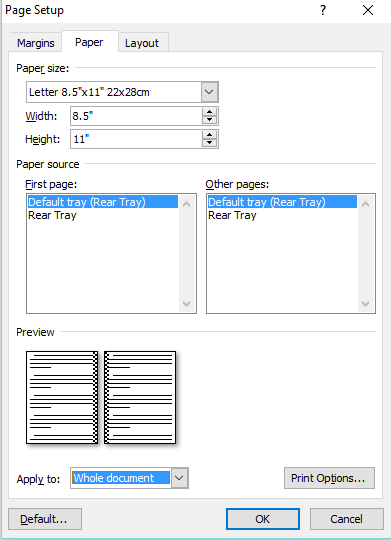
The first thing to do is to set up your paper size.

1Paper Size

And margins.

1Margins

I’m using a large size here, 8.5 x 11 inches, but obviously you would set your own book size and margins accordingly. The next step is to decide how long you want your lines to be. If you want them the width of the page, then simply subtract your gutter, left and right margin sizes from the width of the book. Once you have your book size, it’s easy to decide on the length of line you want—play around with it awhile before saving.

Next, place your cursor where you want your first line to appear, and toggle the Show/Hide (pilcrow) function on. Highlight the pilcrow that appears on the page. Click on the arrow beneath the Change Styles box and select Clear all, to clear the formatting on it.

1Clear Paragraph Formatting

Click on the arrow in the Paragraph box from your home tab, and then click on the Tab box at the bottom of the box that pops up. In the Tab stop position box, type in the number that you get after deducting your margins. Select Right alignment, and select 4 in the Leader box (this is for underline). Click Set and OK.

1Set Tab

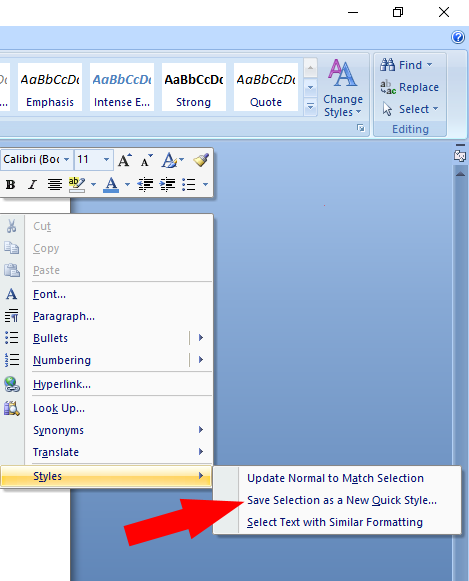
Now go back to your pilcrow and hit the tab key. Your line will now zoom across the page. Right click on the pilcrow and select Save Selection as New Quick Style.

1Save Style

Type in the name of your choice and click OK. To use the lines in this manuscript now, all you have to do is select it from the Change Styles box, and click Tab and Enter.

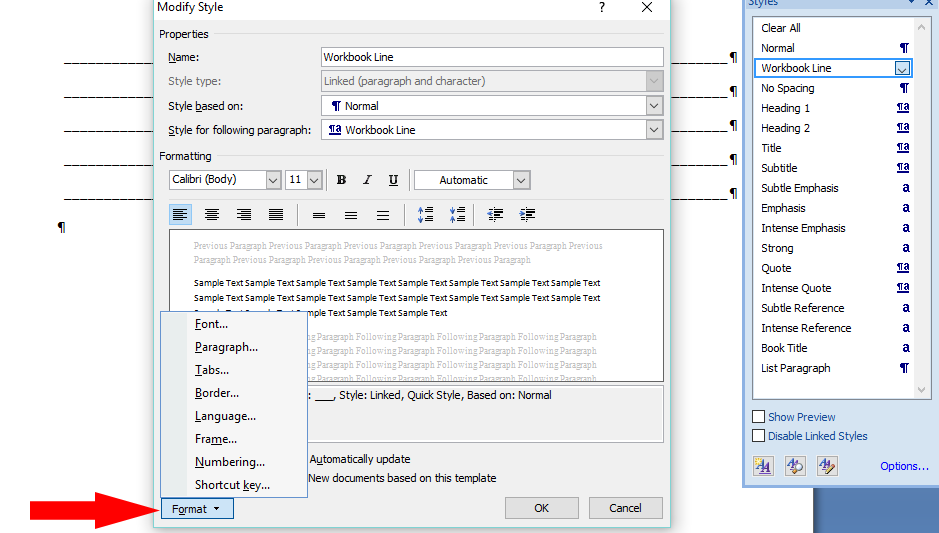
To format your lines, open the Change Styles box and click on the little arrow that appears when you hold your cursor over your newly created style. Select Modify and then Format, and then change the Paragraph line spacing as you wish.

1Format Line

1Format Spacing
Right click on the pilcrow to change the line colour. Unclick the Show/Hide pilcrow to get back to working normally.

Remember that if you change your margins at a later time, you will have to format your lines again, but for this particular book, you’re ready to go, and don’t have to abuse the underscore key or get your head around tables.

Lastly, while we’re on the subject of journals and workbooks, you might want to explore your font horizons on Word for some really pretty or striking effects. Click on the arrow in the Font box from your home page and play around with all the effects and options available for each font. Happy creating fellow scribblers.

1Font2

1f2

21 #Quotes About #Inspiration for the #Author and #Creative.

14 Quotes From Authors About Inspiration

“When we clear the physical clutter from our lives, we literally make way for inspiration and ‘good, orderly direction’ to enter.” Julia Cameron

“I feel like part of getting better at writing is knowing where to find that inspiration. Right after something happens to me, the first thing I’ll do is go write when those feelings are really, really fresh.” Troye Sivan
“Inspiration comes of working every day.” Charles Baudelaire

“The main characters for ‘The Seer and the Sword’ made an appearance one night and then haunted me for over five years before I began to write them down. Does that count as inspiration? For me, characters tend to show up, stay on to help with the work of writing their stories, and then occasionally deign to visit after a book is finished.” Victoria Hanley

“Cease trying to work everything out with your minds. It will get you nowhere. Live by intuition and inspiration and let your whole life be Revelation.” Eileen Caddy

“Our moments of inspiration are not lost though we have no particular poem to show for them; for those experiences have left an indelible impression, and we are ever and anon reminded of them.” Henry David Thoreau

“Who knows where inspiration comes from. Perhaps it arises from desperation. Perhaps it comes from the flukes of the universe, the kindness of the muses.” Amy Tan

“There are little gems all around us that can hold glimmers of inspiration.” Richelle Mead

“What Romantic terminology called genius or talent or inspiration is nothing other than finding the right road empirically, following one’s nose, taking shortcuts.” Italo Calvino
“Inspiration comes from so many sources. Music, other fiction, the non-fiction I read, TV shows, films, news reports, people I know, stories I hear, misheard words or lyrics, dreams… Motivation? The memory of the rush I get from a really good writing session – even on a bad day, I know I’ll find that again if I keep going.” Trudi Canavan

“You can’t wait for inspiration. You have to go after it with a club.” Jack London

“Many a witty inspiration is like the surprising reunion of befriended thoughts after a long separation.” Karl Wilhelm Friedrich Schlegel

“Inspiration is the greatest gift because it opens your life to many new possibilities. Each day becomes more meaningful, and your life is enhanced when your actions are guided by what inspires you.” Bernie Siegel
“Youth is the period in which a man can be hopeless. The end of every episode is the end of the world. But the power of hoping through everything, the knowledge that the soul survives its adventures, that great inspiration comes to the middle-aged.” Gilbert K. Chesterton

7 Quotes From Creatives About Inspiration

“Technique is what you fall back on when you run out of inspiration.” Rudolph Nureyev

“Do not quench your inspiration and your imagination; do not become the slave of your model.” Vincent Van Gogh
 
“The single thing all women need in the world is inspiration, and inspiration comes from storytelling.” Zainab Salbi
 

“Just don’t give up trying to do what you really want to do. Where there is love and inspiration, I don’t think you can go wrong.” Ella Fitzgerald

“Inspiration is hard to come by. You have to take it where you find it.” Bob Dylan
“Without craftsmanship, inspiration is a mere reed shaken in the wind.” Johannes Brahms
“Sometimes, you just have to clear your head and get out to see other things. It is very important to be nourished. I love to go to museums and galleries, I like to see theatre, film, dance – anything creative. It doesn’t promise you inspiration, but it nourishes your creative soul, and that’s good.” Marc Jacobs
 

You can check out the other Inspiration entries  HERE, on SilverThreading.com, Colleen Chesebro’s site, my co-host for the Writers Quote Wednesday Writing Challenge. This is her week to come up with the theme.


Enter your email address to subscribe to this blog and receive notifications of new posts by email.

@RonovanWrites

 © Copyright-All rights reserved by LitWorldInterview.com 2016

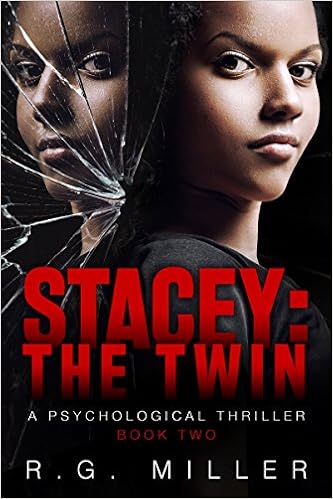
Stacey: The Twin: Book Two

  • Title:  Stacey: The Twin: Book 2 (The Twins: A Psychological Thriller)
  • Author: R.G. Miller
  • File Size: 2221KB
  • Print Length: 211
  • Page Numbers Source ISBN: 1532755236
  •  Publisher: R.G. Miller
  • Publication Date: April 8, 2016
  • Sold by Amazon Digital Services LLC
  •  Language: English
  • ASIN: B01E1MIMFC
  • Formats:  Kindle
  • Goodreads
  • Genres: Psychological Thriller

Summary: If you have to kill one, kill the other also.”
These were the words that the renown psychologist, Dr. Susan Patterson had reluctantly had spoken to Dt. Isis Williams. Their topic of discussion: 16-year-old Stacey and Jannifer McHill, The Twins.

A few weeks after Detective Isis Williams and her partner and lover Annette Toni horrific confrontation with the twins– where Dt. Williams was forced to shoot and kill Jannifer McHill–Stacey McHill was sent to a new facility for the criminally insane. Dt. Isis Williams could not bring herself to pull the trigger on the remaining twin.
“If you have to kill one, kill the other also.”
In the meantime, a sadistic rapist/murderer is on the prowl in Harlem, his targets: middle age women. While Williams and Toni are hot on the rapist trail, Stacey McHill escapes while being treated by her psychologist, Dr. Susan Patterson. Now Detective Isis Williams will come to regret the day she did not take heed to Dr. Patterson’s warning:” If you have to kill one, kill the other also.

Review: Stacey: The Twin is the second book in R.G. Miller’s psychological thriller trilogy. Like its previous counterpart, it starts the ground running with its grotesque scenes and doesn’t let go.

Just under a year after the manhunt for two sadistic teenage serial killers ended, Detective Isis Williams is back, hunting for a brutal rapist and murderer. We are briefly reminded of the past events that took place, and the current fate of Stacey McHill, the only living twin serial killer.

Like the first book, the characters were often referred to by their whole name, which takes me away from reading. There were a lot of misspells or wrong word use throughout the novel, as well as telling rather than showing. However, the scenes were put together much better than the previous, although at times there weren’t breaks between point-of-views, which forced me to reread the paragraph a few times to grasp the difference between the scene changes.

At first, it seemed as though Detective Williams mellowed out from when we are first introduced to her in the first novel. Then at times her moods begin to fluctuate, making it appear to me as though she is bipolar. There was a brief scene when even her partner and lover questions Williams’ morals.

In this book, a lot of psychopaths did, or hinted at doing, psychotic deeds, which made me confused as to who was doing what. And, while the book was titled Stacey: The Twin, it took half the script to delve into the latest story of Stacey McHill, but we do end up finding that everything intertwines together, leading to a climatic ending.

Stacey: The Twins was written with a better effort than its predecessor. If you don’t like novels laced with foul language or you don’t like gruesome scenes, I’d steer clear. However, if you can look past them, then you may truly enjoy this series.

Overall Rate: 3.5 out of 5 stars

About R.G. Miller

Author R.G. Miller image“R.G.Miller, who was born in Brooklyn, N.Y. He’s an avid reader. His favorite subject is Abnormal Psychology. He enjoys classic R&B and Rock. He’s the grandfather of three, and he enjoys picking up a mike and singing a tune or two.

R.G.Miller spent three years working on his trilogy.”If you’re a fan of CSI, Criminal Minds, or Law and Order, The Twins: A Psychological suspense thriller is the book for you.”

The Twins: A Psychological Thriller is R.G.Miller’s first novel.”

Connect with R.G. on his Facebook page.

https://www.facebook.com/r.g.millerthetwins/

#BOOK REVIEW BY @COLLEENCHESEBRO OF “Escaping Psychiatry – Beginnings: Escaping Psychiatry Prequel” BY AUTHOR @OLGANM7

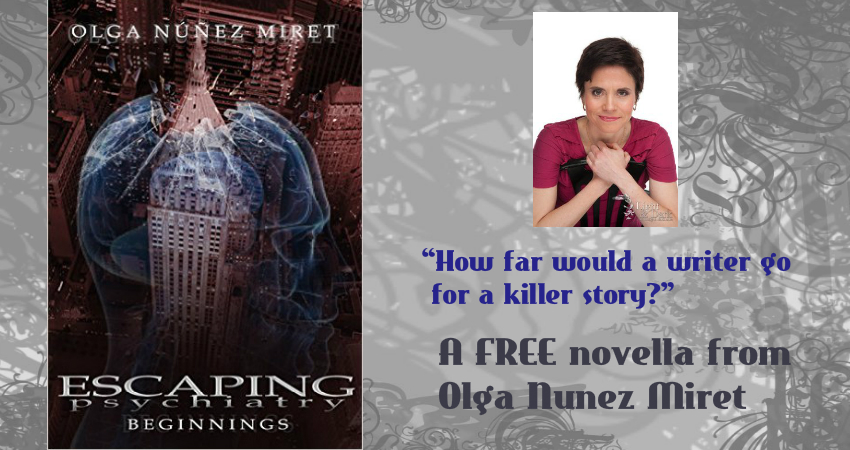
Escaping Psychiarity Beginnings

  • Title:  Escaping Psychiatry – Beginnings: Escaping Psychiatry Prequel
  • Author: Olga Núñez Miret
  • File Size: 2356 KB
  • Print Length: 81 pages
  • Publisher: Just Olga Books
  • Publication Date: February 1, 2016
  • Sold by: Amazon Digital Services LLC
  •  Language: English
  • ASIN: B01BDG102Q
  • Formats:  Kindle
  • Goodreads
  • Genres: Legal Fiction, Mystery, Thriller, Suspense

In the Author’s Own Words:

“How far would a writer go for a killer story?”

“This is the question psychiatrist Mary Miller must answer to solve the first mystery/thriller of her career. You can get to know the main characters of this psychological thriller series for FREE and test your own acumen and intuition in this novella about the price of ambition.
Escaping Psychiatry. Beginnings is the prequel to Escaping Psychiatry a volume collecting three stories where Mary and her psychiatric expertise are called to help in a variety of cases, from religious and race affairs, to the murder of a policeman, and in the last case, she gets closer than ever to a serial killer.
If you enjoy this novella, don’t forget to check Mary’s further adventures. And there are more to come.”

My Recommendation:

I don’t know about you but I love a good mystery. If you do too, get comfy in your easy chair and pour a cup of tea! Escaping Psychiatry – the Beginning is a prequel to a trilogy called Escaping Psychiatry, which includes three books: Cannon Fodder – book 1, Team Work – book 2, and Memory – book 3.

This prequel introduces you to the cast of characters in Escaping Psychiatry. Dr. Mary Miller, the psychiatrist seems to be at a crossroads in her career. When her friend Phil, a criminal lawyer from New York invites her to consult on an interesting new case, Mary jumps at the chance.

The accused is a writer who has made a fortune writing a best-selling novel. He is suspected of assaulting a man who claims the writer stole his story. The author further claims the man was stalking him. He asserts that he was provoked by the stalking and that the attack was done purely in self-defense. Things get really interesting when the man suddenly dies.

Author, Olga Núñez Miret, gives you just enough of the facts to whet your appetite into wanting more of this exciting mystery. I thought it was brilliant to offer the prequel as a FREE purchase. I am intrigued by Mary’s character and look forward to reading the rest of the series!

I CAN’T WAIT TO FIND OUT –

what happened

My Rating:

Character Believability: 5
Flow and Pace: 5
Reader Engagement: 5
Reader Enrichment: 4
Reader Enjoyment: 5
Overall Rate: 4.5 out of 5 stars

4.5 stars

Olga NM

About Olga Núñez Miret:

My name is Olga Núñez Miret and I’m a writer. I also do translations of other author’s work. What else? I was born in Barcelona, Spain, but have lived in the UK for a long time. Over the years I’ve done many things and had other lives but however far I wander I keep coming back to books and stories, my two earliest loves.

When reading was no longer enough, I started writing. My first book was published in 2012 and my publications span different genres, from literary fiction to romance, Young Adult, and psychological thrillers. I plan on writing more novels in the same genres and if my imagination so dictates, I will explore others.

I love to connect with readers, so don’t hesitate to get in touch. If you want to keep informed of all my news, offers, and promos, you can sign up for my e-mail list here: http://eepurl.com/bAUc0v. You can also find me in the usual places and I always include links to my books. Don’t forget to check my website and my blog. There are always surprises.
You can find Olga Núñez Miret on Twitter @OlgaNM7, on Facebook at Olga Núñez Miret, Writer, and her blog authortranslatorolga.com.

Book Review by @ColleenChesebro of silverthreading.com

Colleen 5.3.16

#INTERVIEW BY @LRWLEE OF YA FANTASY AUTHOR JENNA NELSON (VIDEO)

Meet YA Fantasy author Jenna Nelson and watch as she reads from THE SNOW GLOBE, Book one in The Winterhaven Chronicles. Then get to know her as she shares a favorite quote and poses a fun trivia question. Be sure to leave a comment to enter the giveaway for one of two ebook copies of The Snow Globe. Giveaway open to domestic & international entrants.

https://youtu.be/97YRnYUZhIA

Summary: By day, Sondrine Renfrew works at Cimmerian’s Curio Emporium, her aunt’s apothecary and antique shop in London, 1875. By night, she weaves fire, water, and air into both inanimate objects and living creatures. When a hooded stranger offers Sondrine a snow globe in trade for medicinal herbs, she accepts, enchanted by the castle, forest, and sea encapsulated under the glass. Her enchantment fades, however, when her deceitful aunt betroths her to one of London’s wealthiest men—a complete stranger.

Determined to escape the marriage, Sondrine trades her corset for trousers and decides to run away. With one foot out the door, she falls down a veritable rabbit hole into Winterhaven, the haunting world inside the snow globe. Sondrine soon discovers her arrival in Winterhaven is no accident. There, she meets Shán, a man who broods more than the darkened sky above. Turns out Shán is not to be trusted. Not only is he the man who sold Sondrine the snow globe, he is a bounty hunter employed by the king. The beginnings of a sovereign war have been set in motion and an Immortal queen, one who uses fire as a weapon, is set on destroying Winterhaven. Because of her Elemental gifts, only Sondrine has the means to stop the queen. If Sondrine refuses the king’s request, he will behead her. If she rises to the challenge of killing the Immortal queen, her death is just as imminent. After all, an Immortal queen cannot be killed. Or can she?

_________________________________________________________________

Book Nerd ParadiseInterview by Book Nerd Paradise
Twitter: @BookNerdParadis
FB: bit.ly/BookNerdParadiseFB

IF YOU ENJOYED THIS POST, be sure to leave a comment to let us know what you thought.

ALSO, BE SURE TO follow our host YA Fantasy author L. R. W Lee at:
Website: LRWLee.com
Twitter: @lrwlee
FB: LRWLee Author
Blog: blog.LRWLee.com

DOWNLOAD the FREE ebooks of the award winning Prequel andBook one in the Andy Smithson coming-of-age epic fantasy series.

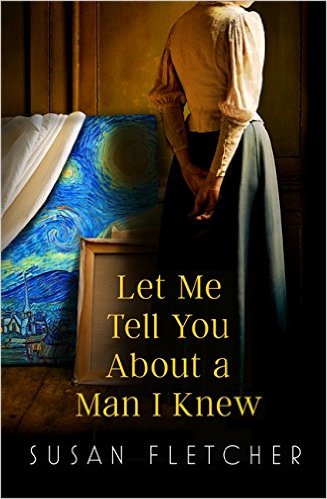
#BOOKREVIEW Let Me Tell You About A Man I Knew by Susan Fletcher. A beautiful, contemplative and touching novel that brings Provence and Van Gogh’s paintings to life.

Let Me Tell You About a Man I Knew by Susan Fletcher

REVIEWS FOR LITERARY WORLD REVIEWS

Title:   Let Me Tell You About A Man I Knew
Author:   Susan Fletcher
ISBN13:  978-0349007618
ASIN:  B010PDPCBI
Published:  2nd June 2016
Pages:  272
Genre:  Historical Fiction

Description:

Just notice that the book will be released later in the week, on Thursday the 2nd June 2016.

Provence, May 1889. The hospital of Saint-Paul-de Mausole is home to the mentally ill. An old monastery, it sits at the foot of Les Alpilles mountains amongst wheat fields, herbs and olive groves. For years, the fragile have come here and lived quietly, found rest behind the shutters and high, sun-baked walls.

Tales of the new arrival – his savagery, his paintings, his copper-red hair – are quick to find the warden’s wife. From her small white cottage, Jeanne Trabuc watches him – how he sets his easel amongst the trees, the irises and the fields of wheat, and paints in the heat of the day.

Jeanne knows the rules; she knows not to approach the patients at Saint-Paul. But this man – paint-smelling, dirty, troubled and intense – is, she thinks, worth talking to. So ignoring her husband’s wishes, the dangers and despite the word mad, Jeanne climbs over the hospital wall. She will find that the painter will change all their lives.

Let Me Tell You About A Man I Knew is a beautiful novel about the repercussions of longing, of loneliness and of passion for life. But it’s also about love – and how it alters over time. 

Body of review:

A beautiful, contemplative and touching novel that brings Provence and Van Gogh’s paintings to life.

Thanks to Virago and to Net Galley for providing me with a free copy of this novel in exchange for an unbiased review.

There are historical (and artistic in this case) figures that set imaginations alight. When I read the description of the book I liked the premise. Rather than being a straight biography of Vincent Van Gogh this novel is built around one episode of Van Gogh’s life, his stay at Saint-Paul-de Mausole, an old-monastery converted into a home for the mentally ill. The story, a third person narrative, is not told from the point of view of the painter, but of Jeanne Trabuc, the wife of the warden, Major Charles Trabuc. She’s the mother of three boys and two girls, but her surviving sons (the girls died at birth) are now grown-ups and have left the family home. Her husband is busy most of the day trying to run the hospital that’s slowly decaying, and her life has become routine and tedious. There have been no new patients for years and she is intrigued by the painter since she first hears about him.

The novel isn’t full of action. Jeanne observes the world around her, and from her thoughts we know she’s always been curious and a woman whose life has spread outside of the boundaries of her everyday life thanks to her imagination. The arrival of the painter brings back memories of her childhood and her dreams of exploring and doing things that others might view as inappropriate or daring. She ignores her husband’s rules and the small town’s gossips and conventions in order to get to know this man. In the process, she learns not only about herself, but she also gains a new understanding of her husband and their marriage.

The Van Gogh we meet in this novel is a man consumed by his art, fond of his brother, seriously ill, but hopeful, at that point, that his illness will improve and he’ll be cured. He is eager to record not the important people and the pieces considered of historical or architectonic interest, but the landscape, the flowers, a moth, olive trees, and everyday people. He finds value and beauty in all things. He only offers Jeanne brief snippets of his life before. The odd mention of flat landscapes in Holland, streets in Arles, a woman he loved, and the incident that brought him there. He paints; he suffers several bouts of his illness and eventually leaves to be closer to his brother and his new-born nephew and under the care of a new doctor. He dies shortly after leaving the monastery of a self-inflicted wound.

The descriptions of the landscape, the seasons, the hospital, and the interactions between the characters are beautiful and poetical. You feel the heat, smell the lavender and the paint, caress the stones and the silk of the yellow dress, listen to the cicadas, and above all, understand this woman’s feelings and experience her emotions. Although I’ve never visited Saint-Paul-de Mausole, now a museum, I felt as if I had, and it is clear that the author is very familiar with the place and has lived and breathed the environment she describes.

I loved the lyrical writing, the feeling of being immersed both in the place and inside Jeanne’s brain and even her body. The characters are consistent, believable and complex human beings. My only doubt was how well Jeanne’s subjectivity, as described on the page, fits in with the background provided. She is a woman who left school at a young age and spent most of the time in the company of a servant with limited social graces and of her father. Her only other contact with the outside world was with the clients of her father’s shop and the people she might meet in her lone walks. She has little formal education (Van Gogh tells her off for leaving school at such a young age, as it was her own choice) although knows how to read and write. But the story, as mentioned before, is not written or told by her in the first person and the author is, in a manner similar to Van Gogh, highlighting that poetry, inspiration and beauty can grow and be found anywhere.

Fletcher acknowledges in a note that she did plenty of research on the subject and tried to be accurate with regards to Van Gogh’s illness and his work whilst at the monastery, but although Jeanne Trabuc and her husband existed (as do their portraits by Van Gogh), the rest of details about their lives are part of her creative (and indeed poetic) license.

Although this is not a book for lovers of action and plot, it is not a difficult or slow read. This is a beautiful, contemplative and touching novel, and a pleasure to read and savour.

Ratings:
Realistic Characterization: 4/5
Made Me Think: 4.5/5
Overall enjoyment: 5/5
Readability: 4.5/5
Recommended: 5/5
Overall Rating: 5/5
 

Buy it at:  
Format & Pricing:
Paperback:  $ 19.84
Kindle:  $ 11.51

Hardback: $ 22.41

Olga Núñez Miret

@OlgaNM7

http://www.authortranslatorolga.com


The Right Way to Write

One of the most important lessons that I’ve learned as an aspiring writer is that it’s a major headache. Sometimes, I feel like finding a new hobby. I don’t know about other genres, but mysteries (my preferred field) can be such a pain. You have to hide evidence in plain sight and weave the story together in this perfect little web so that in the end it makes sense. And the catch is you don’t want your readers to say “yeah, duh. Saw that coming.” You want them to say “wow! I should have seen that coming!”

Because I try to come up with that twist to shock my readers, I hit many roadblocks. When I write, my mind tends to go one way, and then I’m like “well, that’s stupid. It doesn’t make a bit of sense.” I also try to be original. In this day and age, with all the unoriginal ideas, I think people would enjoy something fresh. Sometimes my attempts at originality turn dull, or plain dumb.

A headache. Actually, a migraine now that I think about it.

In the current manuscript I’m working on, I’ve written a hundred pages already, almost 40,000 words of my 80,000-word count goal. Since I had no clue as to where I really wanted to go, I hit a major roadblock. It’s like my characters are all running amuck doing completely different things than they should.

Then I began to stress. I’m a stresser, so it comes on naturally, especially when I want to do well in something I love. After trial and error, I found a few tips to help me iron it out a little bit: I’ve listened to the computer read the pages each morning, which not only helped me to add a few more scenes, but I’ve come to realize that the ending I had in mind wasn’t going to work for where the story was actually heading. In a book I started reading, if I remember correctly, I believe it was Stephen King’s On Writing, he said that he once read  Ernest Hemingway would read his work every morning from beginning to end before he wrote another word. I thought that was a great idea. So I started doing just that. I’ve found that it helped me a great deal. I was able to untangle some of the messes I created by not paying attention, or details I forgot. It takes me longer to finish my writing, but I’ve come to appreciate that in order to do it just right, you have to take your time. Especially if you’re an “organic writer,” like I am.

During a brief stressing out period, I was recently reminded by a fellow writer friend that this is the “fun” time. It’s the time when I’m building new worlds, creating new characters. I was struck by the realization that I’ve forgotten this was supposed to be a hobby. I was stressing myself out by trying to have my sequel (and other manuscripts-to-be) written in a certain time period (30 days).

Stressing causes me to have writer’s block, which in turn, causes depression, which results in my having a hard time getting my writing mojo back on. It is supposed to be fun. Starting a new story is always enjoyable, but I’ve realized setting unreachable goals, such as 30 days for an 80,000-word manuscript, fun will be replaced by a hair-pulling me. I’m not saying that it isn’t possible to reach 80,000 words in 30 days. I’m sure plenty of authors are capable, and I’m sure even I will manage it…some day. But to me, writing can be like losing weight. If you set unrealistic goals, you may fail. It’s better to have a long-term goal, giving you a little leeway. At least when you’re starting out.

Being a writer is a very peculiar sort of a job: it’s always you versus a blank sheet of paper (or a blank screen) and quite often the blank piece of paper wins. ~Neil Gaiman

So instead of moving forward, I began to re-read my story to clean it up. Now that I’ve been able to take a deep breath and stop hyperventilating, I was able to see where it was supposed to go. Sadly I’ve removed a lot of scenes that I’ve spent time writing. It just doesn’t fit…for this particular story, anyway. I have a lot floating around in my head right now. I just might be able to find a home for those scenes somewhere. However, even if I don’t, I don’t feel like I’ve wasted a lot of time and energy writing those scenes. I was able to replace those scenes with an equal amount of wording because somehow it gave me the inspiration.

And because I have a friend that is a writer, I’ve been able to brainstorm new ideas for this story. Whether I use it or not, it helps me overcome those pesky blocks. I suppose that there is no right way to write. I suppose it’s all up to you, as an author, to find out what works for you. For me, it’s a lot of trial and error. I tend to be clumsy and stumble around, but I’m slowly finding my footing in this world. What are some ways that help you to move forward?

There are three rules to writing a novel. Unfortunately, no one knows what they are. ~W. Somerset Maugham

by: Angela Kay

World-Mart by @LeighMLane #BookReview

  • Title:  World-MartWorld Mart Image
  • Author: Leigh M. Lane
  • File Size: 683KB
  • Print Length: 297
  • Page Numbers Source ISBN: 1514105799
  •  Publisher: Cerebral Books
  • Publication Date: October 13, 2011
  • Sold by Amazon Digital Services LLC
  •  Language: English
  • ASIN: B005VTN1OC
  • Format:  Kindle
  • Goodreads
  • Genres: Dystopian Future, Science Fiction

From the author

I wrote this novel in response to the death of Kurt Vonnegut Jr., determined to create not only a dystopia for modern times, but a payment of homage to the genre.  Tucked throughout the work, you’ll find allusions to numerous greats of science fiction past, hints to a future world that could easily come to pass, and subtle references to the death of an important and meaningful literary era.

World-Mart follows the classic dystopian trope, and as such, I recommend it to those who enjoyed Vonnegut’s Cat’s Cradle, Orwell’s 1984, and similar works.

World-Mart is the first in a trilogy, and a chilling story of class segregation, failing energy supplies, food shortages, antibiotic resistant viruses and governmental control over every action and choice made in life. With the way the world seems to be going these days, World-Mart gives a glimpse of a very possible, and frightening, future. It seemed all too real to me.

It’s slow-moving, however, I didn’t mind it because it was at the same time, a quick read. The scenes were put together beautifully. Each character held their own and was very rounded and believable. I enjoyed getting to know them and emphasized with most.

Before agreeing to read the book for a review, I read a review that stated this novel was just a commentary of the author’s rants on the success of businesses, loathing of America, etcetera. After reading, I disagree with that review. World-Mart brings me to mind of The Hunger Games, but better put together, and more realistic. And I enjoyed World-Mart a hundred percent more. I believe that it would make a good Lifetime series or even a mini-series. At the very least, I wouldn’t be too surprised should high school teachers one day decide to have their class read and study its contents for Literature. I enjoyed the ending, which saddened me, but at the same time left me wanting for more.

Still, although the story itself was five stars, there were some imperfections. There was quite a lot of telling, rather than showing, which at times put me off from reading. There were a few misspells and grammatical errors.

Leigh M. Lane followed up with Aftermath: Beyond World-Mart and its prequel, The Private Sector, both of which I would be eager to read.

Overall rate: 4 out of 5 stars.

Leigh M. Lane

“In addition to writing dark speculative fiction for over twenty-five

years, Leigh M. Lane has dabbled in fine arts, earned a black belt in karate, and sung lead and backup vocals for bands ranging from classic rock to the blues. She currently lives in the dusty outskirts of Sin City with her husband, an editor and educator, and one very spoiled cat.

Her published works include traditional Gothic horror novel Finding Poe; the World-Mart trilogy, a dystopian tribute to Orwell, Serling, and Vonnegut; and the dark allegorical tale, Myths of Gods.

Leigh also writes urban and mainstream horror as Lisa Lane: http://www.amazon.com/Lisa-Lane/e/B002BMI5S4.”

Connect with Leigh on her website.
http://www.cerebralwriter.com.

Write On

Sometimes you read a book. It hooks you from the first sentence, and just keeps on getting better. It makes you laugh. It makes you cry. It inspires you to do better, or be better. When you reach the final page, you feel like you’ve lost the best friend you ever had. Then you open your own manuscript, and find that suddenly, from nowhere, an ominous lead ball has miraculously appeared in your gut. You could never write like the author who penned the fabulous book that you’ve just finished reading. In fact, your writing sucks. Big time. And there it is. You can’t write at all anymore. Every sentence is fiddled with. Or worse, deleted. And the next few weeks are spent trying to write just as beautifully as the magical creator of that perfect book that you can’t get out of your mind. But it’s no good. You can’t. At this point quite a few writers give up entirely, their story left to be forgotten—never to see the light of a reader’s smile.

The thing is though, that the author of that magical book probably felt exactly as you did at some point. We all feel that way sometimes. We forget that each and every writer has their very own kind of magic, but I don’t know any writers who can see that wonderful stuff. Their own magic. Writers are by their very nature sensitive. Without natural empathy, wisdom, people-savvy, and a whole lot of general knowledge, they wouldn’t be able to ply their trade very well. Sensitivity tends to go hand in hand with self-criticism a lot of the time too, so we are fabulously capable of metaphorically beating the daylights out of ourselves, without any outside help at all. Unfortunately there is quite a lot of outside help around for any scribbler looking (or even not looking) to be criticised, so we should try really hard not to do it to ourselves. Remember that Stephen King tossed Carrie into the bin, convinced that it was absolute rubbish. If his wife hadn’t fished it out—who knows where he would be today.

Don’t ever let anything stop you from writing until you’re finished. And when you’re finished don’t let anything stop you from getting published, if that is your dream. That’s when you find out whether your book is good or not—only then. And even then, you don’t know the people who will buy your book. You’ll never see the smile on their lips, or hear them laugh loudly at some little sentence that you thought was quite silly, after reading that magic book you found. But that’s alright. We don’t need to know about the readers we may have inspired, or comforted, or irritated for that matter. We just do what we must, and write on.

Writing

Stevie Turner’s Review of ‘Random Tales’ by Don Massenzio

Random Tales

http://bookShow.me/B00VAEKIXY

Don Massenzio has written 4 very readable short stories with different themes. There is the motorbike rider in ‘Heal Thyself’ who discovers his body is startlingly different after an accident, the jazz pianist in ‘Play it again Des’ who gets more than he bargained for, and the delightful ‘Lucy’s Christmas Miracle’ involving Detective Frank Rozzani and a possible child abduction scenario.  However, my favourite was the excellent ‘August 1963’ about how a young white boy, lonely and feeling a misfit amongst his peers, befriends 3 black children in the racial troubles of the 1960’s in the South.

There are a couple of editing errors and so I cannot give the full 5 stars, but nevertheless enjoyed these four stories.  Recommended for fans of suspenseful short stories.

Mr Massenzio also explains how he came to write the four stories, and that in particular ‘Lucy’s Christmas Miracle’ was written in a couple of hours on a turbulent airplane flight.  I would think writing the story must have been very therapeutic in the situation he found himself in!

Picture Book Reviews

estyree's avatarHere there Be Dragons!

Hello everyone! I thought that I would do a quick post today and give you some short reviews on Picture Books that we’ve been reading lately. I hope you enjoy them!

 moonfluteOne of the first things we noticed was that there are no illustrations on the end pages (my daughter is keen on them!) However, the book was beautiful enough that she now forgives them. Though this book is an older picture book, both in publication date (1980) and intended audience (probably k-2) we had a lot of fun looking at the illustrations and reading the story together. The story line is a bit of nonsense, but very well written and beautifully dreamlike. I definitely suggest this to anyone Moonflute

Written by Audrey Wood and Illustrates by Don Wood

One of the first things we noticed was that there are no illustrations on the end pages (my daughter is…

View original post 653 more words