It has been over a year since I made a strange decision. I created a second blog. A place to share my interests and love of books and authors and everything related to writing and literature.
With an ever growing team, now numbering TWELVE with the latest addition of Elizabeth Tyree of Here there Be Dragons, a writer and reviewer I was led to by Colleen who was recently promoted to Editor here at LWI, we’re no longer a normal blog. We have schedules and committed professionals who have a love for this profession and give of their time to add to the joy of others and to the careers of fellow authors.
And a full post with details about Elizabeth will be coming soon.
Today I simply wanted to let you all know about our commitment to you, the author, and to you the reader. You all know that any time a writer shells out money for anything, it’s a big deal. No matter how little or how large. It was determined a little could be put in the budget for something I love so much and I hope brings happiness to others.
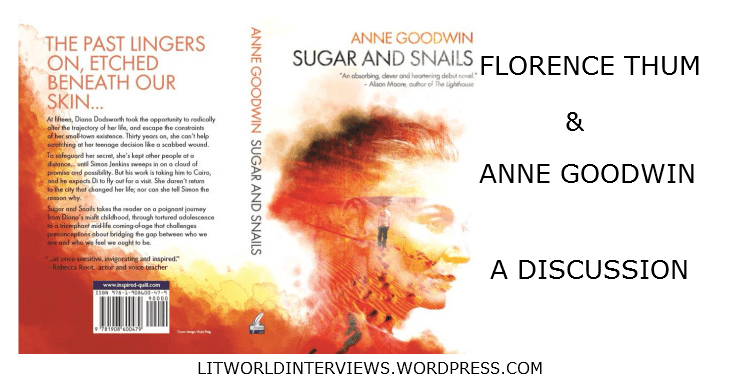
I have the privilege of interviewing author, Anne Goodwin about her debut novel ‘Sugar and Snails’, of which I did a review here on LitWorldInterviews.
To cut a long story short, Anne thought it would be good idea for someone who is associated with psychology to review her book, and I couldn’t be happier to do so. Of course, after reading ‘Sugar and Snails’, I do have a few questions for Anne.
So here goes:
An interview with ‘Sugar and Snails’ author, Anne Goodwin
Anne, what an incredibly thought-provoking book. I guess readers will want to know how you come to conceive the idea/theme for ‘Sugar and Snails’?
Thank you, Florence. I’m not totally sure where the idea came from – I think these things can lurk in our subconscious for quite some time – but there seem to have been three strands, which I have written about in more detail elsewhere: taking almost half a lifetime to figure out my own difficult adolescence; an awareness that many competent professionals have hidden vulnerabilities; and the discovery, part way through a long overseas trip, that an administrative error had led to my travelling on a passport that had registered me as male.
Find out about Anne’s difficult adolescence here. Look here for Anne’s take on the vulnerabilities we harbour. And finally, Anne registered as a male? Look here for what she means.
Your bio states you worked as a clinical psychologist in the UK for some 25 years. What was your area of practice or expertise as a clinical psychologist? When and how did you come to study psychology? And with mathematics?
I specialised in working with adults with severe and enduring mental health problems, often psychosis (Diana’s methodology for researching adolescent decision-making actually comes from a study of psychosis). Many of those I worked with were in residential care, which sparked my interest in organisational dynamics, so I did some additional training in psychoanalytic approaches to organisational consultancy.
I went to university straight from school at eighteen without a clear sense of what I wanted to study. In Britain, you’re expected to specialise early on, but I hadn’t had much guidance. I began studying languages but, being rather shy, I struggled with the spoken side, but eventually found the right place for me in the combination of psychology and mathematics. I liked the fact that in the former “the answer” is always provisional, while in mathematics, if you follow the logical process, you get to the correct solution. I loved reviving these subjects for ‘Sugar and Snails’, making Diana a psychologist and her best friend, Venus, a mathematician.
While maths is conceptual, it is easy to assume there is ‘the’ answer. Perhaps that is where its similarities lay with psychology – we must remember the factors and variables involved in the psychological makeup of a person. It is indeed fascinating to compare the different approaches Venus and Diana have to problem solving, to life in general.
How has your work experience assisted in writing ‘Sugar and Snails’?
As a basic level, it gave me an insight into Diana’s job as well as her, somewhat disastrous, experience of the health service. Yet, when I first answered this question in a Q&A, I didn’t fully appreciate quite how much my professional background has helped. But, having returned to this question after the one on research (below), I realise that the capacity to empathise with lives very different to one’s own is second nature to anyone who has worked therapeutically, as it is to the experienced writer of fiction. Although I was nervous that insiders might doubt my character’s authenticity, my work experience gave me the confidence to give it a go.
I can appreciate this. You certainly haven’t inundated the book with psychological profiling of each of the characters. And to think I wasn’t the first to ask this of you? 🙂 Here is Anne’s interview with Carys Bray on Blogger.
Next, how much research did you have to do for ‘Sugar and Snails’? What did you research?
I probably didn’t do half as much as I ought to have done! There’s a “secret” page on my website that lists my main background reading on attachment, gender and adolescence, although some of this I would have read anyway. I had to check out some legal and medical detail regarding Diana’s situation, but mostly I proceeded on the basis of imagination and intuition. Then I was lucky to have experts-by-experience among my prepublication readers who I hope would have flagged had I got anything drastically wrong.
Are the locations in the book real places, and if so, which are familiar to you and why?
The contemporary strand is set in the city of Newcastle, where I went to university and lived for twenty years; I might have used poetic licence, but the backdrop to Diana’s adult life is very real. The small town where she grew up was imagined, but the country walk she recalls taking with her father is one I’ve trod frequently.
Check out Anne’s interview with Geoff le Pard regarding the country walk.
And why Egypt? Do I sense a certain personal ‘love affair’ with Egypt?
My research suggested Diana could have gone to Casablanca but, never having been there, I crossed my fingers and used a setting in another part of North Africa. While I enjoyed revisiting my memories of a month-long visit twenty years before, many of the Cairean scenes were cut from the final version, so I’m pleased my affection for the place still comes through.
Find out here the scenes of Cairo which were cut from the book A photograph Anne shares.
I am intrigued by the nature of Diana’s relationship with Geraldine which isn’t exactly explained. Is it intentional? If not, what is it?
Mmm, I’m intrigued by your being intrigued, although another reviewer did comment she didn’t quite “get” it. I think their early childhood relationship is quite intense, assuch friendshipsoften are, with Geraldine initially the more “knowing” of the two, using the relationship to explore her own sexual and gender identity. When, at secondary school, she becomes more conscious of social norms, she distances herself from the “oddball”, but still enjoys having power over another child who’ll do anything for her. When they meet again as adults, Geraldine has moved on in a way that Diana hasn’t. I find that quite poignant.
It is indeed poignant, especially when I see how Geraldine is now leading a ‘normal’ internal life while Diana’s somewhat stuck. Yet the book also highlights to me how the world would see them in such a different light.
When did you begin writing ‘Sugar and Snails’? Describe the writing journey from beginning to getting it published – as well as getting the book to us, the readers.
I started it in 2008, filled with confidence aftercompleting a long-distance walk, but it took many drafts to get it right, partly because I didn’t realise what acomplex task I’d set myself, followed bytwo years to find and sign with a publisher(and, yes, I’m still waiting for a couple of agents who enthusiastically asked for the full manuscript to get back to me). So seven years from inception to publication, which felt inordinately long when I was in the thick of it, less so now I’m through to the other side.
When did you get the writing bug? Describe the circumstances which led you to first put pen to paper as a writer?
Now this is an example to follow – at least one day a week 🙂
I note the contribution from book sales to Gendered Intelligence. What is your relationship with this organisation? Why do you support Gendered Intelligence?
As a social enterprise, Inspired Quill is committed to improving community well-being. Although a new venture, theirpledge to give ten percent of profits from book salesto selected charities is part of that.Gendered Intelligence is the perfect fit for Sugar and Snails because Diana would have been saved a lot of grief had she been able to draw on the kind of support they offer young people who are gender variant today.
What message, if any, would you wish ‘Sugar and Snails’ to convey regarding the important issues of gender and sexuality?
Be open todiverse ways of beinghuman in yourself and others; I truly believe it will make the world a better place. But I think fear of difference is also part of being human and acknowledging our discomfort can be a step towards transforming it into empathy rather than hate. Fiction can help with this process by offering a safe space in which to be curious about difference.
Let’s end on a lighter note. Describe your writing spot and how it came about.
My writing space has extended over the years and I now have the luxury of not just an entire desk to myself, buta room I’m only intermittently obliged to share with my husband. We have a rather large house and I dread to think of what I’ll do with all my books if we ever downsize.
What is your beverage of choice when writing? You may be as specific as you wish.
Because I use voice-activated software, I need to drink a lot to protect my throat. I tend to drinka variety of herbal teas throughout the day, often just a sprig of sage, lemon balm, mint, fennel or rosemary from the garden doused in boiling water. I also like very weak lapsang souchong with a slice of lime. You must be thirsty yourself after all these questions. Could I offer you a cup?
Most certainly. I drink green tea for its clear crisp flavour. It’s a psychological trigger for me to relax, usually at the end of the day. I need a strong coffee to wake me up in the morning.
Thank you, Anne for your time and sharing your writing with us. I have thoroughtly enjoyed reading ‘Sugar and Snails’ . Wishing you the best in your writing endeavours, and a positive outcome as you wait to hear from publishers.
*******************************
My review of Anne’s book ‘Sugar and Snails’ is here.
I don’t know you, but I have recently been attending many webinars, on different topics. Recently (22nd October) I attended a free webinar organised by Jane Friedman that had Jerry Jenkins (21 times New York Times best selling author) as guest, on the Secrets of Storytelling.
I’ve read, listened to, and attended courses, lectures and seminars, on writing. And like all advice, some will resonate more with some people than others. Although the seminar seemed geared towards people who were trying to find their confidence writing (if there ever comes such a time) rather than seasoned scribblers, I enjoyed the personal wisdom and Jerry’s style of delivery, and I thought I’d try and bring you some nuggets from it, especially as I know that quite a few people are going for NaNoWriMo. I decided to try and make it less boring with images, but we shall see if it works…
Although most are self-explanatory, I thought I’d give a few pointers on some.
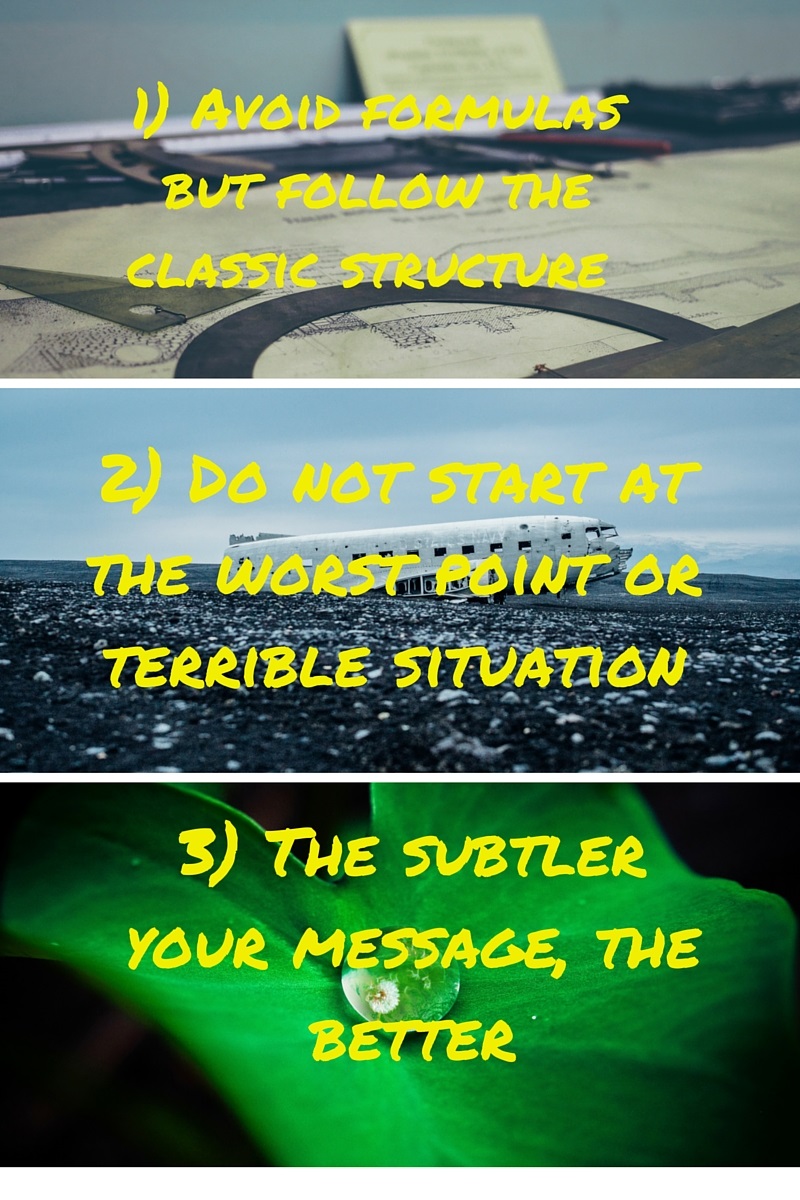
Jerry Jenkins said that formulas don’t really work, as they make the story seem… well, formulaic, I guess. He referred to Dean Koontz How to Write Best Selling Fiction when talking about the classic structure. His brief summary was: Plunge your character into a terrible situation; everything he tries to do makes the situation worse; things look hopeless, and hero saves the day (by doing what he’s learned on the way).
In reference to his previous point, he said that although you have to put your characters in extreme situations, it’s best not to start the novel at that point, because it’s better to build up the character so that the reader gets to care for him or her (or them).
I think it’s self-explanatory. Don’t hit the readers in the head with a hammer, although for him, there’s always a message, otherwise there’s no novel.
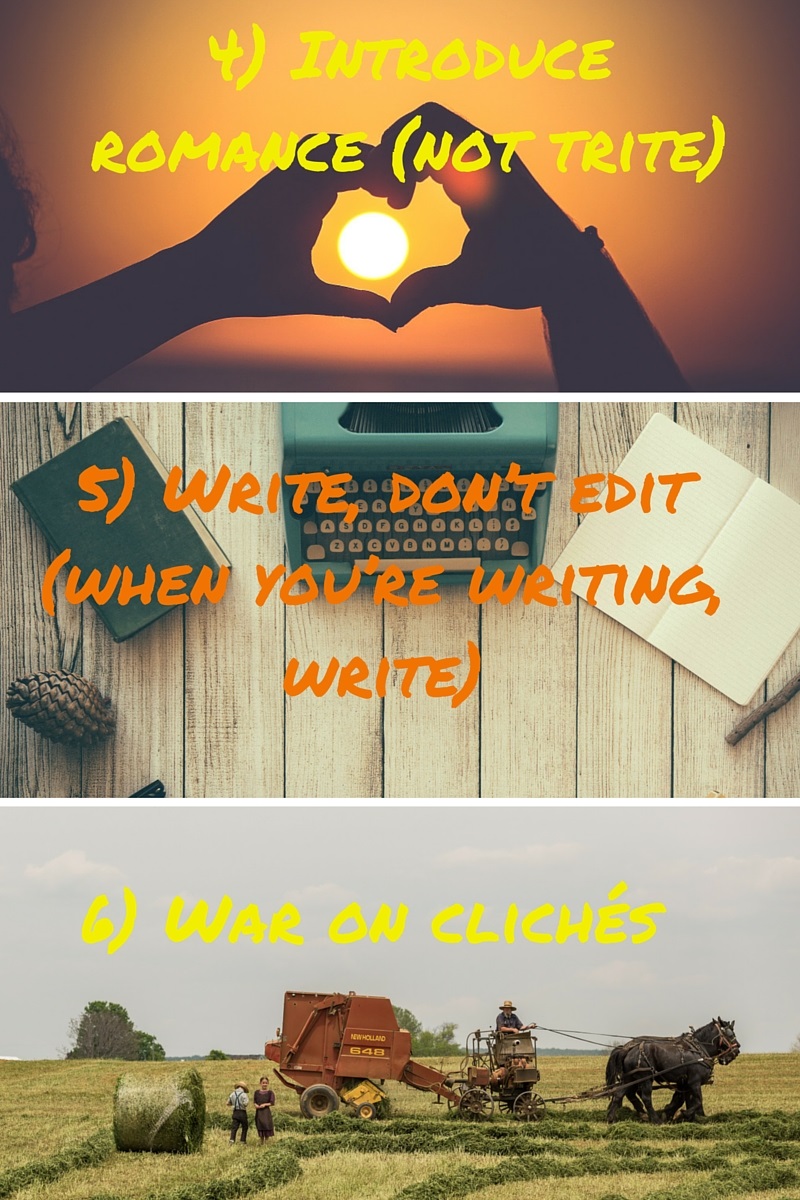
There isn’t always romance in all novels (or movies, it might depend on genre) but it’s very common. He gave many examples of not very original ways of introducing the love interest (although referring to movies, characters bumping into each other, blind date…), but it all depends on how it’s done.
His advice, that I’ve seen in many places, is that it’s best to get the story down once you get writing, and not try to edit at the same time. He said that he’d edit first thing the next day what he’d written the previous day. In the case of NaNoWriMo, unless your brain goes completely blank and can’t remember what you’ve written, it’s probably best to keep going…
Nothing to add (unless it’s a peculiarity of a character).
I couldn’t find a colour that would show well, so I’m transcribing: Writers are readers. Read in your genre, but also read about the craft of writing. He mentioned quite a few of his favourite books, but the world (or the library) is your oyster.
In discussing point of view of the character he reminded the audience that it’s like the camera we see the action through. He mentioned the most common (first person narrated in past tense, or third person limited), and noted that perhaps for somebody starting to write, first person might be easier. He talked about his own experience of struggling with one of his stories and how he heard a particular character talking in the first person in his head, and that was it.
This is a very personal take on the matter, but he observed that sometimes other characters in the story might take over and run with it.
He didn’t seem to be a big lover of flashbacks explaining the background story, as he felt they slowed down the action. In real life we get to know people gradually.
This one sounds a bit zen, but he referred to himself as a pantser, and said that sometimes you might get to a certain ending through writing the story, and that’s a perfect way to make sure that it’s surprising to the reader, because it’s a surprise to you too.
If you’re worried, you’re on the right track. He referred to this as the ‘Exponential multiplication of emotions’ equation. If you feel sad at some point in your story, the reader will feel the same but magnified. And if you feel bored… well, you get the gist.
You’re not alone. His message was that if you get stuck, there are many places where you can get help, be it virtual or real writers’ groups (his comments were invaluable but…), coaches, books, other writers…
He offers courses, including one he was promoting, later in October, but you can check his page and that of Jane for more information if you’re an interested (I have no connection with them other than attending the webinar, that was free).
Thanks to Jane Friedman and Jerry Jenkins for the the webinar and thanks to you all for reading. Do take care, and good writing.
Series is the new black. It seems like everyone is writing them these days. Having a published series of books is a great way to keep readers interest for long enough to have them remember your name, actively seek you out, sign up for your newsletter, or ask to be advised by Amazon when you publish a new book. I’ll be publishing the second and third books in my series at the same time either late December or early January. In retrospect I think that publishing the first book on its own was a mistake, which is why I haven’t tried to sell it so far. The time for readers to buy books in a series is directly after reading one of them, so it’s better to publish three at the same time to begin with. My book one will really only get properly launched with two and three, so most of the readers who read it before will probably have been lost. It’s so exciting to publish your first book, but for me from now on three books at the same time will be the procedure for series. After that I think you can safely add one at a time. Possibly you already have the material for a series in a book you’ve already published though, and maybe even whole plotlines for future stories in the outtakes.
Writing a series is really worth considering as an Indie. Readers love revisiting characters they love, so while they might not be tempted to buy a totally different novel written by you, if they’ve fallen in love with a certain story they will almost certainly be willing to buy some more of it. I know that I for one get quite sad when I finish a book wanting more of those lovely folk between its covers, but knowing that I’ll never meet them again. Why not turn your standalone novel into a series of standalone books? Same people and places, but not having to be read in sequence. Not all books would be suitable, but quite a few novels that I’ve read would definitely make for fabulous future tales. Writing more in a world that already exists would be a nice way to revive old titles in your backlist and a lot of fun because you already know all the characters, so you’re playing with old friends. All you need is a new plotline. This isn’t the same as intentionally setting out to write a series, and announcing it as such, but rather a pleasant surprise for future and current readers.
Self-publishing is a learning journey. These days there’s so much more help to be found for newbies starting out, but quite a lot of us didn’t have a clue when we first set out, so maybe some of our first books are languishing. That doesn’t mean that your only way forward is to write and promote new books. There’s no reason not to revamp your first novel, write another to follow it, and give it a relaunch at the same time. Consider giving it a brand new cover to go with its new companion, and treat it as a brand new book. That’s the great thing about being Indie. Your books don’t get moved further and further away from new releases, finally to end up in boxes in back rooms somewhere. Your backlist is always as current as you choose to make it. So dust that poor forgotten novel off, and either write more of it, or give it a makeover and a do-over launch party. Another possibility for your NaNoWriMo book this year too – have a go at a sequel.
Title: Sugar and Snails Author: Anne Goodwin Publishers: Inspired Quill (23 July 2015) Format: Paperback ISBN-10: 1908600470 ISBN-13: 978-1908600479 Website: http://annegoodwin.weebly.com/ Twitter: @annecdotist Pages: 342 Genre: Contemporary Fiction, LGBT
What’s it about?
This is a story of a woman’s journey of self-discovery.
I am introduced to Diana through the narrative of the life she’s lived, so far filled with insecurities and fears. The story begins in the present day with a confronting scene of Diana self-harming as a result of, so it seems, her partner leaving. The vivid description of her bringing a knife to her arm, after many years of abstinence, caused me to put the book down and almost not returning to it. But I did, because I wanted to know more.
What happened in Cairo? Why is it significant? What is she hiding? Why? What? How? So many more questions asked as I followed Diana Dodsworth’s life journey…from a young kid to a professor of psychology at university.
Diana’s story weaves in and out of different pasts as she held the attention of the reader, slowly and steadily divulging the story of her life. Goodwin has written real characters, not just in Diana but with each of the significant figures in Diana’s life – flawed, conflicted. As the reader, I can empathise with each of them. What are the motivations for parental love? How is one changed by childhood events? Is an adolescent capable of deciding her future? What is the value of friendship and love in shaping a life?
As a therapist, I would have loved to get greater insights and explore Diana’s psyche as she slowly comes to the realisation that she has held herself back and living in a time bubble, and that she is indeed alright. Not that it is indeed the case, or is it? I appreciate a psychological study however may not be everyone’s cup of tea. This said, my reading experience was not compromised in any way. There is enough to maintain my attention and interest. After a somewhat slow and for me, perplexing take by Goodwin in ‘jumping’ across time and events, the second half of the book provide resolutions which showed Goodwin’s skill in weaving all the threads into a coherent tapestry.
Goodwin has created an intriguing story of a person’s life, complex and filled with the confusions of a child, the pain of existence, of irrevocable decisions and the effects on the subsequent decades of her life.
Would I recommend it?
Absolutely. Mesmerising, especially the second half of the book, thought-provoking and sensitively written.
If you enjoy reading real and flawed characters set in a contemporary background with controversial issues (still!) to boot, this is the book for you (and your book club, if you belong to one).
Ratings:
Realistic Characterization: 3.5/5
Made Me Think: 4/5
Overall enjoyment: 4/5
Readability: 4/5
Recommended: 4/5
Overall Rating: 4/5
I can’t say I didn’t see it coming. Now that my book, ‘’Dancing to Irish Reel” is out, I’m being asked the inevitable question, “How much of the story is true?” Everyone who knows me personally knows I picked up and moved to the west coast of Ireland without much of a plan, and that I stayed for a year. Add that to the fact that the book is written in the first person, that the narrator’s interior monologues in the story are unabashedly confessional to the point of unnecessary risk. I’ve been told the book reads like a…
Who do you get when you combine 129 Five Star Ratings and 83 Four Star Ratings on Amazon and GoodReads? An author I met about a year ago and did a somewhat stock interview with that I’ve thankfully gotten away from.
I was newish to the arena of interviews and she was generous to say yes. The worst part was, I hadn’t had an opportunity to read her work. But now? It’s a year later, I’ve read and reviewed her latest. And here we are again with another, what I believe better interview. And I like to call us friends. Just don’t tell her that. I don’t want to get the raised eyebrow of “Say What?” from her.
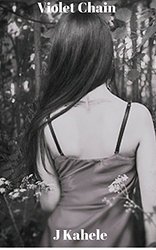
You may have read my review of her book, Violet Chain, the book we’re discussing today. I don’t think the review does the book as much justice as I might have wished for it to. The characters have great layers to them and are not one dimensional, even the supporting cast. She just writes a great annoy character that bugged me. I hope she doesn’t read that line. Now let’s talk to J. Kahele. Author and More.
Let’s start off with why did you write Violet Chain?
Believe it or not I was throwing titles around in my head and come up with this one, then decided to create a story.
After catching her fiancé cheating on her the night of their engagement party, Violet Townsend, a woman people hold in high regards in all aspects of her life, goes through a transformation of character. What do you think brings out that seemingly sudden change the way it does that finds her in the arms of the books leading man?
It is out of the norm for a woman like Violet to delve into a one night stand, but as with every women, when hurt badly by a person they love, she needed an escape from the pain and hers was Chain.
The leading man, Chain Alexander, is sucked in to this wild ride of Violet’s road to recovery. Being a man myself, thank you very much, I would like to say a few things. I’ve read the reviews. Some love him, some don’t get him. Personally I think you nailed the emotional aspects of a character caught up in this situation perfectly. How do you come to write a male character role like that? What do you draw from to give him just the right male reactions? Psychic, or great observer?
Chain was not at all the character I had in my mind for original lead. I wanted more of an alpha male type, but with Violet’s character, there was no way an alpha male would have fit well, so I guess you could say that Chain kind of was a creation from the story itself.
Some people are going to buy this book for the sex, and romance angle. If people are narrow in their thinking and stick to that, I personally believe they are missing a lot of what you’re telling. Would you tell us about the psychological aspects of both the lead characters that make them just like anyone else once you take them out of their palaces and ivory towers, metaphorically speaking of course, and how they deal with love in a damaged arena? I believe readers connect with them in a great way.
I wanted real characters that everyone could identify with, the good, the bad and so I took a lot of extra time concentrating on that. I believe Violet and Chain both have very real emotions and turmoil’s and imperfections that make them very relatable.
Crazy as it may seem, I see a lot of . . . well crazy people in this book. Not so much crazy but people with quirks and foibles. You have a good supporting cast. Speaking to those quirks and the like, do you have a leaning toward or fascination with things like OCD and personality/mental issues that seems to come through in your writing?
Haha. My husband says I’m very OCD about certain things and I believe everyone has their little quirks, don’t you?
I am not falling into the trap of answering what my foibles are. Feel like I’m being cross examined here.
I have to say that you write a great annoying character in the part of Harrison, the cheating fiancé. And honestly even in the best friends of each of the leads in their certain quirks at times which doesn’t make you not like them, but as for Harrison, how much do you use your own personal experience or that of friends when being inspired to create a character like that, not so much the cheating part but his personality and actions through the remainder of the book?
Harrison was probably the easiest character to write, yes I did use personal dislikes I had for men, when writing him.
You did great, I wanted to throw him into a wall or out a door a few times, well every time. That’s how well you made me not like him.
As I was reading Violet Chain I noticed the organic style of writing. You touched on this subject when talking about CHain Alexander earlier. By organic I mean things didn’t always go where you planned. To me that often means the story, the characters themselves, have taken over the mind of the writer and begun to tell the story. Is that how you write, you start out writing, or does it take over at some point and if so, when do you give the characters their head and let them run?
I have never had control of the characters, once I have created them, they tend to go in a direction that I don’t always like and believe it or not I try to fight it, but I think when creating characters true to life, we lose control and that isn’t so bad.
I’ve read where a lot of people are hoping for a sequel. Is that the plan?
Yes. The sequel will be out in November.
You’re quite prolific in your writing and never seem to tie yourself down to one thing. What are you working on now that your fans will be excited to hear about? Because I know from the reviews that you do have fans, not just readers.
I am currently working on the final sequel of the Mine Series and a new series that I’m not revealing yet.
A question I’ve begun to ask my authors is this, what is your favorite line from the book? I think by sharing that you somewhat give us a peek into who J. Kahele is.
I wouldn’t say there is a favorite line in the book, but I do have a favorite part. It is when Chain and Violet are saying goodbye at the restaurant and Chain is begging to see her again and she kind of leaves him hanging. I love that part a lot.
And a final question. What motivates you to put words to your thoughts and begin a book? Writers have ideas, but what is your process of deciding “This is it!”?
When the thoughts follow you everywhere you go and you can’t shake them, until you write them down on paper.
Ronovan is an author, and blogger who shares his life as an amnesiac and Chronic Pain sufferer though his blog RonovanWrites.WordPress.com. His love of poetry, authors and community through his online world has lead to a growing Weekly Haiku Challenge and the creation of LitWorldInterviews.WordPress.com, a site dedicated to book reviews, interviews and author resources. For those serious about book reviewing and interested in reviewing for the LWI site, email me at ronovanwrites (at) gmail (dot) com to begin a dialogue. It may not work out but then again it might.
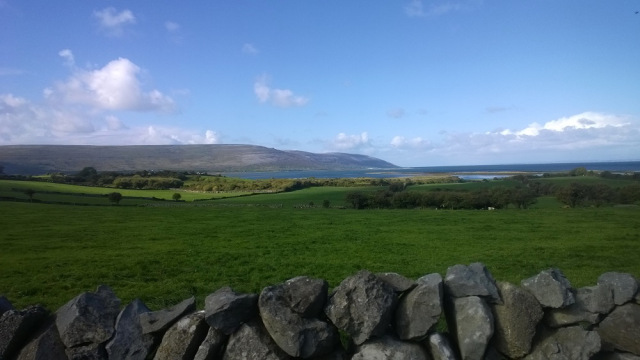
Once upon a time, I spent a year living on the west coast of Ireland, in the rural region of Inverin, while I worked thirteen miles down the coast road in Galway City. I had the best of both worlds, for Galway City is a vibrant college town with cobblestone streets in its center, where local musicians busk for change before pubs as old as the streets themselves, and locals come in from the outlying areas for the day to tend to important business. Contrarily, Inverin, Ireland is a land separated into geometric prisms by grey-stone walls leading down to the rock encrusted shores of the Atlantic on one side of the coast road and bog-land that stretches out forever on the other. Inverin is known as the gateway to Connemara, and is part of a region known as the Gaeltech, which refers to the area…
Did you know that Fangirl by Rainbow Rowell, Wool by Hugh Howey, and Water for Elephants by Sara Gruen, were all begun for one of the annual NaNoWriMo challenges? Anyone who says that NaNo is just a bit of silliness for wannabe writers might want to ponder that a while, and anyone who is finding their writing stuck or slow going right now might want to consider taking up that challenge this year. You can take it as seriously or not seriously as you like. It’s only thirty days, so the world won’t end if you don’t make your word count or if you absolutely hate what you wrote, but if you’re having trouble getting nice chunks of words down towards your WIP, this little challenge should get you going. I see that there is also a twenty percent discount to purchase Scrivener for this year’s players, so if you’ve been thinking about getting that, here’s your chance.
You can write anything you want to. It doesn’t have to be a brand new book. You can continue to write something you’ve already started, as long as you only add the newly typed sections for each day to your official word count. Only you know what you’ve typed, because NaNoWriMo don’t save your work when you go to add your daily count on the site, so it’s not possible for anyone to ever read it unless you publish it, so typos and gremlins mean absolutely nothing. In fact, the last thing you want to be doing is looking back every day over what you wrote the day before. Just zoom straight on through to the end before editing anything. Another fine lesson to learn for those of us who over edit as we write. NaNoWriMo cured me of that.
The whole premise of the NaNo is to write fifty thousand words of a novel in thirty days, which works out to roughly one thousand, six hundred and sixty seven words written per day. This is your rough draft, so it doesn’t matter if there are plot holes in there. You write around them, and then fix them later if you decide to publish the book. If you win the challenge, you get the badge for this year, and also whatever swag they have going as prizes, which can come in really handy too – like getting free CreateSpace copies if you publish your NaNo novel.
If you’re competing this year, remember to stock your freezers now with food that can just be defrosted for some November meals, and get lists done of chores that your family and friends can do to help you out for that time too. The site launches on the fifth of October. Zoom over to the NaNoWriMo site to sign up, and then create your NaNo novel project by going to My Novels under the NaNoWriMo tab from that date.
Everyone has their own way of doing a book review and in a way that is how it should be. Always remember a book review is an opinion. That being said and out of the way, I do think there needs to be some common considerations taken.
I don’t believe published book reviews on volunteer sites should:
Be for tearing down an author and that author’s work.
Nor do I think a poorly written book should be praised.
And being paid for a review just doesn’t cut it, unless you work for a site that has ads and also gets paid for the service of book reviewing like major newspapers or magazines. But that’s a job, not a volunteer thing. And even then, honesty is the best policy. For most of us, receiving a good book to review is a nice perk of book reviewing.
Poorly Written Books
Yes, I’m beginning with the tough one. I’ve read books with a great idea, but poor execution. I’ve written books like that as well. We all have to learn and we get excited to get that book out and into hands. I’ve put my novels away, come back to them months later, and found so many mistakes that I didn’t realize were there before.
Personally, I offer the author an out up front. If I read the book and the review is less than a 3 out of 5 Rating, they can choose not to have it published or go forward with it. It’s up to them. If less than a 3 and published, I will make a note I have the consent of the author to do so. This consent is a question on the LWI site Book Request Submission Form. (Why do I give this out? I feel that by putting faith in me and providing a copy of the book to me, they at least deserve that option. If I buy the book myself…I have the option to post as I see fit.)
If the author says to publish, then make certain to be professional and do not write to destroy and tear down. Your Rating will give the reader one idea of what the book is, while your words explain things. Some people want to see a reviewer go off on an author and make fun of them. You won’t find that on LWI. We’re mature adults who are teachers, professors, doctors, lawyers, authors, and university students. We take our role in the career of an author seriously.
Great Books
You have to decide ahead of time what your idea of a great book is. Some may protest at this idea, but there needs to be some reference point to go by. If you are considering F. Scott Fitzgerald or Hemingway as the great, a 5 Star read, then a 4 may be an extremely great review from you. I tend to lean this way, but I do still let the book itself stand on its own merits. I do give a 5 or a round up to a 5 from something like a 4.8 at times. But for me to do that it MUST be a great book and MUST connect with me. As always, every review is an opinion. The more books you read in the genre areas you like with a reviewer mind the more you come to recognize great writing in those areas. But then you have entertaining writing as well. Book Reviewing is not easy when you are doing it seriously.
Keep in mind that even though the book is great there still might be that something you didn’t like or that bothered you. Is it something worth sharing? Did it stay with you? If if did, then you may want to refer to it. Why? Credibility. You want your review to mean something.
Book Information
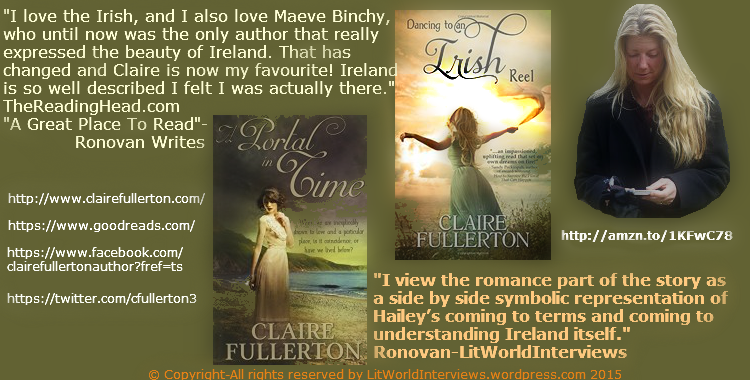
For the LitWorldInterviews site we include the basic information for the book such as Author, Title, Publisher, Publication Date, ASIN and so on. You can look at any of our Book Reviews and see our basic layout. Many Book Review sites include this information. We do add some to it, such as Author, Title, Genre, sometimes formats available and pricing (If I remember to do it on mine). You can checkout Book Review of Dancing to an Irish Reel by Claire Fullerton to see how I put a book review together and how the Book Information looks.
Author Information
A Book Review, for me, is a way to advertise for an author. Therefore, I include as many of the online ways to connect to the author as I can, and I include a profile/bio of the author.
Writing the Review
Most likely if you are reading this you are wondering what you should include in the review. There isn’t a magical formula. Things I attempt (as always depending on my memory and excitement level) to include are:
At least the basic story idea and main characters.
Things that I connected to without giving away too much of the story.
How the flow of the book is.
How engaging and immersing the story is.
If the characters and voice are authentic.
If the setting is authentic, especially if describing an actual place. (You may not know this part but if there is something described that nags at you, such as a high-rise building in the middle of a swamp, then that may be an issue for you.)
What genres the book falls into as far as you feel. A book may be classified as a Romance by a publisher but in reality be Literary Fiction that has a relationship in it, but has very little to do with what people consider as Romance.
Comparison to any big ‘stars’ of the literary world that may help people connect to the feel of the story and thus prompt a person to purchase the book.
Is it a MUST to include all of the above, or even half of the above? No. Those are suggestions, and there are plenty of other things people include. Your goal as a Book Reviewer is to give your opinion of if the book is good or not and provide enough information to send a reader off to purchase the book.
One thing to remember about Book Reviewing is to find your voice. There are a great many reviewers out there and in order for you to convey what you are wanting to say you need to say it with honesty, and that will come out as your voice. You can look here on LitWorldInterviews and see we all have different styles and voices. My style is dictated by the book and my enjoyment of it and you can easily tell by a review I have done if I truly loved a book or not before you even get to the Rating at the bottom.
A Book Review isn’t all about proper sentence structure. Sure, you want to be professional, otherwise people will wonder what do you know about reviewing a book. But you are reviewing for story, engagement, flow, and things of that nature. You are telling a story of your own when you write a review, and as James Patterson says, “Focus on the story not the sentence.”
Ronovan is an author, and blogger who shares his life as an amnesiac and Chronic Pain sufferer though his blog RonovanWrites.WordPress.com. His love of poetry, authors and community through his online world has lead to a growing Weekly Haiku Challenge and the creation of LitWorldInterviews.WordPress.com, a site dedicated to book reviews, interviews and author resources. For those serious about book reviewing and interested in reviewing for the LWI site, email me at ronovanwrites (at) gmail (dot) com to begin a dialogue. It may not work out but then again it might.
Unless you’ve been hiding under a CPU and working on your own book, then you know how much I’ve enjoyed a book called Dancing to an Irish Reel by Award Winning author Claire Fullerton. But I made a mistake with that book review. And I want to correct that up front. I wrote the review too soon after reading the book and failed to give time for reflection and full comprehension to take place. I didn’t take it all in and examine all the nuances hidden within the story. Every day since then I’ve been working on some aspect of the Claire Fullerton Experience. Yes, I call time spent working with an author an Experience like that because it does not normally end with a review and/or an interview. There is a lot more going on in the background than anyone other than one of my authors knows.
During the Experience I realized just how much Claire put in her book and how much she put in to her book. The more I think about it, the more I love the book. I don’t normally dwell very long after a review and interview, I always have the next to go to and I have since. But this would had a truth about it, a realness that one connects with and it stays with you. But before I get too carried away, unless I’m already too late, let’s get to my discussion with Claire Fullerton, Award Winning author and #1 GoodReads Irish Romance.
Claire, for a book that finds itself at times falling into the category of Romance, I have to say I was surprised by what I found with keeping that genre in mind. Did you set out to write a Romance? Was that your goal?
I’m so glad you asked this question, Ronovan. Actually, “Dancing to an Irish Reel” is literary fiction, which is a genre that means true to life. It’s a story about those near misses people experience on the road to a love that endures. I can’t think of anyone I know who hasn’t been in this situation before; where all the variables of attraction are in play, while two people are coming to know each other, yet for one reason or another, they can’t seem to get it together. But there is always such hope, and I think new love is typically replete with uncertainty. There is excitement and high hopes, yet on the flip side there is unpredictability and attendant fears. Extending oneself in new love can be risky and can leave one feeling vulnerable. It’s my belief that most people experience uncertainty and doubt when in the throes of new love, it’s just a question of to what degree they’re going to admit it! This is what “Dancing to an Irish Reel” is about. This is also why this book does not fall into the romance genre, but it does explore the subject.
Actually when I was thinking about this interview and the book I thought of real life with those moments of almost romance, or more relationship to tell the truth.
I think so as well. This is why I gave the reader Hailey’s thoughts throughout this book. I’m fascinated by the way people will say and do things in order to project a certain appearance, while thinking something completely at variance with their words and actions. I wanted the reader to know Hailey’s personality as she made her way in rural Ireland; that she saw things from an American frame of reference for much of this book, yet as the story progresses, that frame of reference was changed as she came to understand the Irish culture. I think this is what people do in life: they tend to resist what is new because their mind is already made up, but if one allows themselves to be influenced, there is much to learn!
Click Image for Amazon
The role of Hailey Crossan is a strong woman who knows who she is and what she wants. Where did those characteristics come from, as far as a model for her?
I love your use of the word role! I, too, see this book as a movie! You’ve just made my day! But seriously, and to your astute point, I know more women like Hailey Crossan than otherwise. When I consider all the close girlfriends, with whom I was lucky enough to grow up in Memphis, I realize they are all nobody’s fool. My mother was the same way. The women in my life have always been self-confident and self-reliant. They have a savvy, keen eye with regard to sizing people up. And the thing I’ve found with many of my friends is they rarely let on. They prefer to keep things close to the vest, so you have to know them for a while before you realize how aware they really are. This is how I wanted to write the character of Hailey. It was necessary that she was self- sufficient and sure of herself in order to move to another country without fear. She had to be able to hold her own in her new environment because she was a fish-out-of-water, so to speak.
I think your description of close to the vest fits Hailey well, now that I think about her. Cautious is another word that comes to mind. Recently I became a fan of a young man named Hozier, an Irish blues singer/musician/songwriter of about 26. I couldn’t help but picture him during my reading of Dancing to an Irish Reel. Did you have any images in mind, anyone in particular when you were writing Liam Hennessey?
Generally yes, but no one specifically. But I’ll use Hozier to make a point because the look of him is a good example; it is common in Ireland. There are many with dark hair and fair skin. And having lived in Ireland myself, I found the men to be subtle and beautiful, almost with a graceful, feminine quality. And those artistically attuned are the sensitive sort. This is what I had in mind when I created Liam Hennessey.
Oh, and one other thing before we move on, why that name, why Dancing to an Irish Reel?
Spiddal Pier Shore Galway Bay, Ireland
In Irish traditional music, a reel is a tune that is circular; it goes back and forth and in and out in its execution, and to the listener it may seem unstable, but it is not. A reel has a plan! The title “Dancing to an Irish Reel” is meant to evoke this concept. It refers to the push and pull of the story and the search for stability. Hailey’s navigation of Ireland as an outsider and her sometimes off, sometimes on relationship with Liam Hennessey left her in the position of having to artfully manage a shifting tide, so to speak. She had to learn the ways of the Irish culture in order to live there inconspicuously, and the unpredictability of Liam Hennessey’s actions left her constantly searching for solid ground!
I’ve seen your handling of Ireland compared to that of one of Ireland’s most famous and beloved authors the late Maeve Binchy. When you see comparisons like that what comes to mind?
With regard to Maeve Binchy, because she was Irish, she handled Irish nuances effortlessly, as a matter of course. They were not unusual to her at all, but she reveled in their specific, unique quality. With regard to Ireland, she was in it as well as of it, yet able to stand back and observe the islands peculiarity in a way that celebrated its facets. I sought to do exactly this in “Dancing to an Irish Reel” because I carry a love and appreciation for the land and its culture. I find the Irish people earthy and authentic, unpretentious and in possession of a good perspective with regard to what is important in life. They place importance on quality of life and seem to me to accept life on life’s terms, as opposed to trying to manipulate their way through it.
When you were writing the book, was it an organic experience or did you have a specific outline in mind first? And whichever way, is that the same way you wrote A Portal in Time, your previous release?
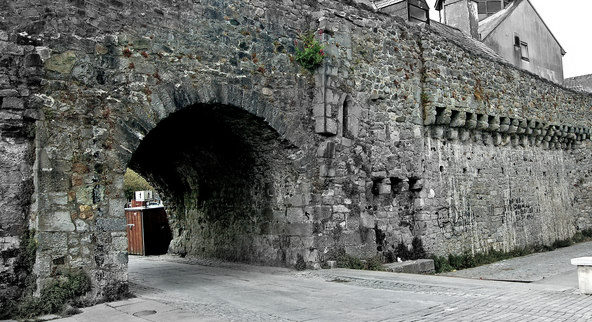
Spanish Arch Galway, Ireland
For both books, I had a point to make, as in something to say. I started with a premise as a statement then set about getting there via a story that unfolded. As for an outline, my process is very loose. I leave room for the story to tell itself, which is something best exemplified as I write dialogue. I never know ahead of time what the dialogue will be, yet I aim for information to be revealed. We learn about characters through what they say and what other characters say about them. In both books, I was mindful of the spirit of intention and had a loose outline of what was going to happen with regard to turning points. I simply held a firm impression of who the characters were to make the events in both books plausible.
Reading your book and the description of A Portal in Time, I get the feeling of your enjoyment of writing about past lives, mystical and spiritual elements. Is this something that comes natural to you, I mean as in the aspects of writing?
Click Image for Amazon
My introspection must be showing! In truth, I’m not completely decisive on the subject of past lives one way or the other, but I do love the mystery. Perhaps the idea of past lives shares a blurred line with genetic memory, who’s to say? If you consider the idea of genetic memory, what it basically proposes is that we carry the impressions and experiences of our forebears because they are past down to us through genetics like imprints. This explains inherited talents and proclivities in an understandable way. And if you look at, say, the Druids, they didn’t believe so much in past lives as they did in the transmigration of the soul, meaning we are souls gathering wisdom in this business of living on earth, but it takes many incarnations to accumulate something with staying power. We can’t just get it all in one lifetime, if the aim is enlightenment, i.e, perfection. And because it is an ongoing endeavor, the idea is we return to this earthly plane repeatedly, where we try on different hats. I think there is confusion over the idea of past-lives because it places importance on the experience of the human as opposed to the experience of the soul as it seeks alignment with the divine, however you choose to define the divine. But this subject is important, and it’s enough for me to be mindful of the question. I think Sting touched upon something beautiful when he proclaimed we are spirits in the material world, and I know he wasn’t the first to posit this, but he did make a proclamation that brought it to the public fore.
Everyone that’s read my review of your book knows I loved it, and that I suggested a sequel. We’ve talked about it and it hadn’t come to you as an idea until then. But you set it up so well with the tarot card reading of Hailey. Do you think maybe some of those outside forces were guiding your story during certain parts? Maybe they want you to take another trip to Ireland.
Actually, I have been back to Ireland since I wrote “Dancing to an Irish Reel,” and I plan on going again! As for going back to Ireland in a sequel, I never thought along those lines because “Dancing to an Irish Reel” is a self-contained story with a point to it, which is to say we make our choices in life and from them our lives are set on a consequential course. As of this interview, I am not ruling a sequel out. I’ll let Hailey decide.
Now let’s get something a little more personal. We have a lot in common. Southern. Music business. Location of living for a time. How does your time in the South influence your writing, and is that part of your heritage something that you think might have drawn you to Ireland?
Ireland and the American South share something in common, but do keep in mind that much of the American South was settled by the Scotch-Irish, so perhaps it is something inherent in the area. Both areas spawn terrific communicators in possession of the gift of the entertaining story. It is a cultural way of being in the world, and therefore something passed down to each generation. In both the South and Ireland, I’ve found extremely colorful characters, completely unabashed in personality. As for the South influencing my writing, all I can say is that I write as I think, from the internal monologue I have in my head as well as how I see the world. The South has clearly influenced this as an environment because it is my frame of reference.
What’s the most satisfying thing that has happened to you so far while you’ve been an author?
The writer’s life style. I write daily for one reason or another. It has transpired that with two books in the world and the dynamic that promotion brings therefore, that I am always writing something, and this is due to the affiliations my books have given me. Take for instance the Irish online community “The Wild Geese.” They’re a group of the most erudite, Ireland loving writers I’ve ever come across, all with the desire to communicate and share their love of the island. I contribute to this community regularly by writing pieces that appear as blog posts, but what they really are is a way to celebrate the business of what it means to be Irish! So there is that gift, but I have also spent the last two years writing my third novel, which has been a joyous process. Then, of course, I contribute to magazines. It seems I’m always writing something and sharing it, which to me is simply the high art of communication for its own sake. All this is my idea of fulfilling days with a purpose. Can’t get more satisfying than this!
Do you have a favorite line in Dancing to an Irish Reel?
Yes, it is this: “There’s a feel about Galway that you can wear around your shoulders like a cloak.” It is very true.
Thank you, Ronovan. This has been big fun! Thank you for supporting writers through your exceptional blog.
About Claire
Claire Fullerton grew up in Memphis, TN and now lives in Malibu, CA. She is the author of literary fiction, “Dancing to an Irish Reel,” which is set in Connemara, Ireland, where she once lived. She is also the author of “A Portal in Time”: A paranormal mystery that unfolds in two time periods set on California’s hauntingly beautiful Monterey Peninsula, in a little village called Carmel-by-the-Sea. Both of Claire’s novels are published by Vinspire Publishing. Claire is a three- time award winning essayist, a former newspaper columnist, a contributor to magazines including Celtic Life International and Southern Writers Magazine. She is a five-time contributor to the “Chicken Soup for the Soul” book series and can be found on Goodreads as well as the website under her name. Currently, Claire is writing her third novel, which is a Southern family saga based on her award winning essay in the 2013 San Francisco Writer’s Conference.
What is a book? Is it the paper that it’s printed on? Would it still be a book if all its pages were blank? Technically – yes it would, but it would be a book to write in rather than a book to be read. An eBook is a book. Even one day in the far future when we read by hologram or crystal brain implant, books will always be books. To some, the pleasure of reading a book includes the feel of it in their hands, and the pleasure of turning an actual page. These days I find reading eBooks a lot more pleasant, although I still enjoy paper now and then. Paper books cost more than eBooks because of the production costs, but at the end of the day what we are selling isn’t paper, it is the stories within. We need to look at eBooks for what they are – books, and give them the same love when we publish them as we would our paper books. They need everything in them that you would put in or on a paper book, and that includes a blurb. About This Book.
I’ve mentioned this before in passing, but I think it deserves its own conversation. When you buy a paper book, you look on the back to see what it’s about. If it’s by an author that you recognise and love there will be the familiar titles that you’ve read in the first pages of it to nudge your memory. When you take that book home and put it on your bookshelf to read later, it will still have those things many months later when you’ve forgotten all about buying it amongst your other pile of book purchases if you’re a voracious reader, as most writers are. If for some reason the book description were to completely disappear, possibly it’s not written by an author you know, you’ve totally forgotten what it was about, and all you’re left with is cover art, would you choose to read it straight away rather than another book with all that about the book information still there?
We need to stop thinking of eBooks as not real because they’re not physical in the real sense of the word. I actually think that they are physical in the real sense of the word. A book isn’t about the packaging it comes in. Whether it’s hardback, paperback, or written in flowing longhand on individual toilet paper sheets smuggled out of a prison, a book is the story. It’s the reading of it that counts. I love reading on my Kindle – I love reading on my Kindle for PC more – such a lovely big page with lovely non-eye straining print. I don’t love eBooks not having About This Book pages, and because of my book hoarding tendencies I’m pretty sure that I’m missing out on some fabulous reads, not to mention wasting a pile of money buying books that I know I’ll love at the time, but don’t have the time to invest in finding out about what they’re about when I’m looking for a read months later. Fair enough, I do have over a thousand books downloaded, and a thousand odd more on my cloud reader, but I’m sure so do a lot of other avid readers.
When I open an interesting looking read on my Kindle, I want to know what it’s about. I also want future readers of my own books not passing over them because they’ve forgotten why they bought them. It’s a simple matter of copying and pasting your book blurb into a dedicated page of your front matter with the heading About This Book that might give you a better chance of your books being read, especially if you have it on free or discounted promotions. That’s when we hit the download button to keep for later. I’m always finding books that I’ve bought a couple of years ago at full price that I have to go back to their Amazon pages to read the blurb before I know if I feel like reading them at the time, and most of the time when I’m looking for a new read I don’t do that – I just move on to the next book. It might be well worth your while to head over to Amazon and reload your eBooks with their blurbs added if you don’t already do this.
Beta Readers needed by author Viv Drewa for the following. Please contact her at the-owl-lady(at)att(dot)net with interest. She is a great supporter of Indie Authors.
MIDNIGHT OWL
(A Joe Leverette Mystery)
Book 1
By Viv Drewa
When the dismembered body of a young woman is found Detectives Joe Leverette and Philip
Marsden are assigned the case. After investigating the Port Huron, Michigan area where the six body
parts were found there’s a twist in the case: The murderer goes after each individual who found the parts,
Leverette becomes interested in one of the women, Carole Sage, a sensitive, but because of the
case he’s not able to take it any further. Everyone on the police force sees his infatuation, but Carole
Each of the six witnesses has a dream about the murderer removing the particular body part they
found the night. They are startled awake and hear an owl hoot three times. None of them want to reveal
Carole sees the actual murder and each murder as it happens to the witnesses. The police chief,
Billingsley, understands her ‘gift’ and sets up a sting to catch him. It fails and they have to regroup to think
of something else. Two witnesses are dead and they don’t want a third to die.
Maddison Wood is a Watcher, a mercenary warrior, appointed by the Race Alliance to serve within a specific hunter cell after the Demonic War in which the mortal realm was destroyed. Demons, part of the Fractured, are a group of lost souls who continue to roam the earth and refuse to leave. The Fractured are the ones responsible for the Demonic War. They have one goal and that is to destroy those that belong to the higher realms.
London has lost its appeal and people are afraid to leave the inner confines of the city. Maddison’s responsibilities are to protect and serve the Fallen; guardian angels who have fallen to Earth to prepare for the next insurrection. Maddison Wood is a witch, the first of her kind appointed to such an honor.
An unlikely alliance forms with a Witch, a Hympe, a Guardian Angel, and a Prime
Maddison, along with her side-kick, Donovan, a mercenary warrior Hympe whose gifts are that of an empath, has been assigned a new mission. Donovan is a formidable ally to Maddison’s team. Once he opens up to a connection through his sense of touch he can find out everything they needed to know about an entity. A rare gift, indeed.
Zara, one of the select guardian angels, who also possesses empathic powers, has taken the fall and Maddison and Donovan are sworn to protect her and guide her through her transition. Her soul must be protected at all costs. With the help of Obadiah, a Prime who is a “God” of epic proportions who has also fallen, the group takes on Draco, the leader of the Fractured, and the original lost soul.
Recommendation:
“The Fallen,” is an action-packed journey into a post-apocalyptic alternate reality where angels and demons clash in an age-old battle between good and evil. I was immediately caught up in the lore of the creatures and of the detailed society of the Race Alliance that fought against the tyranny of The Fractured.
I found the battle scenes to be completely realistic and believable. A few times, I think I caught the glint of steel in my eyes from the knife wielding Maddison, as she battled the demons that pursued the group. Having served in the military myself, I could identify with the character of Maddison, portrayed as a strong, confident and capable woman fulfilling her destiny as a soldier. Maddison is full of rich humor and a true delight as a character.
This was my first experience with Melissa Barker-Simpson’s writing. I was not disappointed. She weaves a tale of suspense and intrigue that leaves you wanting more of this story and the characters she has crafted. Subtle hints are left as to the future direction of the story line, spread like breadcrumbs along a path, urging the reader to continue on the mysterious trek with the characters in the hope of winning the war. I look forward to the next book in the Fractured Series because I suspect, there is more excitement lurking in the dark recesses of this author’s mind.
Author, Melissa Barker-Simpson
Character Believability: 4.5 Flow and Pace: 5 Reader Engagement: 4.5 Reader Enrichment: 4.5 Reader Enjoyment: 4.5 Overall Rate:4.5 About Melissa Barker-Simpson:
I’ve been writing since, well…since I was knee-high to a grasshopper. I often look back on those earlier stories, and apart from laughing at the heavy-handed drama, or cringing at my inexperience, I am reminded that I have always lived in other worlds.
My first novel was published in 2008, and I love nothing more than working on a new project. The voices inside my head invariably pull me in different directions, so although I try to work on one thing at a time, those who know me would tell you it doesn’t always work!
I have a full-time job which, though does not involve writing per se, incorporates my love of language. As a British Sign Language Interpreter, I get to translate information between two languages which is (mostly) fun.
I have two beautiful daughters who bring me great joy. They also keep me grounded, because otherwise I would have my head in the clouds permanently!
Make certain to connect with Melissa Barker-Simpson through her Twitter @mbarkersimpson
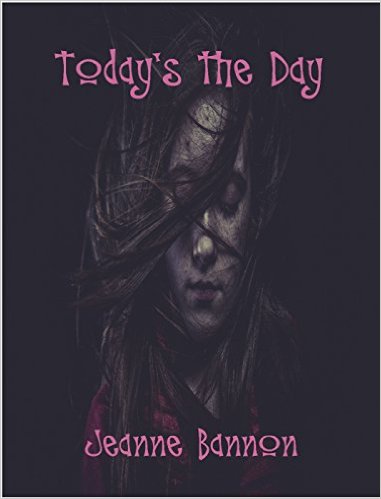
I always like repeat offenders. I mean that as in previously interviewed authors by LWI who come back for more punishment. Today I have the amazing honor of Jeanne Bannon joining me. You may have read my review of her short story Today’s the Day to be released September 15, 2015 but pre-order now. At .99 it’s more than worth it. Bargain time! It may not be my usual fare but she handles the story so well I enjoyed it and you can read about it by clicking here.
Since I’ve interviewed Jeanne before when her book Nowhere to Run was released, I thought I would simply ask a couple of questions to go along with the previous interview and give you a bit of a mix about her.
One thing about Jeanne’s writing the shocks me is you first take a look at her, the author, and then think “She writes this stuff? What is going on inside the wonderful head of hers?” I mean I see a nice, pleasant person who would write beautiful Romances or Mysteries and I get make-me-want-to-pee-my-pants evil stuff. Still trying to figure that one out.
How different is it for you to write a short story, the difficulties or ease as opposed to a full length novel?
In some respects, writing a short story is much more difficult than crafting a novel. It’s more difficult to develop characters and a storyline with a limited number of words/pages. With a short story, details have to be left out, in other words, it’s more of a cut to the chase scenario. I think it’s more difficult to write a satisfying ending to a short story than a novel since there’s not the luxury of time to build the believability factor of your story. However, I do enjoy writing short stories and novellas after completing a novel. It keeps me writing and it’s still satisfying to see a project come to fruition.
The story set to be released on September 15th, Today’s the Day, is an extended version of a story I wrote a few years back titled The Search for Trisha Campbell. It’s about a girl who goes missing on Halloween and the unfortunate police officer who finds her. I’d often thought of that story and wondered about the protagonist, officer John Galloway. What kind of man was he? These thoughts led to my doubling the length of the original and when a call for submissions for short stories was put out by my publisher,Solstice Publishing, I thought Today’s the Day would be a perfect fit. And it’s great timing – scary stuff with Halloween around the corner.
Who would you say, as in the commonly known superstar authors, your writing might be compared to?
Dare I say Stephen King? I’m not worthy of the comparison but he is my greatest influence. Today’s the Day is not for the YA crowd. There’s blood and gore along with a big of mystery. It was fun to write. I love to craft gut wrenching scenes – ala Stephen King, I suppose.
I want to say that the Stephen King comparison may just be about right. She is not overboard with the horror in her story, but gives just enough for you to get freaked out at the right times and keeps you a bit uncomfortable as well. So Stephen King? Yeah, I see it.
Maybe explaining how you came to be a writer might help explain where the ‘pleasant-not-Stephen-King-crazed-looking-woman’ turned the corner to write what you do.
I’ve always written. I can’t remember a time when I didn’t. I remember writing a bunch of poems in grade one and my teacher graciously transforming it into a book by stapling the pages into a folder and letting me decorate the front cover. Then she put it in our classroom library. I believe that was the time when I decided I wanted to keep writing. I’d gotten attention and some accolades. It was pretty nice. I do have a degree in journalism, but I’m not sure that makes me a writer. I’ve also worked in the publishing industry as an editor for over twenty years. Perhaps I’m a writer because I’m a reader first and foremost. My parents were readers and would leave paperbacks sitting around the house. I remember being curious about the books and started to read them. I was hooked after reading Cain and Abel by Jeffery Archer at the ripe old age of eleven. Then I moved on to Sidney Sheldon novels, lol.
I think how your book Nowhere to Run got its name would be interesting to our readers as well as to aspiring authors.
The title Nowhere to Run was not the original title. I’d titled it Love, Lies, and Redemption but the publisher decided the story needed a title that would better reflect the suspenseful elements of the novel and asked me to come up with a list of five alternatives. Nowhere to Run was on that list and that was the one they chose.
You have another venture outside of writing your books. Tell us about it.
I’ve recently begun actively seeking out freelance editing/proofreading work.
And if I understand correctly that’s something you have over 25 years experience doing and now want more clients?
That’s right.
I think you are insane but I checked out your Editorial Services page. Very nice. I may be looking your way sooner than later. Here are a few testimonials about her services.
“Jeanne is a very careful, precise copy editor who knows Word backwards. She is excellent at formatting and has years of experience. She also excels at evaluating mss., and structural editing of fiction.” –Sheila Dalton, author
“I have known and shared writing experiences with Jeanne Bannon for over seven years. She always impresses me with her dedication and professional work ethics. I prize her skills as an editor and proofreader. I have personally relied upon her talent and good nature in assisting me in preparing short stories from a variety of authors for inclusion in an anthology called Storyhole. I strongly endorse her to anyone seeking copy edit or proofreading help for their publication.”–C. Lee Brown, sci-fi/fantasy author
“I have been a published author since 2010. English and I have never been friends. I’m not a good editor/proofreader and I am always guilty of head hopping and verb usage, just to name a few. Jeanne Bannon is a person who has saved my stories. She has the eye and the knowledge to spot any incorrect usage of the English language.
Jeanne is a true professional and gets my work back to me in a timely manner. Because I am thankful to have found such an experienced editor/proofreader, I would recommend her to anybody!”–P.A. Estelle, author
And with that we end our visit with Jeanne Bannon, Author, Editorial Goddess and more. Click her book covers below and get her books. Varied in genre, just like when you see Jeanne, you’ll be surprised at what you get. Go NOW and BUY!!!
I’ve worked in the publishing industry for over twenty-five years, first as a freelance journalist, then as an in-house editor for LexisNexis. I currently work as a freelance editor and writer and am represented by the Serendipity Literary Agency.
My debut novel, Invisible, a young adult paranormal romance, was published by Solstice Publishing in 2011 and was subsequently optioned for film. Invisible is an Amazon bestseller both domestically and internationally.
In 2014, Nowhere to Run, a romantic thriller was published by Etopia Press. This past winter, I tried my hand at self-publishing with a paranormal romance novella, Beautiful Monster, The Exchange (Book One). I had a lot of fun writing and promoting my novella and am currently finishing up work on the second in the Beautiful Monster series.
Ronovan is an author, and blogger who shares his life as an amnesiac and Chronic Pain sufferer though his blog RonovanWrites.WordPress.com. His love of poetry, authors and community through his online world has lead to a growing Weekly Haiku Challenge and the creation of a site dedicated to book reviews, interviews and author resources known as LitWorldInterviews.WordPress.com.
Before I get to the money talk, I’ve updated the post on Creating NCX Table of Contents because in Amazon’s acceptable eBook files to upload, they now say that only MOBI files generated using their own software will be accepted. This is just as easy to do now – easier in fact, so I’ve changed the instructions, and will change the screenshots as quickly as I can.
Yesterday saw Amazon announce that the Kindle Scout programme will be available to writers worldwide and not only in the US. This means that anyone can now submit a previously unpublished novel for voting on by readers for a chance at a $1 500 advance and a fifty percent royalty rate, with a five year publishing contract and Amazon advertising. With readers voting rather than trying to storm the mostly unread traditional slush piles, this is a great way for Indies to spread their publishing wings.
Now to the cash problem. Only authors in the United States and certain other countries are eligible for royalty payments by electronic funds transfer. This means that those not eligible get their royalties in the form of paper cheques every time they have one hundred dollars in their Amazon accounts. Bank charges on cashing these are high, and they take ages to clear. Rather than getting paid that way, why not get yourself a Payoneer account instead? It’s very easy to do.
Go to the Payoneer site and register. They then post you a pay as you go credit card. Once you get this card in the mail, you activate it online following their step by step instructions. You will be issued with your own US cheque account details. Next, you click on the button to request that you be allowed to receive payments in the US. Payoneer will request that you upload your identification. Load up a PDF copy of your passport or identity document, and after a short wait you’ll be approved.
Log on to your Amazon account and select EFT as the method for you to receive your royalties. Fill in the exact details that you have for your US account and click save. Within a few days you’ll start getting emails from Amazon letting you know that payment has been made, and Payoneer email you too when the funds arrive.
To draw your cash just use the card at any ATM in your country, or use it the same as you would any other credit card online or in stores – as long as you have money in it that is. Payoneer charges are just under thirty dollars a year, although once your balance reaches a hundred dollars they gift you with twenty five dollars, so your first year comes cheap. The cash withdrawal fee is three dollars, but these charges are still way below what the bank will take converting the paper cheque.
Any other US companies that pay by EFT can pay you this way too. So if you sell art or anything else online in America your earnings are easy and convenient to get to like this.
It’s easy to get daunted by the vast quantities of books published on Amazon every day, and also by some successful author’s suggestions that you shouldn’t be trying to charge for your books if your work has not been approved by legitimate traditional gatekeepers. Why bother putting in all the hard work of writing books if they’re just going to be buried by the millions, or trashed by the literati?
Why you should definitely bother is because of what self-publishing is. People who buy books from Amazon are fully aware that the vast majority of them are by Indie authors, and they’re going to be pretty sure that they want any given book before they pay for it. Not every book you write is going to be great. I never figured out what the point was to Stephen King’s The Girl Who Loved Tom Gordon, so writing every book that you write that everyone will love is not something that even the greats can do.
The rules are that anyone can publish on Amazon and nobody has the right to try and prevent you from doing just that. Obviously we’re not going to purposely publish a book that is going to get trashed, because when we write books we’re doing it to make for pleasurable reading. If we do slip up and readers hate what we’ve written we can unpublish that book and try harder to get it right next time.
Before the advent of self-publishing, I would say that I absolutely loved about twenty percent of the traditionally published books that I bought. Some I liked. Some were just so-so, and some I disliked so much I never finished reading them. I paid for all of those books, but I never once thought I was entitled to a refund. If they’d been totally full of typos and illegible I would have though, so that’s not what I’m talking about here. I’m talking about the actual stories.
Of the Indie books I’ve bought I’ve actually loved more than twenty percent and liked most of them. Only a small percentage have been typo riddled or illegible. Indies try harder to perfect their end product, and should not be discouraged by negative talk from any author, no matter how popular their own books are. Fair is fair, and every single writer fresh out of the gates is just as entitled to their own publishing journey.
Don’t let this sort of thing put you off Indie scribblers, and don’t feel that you have to submit your book for years and receive a hundred rejection slips before you share your tales with the world. Produce the best book that you can, and let your readers decide. This is a great time to be a self-published writer, and everyone has to start somewhere. Keep your eye on the prize, and write on. Never let the naysayers steal your mojo.
Since sites like Amazon gave the general public the opportunity to review any book they have read, what many still fail to understand, or indeed appreciate, is the difference between writing a review and what amounts to a critique.
***
Here is a typical example of a professional newspaper review:
The Secret History of the Blitz by Joshua Levine, review: ‘tunnels behind clichés’.
Next is an example of a critique by an individual who quite simply failed to appreciate the book they read:
A second weakness in Frankl’s writing is in the assumptions he sometimes makes to prove his point. He makes overarching generalizations several times in his book, making statements that, although may have been true for himself and those around him, might not have been true for every prisoner in every concentration camp during the Holocaust. For example, in one instance, he says, “The prisoner of Auschwitz …





















 Lit World Interviews