Series is the new black. It seems like everyone is writing them these days. Having a published series of books is a great way to keep readers interest for long enough to have them remember your name, actively seek you out, sign up for your newsletter, or ask to be advised by Amazon when you publish a new book. I’ll be publishing the second and third books in my series at the same time either late December or early January. In retrospect I think that publishing the first book on its own was a mistake, which is why I haven’t tried to sell it so far. The time for readers to buy books in a series is directly after reading one of them, so it’s better to publish three at the same time to begin with. My book one will really only get properly launched with two and three, so most of the readers who read it before will probably have been lost. It’s so exciting to publish your first book, but for me from now on three books at the same time will be the procedure for series. After that I think you can safely add one at a time. Possibly you already have the material for a series in a book you’ve already published though, and maybe even whole plotlines for future stories in the outtakes.
Writing a series is really worth considering as an Indie. Readers love revisiting characters they love, so while they might not be tempted to buy a totally different novel written by you, if they’ve fallen in love with a certain story they will almost certainly be willing to buy some more of it. I know that I for one get quite sad when I finish a book wanting more of those lovely folk between its covers, but knowing that I’ll never meet them again. Why not turn your standalone novel into a series of standalone books? Same people and places, but not having to be read in sequence. Not all books would be suitable, but quite a few novels that I’ve read would definitely make for fabulous future tales. Writing more in a world that already exists would be a nice way to revive old titles in your backlist and a lot of fun because you already know all the characters, so you’re playing with old friends. All you need is a new plotline. This isn’t the same as intentionally setting out to write a series, and announcing it as such, but rather a pleasant surprise for future and current readers.
Self-publishing is a learning journey. These days there’s so much more help to be found for newbies starting out, but quite a lot of us didn’t have a clue when we first set out, so maybe some of our first books are languishing. That doesn’t mean that your only way forward is to write and promote new books. There’s no reason not to revamp your first novel, write another to follow it, and give it a relaunch at the same time. Consider giving it a brand new cover to go with its new companion, and treat it as a brand new book. That’s the great thing about being Indie. Your books don’t get moved further and further away from new releases, finally to end up in boxes in back rooms somewhere. Your backlist is always as current as you choose to make it. So dust that poor forgotten novel off, and either write more of it, or give it a makeover and a do-over launch party. Another possibility for your NaNoWriMo book this year too – have a go at a sequel.
Title: Sugar and Snails Author: Anne Goodwin Publishers: Inspired Quill (23 July 2015) Format: Paperback ISBN-10: 1908600470 ISBN-13: 978-1908600479 Website: http://annegoodwin.weebly.com/ Twitter: @annecdotist Pages: 342 Genre: Contemporary Fiction, LGBT
What’s it about?
This is a story of a woman’s journey of self-discovery.
I am introduced to Diana through the narrative of the life she’s lived, so far filled with insecurities and fears. The story begins in the present day with a confronting scene of Diana self-harming as a result of, so it seems, her partner leaving. The vivid description of her bringing a knife to her arm, after many years of abstinence, caused me to put the book down and almost not returning to it. But I did, because I wanted to know more.
What happened in Cairo? Why is it significant? What is she hiding? Why? What? How? So many more questions asked as I followed Diana Dodsworth’s life journey…from a young kid to a professor of psychology at university.
Diana’s story weaves in and out of different pasts as she held the attention of the reader, slowly and steadily divulging the story of her life. Goodwin has written real characters, not just in Diana but with each of the significant figures in Diana’s life – flawed, conflicted. As the reader, I can empathise with each of them. What are the motivations for parental love? How is one changed by childhood events? Is an adolescent capable of deciding her future? What is the value of friendship and love in shaping a life?
As a therapist, I would have loved to get greater insights and explore Diana’s psyche as she slowly comes to the realisation that she has held herself back and living in a time bubble, and that she is indeed alright. Not that it is indeed the case, or is it? I appreciate a psychological study however may not be everyone’s cup of tea. This said, my reading experience was not compromised in any way. There is enough to maintain my attention and interest. After a somewhat slow and for me, perplexing take by Goodwin in ‘jumping’ across time and events, the second half of the book provide resolutions which showed Goodwin’s skill in weaving all the threads into a coherent tapestry.
Goodwin has created an intriguing story of a person’s life, complex and filled with the confusions of a child, the pain of existence, of irrevocable decisions and the effects on the subsequent decades of her life.
Would I recommend it?
Absolutely. Mesmerising, especially the second half of the book, thought-provoking and sensitively written.
If you enjoy reading real and flawed characters set in a contemporary background with controversial issues (still!) to boot, this is the book for you (and your book club, if you belong to one).
Ratings:
Realistic Characterization: 3.5/5
Made Me Think: 4/5
Overall enjoyment: 4/5
Readability: 4/5
Recommended: 4/5
Overall Rating: 4/5
It’s that time of the year, or almost. November. Writing 50,000 words in one month. We cringe at the thought, but have you ever thought how many words you write on your blogs, social media, and just general messing around online? Think about it that way and you would be surprised how books you’ve written. Here’s a way to get focused, bear down, and get it done. WITH SUPPORT.
Here on LWI we’re going to have a page dedicated to NaNoWriMo. There will be inspirational posts you can comment on and receive feedback and support. If you need a pep talk, we’re here for you. Whenever we find something great we’ll share it and it will show under that dedicated page. So you visit here and click the NaNoWriMo tab/page in the menu and there you are. Our resident guru of Indie Authorship suggested we do something. I might be taking it over the top but I shoot for the unknown galaxies and your bound to hit a star somewhere along the way.
To start us off, here is an article from Writer’s Digest by Jessica Strawser. The beginning blurb is below, then click the HERE to go to juicy parts.
“Sometimes it’s a lone writer who’s been putting off a story idea for too long, and decides it’s now or never. Sometimes it’s a pair or a group determined to find out what they can achieve by sharing self-imposed deadlines and strong pots of coffee. Sometimes it’s peer pressure or curiosity about National Novel Writing Month (NaNoWriMo.org), that challenge that rallies ever-increasing numbers of writers around the globe every November to band together in pursuit of a 50,000-word “win.”
Book-in-a-month challenges take all forms, fueled by all stripes of writers with all manner of motivations—make the most of that time alone in a borrowed cabin, hunker down for the winter, stop procrastinating, have something ready to pitch at that conference, prove to yourself you can do it, prove to someone else you can do it, get a fresh start—and in this hyperconnected age of 24-hour fingertip resources and networks, of tiny portable keyboards and glow-in-the-dark screens, they’re more popular than ever.”
For the rest of the article and the 30 Tips, click HERE.
Editor of Writer’s Digest magazine | debut novel, ALMOST MISSED YOU, coming from @StMartinsPress in 2017 | mother of two | book lover | repped by agent @bpoelle
About the Finder of the Article and a Winner of NaNoWriMo 2014!
Ronovan is an author, blogger and former educator who shares his life as an amnesiac and Chronic Pain sufferer though his blog RonovanWrites.WordPress.com. His love of poetry, authors and community through his online world has lead to a growing Weekly Haiku Challenge and the creation of LitWorldInterviews.WordPress.com, a site dedicated to book reviews, interviews and author resources. For those serious about book reviewing and interested in reviewing for the LWI site, email Ronovan at ronovanwrites (at) gmail (dot) com to begin a dialogue. It may not work out but then again it might.
Genres: Action, Adventure, Thriller, Suspense, War
I received a copy of this book for an honest review and I’m glad I did.
Levant Mirage takes snapshots from the headlines of the past few years to build a character and combines it with frighteningly realistic possibilities to give a story you pray never happens.
35 year old U.S. Army Major Adam Michaels is no James Bond, nor did he ever set out to be. What is he? He’s a man who rejects the easy path that being the heir to a shipping empire gives him in order to join the military, serve his country, and be a father. Right, no money other than what he makes as a Major in the Army. You don’t see jet flying, limousine riding, womanizing and all of that. I would trade in the 10 year old Corolla for something a little better though. Tap into the trust fund already.
Finding himself used as a scapegoat for a foreign relations nightmare, Michaels works out his days in the Pentagon pushing papers, and paying alimony, child support and the mortgage on his rising political star ex-wife’s house. You see the everyday life to some extent leading up to the changes in life the military can throw at you. You don’t control you in the Army. And there are times when that twists the guts out of Michaels.
Michaels is of a dubious parentage, with his father not being who he thought he was, but upon finding out explains a great deal. This in part leads to his choice of path in life. He wants to be his own man. He doesn’t want to be identified with a past that isn’t really what he thought it was.
But part of that past comes back in one night and changes a quiet world into a search to find the defense against a missile guidance system he created that is now in the hands of terrorists. Which terrorists? Who is the enemy? You won’t believe it. Or you will believe it but be surprised.
The believability of Levant Mirage is what makes it so freakin’ scary at times. Perhaps the guidance system isn’t real, or I hope it’s not. But I’m sure there is something like it out there. The enemy Michaels must fight against is out of this world. If he fails, billions die. If he succeeds?
Chase writes with detail and a knowledge base that gives the story realism. You are able to submerse yourself into Levant Mirage and you don’t get pulled out by oddities and unbelievable scenes. Some scenes are high energy and amped up, but still possible.
Being honest, the amount of detail is incredible at times and I could have done with a little less of the technological speak, but it doesn’t take away from the story. In truth, it adds the believability—you don’t have these leaps from action to intellect in the span of a few seconds. Okay, maybe you do but for a whole different reason, but I’m not giving those parts away. Ah, that does remind me of one scene that did cause me pause and have to reread in order to get it clear. In part, that was due to the surprise of those involved.
I enjoyed the handling of the terrorists. As you read you’ll develop ideas but never get to comfortable, you never know what is going to happen next, who is going to happen, or what the truth is until it’s almost too late. But there are clues along the way.
Recommendation
I would recommend Levant Mirage to those who like believable action thrillers. Clive Cussler’s Dirk Pitt and other NUMA series books come to mind, but not that fantastical or off the charts. Where Cussler takes you over the edge of believability at times, Chase keeps you here on earth and scares the life out of you with reality you can find in your neighbors living room.
Character Believability: 4 Flow and Pace: 4 Reader Engagement: 4 Reader Enrichment: 4 Reader Enjoyment: 4 Overall Rate:4
Share this Review to Support this Author.
About the Author
Oliver spent five years in a police department working narcotics and SWAT, and the next 22 in the FBI. Now he’s the author of Marsh Island, Blind Marsh, the first two installments of the Hirebomber Series. And now Levant Mirage, releasing Oct. 15, 2015.
Ronovan is an author, blogger and former educator who shares his life as an amnesiac and Chronic Pain sufferer though his blog RonovanWrites.WordPress.com. His love of poetry, authors and community through his online world has lead to a growing Weekly Haiku Challenge and the creation of LitWorldInterviews.WordPress.com, a site dedicated to book reviews, interviews and author resources. For those serious about book reviewing and interested in reviewing for the LWI site, email Ronovan at ronovanwrites (at) gmail (dot) com to begin a dialogue. It may not work out but then again it might.
I’m organising more interviews and in the meantime, I thought I’d share some reviews of book by independent authors that I’ve read while I was away. I have plenty to choose from, but I chose to talk about Conditions today, not only because I’ve enjoyed Christoph Fischer’s writing in the past, and he is always hard at work promoting other writers, but because I saw that his new book, Conditioned, the continuation of the adventures of those characters will be on the 16th October and is already available in pre-order. So, what better?
Title: Conditions Author: Christoph Fischer ASIN: B00NZ1VTBU Published: 16th October 2014 Pages: 224 Genre: Family life
Body of review:
Conditions by Christoph Fischer
Conditions by Christoph Fischer
When Charles and Tony’s mother dies the estranged brothers must struggle to pick up the pieces, particularly so given that one of them is mentally challenged and the other bitter about his place within the family.
The conflict is drawn out over materialistic issues, but there are other underlying problems which go to the heart of what it means to be part of a family which, in one way or another. has cast one aside.
Prejudice, misconceptions and the human condition in all forms feature in this contemporary drama revolving around a group of people who attend the subsequent funeral at the British South Coast.
Meet flamboyant gardener Charles, loner Simon, selfless psychic Elaine, narcissistic body-builder Edgar, Martha and her version of unconditional love and many others as they try to deal with the event and its aftermath.
Here is my review:
I’m a psychiatrist, and what is normal and how we define normality are questions that the more one works in the field, the more one wonders about. Absence of a diagnosable mental illness is not the same as what society might think as “normal behaviour”. And each individual’s opinion on the matter is even more varied. Culture shock, for instance, results from differences in what is accepted behaviour in countries far apart (although not necessarily as far as we might think). Being transplanted into a culture or a situation brand new for us might make us question if our version of normal is the correct one. Even what might be normal for our neighbours we might consider utterly bizarre.
The author of this novel explores the reactions to a character, Charles, who has a psychiatric condition (a mental disorder unspecified in the book), by a number of people, including relatives (his brother and sister-in-law), close friends and acquaintances, complete strangers and previous employers. Charles’s diagnosis is left intentionally vague (we can speculate, based on the description of his behaviours, but that is not the point of the story. Charles’s behaviour is peculiar and bizarre at times, but he does not appear to be a danger to others and most of the time remains capable of making his own decisions and explaining himself, although not always) probably to avoid the temptation of turning the book into an apologia or a treatise to defend the sufferers of a particular illness or disorder. It is not about one set of symptoms or even one character, but it reflects back to us some of the standard reactions to people who might be affected by such a disorder. Are they really unable to do a day’s work, or is it all an excuse? Are they telling the truth or are they making up stories to get attention? Why should they be treated differently and given special privileges when they aren’t pulling their weight? Are they just exploiting the system? Should they just be locked up?
The novel is written in the third person, at times by an omniscient narrator that shares the internal thoughts of some of the many characters, at times the third person narrator simply shares what is happening, without taking any specific point of view, but rather that of an objective observer. That contrast allows us to get a better understanding of the psychological make-up and reasons behind some of the characters’ reactions, and we can compare those reactions to the facts.
Although we never get to see things from Charles’s perspective, we hear the stories of his friends (some closer than other) who are gathered, at the beginning of the book, to help him and accompany him on the occasion of his mother’s funeral. There are a number of works of fiction where a funeral brings people together to discuss the deceased, and in the process discover the true selves of those in attendance, although here, there is less discussion of Rose, the mother, and more of Charles. And also of the rest of the guests. We get to learn about them, their relationships (or lack of them), their sexuality, their weaknesses, their beliefs and interests, mostly through their conversations. All the characters have interesting backgrounds, lives and stories, and we become as curious about them as they are about each other. And we want to learn more. There is plenty of dialogue and not much description or narration. It struck me that this book would make a great play with many juicy parts for talented actors and actresses.
When we get to know both his friends and those who aren’t that close to Charles, we come to understand that all of them (and by extension, also us) have their own conditions, and we shouldn’t be so quick to judge. Even the most enlightened of us can have prejudices and misjudge others if we are not open and refuse to take them on their own terms.
Conditions has a fascinating array of characters and is a book that will make all readers think. I believe there is or will be a second part that will follow some of the characters’ stories. I’m looking forward to it. This is the second book I’ve read by this writer and I’m happy that he has so many books available and of varied styles and genres. I’ll keep reading him, enjoying his stories and watching his career.
Ratings: Realistic Characterization: 4.5/5 Made Me Think: 5/5 Overall enjoyment: 4.5/5 Readability: 4.5/5 Recommended: 5/5 Overall Rating: 5/5
Buy it at: Amazon Format & Pricing: Paperback: $8.99 Kindle: $3.71
And now, here is a link to the cover reveal of Conditioned where you can get more information from the horse’s mouth:
CONDITIONED dives back into the world of gardener Charles, his friends and the state of his mental health – one year on. We meet loner Simon and his battle with the outside world, co-dependent Martha and her abusive husband Clive, neurotic poet Catherine on the verge of getting married, Tony, who finds his strange brother Charles a challenge, psychic Elaine looking for a new direction in life and quirky widow Sarah Roseberg who has a go at sorting out all of their problems.
CONDITIONS aimed to sensitise readers and make them think about tolerance and acceptance. CONDITIONED wants readers to look beyond their attitude towards Conditions and examine what we all do and what we can do to overcome our challenges. The sequel is another snapshot of this circle of friends. Some will have improved their lives, others will not.
I can’t wait!
You can also follow news about Christoph’s books, here.
And check out his blog, where he writes about the characters and also about why he decided to write about mental health issues.
Thanks to Christoph for your book, thanks to you all for reading, and if you’ve enjoyed it, you know what to do, like, share, comment and CLICK! And I’ll keep you updated!
I can’t say I didn’t see it coming. Now that my book, ‘’Dancing to Irish Reel” is out, I’m being asked the inevitable question, “How much of the story is true?” Everyone who knows me personally knows I picked up and moved to the west coast of Ireland without much of a plan, and that I stayed for a year. Add that to the fact that the book is written in the first person, that the narrator’s interior monologues in the story are unabashedly confessional to the point of unnecessary risk. I’ve been told the book reads like a…
Hetta Coffey is a sassy Texan with a snazzy yacht, and she’s not afraid to use it!
A globe-trotting engineer with attitude, a penchant for trouble, and a yacht, Hetta is back, and this time she’s steering us into hot Mexican waters. Miffed that vacation plans with her chronically absent boyfriend, Jenks Jenkins, have gone awry, she accepts a job in Baja.
So what, if she and her friend Jan are spectacularly unqualified to take her yacht on a thousand-mile cruise in the eastern Pacific Ocean during hurricane season?
Hiring a handsome, if somewhat fishy captain for the trip might keep them off the rocks, but probably won’t do the same for her future with Jenks. Meanwhile, a little eye candy on board can’t be all bad.
Hetta’s fierce independence impels her to tackle a very profitable (if environmentally and politically incorrect) project south of the border. True to form, her irreverent nature and disregard for danger soon swamps her in a sea of mayhem, illegal aliens, a pesky whale, and a menacing Mexican machinator.
Set sail for Baja Mexico’s Magdalena Bay as Hetta Coffey leads us once more into a morass of intrigue that will keep you laughing, breathless, and wanting more.
Top Most Useful Review
“When I finished the first book in the series, I realized I had Hetta withdrawals. I hurried to Amazon and purchased Just Add Salt. I would advise reading the first book first because it supplies the background – where it all began. But I enjoyed the second book even more than the first. There is danger from the get-go and tension on every page. I love a mystery with a touch of romance, and this book has it all. What it doesn’t have is over-the-top graphic violence or explicit sex. The Hetta Coffey mysteries are a refreshing change and I look forward to reading more. “– Laurie Hanan, author of the Louise Golden Hawaiian mysteries
P.S. BARTLETT WITH HER SHORT NOVELLAIVORY DAWN
A PREQUEL TO HER AWARD WINNING BLUE DIAMOND: THE RAZOR’S EDGE
Ivory Shepard didn’t want to be a pirate when she grew up but she didn’t plan on being orphaned and alone at thirteen with her three cousins either. After a Spanish raid in Charles Towne left them with nothing, Ivory held her cousins together, trained them to fight for their lives and led them to a life of quiet refuge on the banks of the Ashley River. Believing they were out of reach of the hands of unscrupulous men, they found life on the farm a tolerable substitute for the traditional alternatives life would force onto them—until the night the pirates showed up. Unfortunately for the pirates, these handy young women were ready, and they weren’t going anywhere without a fight.
Top Most Useful Review
“The last thing he will see is my eyes before the Devil welcomes him home.” Oh, how I missed you Ivory! This was my second read by P.S. Bartlett and she doesn’t know the meaning of disappointment! Thank you so much for sending me a file, you made my day! This short story is a prequel of my first read, Demons & Pearls, and it was fascinating to learn how Ivory got granted passage onto Barclay’s ship. I must admit, that I missed him too. I only got a short time with him on the last book but I’m glad I got a little more of his banter with Ivory in this one. This was a hilarious quick read and I love how the bond these women have is as strong as ever. They seem to be extensions of themselves and they trust each other completely which is easily seen. Only con is that it’s too short, but that’s just because I will never get enough of Ivory and her adventures! I can’t wait to read more. I am addicted to pirate stories now!”-Cassandra Carpio-Serious Book Reviewer. Her Site.
Hetta Coffey is a sassy Texan with a snazzy yacht, and she’s not afraid to use it!
A globe-trotting engineer with attitude, a penchant for trouble, and a yacht, Hetta is back, and this time she’s steering us into hot Mexican waters. Miffed that vacation plans with her chronically absent boyfriend, Jenks Jenkins, have gone awry, she accepts a job in Baja.
So what, if she and her friend Jan are spectacularly unqualified to take her yacht on a thousand-mile cruise in the eastern Pacific Ocean during hurricane season?
Hiring a handsome, if somewhat fishy captain for the trip might keep them off the rocks, but probably won’t do the same for her future with Jenks. Meanwhile, a little eye candy on board can’t be all bad.
Hetta’s fierce independence impels her to tackle a very profitable (if environmentally and politically incorrect) project south of the border. True to form, her irreverent nature and disregard for danger soon swamps her in a sea of mayhem, illegal aliens, a pesky whale, and a menacing Mexican machinator.
Set sail for Baja Mexico’s Magdalena Bay as Hetta Coffey leads us once more into a morass of intrigue that will keep you laughing, breathless, and wanting more.
Top Most Useful Review
“When I finished the first book in the series, I realized I had Hetta withdrawals. I hurried to Amazon and purchased Just Add Salt. I would advise reading the first book first because it supplies the background – where it all began. But I enjoyed the second book even more than the first. There is danger from the get-go and tension on every page. I love a mystery with a touch of romance, and this book has it all. What it doesn’t have is over-the-top graphic violence or explicit sex. The Hetta Coffey mysteries are a refreshing change and I look forward to reading more. “– Laurie Hanan, author of the Louise Golden Hawaiian mysteries
P.S. BARTLETT WITH HER SHORT NOVELLAIVORY DAWN
A PREQUEL TO HER AWARD WINNING BLUE DIAMOND: THE RAZOR’S EDGE
Ivory Shepard didn’t want to be a pirate when she grew up but she didn’t plan on being orphaned and alone at thirteen with her three cousins either. After a Spanish raid in Charles Towne left them with nothing, Ivory held her cousins together, trained them to fight for their lives and led them to a life of quiet refuge on the banks of the Ashley River. Believing they were out of reach of the hands of unscrupulous men, they found life on the farm a tolerable substitute for the traditional alternatives life would force onto them—until the night the pirates showed up. Unfortunately for the pirates, these handy young women were ready, and they weren’t going anywhere without a fight.
Top Most Useful Review
“The last thing he will see is my eyes before the Devil welcomes him home.” Oh, how I missed you Ivory! This was my second read by P.S. Bartlett and she doesn’t know the meaning of disappointment! Thank you so much for sending me a file, you made my day! This short story is a prequel of my first read, Demons & Pearls, and it was fascinating to learn how Ivory got granted passage onto Barclay’s ship. I must admit, that I missed him too. I only got a short time with him on the last book but I’m glad I got a little more of his banter with Ivory in this one. This was a hilarious quick read and I love how the bond these women have is as strong as ever. They seem to be extensions of themselves and they trust each other completely which is easily seen. Only con is that it’s too short, but that’s just because I will never get enough of Ivory and her adventures! I can’t wait to read more. I am addicted to pirate stories now!”-Cassandra Carpio-Serious Book Reviewer. Her Site.
These next few weeks leading up to November will have lots of newbie scribblers looking for inspiration and writing advice. Some authors kindly share their secrets to their success, and it’s always a good idea, and fascinating too, to read up on the different paths that led to famous writer’s successes, but not so much a good idea to stubbornly follow anyone else’s rules, without first finding out your own. They know the road to their success, but that won’t necessarily be the road to yours. We all develop our own patterns and habits over time by writing the way we naturally do. Certainly, try out various techniques, but at the end of the day, follow your own instinctive processes – write the way that makes you happy. Find your own comfort zone – you’ll know when you’re there.
Outlines work for some authors, and they might go so far as to say that you can’t write a cohesive tale without one. I sometimes do outline, but mostly I don’t. I only have an outline for my science-fiction series, but it changes so constantly and dramatically as the characters show me what’s really going to happen, that I wonder if the time I spent creating it was a waste of time. Looking at a couple of famous authors – Dean R Koonz never, ever outlines. He says that he starts with two interesting characters and a brief premise, and that character development is never a separate task. He says that for him, plotting resolves itself in the process of writing. Me too. He doesn’t write the whole book before editing though, and revises it pretty minutely as he goes along, so by the time he’s done, he’s pretty much done. I don’t revise much as I go along, which works for me. He’s also known for writing for twelve hours straight through, without eating lunch. Owie! Occasionally yes, but no way every day for me. These things work for him, very well indeed, but they probably won’t work for everyone.
Stephen King also doesn’t outline. In his book, On Writing, he says, “I often have an idea what the outcome may be, but I have never demanded of a set of characters that they do things my way. On the contrary. I want them to do things their way.” I personally agree with him. My writing comfort zone is typing the first sentence, and then seeing where my characters go. I have written a few outlines, but for some reason they always end up being forgotten. What works for me, or any other writer, doesn’t matter though, if you prefer knowing exactly where you want your story to go. The best advice here is to outline if you want to, but if you don’t, then enjoy that crazy trip of allowing your story to happen to you. Another quote from our dear Steve. “Writing fiction, especially a long work of fiction, can be a difficult, lonely job; it’s like crossing the Atlantic Ocean in a bathtub.” This is especially true. Writing your stories comes from you. It’s not a group activity with absolute written in stone rules. Follow your own rules.
One final bit of Stephen King writing trivia. He consistently writes ten pages a day (two thousand words) and will not allow himself to stop for the day until he has those words down unless there is a dire emergency. This isn’t as hard as it seems once you get into the habit actually, and more is easy too when you find yourself on a fabulous roll. Dean Wesley Smith suggests that an average word count of five and a half thousand words per day is doable, writing for eight hours a day every day for five days a week, and that he in fact knows writers who do this. In this case I would imagine that an outline really would be essential. He’s talking about writers of pulp fiction though, who strove to churn out their stories really quickly to support themselves. I wouldn’t want to put myself through this sort of thing at all, so I follow my own pace, and my own rules.
I wouldn’t agonise too much about creating an in-depth outline, unless you particularly want to, for this year’s NaNoWriMo if you’re doing the challenge. Have your general idea, plonk your characters down on the page, and let them show you the way.
Who do you get when you combine 129 Five Star Ratings and 83 Four Star Ratings on Amazon and GoodReads? An author I met about a year ago and did a somewhat stock interview with that I’ve thankfully gotten away from.
I was newish to the arena of interviews and she was generous to say yes. The worst part was, I hadn’t had an opportunity to read her work. But now? It’s a year later, I’ve read and reviewed her latest. And here we are again with another, what I believe better interview. And I like to call us friends. Just don’t tell her that. I don’t want to get the raised eyebrow of “Say What?” from her.
You may have read my review of her book, Violet Chain, the book we’re discussing today. I don’t think the review does the book as much justice as I might have wished for it to. The characters have great layers to them and are not one dimensional, even the supporting cast. She just writes a great annoy character that bugged me. I hope she doesn’t read that line. Now let’s talk to J. Kahele. Author and More.
Let’s start off with why did you write Violet Chain?
Believe it or not I was throwing titles around in my head and come up with this one, then decided to create a story.
After catching her fiancé cheating on her the night of their engagement party, Violet Townsend, a woman people hold in high regards in all aspects of her life, goes through a transformation of character. What do you think brings out that seemingly sudden change the way it does that finds her in the arms of the books leading man?
It is out of the norm for a woman like Violet to delve into a one night stand, but as with every women, when hurt badly by a person they love, she needed an escape from the pain and hers was Chain.
The leading man, Chain Alexander, is sucked in to this wild ride of Violet’s road to recovery. Being a man myself, thank you very much, I would like to say a few things. I’ve read the reviews. Some love him, some don’t get him. Personally I think you nailed the emotional aspects of a character caught up in this situation perfectly. How do you come to write a male character role like that? What do you draw from to give him just the right male reactions? Psychic, or great observer?
Chain was not at all the character I had in my mind for original lead. I wanted more of an alpha male type, but with Violet’s character, there was no way an alpha male would have fit well, so I guess you could say that Chain kind of was a creation from the story itself.
Some people are going to buy this book for the sex, and romance angle. If people are narrow in their thinking and stick to that, I personally believe they are missing a lot of what you’re telling. Would you tell us about the psychological aspects of both the lead characters that make them just like anyone else once you take them out of their palaces and ivory towers, metaphorically speaking of course, and how they deal with love in a damaged arena? I believe readers connect with them in a great way.
I wanted real characters that everyone could identify with, the good, the bad and so I took a lot of extra time concentrating on that. I believe Violet and Chain both have very real emotions and turmoil’s and imperfections that make them very relatable.
Crazy as it may seem, I see a lot of . . . well crazy people in this book. Not so much crazy but people with quirks and foibles. You have a good supporting cast. Speaking to those quirks and the like, do you have a leaning toward or fascination with things like OCD and personality/mental issues that seems to come through in your writing?
Haha. My husband says I’m very OCD about certain things and I believe everyone has their little quirks, don’t you?
I am not falling into the trap of answering what my foibles are. Feel like I’m being cross examined here.
I have to say that you write a great annoying character in the part of Harrison, the cheating fiancé. And honestly even in the best friends of each of the leads in their certain quirks at times which doesn’t make you not like them, but as for Harrison, how much do you use your own personal experience or that of friends when being inspired to create a character like that, not so much the cheating part but his personality and actions through the remainder of the book?
Harrison was probably the easiest character to write, yes I did use personal dislikes I had for men, when writing him.
You did great, I wanted to throw him into a wall or out a door a few times, well every time. That’s how well you made me not like him.
As I was reading Violet Chain I noticed the organic style of writing. You touched on this subject when talking about CHain Alexander earlier. By organic I mean things didn’t always go where you planned. To me that often means the story, the characters themselves, have taken over the mind of the writer and begun to tell the story. Is that how you write, you start out writing, or does it take over at some point and if so, when do you give the characters their head and let them run?
I have never had control of the characters, once I have created them, they tend to go in a direction that I don’t always like and believe it or not I try to fight it, but I think when creating characters true to life, we lose control and that isn’t so bad.
I’ve read where a lot of people are hoping for a sequel. Is that the plan?
Yes. The sequel will be out in November.
You’re quite prolific in your writing and never seem to tie yourself down to one thing. What are you working on now that your fans will be excited to hear about? Because I know from the reviews that you do have fans, not just readers.
I am currently working on the final sequel of the Mine Series and a new series that I’m not revealing yet.
A question I’ve begun to ask my authors is this, what is your favorite line from the book? I think by sharing that you somewhat give us a peek into who J. Kahele is.
I wouldn’t say there is a favorite line in the book, but I do have a favorite part. It is when Chain and Violet are saying goodbye at the restaurant and Chain is begging to see her again and she kind of leaves him hanging. I love that part a lot.
And a final question. What motivates you to put words to your thoughts and begin a book? Writers have ideas, but what is your process of deciding “This is it!”?
When the thoughts follow you everywhere you go and you can’t shake them, until you write them down on paper.
Ronovan is an author, and blogger who shares his life as an amnesiac and Chronic Pain sufferer though his blog RonovanWrites.WordPress.com. His love of poetry, authors and community through his online world has lead to a growing Weekly Haiku Challenge and the creation of LitWorldInterviews.WordPress.com, a site dedicated to book reviews, interviews and author resources. For those serious about book reviewing and interested in reviewing for the LWI site, email me at ronovanwrites (at) gmail (dot) com to begin a dialogue. It may not work out but then again it might.
Once upon a time, I spent a year living on the west coast of Ireland, in the rural region of Inverin, while I worked thirteen miles down the coast road in Galway City. I had the best of both worlds, for Galway City is a vibrant college town with cobblestone streets in its center, where local musicians busk for change before pubs as old as the streets themselves, and locals come in from the outlying areas for the day to tend to important business. Contrarily, Inverin, Ireland is a land separated into geometric prisms by grey-stone walls leading down to the rock encrusted shores of the Atlantic on one side of the coast road and bog-land that stretches out forever on the other. Inverin is known as the gateway to Connemara, and is part of a region known as the Gaeltech, which refers to the area…
As promised, today I bring you an interview. If you remember, I brought you Lola Mariné’s book, Havana Jazz Club when it was in pre-order and being shared in Net Galley for early reviews. Now that it has been published, it’s a great chance to have a chat with the author. First, a little information about her:
Author Lola Mariné
Lola Mariné is a writer and has a degree in Psychology.
She has taken part in four anthologies of short-stories: Tiempo de Recreo (2008), Dejad que os cuenta algo (2009), Atmósferas (2009) in aid of the Foundation Vicente Ferrer, and Tardes del Laberinto (2011).
Nunca fuimos a Katmandú (We Never Went to Katmandú), her first novel, was published by Viceversa in 2010. Two years later, the author published the e-book herself in Amazon and it became one of the bestselling books in Amazon Spain in 2012.
Gatos por los tejados (Cats on the roof), a book of short stories on varied subjects, was published in 2012 through Amazon.
Habana Jazz Club (Havana Jazz Club) , her second novel, was published in Amazon in 2013 and has been recently translated by AmazonCrossing to English and German.
In 2014 Parnass Publishers launched her book on travel Nepal, cerca de las estrellas (Nepal, close to the stars), also translated to English.
And in 2015 she published a children’s book called Aburrilandia, el país sin libros (Boredomland, the country with no books). She has also recently entered the second Amazon contest for independent books written in Spanish with a thriller El caparazón de la tortuga (The tortoiseshell) that is one of the five finalists. The winner will be announced on the 15th of October.
She is hard at work on a new novel and teaches courses on Creative Writing.
She is the creator of a cultural blog: http://gatosporlostejados.blogspot.com, and has a prominent and active presence in social networking sites like Facebook and Twitter.
And now, the interview:
When did you start writing?
I started writing when I was eight years old, more or less. Before that I would always tell stories out loud that I would invent them as I went along according to the requests of my listeners: love stories, horror, adventures… My audience used to be my friends and the other girls in the same class in school. The nuns (it was a religious school) would always ask me to tell stories to keep the class under control and quiet when we were doing sewing, crafts and those kinds of things.
I wrote my first novel when I was 12.
How have you found your experience as an independent writer?
The truth is that my first novel, Nunca fuimos a Katmandú, was first published in paper through a traditional publishing company (Viceversa). Luckily I hadn’t sold them the digital rights, and a year after its publication I decided to upload it to Amazon. It became a bestseller and it was one of the books that sold more copies in Spain in 2012. That encouraged me to carry on writing and publishing books and up to now I’ve already published seven. The last one, El caparazón de la tortuga, is a finalist in the 2015 Contest for Independent Writers in Spanish organised by Amazon.
Is there a moment you remember with special affection from your experience as a writer?
Without a doubt when I saw my first novel, Nunca fuimos a Katmandú, published. The day when it reached the bookshops we celebrated it with cava, and afterwards we went to visit the biggest bookshops in Barcelona to enjoy seeing it among the new books in the shelves and take pictures. It was one of the happiest days of my life: a dream come true.
There have also been wonderful moments in my interaction with readers: letters, comments, messages that moved me, where they explained to me their thoughts after reading the novel, their feelings and they also told me they admired my work. Writing is a lonely and uncertain job and obtaining that feedback from the readers is the best reward.
What’s your favourite genre (both as a reader and as a writer)?
I like to write the types of books I enjoy reading: basically stories about women, actual, real, what is called Women’s Fiction. Although in fact, among the seven books I’ve read there have appeared other genres; I have written a travel book (also translated to English), a children’s book and even an erotic novel, and now my last novel is a psychological thriller.
What made you decide to translate your book? And how did you find a translator?
Well, in my case it wasn’t my own decision but Amazon’s. They offered (as a publishing company) to translate Habana Jazz Club to English and German. And with that I also reply to your second question: they found me and they took care of everything.
Tell us something about your book
Havana Jazz Club by Lola Mariné
Habana Jazz Club (Havana Jazz Club, in English) is a love story, but it’s not a romantic novel. Love is force that drive the protagonist throughout her life, but it’s not only romantic love, it’s also the love she feels for her family, for her parents, her son, and her friends, and even for somebody who cannot return her love in the same way. It’s a story of fighting against the odds and courage and a little homage to the great Billie Holliday, whose name is shared by the protagonist.
Any advice for your peer writers (especially for new writers)?
The best advice I can give them is that they should be self-critical and humble. A lot has been said about the ego of the writers and probably there’s some truth in that. We all believe we have written the great work of art the world had been waiting for. But there are many and very good writers. If a publishing company (or several) rejects you, it isn’t because they know nothing about literature or they don’t like you; probably your work isn’t as good as it should be. Carry on working and never give up.
I’ve had the pleasure of reading Havana Jazz Club and I leave you my review:
Love doesn’t conquer everything but art is a great consolation
The novel Havana Jazz Club by Lola Mariné narrates the adventures of Billie, a Cuban girl, daughter of a woman who adores jazz and decides to call her Billie as an homage to Billie Holiday, despite everybody telling her that ‘it’s a boy’s name’. Billie inherits her mother’s love for music, particularly jazz music, and luckily for her, that love never disappoints her. Unfortunately, the rest…
I’ve never been to Cuba and I only know about it what I’ve read in books or watched in movies. I wouldn’t dare to comment on how realistic or not the description of Billie’s life before leaving Cuba is, but her home life is endearing and loving and shows us a close and happy family. Although we all know mothers’ are always right, unfortunately Billie ignores her mother’s advice and her mistrust, and marries a boy, who isn’t only handsome but also knows it, Orlando. Billie leaves Cuba and a big chunk of her heart there, and follows her husband, and things don’t work well for them. Billie’s story once they arrive in Spain becomes one of domestic violence and exploitation. And things only go from bad to worse, to the point when she ends up living in the streets of Barcelona, where she is rescued by her guardian angel, Armando. And when things start to look up, the men in her life continue making her miserable. And I won’t tell you anything else because you must read the novel.
Lola Mariné has written a masterful melodrama. There are irredeemable baddies, goodies as sweet as sugar, terrible suffering, and talent and music, plenty of music. There were moments when I couldn’t help reading ahead convinced of what would happen, and that it would be bad, but the same as when we’re dragged by a fast current, I couldn’t do anything else but let myself go and see if I came up, unscathed, at the other side. And despite her trials and tribulations, and the disasters that pepper her journey, or perhaps because of them, the protagonist makes her dreams come true (in a small-scale but…), and creates a family made up of people who love her because she is who she is, and not because she’s been born here or there, or because it is their duty.
The part I enjoyed the most (and I loved it all) was when towards the end, the author, first through Gerardo and later through Billie herself, reflects upon the nature of creativity, about what the really important things in life are, and the tranquillity of feeling happy and comfortable in one’s own skin, without pretending or having to worry about appearances. I hope we can all reach such a state at some point in our lives.
If you enjoy novels with a heart, with unforgettable protagonists, and the stories about self-improvement and personal achievement, I wholeheartedly recommend it to you.
Thanks so much to Lola Mariné for bringing us her novel and answering our questions. Thanks to all for you for reading, and remember to like, share, comment and CLICK!
Author:J. Kahele Title:Violet Chain File Size: 1552 KB Print Length: 243 pages Simultaneous Device Usage: Unlimited Publication Date: July 17, 2015 Sold by: Amazon Digital Services, Inc. Language: English ASIN: B011WHGT9K Text-to-Speech: Enabled Word Wise: Enabled Lending: Enabled Formats:Kindle Price: $3.99 Genres: Romance, Contemporary Fiction
As always with any Book Review, these are one person’s opinions. That includes the great, the good, and the bad.
Violet Chain is a story of two people on roads to recovery. One to recover her self-worth and identity, and the other his life as a man and not a character he plays in the playboy world he’s created.
I received this book to form questions for an upcoming interview and not to do a book review. And truthfully I wasn’t intending to do one. But one of the mottos I’ve put forth is “Read a book, write a review.” And with that in mind I could not keep from writing a review.
Violet Chain falls into the genre of Romance. Throw in some sex and you’ve got what you might think of as your typical fare these days. For me, I look underneath the surface of a story to the characters center, what’s driving them. I am not setting centric as much a I am emotional and thinking centric when I read a book.
The book starts off with Violet Townsend, the leading lady of the book, walking in on her fiancé in a sexual situation with another woman at their engagement party. For Violet, the world flips upside down and her journey begins to define herself as Violet Townsend and not the girlfriend of someone. She’s alone. She’s hurting in a deep way. This guy has messed her up emotionally and mentally. She doesn’t want a man.
Not even 48 hours passes and she meets Chain Alexander, millionaire playboy builder of malls across North America. Self-made man who likes to be in control and doesn’t know how to live any other way. That is until the night he meets his best friend’s fiance’s best friend, Violet. The two forces meet and almost everyone tries to stop the inevitable from happening.
While one person attempts to become emotionally detached, the other finds himself feeling emotions he’s never experienced before. And he can’t do a blessed thing about it. From one night stands to one woman dreams.
The characters are believable on the level in which they are played. They stay true to who and what they are as the story goes along and as the characters grow in their emotional lives. Kahele does a great job of character building and giving them layers of personality. The supporting cast is great. Some are humorous at times, some annoying, and some you think were written about people you know. And none of them are perfect. In other words, we get real, albeit on a big rich people scale.
But the rich are people to and they get just as screwed up in life as the rest of us and have to deal with it. That’s what the author Kahele has recognized. People are the same no matter what, take a relationship and just put it in a setting you want to. We can all connect with characters that are authentic on the base emotional levels.
I believe there were only a very few areas of concern with the book and that was the speed of change in Violet’s character, her apparent personality that is pointed to throughout the book differs greatly from this new Violet that we see. I kind of see how it works being that there is an emotionally stressful situation that perhaps cracks her a bit or flips a switch during certain moments. That part doesn’t really take away from the story as it progresses, but it gave me pause for a moment so I am mentioning it. This was perhaps the only big issue of character believability for me.
The part of Harrison, the cheating fiancé, was a bit repetitive to me in his scenes and annoyed me to no end. Now this annoyance was intentional I am sure. You are not supposed to like the guy.
The final area is the ending. Now there is a sequel coming in November, so the ending isn’t as final and shocking with that in mind. The new Violet isn’t liked by everyone in the book, unlike the old Violet.
My favorite take away from Violet Chain is Chain Alexander. That could just be the guy in me. Kahele describes certain situations and emotions from a man’s perspective perfectly. I could actually feel what Chain was going through. The writing was urgent at times when it needed to be to convey what Chain was feeling.
I guess that is really the great thing about the book, the pacing of the sentence structure and word usage. Kahele does a great job of switching between the soft and touching to the hard and edgy to carry you along where she wants you to go. She divides the chapters up between first person in the first half of the chapter being Violet and the second half being Chain. I have to say I like this better than the full chapters that are done much the same way. These are smaller bites and don’t take you away from the either character’s perspective for too long.
When J. Kahele gave me the book, she warned me about the sex in it being edgy. She knows of my sensibilities. All I can say to that is, lady, you don’t know me as well as you think. The sex scenes are well done without being over the top and unbelievable and graphic. Some of the situations are awesome. Oh that balcony. Mm, mm, mm.
Recommendations
For the most part this is a safe book for most adults. Nothing too extreme. The ending disturbed me a bit. I’ve taken about a week to think about it and been able to decide that with a sequel coming, I can handle it. I might ask to read the next one to see what happens. A lot of Kahele’s fans trust her and have no problems with it so far, so I’m going to trust her as well to handle it as well as she did the rest of the book.
Character Believability: 4 Flow and Pace: 4 Reader Engagement: 4 Reader Enrichment: 3 Reader Enjoyment: 3 Overall Rate:3.6
The Rating– First off, a 4 out of 5 from me is a great book. The score is lower than I expected, but I think the reason is the ending for me personally, and just little factors that took away from my own overall enjoyment. The book was well written, great layers to it. Don’t let a 3.6 keep you from the book. I am a tough reviewer.
About the Author
“I am a proud mother of three daughters who are my absolute complete existence. I write to relieve the scattered thoughts that stream through my mind, constantly. My biggest downfall is that I am a huge procrastinator, which makes my life at times hectic!”
Ronovan is an author, and blogger who shares his life as an amnesiac and Chronic Pain sufferer though his blog RonovanWrites.WordPress.com. His love of poetry, authors and community through his online world has lead to a growing Weekly Haiku Challenge and the creation of LitWorldInterviews.WordPress.com, a site dedicated to book reviews, interviews and author resources. For those serious about book reviewing and interested in reviewing for the LWI site, email me at ronovanwrites (at) gmail (dot) com to begin a dialogue. It may not work out but then again it might.
Did you know that Fangirl by Rainbow Rowell, Wool by Hugh Howey, and Water for Elephants by Sara Gruen, were all begun for one of the annual NaNoWriMo challenges? Anyone who says that NaNo is just a bit of silliness for wannabe writers might want to ponder that a while, and anyone who is finding their writing stuck or slow going right now might want to consider taking up that challenge this year. You can take it as seriously or not seriously as you like. It’s only thirty days, so the world won’t end if you don’t make your word count or if you absolutely hate what you wrote, but if you’re having trouble getting nice chunks of words down towards your WIP, this little challenge should get you going. I see that there is also a twenty percent discount to purchase Scrivener for this year’s players, so if you’ve been thinking about getting that, here’s your chance.
You can write anything you want to. It doesn’t have to be a brand new book. You can continue to write something you’ve already started, as long as you only add the newly typed sections for each day to your official word count. Only you know what you’ve typed, because NaNoWriMo don’t save your work when you go to add your daily count on the site, so it’s not possible for anyone to ever read it unless you publish it, so typos and gremlins mean absolutely nothing. In fact, the last thing you want to be doing is looking back every day over what you wrote the day before. Just zoom straight on through to the end before editing anything. Another fine lesson to learn for those of us who over edit as we write. NaNoWriMo cured me of that.
The whole premise of the NaNo is to write fifty thousand words of a novel in thirty days, which works out to roughly one thousand, six hundred and sixty seven words written per day. This is your rough draft, so it doesn’t matter if there are plot holes in there. You write around them, and then fix them later if you decide to publish the book. If you win the challenge, you get the badge for this year, and also whatever swag they have going as prizes, which can come in really handy too – like getting free CreateSpace copies if you publish your NaNo novel.
If you’re competing this year, remember to stock your freezers now with food that can just be defrosted for some November meals, and get lists done of chores that your family and friends can do to help you out for that time too. The site launches on the fifth of October. Zoom over to the NaNoWriMo site to sign up, and then create your NaNo novel project by going to My Novels under the NaNoWriMo tab from that date.
Everyone has their own way of doing a book review and in a way that is how it should be. Always remember a book review is an opinion. That being said and out of the way, I do think there needs to be some common considerations taken.
I don’t believe published book reviews on volunteer sites should:
Be for tearing down an author and that author’s work.
Nor do I think a poorly written book should be praised.
And being paid for a review just doesn’t cut it, unless you work for a site that has ads and also gets paid for the service of book reviewing like major newspapers or magazines. But that’s a job, not a volunteer thing. And even then, honesty is the best policy. For most of us, receiving a good book to review is a nice perk of book reviewing.
Poorly Written Books
Yes, I’m beginning with the tough one. I’ve read books with a great idea, but poor execution. I’ve written books like that as well. We all have to learn and we get excited to get that book out and into hands. I’ve put my novels away, come back to them months later, and found so many mistakes that I didn’t realize were there before.
Personally, I offer the author an out up front. If I read the book and the review is less than a 3 out of 5 Rating, they can choose not to have it published or go forward with it. It’s up to them. If less than a 3 and published, I will make a note I have the consent of the author to do so. This consent is a question on the LWI site Book Request Submission Form. (Why do I give this out? I feel that by putting faith in me and providing a copy of the book to me, they at least deserve that option. If I buy the book myself…I have the option to post as I see fit.)
If the author says to publish, then make certain to be professional and do not write to destroy and tear down. Your Rating will give the reader one idea of what the book is, while your words explain things. Some people want to see a reviewer go off on an author and make fun of them. You won’t find that on LWI. We’re mature adults who are teachers, professors, doctors, lawyers, authors, and university students. We take our role in the career of an author seriously.
Great Books
You have to decide ahead of time what your idea of a great book is. Some may protest at this idea, but there needs to be some reference point to go by. If you are considering F. Scott Fitzgerald or Hemingway as the great, a 5 Star read, then a 4 may be an extremely great review from you. I tend to lean this way, but I do still let the book itself stand on its own merits. I do give a 5 or a round up to a 5 from something like a 4.8 at times. But for me to do that it MUST be a great book and MUST connect with me. As always, every review is an opinion. The more books you read in the genre areas you like with a reviewer mind the more you come to recognize great writing in those areas. But then you have entertaining writing as well. Book Reviewing is not easy when you are doing it seriously.
Keep in mind that even though the book is great there still might be that something you didn’t like or that bothered you. Is it something worth sharing? Did it stay with you? If if did, then you may want to refer to it. Why? Credibility. You want your review to mean something.
Book Information
For the LitWorldInterviews site we include the basic information for the book such as Author, Title, Publisher, Publication Date, ASIN and so on. You can look at any of our Book Reviews and see our basic layout. Many Book Review sites include this information. We do add some to it, such as Author, Title, Genre, sometimes formats available and pricing (If I remember to do it on mine). You can checkout Book Review of Dancing to an Irish Reel by Claire Fullerton to see how I put a book review together and how the Book Information looks.
Author Information
A Book Review, for me, is a way to advertise for an author. Therefore, I include as many of the online ways to connect to the author as I can, and I include a profile/bio of the author.
Writing the Review
Most likely if you are reading this you are wondering what you should include in the review. There isn’t a magical formula. Things I attempt (as always depending on my memory and excitement level) to include are:
At least the basic story idea and main characters.
Things that I connected to without giving away too much of the story.
How the flow of the book is.
How engaging and immersing the story is.
If the characters and voice are authentic.
If the setting is authentic, especially if describing an actual place. (You may not know this part but if there is something described that nags at you, such as a high-rise building in the middle of a swamp, then that may be an issue for you.)
What genres the book falls into as far as you feel. A book may be classified as a Romance by a publisher but in reality be Literary Fiction that has a relationship in it, but has very little to do with what people consider as Romance.
Comparison to any big ‘stars’ of the literary world that may help people connect to the feel of the story and thus prompt a person to purchase the book.
Is it a MUST to include all of the above, or even half of the above? No. Those are suggestions, and there are plenty of other things people include. Your goal as a Book Reviewer is to give your opinion of if the book is good or not and provide enough information to send a reader off to purchase the book.
One thing to remember about Book Reviewing is to find your voice. There are a great many reviewers out there and in order for you to convey what you are wanting to say you need to say it with honesty, and that will come out as your voice. You can look here on LitWorldInterviews and see we all have different styles and voices. My style is dictated by the book and my enjoyment of it and you can easily tell by a review I have done if I truly loved a book or not before you even get to the Rating at the bottom.
A Book Review isn’t all about proper sentence structure. Sure, you want to be professional, otherwise people will wonder what do you know about reviewing a book. But you are reviewing for story, engagement, flow, and things of that nature. You are telling a story of your own when you write a review, and as James Patterson says, “Focus on the story not the sentence.”
Ronovan is an author, and blogger who shares his life as an amnesiac and Chronic Pain sufferer though his blog RonovanWrites.WordPress.com. His love of poetry, authors and community through his online world has lead to a growing Weekly Haiku Challenge and the creation of LitWorldInterviews.WordPress.com, a site dedicated to book reviews, interviews and author resources. For those serious about book reviewing and interested in reviewing for the LWI site, email me at ronovanwrites (at) gmail (dot) com to begin a dialogue. It may not work out but then again it might.
I’ve been catching on some of the books I had pending, and as I’ve finally got around to reading one by our fantastic Jo Robinson, I had to share. Here it is:
Echoes of Narcissus in the Gardens of Delight by Jo Robinson
Title: Echoes of Narcissus in the Gardens of Delight
Author: Jo Robinson
ASIN: B00RBRYMD6
Published: 21st December 2014
Pages: 230
Genre: Spirituality, Personal development, genre fiction
Donna, the protagonist of this novel, has been married for over thirty years to Marco, a horrible man who has made her believe she’s unstable and unworthy of anybody’s love or attention. Their daughter, Shelley, was packed to boarding school and has avoided the family home ever since. Donna has managed to survive thanks to a huge garden (partly the land of an old farmhouse) and her renewed interest in Horticulture. Researching heritage tomatoes she stumbles upon information that makes her believe perhaps her disastrous and unhappy marriage (at least for her. Her husband seems to get all he needs from the relationship and other relationships) is not her fault. And her husband’s behaviour might not be unique either. She discovers malignant narcissistic personality disorder.
Jo Robinson creates a unique set of characters and a beautifully nuanced novel of sensations and feelings out of a story that might sound familiar (I think many people who read the novel will perceive similarities between the couple in the book and some people they know, if not in the detail, at least in the essence). Despite that familiarity, the immediacy of the story (although it is told in the third person, we see everything that happens from Donna’s point of view, live her anxieties, panic, feel her frustrations, and finally, her hopes and achievements), the elements of surprise (Donna keeps some cards under her sleeve), the sympathetic and likeable characters (except for Marco), and the overall optimism of a book that shows the positive effects of creativity (gardening in this instance) and friendship make it highly recommended.
The pace of the book changes from slow and meditative at the beginning (when, like the character, we live inside of her head, in fear of what might happen if we dare to tread outside of Donna’s house and insular life) to fast-paced and full of adventures, danger and varied characters at the end. The novel flows well and we engage and root for the main character. The ending is satisfying and the novel is a pleasurable read.
Although this is a work of fiction, it reminded me of Alice Walker’s In Search of Our Mothers’ Gardens in its love for alternative ways of finding one’s calling and life-affirming creativity.
Having read the author’s blog and now one of her novels, I can’t wait to read more of her writing. I expect more fascinating topics and engrossing stories.
As a side note, I’m a psychiatrist, and narcissistic personality disorder is one of the well-described personality disorders in several psychiatric classifications. Most psychiatrists would distinguish between mental disorders and mental illnesses. Personality disorders manifest themselves as a series of traits of an individual’s personality (as such they appear from a young age, and continue to manifest themselves, in most cases, throughout the person’s life). They are considered disorders when they have a negative impact on the life of either the person, others who relate to them or often both, and in most cases are extreme manifestations of characteristics that a lot of people might share. Among other personality disorders are: borderline personality disorder, paranoid, obsessive, depressive, anxious, antisocial…Mental illnesses are mental disorders too, although those appear at a certain point in life and like other illnesses can last for a period of time and get better (with treatment in most cases, although some mental illnesses run a chronic course and it’s more difficult to be specific as to when they are “cured”. It is usually possible to recall a time before the illness became manifest). People suffering from personality disorders might present with short-lived pseudo-psychotic symptoms (delusions or hallucinations), although in the case of Marco there doesn’t seem to be any evidence of that (or at least Donna does not describe delusions or hallucinations). It is likely though that if we scored Marco using the PCL-R (Psychopathy Checklist-Revised) he would score above the cut-off point for psychopathy, although this is not a specific psychiatric diagnosis.
Ratings: Realistic Characterization: 4/5 Made Me Think: 5/5 Overall enjoyment: 4.5/5 Readability: 5/5 Recommended: 5/5 Overall Rating: 5/5
Buy it at: Amazon Format & Pricing: Paperback: $8.99
Unless you’ve been hiding under a CPU and working on your own book, then you know how much I’ve enjoyed a book called Dancing to an Irish Reel by Award Winning author Claire Fullerton. But I made a mistake with that book review. And I want to correct that up front. I wrote the review too soon after reading the book and failed to give time for reflection and full comprehension to take place. I didn’t take it all in and examine all the nuances hidden within the story. Every day since then I’ve been working on some aspect of the Claire Fullerton Experience. Yes, I call time spent working with an author an Experience like that because it does not normally end with a review and/or an interview. There is a lot more going on in the background than anyone other than one of my authors knows.
During the Experience I realized just how much Claire put in her book and how much she put in to her book. The more I think about it, the more I love the book. I don’t normally dwell very long after a review and interview, I always have the next to go to and I have since. But this would had a truth about it, a realness that one connects with and it stays with you. But before I get too carried away, unless I’m already too late, let’s get to my discussion with Claire Fullerton, Award Winning author and #1 GoodReads Irish Romance.
Claire, for a book that finds itself at times falling into the category of Romance, I have to say I was surprised by what I found with keeping that genre in mind. Did you set out to write a Romance? Was that your goal?
I’m so glad you asked this question, Ronovan. Actually, “Dancing to an Irish Reel” is literary fiction, which is a genre that means true to life. It’s a story about those near misses people experience on the road to a love that endures. I can’t think of anyone I know who hasn’t been in this situation before; where all the variables of attraction are in play, while two people are coming to know each other, yet for one reason or another, they can’t seem to get it together. But there is always such hope, and I think new love is typically replete with uncertainty. There is excitement and high hopes, yet on the flip side there is unpredictability and attendant fears. Extending oneself in new love can be risky and can leave one feeling vulnerable. It’s my belief that most people experience uncertainty and doubt when in the throes of new love, it’s just a question of to what degree they’re going to admit it! This is what “Dancing to an Irish Reel” is about. This is also why this book does not fall into the romance genre, but it does explore the subject.
Actually when I was thinking about this interview and the book I thought of real life with those moments of almost romance, or more relationship to tell the truth.
I think so as well. This is why I gave the reader Hailey’s thoughts throughout this book. I’m fascinated by the way people will say and do things in order to project a certain appearance, while thinking something completely at variance with their words and actions. I wanted the reader to know Hailey’s personality as she made her way in rural Ireland; that she saw things from an American frame of reference for much of this book, yet as the story progresses, that frame of reference was changed as she came to understand the Irish culture. I think this is what people do in life: they tend to resist what is new because their mind is already made up, but if one allows themselves to be influenced, there is much to learn!
Click Image for Amazon
The role of Hailey Crossan is a strong woman who knows who she is and what she wants. Where did those characteristics come from, as far as a model for her?
I love your use of the word role! I, too, see this book as a movie! You’ve just made my day! But seriously, and to your astute point, I know more women like Hailey Crossan than otherwise. When I consider all the close girlfriends, with whom I was lucky enough to grow up in Memphis, I realize they are all nobody’s fool. My mother was the same way. The women in my life have always been self-confident and self-reliant. They have a savvy, keen eye with regard to sizing people up. And the thing I’ve found with many of my friends is they rarely let on. They prefer to keep things close to the vest, so you have to know them for a while before you realize how aware they really are. This is how I wanted to write the character of Hailey. It was necessary that she was self- sufficient and sure of herself in order to move to another country without fear. She had to be able to hold her own in her new environment because she was a fish-out-of-water, so to speak.
I think your description of close to the vest fits Hailey well, now that I think about her. Cautious is another word that comes to mind. Recently I became a fan of a young man named Hozier, an Irish blues singer/musician/songwriter of about 26. I couldn’t help but picture him during my reading of Dancing to an Irish Reel. Did you have any images in mind, anyone in particular when you were writing Liam Hennessey?
Generally yes, but no one specifically. But I’ll use Hozier to make a point because the look of him is a good example; it is common in Ireland. There are many with dark hair and fair skin. And having lived in Ireland myself, I found the men to be subtle and beautiful, almost with a graceful, feminine quality. And those artistically attuned are the sensitive sort. This is what I had in mind when I created Liam Hennessey.
Oh, and one other thing before we move on, why that name, why Dancing to an Irish Reel?
Spiddal Pier Shore Galway Bay, Ireland
In Irish traditional music, a reel is a tune that is circular; it goes back and forth and in and out in its execution, and to the listener it may seem unstable, but it is not. A reel has a plan! The title “Dancing to an Irish Reel” is meant to evoke this concept. It refers to the push and pull of the story and the search for stability. Hailey’s navigation of Ireland as an outsider and her sometimes off, sometimes on relationship with Liam Hennessey left her in the position of having to artfully manage a shifting tide, so to speak. She had to learn the ways of the Irish culture in order to live there inconspicuously, and the unpredictability of Liam Hennessey’s actions left her constantly searching for solid ground!
I’ve seen your handling of Ireland compared to that of one of Ireland’s most famous and beloved authors the late Maeve Binchy. When you see comparisons like that what comes to mind?
With regard to Maeve Binchy, because she was Irish, she handled Irish nuances effortlessly, as a matter of course. They were not unusual to her at all, but she reveled in their specific, unique quality. With regard to Ireland, she was in it as well as of it, yet able to stand back and observe the islands peculiarity in a way that celebrated its facets. I sought to do exactly this in “Dancing to an Irish Reel” because I carry a love and appreciation for the land and its culture. I find the Irish people earthy and authentic, unpretentious and in possession of a good perspective with regard to what is important in life. They place importance on quality of life and seem to me to accept life on life’s terms, as opposed to trying to manipulate their way through it.
When you were writing the book, was it an organic experience or did you have a specific outline in mind first? And whichever way, is that the same way you wrote A Portal in Time, your previous release?
Spanish Arch Galway, Ireland
For both books, I had a point to make, as in something to say. I started with a premise as a statement then set about getting there via a story that unfolded. As for an outline, my process is very loose. I leave room for the story to tell itself, which is something best exemplified as I write dialogue. I never know ahead of time what the dialogue will be, yet I aim for information to be revealed. We learn about characters through what they say and what other characters say about them. In both books, I was mindful of the spirit of intention and had a loose outline of what was going to happen with regard to turning points. I simply held a firm impression of who the characters were to make the events in both books plausible.
Reading your book and the description of A Portal in Time, I get the feeling of your enjoyment of writing about past lives, mystical and spiritual elements. Is this something that comes natural to you, I mean as in the aspects of writing?
Click Image for Amazon
My introspection must be showing! In truth, I’m not completely decisive on the subject of past lives one way or the other, but I do love the mystery. Perhaps the idea of past lives shares a blurred line with genetic memory, who’s to say? If you consider the idea of genetic memory, what it basically proposes is that we carry the impressions and experiences of our forebears because they are past down to us through genetics like imprints. This explains inherited talents and proclivities in an understandable way. And if you look at, say, the Druids, they didn’t believe so much in past lives as they did in the transmigration of the soul, meaning we are souls gathering wisdom in this business of living on earth, but it takes many incarnations to accumulate something with staying power. We can’t just get it all in one lifetime, if the aim is enlightenment, i.e, perfection. And because it is an ongoing endeavor, the idea is we return to this earthly plane repeatedly, where we try on different hats. I think there is confusion over the idea of past-lives because it places importance on the experience of the human as opposed to the experience of the soul as it seeks alignment with the divine, however you choose to define the divine. But this subject is important, and it’s enough for me to be mindful of the question. I think Sting touched upon something beautiful when he proclaimed we are spirits in the material world, and I know he wasn’t the first to posit this, but he did make a proclamation that brought it to the public fore.
Everyone that’s read my review of your book knows I loved it, and that I suggested a sequel. We’ve talked about it and it hadn’t come to you as an idea until then. But you set it up so well with the tarot card reading of Hailey. Do you think maybe some of those outside forces were guiding your story during certain parts? Maybe they want you to take another trip to Ireland.
Actually, I have been back to Ireland since I wrote “Dancing to an Irish Reel,” and I plan on going again! As for going back to Ireland in a sequel, I never thought along those lines because “Dancing to an Irish Reel” is a self-contained story with a point to it, which is to say we make our choices in life and from them our lives are set on a consequential course. As of this interview, I am not ruling a sequel out. I’ll let Hailey decide.
Now let’s get something a little more personal. We have a lot in common. Southern. Music business. Location of living for a time. How does your time in the South influence your writing, and is that part of your heritage something that you think might have drawn you to Ireland?
Ireland and the American South share something in common, but do keep in mind that much of the American South was settled by the Scotch-Irish, so perhaps it is something inherent in the area. Both areas spawn terrific communicators in possession of the gift of the entertaining story. It is a cultural way of being in the world, and therefore something passed down to each generation. In both the South and Ireland, I’ve found extremely colorful characters, completely unabashed in personality. As for the South influencing my writing, all I can say is that I write as I think, from the internal monologue I have in my head as well as how I see the world. The South has clearly influenced this as an environment because it is my frame of reference.
What’s the most satisfying thing that has happened to you so far while you’ve been an author?
The writer’s life style. I write daily for one reason or another. It has transpired that with two books in the world and the dynamic that promotion brings therefore, that I am always writing something, and this is due to the affiliations my books have given me. Take for instance the Irish online community “The Wild Geese.” They’re a group of the most erudite, Ireland loving writers I’ve ever come across, all with the desire to communicate and share their love of the island. I contribute to this community regularly by writing pieces that appear as blog posts, but what they really are is a way to celebrate the business of what it means to be Irish! So there is that gift, but I have also spent the last two years writing my third novel, which has been a joyous process. Then, of course, I contribute to magazines. It seems I’m always writing something and sharing it, which to me is simply the high art of communication for its own sake. All this is my idea of fulfilling days with a purpose. Can’t get more satisfying than this!
Do you have a favorite line in Dancing to an Irish Reel?
Yes, it is this: “There’s a feel about Galway that you can wear around your shoulders like a cloak.” It is very true.
Thank you, Ronovan. This has been big fun! Thank you for supporting writers through your exceptional blog.
About Claire
Claire Fullerton grew up in Memphis, TN and now lives in Malibu, CA. She is the author of literary fiction, “Dancing to an Irish Reel,” which is set in Connemara, Ireland, where she once lived. She is also the author of “A Portal in Time”: A paranormal mystery that unfolds in two time periods set on California’s hauntingly beautiful Monterey Peninsula, in a little village called Carmel-by-the-Sea. Both of Claire’s novels are published by Vinspire Publishing. Claire is a three- time award winning essayist, a former newspaper columnist, a contributor to magazines including Celtic Life International and Southern Writers Magazine. She is a five-time contributor to the “Chicken Soup for the Soul” book series and can be found on Goodreads as well as the website under her name. Currently, Claire is writing her third novel, which is a Southern family saga based on her award winning essay in the 2013 San Francisco Writer’s Conference.
What is a book? Is it the paper that it’s printed on? Would it still be a book if all its pages were blank? Technically – yes it would, but it would be a book to write in rather than a book to be read. An eBook is a book. Even one day in the far future when we read by hologram or crystal brain implant, books will always be books. To some, the pleasure of reading a book includes the feel of it in their hands, and the pleasure of turning an actual page. These days I find reading eBooks a lot more pleasant, although I still enjoy paper now and then. Paper books cost more than eBooks because of the production costs, but at the end of the day what we are selling isn’t paper, it is the stories within. We need to look at eBooks for what they are – books, and give them the same love when we publish them as we would our paper books. They need everything in them that you would put in or on a paper book, and that includes a blurb. About This Book.
I’ve mentioned this before in passing, but I think it deserves its own conversation. When you buy a paper book, you look on the back to see what it’s about. If it’s by an author that you recognise and love there will be the familiar titles that you’ve read in the first pages of it to nudge your memory. When you take that book home and put it on your bookshelf to read later, it will still have those things many months later when you’ve forgotten all about buying it amongst your other pile of book purchases if you’re a voracious reader, as most writers are. If for some reason the book description were to completely disappear, possibly it’s not written by an author you know, you’ve totally forgotten what it was about, and all you’re left with is cover art, would you choose to read it straight away rather than another book with all that about the book information still there?
We need to stop thinking of eBooks as not real because they’re not physical in the real sense of the word. I actually think that they are physical in the real sense of the word. A book isn’t about the packaging it comes in. Whether it’s hardback, paperback, or written in flowing longhand on individual toilet paper sheets smuggled out of a prison, a book is the story. It’s the reading of it that counts. I love reading on my Kindle – I love reading on my Kindle for PC more – such a lovely big page with lovely non-eye straining print. I don’t love eBooks not having About This Book pages, and because of my book hoarding tendencies I’m pretty sure that I’m missing out on some fabulous reads, not to mention wasting a pile of money buying books that I know I’ll love at the time, but don’t have the time to invest in finding out about what they’re about when I’m looking for a read months later. Fair enough, I do have over a thousand books downloaded, and a thousand odd more on my cloud reader, but I’m sure so do a lot of other avid readers.
When I open an interesting looking read on my Kindle, I want to know what it’s about. I also want future readers of my own books not passing over them because they’ve forgotten why they bought them. It’s a simple matter of copying and pasting your book blurb into a dedicated page of your front matter with the heading About This Book that might give you a better chance of your books being read, especially if you have it on free or discounted promotions. That’s when we hit the download button to keep for later. I’m always finding books that I’ve bought a couple of years ago at full price that I have to go back to their Amazon pages to read the blurb before I know if I feel like reading them at the time, and most of the time when I’m looking for a new read I don’t do that – I just move on to the next book. It might be well worth your while to head over to Amazon and reload your eBooks with their blurbs added if you don’t already do this.
Genres: Women’s Fiction, Romance, Drama, Young Adult Fiction, Young Adult Romance
The boxed set of The Crater Lake Series is comprised of three full-length novels. I will give a brief review of all three books in sequence order.
*The author provided me a copy of the series in exchange for an honest review which follows.*
“Disappearing in Plain Sight” Book One
Sixteen-year-old Lisa Marie has a dark past in Ontario that she would like to get away from, so when she is forced to visit her aunt in Crater Lake on Vancouver Island off the coast of British Columbia for the summer, she jumps at the chance.
Aunt Bethany and her partner, Beulah aren’t sure what to do with a teenager who has emotional issues. The running of their bread business is time consuming enough. In no time, Lisa Marie has her own agenda, and when she meets Justin Roberts, one of the troubled teens who resides at Camp Micah, a refuge for troubled teens who have been in the system, Lisa Marie is forced to grapple with her teenage past.
With the help of Izzy Montgomery, a trauma counsellor at Camp Micah, and owner of the Crater Lake Community, and Liam Collins, an employee of the camp, Lisa Marie attempts to deal with her own secrets and guilt from the past. Unaware that the entire community is dealing with the loss of one of their own, Lisa Marie spirals into adult situations and consequences that come to affect her entire life.
Within the tight-knit community swirl the stories of the troubled teens and the legacy of Caleb Montgomery, the man larger than life, whose dreams became a reality at Crater Lake.
“The Light Never Lies” Book Two
Lisa Marie’s story continues and she finds herself frantic to return to Crater Lake once she knows that Justin will be working at the sawmill for the summer. In typical self-centered teenage fashion, Lisa Marie is worried about herself and her needs only. However, all is not as it seems in this quiet idyllic lakeside community.
During Lisa’s school year, Izzy Montgomery and Liam Collins advanced their relationship once they realized their love and passion for each other. Liam and Izzy find their love tested with the appearance of Lisa Marie as she complicates matters further for the couple with the announcement of her pregnancy.
To add further stress to their relationship, Izzy and Liam find themselves suddenly surrounded by family. Izzy’s elderly father has come for a visit from England. In addition, Liam’s father, Alex appears with a brother named Bobby that Liam has never met. Bobby is a lovable child with a supernatural ability that bodes watching.
At Crater Lake, life is messy and never just black and white. This entire volume is dedicated to relationships, changes, new beginnings, and the realization that family comes from those you choose to let into your life.
“Chasing Down the Night” Book Three
A cougar lurks in the hills surrounding Crater Lake bringing disturbing empathic visions to Bobby Collins that usher in further changes to the residents of this small community. Bobby’s mystical qualities strengthen and he begins to associate with his spirit animal, the cougar, in an unhealthy way.
Izzy and Liam continue to grapple with home life, family, and Izzy’s challenges at work as the administrator of Micah Camp. Lisa Marie deals with the challenges of motherhood and an advancing photographic career, all the while seeking balance in her relationship with Justin.
Meanwhile, Liam’s sister, Fiona accepts an internship with Micah Camp’s local physician and arrives carrying the baggage of her Native American heritage and bringing additional upheaval to the family.
The final volume of the Crater Lake series deals with building a family, respect for tradition, and embracing the new things in life. Caleb Montgomery’s legacy at Crater Lake is secure in the community of family that meant the world to him. Recommendation:
Have you ever read a book or a series where you become emotionally bonded to the characters? This is what I did with Francis Guenette’s Crater Lake series. At the end of the last book, I was heartbroken that I would not encounter the beauty that surrounds Crater Lake and the cast of characters anymore.
Yes, I was going to miss my new friends and their lives. In fact, I had to stop reading for a few days so that I could adjust to my life without them. I had a book hangover, one of which I have not experienced in a long time!
The complexity of the characters and the realistic relationships shared between them are what propel this saga forward. Pair that with the beautiful descriptions of the surrounding area and Crater Lake comes alive in magnificent colors much like a rainbow which spreads hope in the darkest times.
There is something here for everyone. Love, sex, lust, greed, spirituality, sacrifice, death, murder, life… the list goes on and on. Each book in the series leads you on to a different life lesson much like the lessons you learn within your own family unit.
There was a kinship found within these pages where I as the reader was drawn along, all the while given permission to become part of the family. I feel my life has been enriched for having shared their lives. I will reread these books numerous times because it will feel like coming home.
Author, Frances Guenette
Character Believability: 5 Flow and Pace: 5 Reader Engagement: 5 Reader Enrichment: 5 Reader Enjoyment: 5 Overall Rate:5 About Frances Guenette:
Francis Guenette has spent most of her life on the west coast of British Columbia. She finds inspiration for writing in the beauty and drama of a lakeshore cabin and garden on the Northern end of Vancouver Island. She shares an off-the-grid home that employs a combination of micro-hydro and solar power with her husband Bruce.
Between May and September, Billy Bob the Bear drops over to graze and eat huckleberries and salal. Now and then cougar tracks are spotted meandering across the property. Life is good in the hinterlands, but Francis warns – you have to keep your eyes open and know where you are.
Francis has a daughter and a son – both happily married and pursuing interesting careers. She also has two beautiful and wildly funny granddaughters who provide her with inspiration for writing and living.
For most of her working life, Francis has been an educator. She has worked with special needs children and youth and taught at the undergrad level at the University of Victoria. She has a graduate degree in counselling psychology and very nearly completed her Ph.D. There was that pesky matter of the doctoral dissertation, but enough said on that score! She has worked as a trauma counsellor, a researcher, and a graduate student supervisor.
During her academic life Francis published (on her own and with others) several articles that were accepted to peer-reviewed journals as well as contributing to chapters in two published books.
Please connect with Francis Guenette through her Twitter @FrancisGuenette





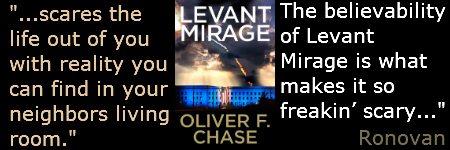
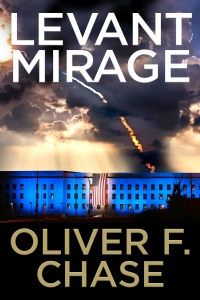




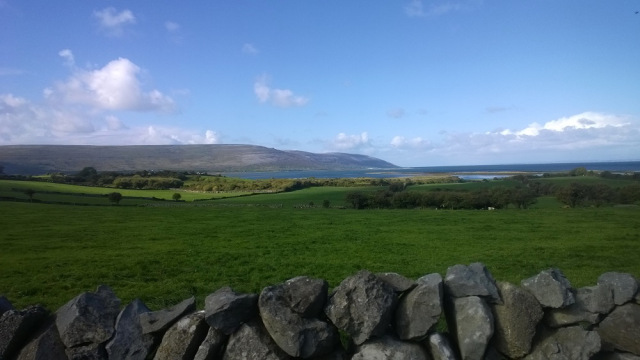


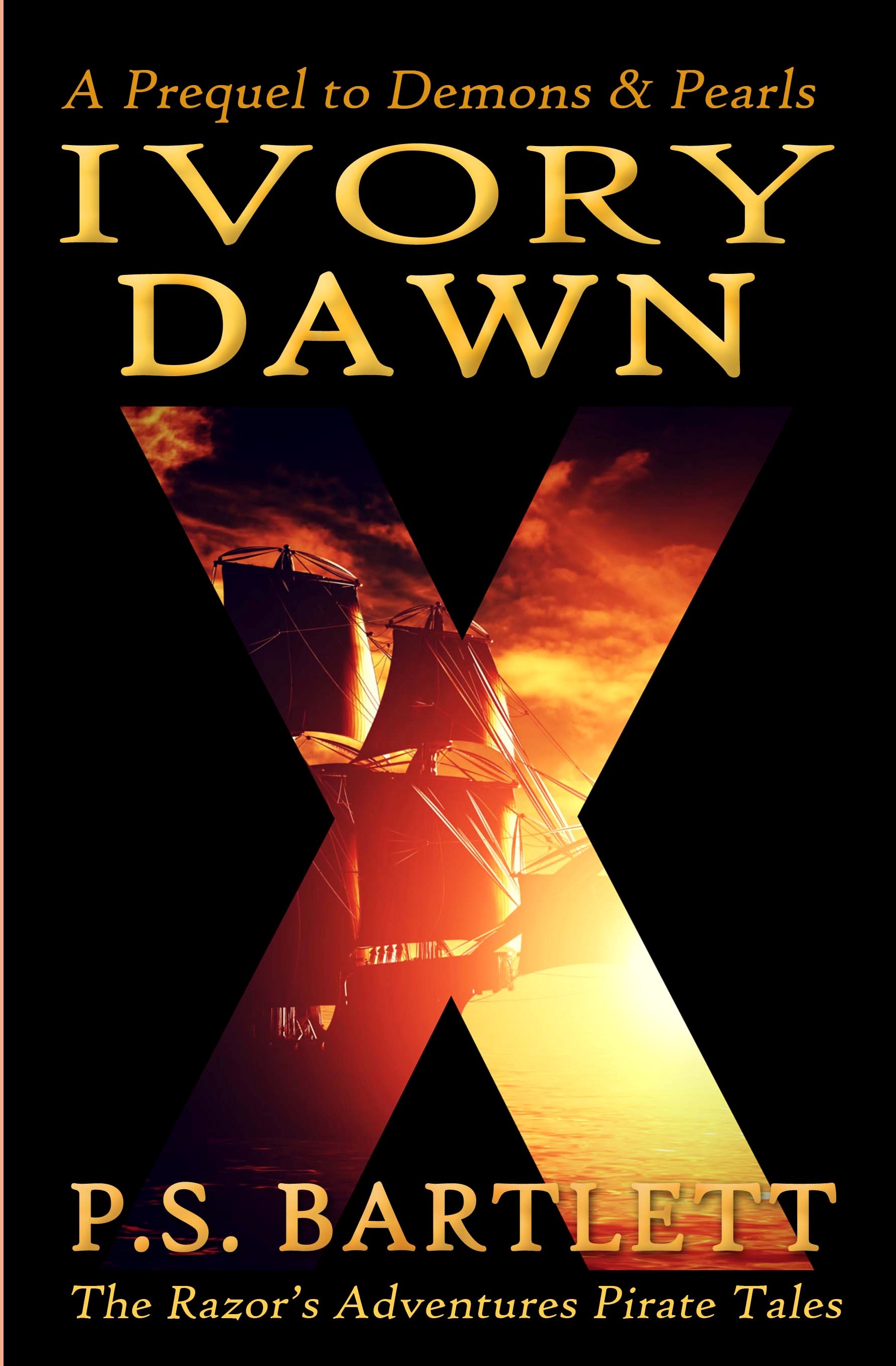





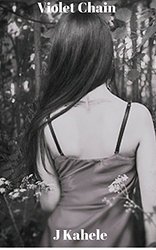




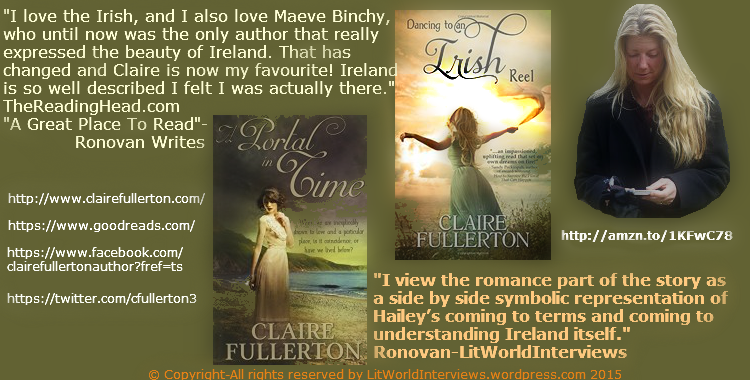


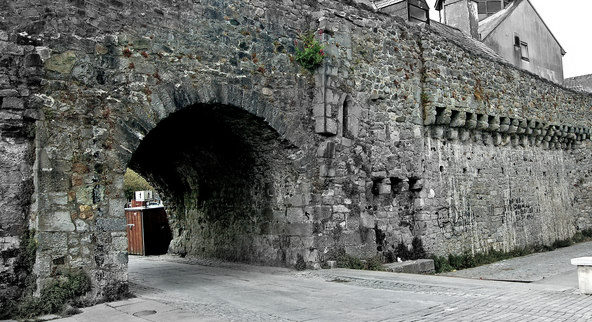





 Lit World Interviews