#Interview with @JasmineAziz of Sex & Samosas.

Not long ago I met an author, one of the best I’ve come across in a one on one way ever, through another great author Dan McNeil. I’ve read and reviewed her book, and you can read the review on LWI by clicking here. What did I say? Read it, but I warn you, if you know my normal reviews and ratings…you will be shocked. Her name is Jasmine Aziz. Her book is:

Jasmine Aziz Sex and Samosas Book Cover

First of all, I think people would like to know how in the world you got into the world of selling vibrators. I think that is somewhat important regarding your book. And in addition, how did you get out of doing that?

Well it isn’t exactly something your Guidance Counsellor in school tells you that you were born to do so no one was more surprised than me when I ended up doing door-to-door dildo sales. I went to a party (my first) with my girlfriend and the consultant that was presenting the products was stiffer than the toys on the table. She made everyone uncomfortable. Naturally, coming from a long line of sales people, I did what I know how to do best: make light of the situation to put everyone at ease. The consultant told me to keep quiet but at the end of the presentation, five women I had never met before came up to me to ask me if I could help them choose what to buy. I can’t be sure what made them come to me for guidance but I sensed I was on to something. That, or it was the “Sex Crazed Loon” shirt I was wearing.

There is an amount of honesty in your book that takes courage. How many times did you stop writing or have doubts and who helped push you to complete the project?

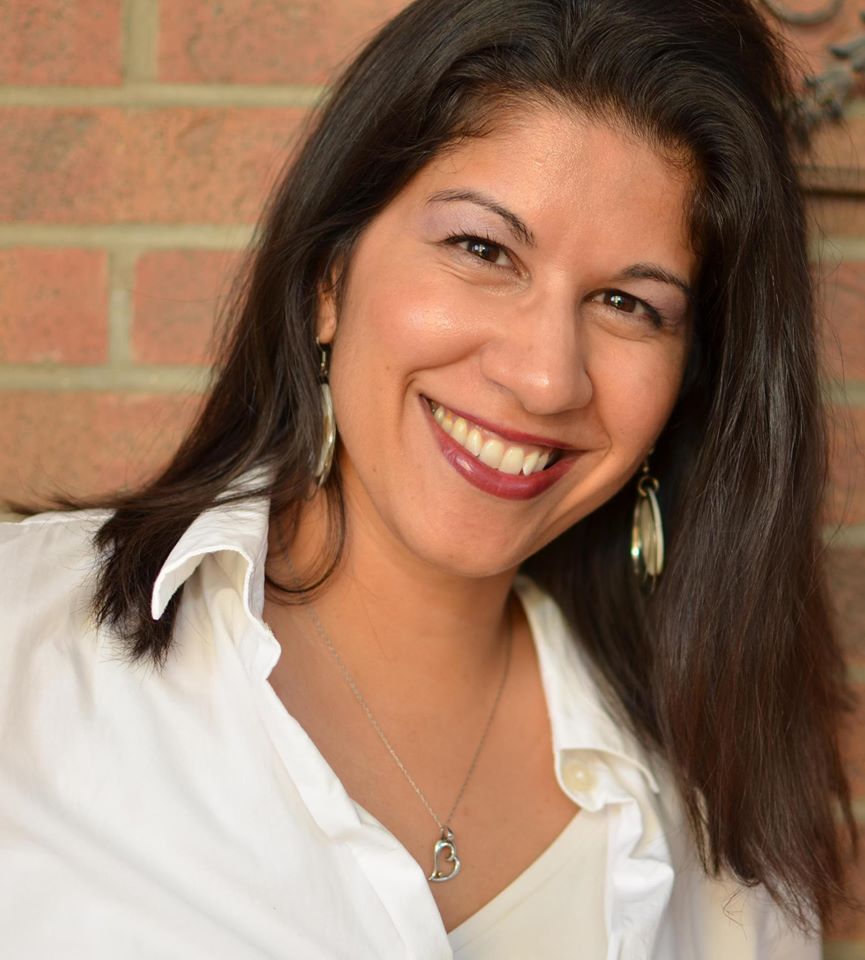
It took me six years to complete the book because I wasn’t sure I could face the potential wrath I was expecting from my extended family. But I had spoken to too many women and men that I felt Jasmine Aziz Author of Sex and Samosasneeded the story so I forged forward. It was actually a fateful trip to Las Vegas that propelled me in the right direction. It was there that I was told I wasn’t “sexy” enough to get free tickets to a club. That made me stop and think, well, what is the definition of “sexy” anyway? It was that concept that helped me string the book together. Now if I ever go back to Las Vegas I’m just going to wear a copy of my novel and we’ll see who gets the last laugh.
How many strange men have proposed to you since the book came out?

Are you proposing? 🙂 If so, then only one 😉 Just kidding!

One thing I believe that makes the book so easy to read and perhaps become comfortable with is the humor. Where did the stories told about the sexual explorations and the disasters resulting come from? (I still laugh at the burning man scene.)

I’m often asked how much of it is based on my own adventures but the truth is, they were inspired by my protagonist Leena herself. I’ve always believed that one of the best ways to tackle difficult topics is through humour. When you are relaxed and laughing, you are more likely to be receptive to information. You don’t even realize that you’re learning something. I personally think laugh lines are extremely sexy too!

Why did you write this book? Your storytelling is great. You could easily have written a romantic comedy of the more traditional type but you chose this one. Why?

Well, thank you! In fact, I am trying my hand at a romantic comedy as we speak! The main reason I wrote “Sex & Samosas” was because I needed a way to purge my own feelings after a very bad breakup so I started writing them down. As I continued with my adult toy parties, I started to realize that other people had the same issues and insecurities that I did and that this was a story that so many others would find relatable. Page after page my personal bitterness and angst gave way to the fiction that unfolded. It’s not necessarily cheaper than therapy, but writing the book helped me work through some very difficult issues.

What has been the public reaction to the book?

I’m really blessed with the reaction. I frequently get emails and notes from people telling me that they not only loved the book and have loaned it to everyone they know, but that they have learned something from it or changed their lives as a result. No author could ask for more than that, I think.

sex-and-samosas-jasmine-aziz-review-feature1

What have men said to you about the book?

When they’re not proposing to me…more men have told me that they love the book because it has helped them to understand how a woman’s mind works. There is a voyeuristic quality to being in Leena’s head all the time that helps them to empathize in ways they couldn’t before. Some have even told me that it has helped them improve on their relationships and pick up women in the book store. It’s all good. Just name the baby Jasmine, is all I say!

I enjoyed the cultural aspects you discussed in the book. I think those parts might be the most surprising to people and maybe in some cases the most informative. Was there an intention of putting that in the book or did it just happen?

That was the starting point of the book actually. Leena and I both struggled with finding balance between two opposing cultures and asserting yourself comfortably in both. She has to find her footing and learn to love herself for the hybrid of cultures that she is as I had to when I was writing it.

What do you have to say or would say to people who say you wrote a sex book and you’ve gone against what a “proper” person should do?

If you’re going to be a suck, then at least read my book so you know you’re doing it right.

What did you want to convey to readers with this book?

My message is simple: if you can’t love yourself, don’t expect anyone else to. And that masturbation is healthy and natural. Sure, I can’t see my hand in front of my face and I have the hairiest palms on the planet, but I know better than anyone else how to please myself and that’s all that matters.

Give me your best sales pitch to get me to buy this book.

Buy my book: there’s sex in it.

Kidding again! I realize my novel isn’t for everyone so when people ask me what it’s about I tell them it’s a funny journey of self-discovery that just happens to have a bunch of vibrators in it.

When can we expect the next book to come out?

There’s the trickiest question of them all. I’ve been really busy and not able to finish my follow up memoir about the four years I sold adult toys, though the frame of the story is complete. It’s only now that I’m beginning to wonder if it should be a television series (Netflix, I’m talking to you!) instead. So I’m going to pursue that first before I head back to finish it as a novel.

Where can you connect with Jasmine? Well, she’s made it easy. Drop a hat and you’ll likely find her, and thajasmine-azizt’s as it should be with a future star of the publishing world.
First go and buy the book!
Click here to find your preferred method. Jasmine has them all listed for you.
@JasmineAziz 
www.facebook.com
www.goodreads.com
Jasmine on LinkedIn.
Want to discover more about Jasmine? Visit her website, JasmineAziz.com.


Ron_LWIRonovan is an author, and blogger who shares his life as an amnesiac and Chronic Pain sufferer though his blog RonovanWrites.WordPress.com. His love of poetry, authors and community through his online world has lead to a growing Weekly Haiku Challenge and the creation of a site dedicated to book reviews, interviews and author resources known as LitWorldInterviews.WordPress.com.

© Copyright-All rights reserved by litworldinterviews.wordpress.com 2015

What to Put in your Author Media Kit

Having a ready to go press release kit is something every Indie author should have. It’s also a good idea to have it on a static page on your website or/and blog. Rather have everything in one place than have to scramble around when it’s called for. Having it on your website means that anyone who would like to post reviews of your books on their own sites can just grab what they need without the need to try and contact you first. I’m working on my website at the moment so the link here is down, but if you want great examples, just do a Google search of some of your favourite authors.

Include your author photo – a nice size and quality image. Some authors change their photos regularly. Danielle Steel has a new picture of herself in extravagant gowns on the backs of each of her books. I don’t think that for a new Indie author that changing photos regularly is a particularly good idea though. It’s going to take a while to build your brand, and get to the point where you’re recognisable. It’s also good for Google searches to stick to a single author picture for a couple of years at any rate.

Next would be your biography. I prefer bio’s written in the third person, but that’s up to you. A bio of around two to two hundred and fifty words is a good length.

Then your press release, which would be details of your latest book, with a nice cover image and blurb, with an excerpt if you like.

You can include editorial reviews, or if the book is already published, some of your other reviews.

It’s good to have a short author Q&A too. Answer questions like what inspired you to write the book, information on the actual book, and anything that you’d like to share that could pique interest in you and your books.

Lastly, add all of your contact information, including links to all of your online sites, links to the book’s trailer and anything else that you have by way of promotion.

It’s a good idea to keep all of this information in a single folder on your computer, as well as a list of all the links to all of your books, so that whenever these details are requested, you can send all that you need to across in minutes. It’s never too soon to start setting this up. Even if you haven’t yet published your first book, you’ll save yourself a lot of hard work later when you do.

photo-1421757295538-9c80958e75b0

#BOOK REVIEW BY @ColleenChesebro OF FACES OF A SMALL CITY BY AUTHOR @PaulStearsNews

  • Title:  Faces of a Small City
  • Author:  Paul Stears
  • File Size:  879 KB
  • Print Length:  322 pages
  • Page Numbers Source ISBN:
  • Publisher: CreateSpace Independent Publishing Platform
  • Publication Date:  December 11, 2014
  • Sold by: Amazon
  • Language: English
  • ASIN: B00QJI5VL0
  • ISBN-10: 1505349648
  • ISBN-13: 978-1505349641
  • Formats: Paperback  Kindle
    Goodreads
  • Genres:  Contemporary Fiction, Romance, Drama

* I received a copy of this book from the author in exchange for an honest review which follows. *

Recently graduated from University, James is excited to get on with living the rest of his life. His existence in Canterbury seems to crawl by and his prospects are slim. With no job, no girlfriend, and without a place to call his own James drifts, all the while self-medicating himself with alcohol and women that mean nothing to him. One night, celebrating at a local pub with friends, James has a chance encounter with the elusive and stunningly beautiful Maisie. For James, Maisie is the stuff dreams are made of and he can’t shake her memory from his mind. He can’t wait to see her again, although it seems they are never in the right place at the same time.

Maisie has insurmountable problems of her own to contend with as her mother continues to lose touch with reality. Maisie struggles to live up to the demands her mother places upon her. Much like James, Maisie is floundering in an adult world while desperately trying to get on with the business of living and finding her own identity.

James and Maisie’s stories wrap around each other while both live in the small city of Canterbury. Their lives intertwine through their friends, families, and life circumstances.  Jakes, the narrator of the story leads you into the contemporary lives of Canterbury’s younger population who are filled with hope at the beginning of their adult lives.

Recommendation:

“The Faces of a Small City,” is Paul Stears debut novel. Although, the book starts out slowly, I found myself swept up in the descriptions of Canterbury, the people, and the many life situations that are thrown at the characters of Maisie and James. It was easy to identify with both, James and Maisie as each seemed to be real characters with strengths and weaknesses just like the rest of us.

A true coming of age love story, Stears does a marvelous job depicting and adding depth to the characters featured in this story. Many times I found myself reminiscing about my own first love experiences and how it felt to be that young again. Throughout the novel, a message of hope resounds in the face of formidable life obstacles. I really enjoyed seeing James and Maisie grow up and enter the next stage of their lives.

If you enjoy contemporary love stories with the backdrop of an English city to add culture and ambiance, you will enjoy this book. It is a quick read that will leave you feeling hope that there truly is someone out there for each of us, sometimes found right in the small city we live in.

Character Believability: 4
Flow and Pace: 3.5
Reader Engagement: 4
Reader Enrichment: 3.5
Reader Enjoyment: 4
Overall Rate: 4

About Paul Stears:

PAUL STEARS has recently released his debut novel, “Faces of a Small City.” Graduating from Canterbury University in 2010, he spent his time working and writing. Born and bred in Kent, UK, he lives to write. You can follow him and find out more information about him at his blog: paulstearsauth.wordpress.com.

Please make certain to connect with Paul Stears through his Twitter @PaulStearsNews.

Book Review by: @ColleenChesebro of silverthreading.com

Colleen 10.21.14


How to Get Page Numbers to Start in Chapter One for CreateSpace

Getting the page numbers and book title in the headers starting on the correct page for CreateSpace can have you pulling your hair out in bunches sometimes. You can download an already formatted template from CreateSpace and copy and paste your manuscript into that rather than going for the bald look, or you can make a nice clean template of your own.

Trying to reformat a couple of hundred pages of an already otherwise formatted Word document sometimes causes strange things to happen, so after many trial and errors along the way, I finally figured out that the easiest thing to do was to type my manuscripts without any formatting at all, and then copy and paste them into my own template before working on paragraphs, margins, and styles for CreateSpace. It’s wonderfully simple to do.

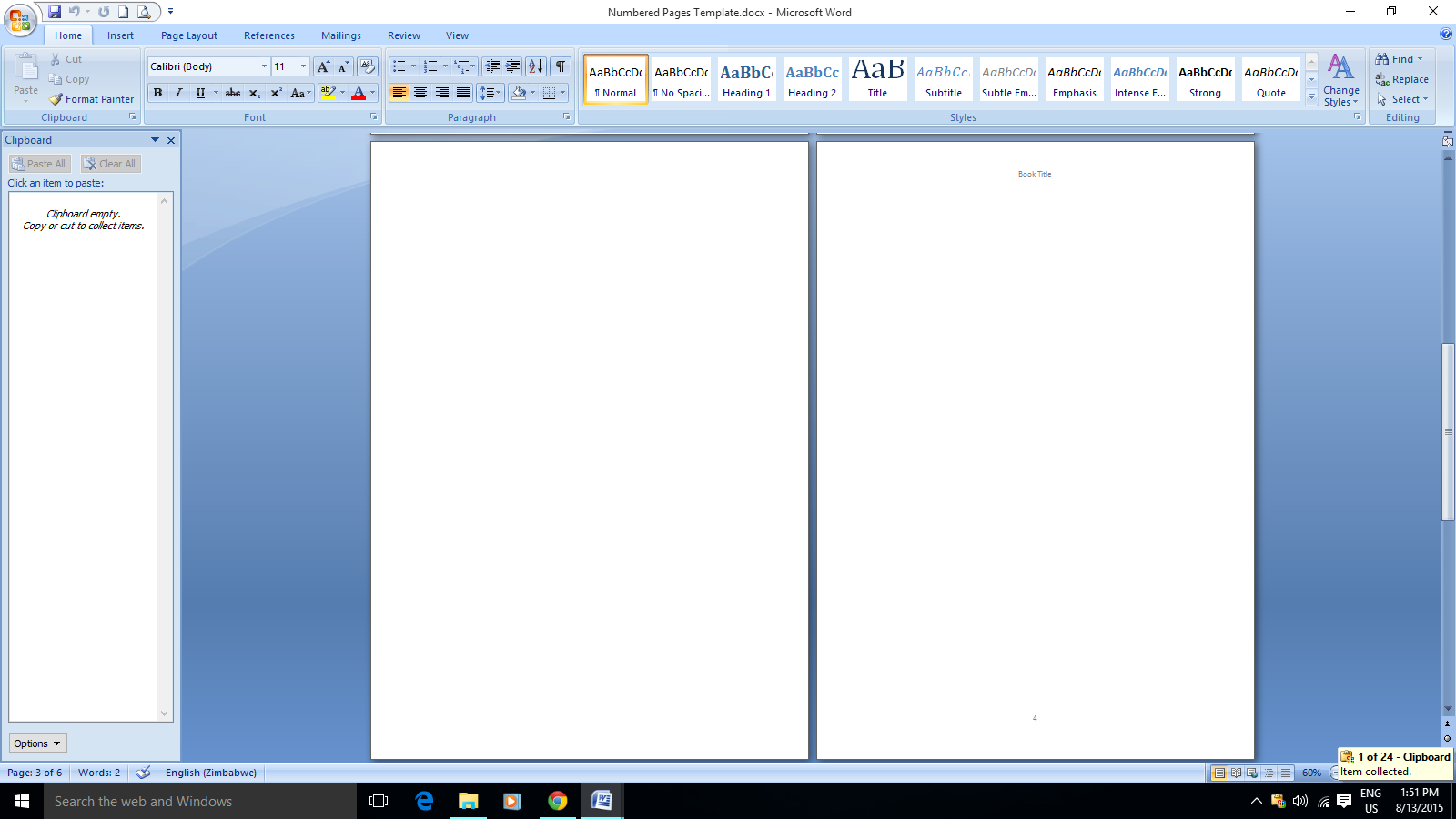
Open a new word document. Hit Enter twice, and then go to Page Layout > Breaks > Next Page to insert a Section Break. Repeat this for as many pages you need for your front matter. Three times is enough though, because you can always add more later.

On the first page of what will be the first chapter hit Enter twice and then Insert > Page Break. Insert page breaks between chapters rather than section breaks.

Double click to open Headers and Footers and unclick Same as Previous on all of them, working your way back through to the first page for your front matter.

Go back to the first page of the first chapter and Insert > Page Numbers. Then double click to open the Headers and Footers again, and you can type in your book title in the header. Save it, and whenever you have a book ready for paper just copy and paste it into your template, change the title in the header, complete your front matter, and Save As your book title. Once that’s done, the rest of the formatting is a piece of cake.

FC Page Numbers

How to Use Pinterest to Get Massive Amounts of New Readers (Guest Post)…

Check out this very useful article from over on our friend the Ape’s blog.

Chris The Story Reading Ape's avatarChris The Story Reading Ape's Blog

A reader was confused.

After reading a persuasive blog post about the value of Pinterest, he inquired of the writer, “Is it possible for authors to use Pinterest to get attention to their writing.

I only have one word for this reader and anyone else wondering.

Absolutely!

Pinterest has great value for writers and anyone looking to grow their readership due to the vast amount of people using Pinterest.

More than 60% of all consumers get information visually, by looking at pictures. Pinterest is comprised of these graphics, or pins, displayed on virtual bulletin boards.

The answer for writers looking to use Pinterest to grow their audiences is simple—use Pinterest bulletin boards to get interest in snippets of your writing.

How to Use Pinterest Boards to Create Interest in Your Writing

The diagram below shows a basic plot structure. If you make a Pinterest board for each element of your…

View original post 890 more words

Can You Call Yourself Stephen King? by @JoRobinson176

Apparently. But should you? There’s an author who publishes on Amazon called Stephen King. He isn’t the Stephen King who we know and love though. The four short books of his that I noticed all have two and a half, or two star average ratings overall. One of them has over two hundred reviews. All four of them are being lambasted, but all of their rankings are high, so they’re consistently selling well and have been for quite some time. This writer is obviously quite happy to take the flack while making money.

Many of the outraged reviews sharing that this isn’t the “real” Stephen King would make you wonder why people would keep on buying it. I nearly bought it though. Certain authors like King and Terry Pratchett I always just grab when I see one that I don’t have in my collection. It was only because the cover was so bad that I scrolled down to the reviews. I also don’t read these books as soon as I buy them. Generally they hang about for months in my Kindle – I’ve got some that have been lurking unopened in there for years, so returning them wouldn’t be an option. I could see where such a deception could lead to me posting my first ever one star review.

I’m pretty sure that Amazon wouldn’t let anyone use Stephen King as a pen name, so I’m assuming that this writer really does own that moniker. It must be a fairly common name. He’s not doing anything illegitimate if that really is his name, but I wonder why anyone would want to purposely sell his books knowing full well that readers think that they were written by someone else. And then just carry on doing that after hundreds of complaints. I don’t see any glory in that. When the other Jo Robinson’s books occasionally get added to my lists, I always request that Amazon remove them. I don’t want to reach readers by hanging on to the coat tails of an already very successful author. Slow and steady is good enough for me.

The minute there’s a breakout success, thousands of writers latch on and try to emulate the bestseller. The thing about breakouts is that they are in some way unique. They challenge, inspire, are relatable, or in some way emotionally moving or funny. Carbon copies of them might possibly give a reader some pleasure, but it will never be the same as the original. We need to be our own breakouts. If we believe in our work there is no need to think for a moment that tricking readers into thinking that we’re the real Danielle Steele will lead to anything but rage, just because we have the same name. E L James did manage to luck out by piggy backing Twilight, but that’s a one in a million kind of thing, and a whole other can of worms. Write what you write, follow your own star, and be proud and brave enough to make sure that readers see the real you.

12247844751816776100wsnaccad_feather-pen.svg.hi

Bye, Bye for now @OlgaNM7

Hi all:

Today just a short post to let you know that from later this week I’ll be away and going to a place where I don’t expect to have regular access to internet. My Dad passed away earlier this year and my Mom and I are going to the little hamlet where he was born to take his ashes, visit relatives and try to sort a few things out. I’m not sure when I’ll be back, but I hope it will be some time in early September.

I hope I’ll have some time to catch up on some reading, writing, and will come back full of ideas, and definitely reviews. And a few more interviews that are coming my way soon.

I thought I’d leave you a present, if you don’t mind. I’ve been quite busy recently with the publication of my new YA series, Angelic Business. By the time you read this post, the three books will have been published already, and to give people a bit of an incentive, I decided to make the first book in the series, Angelic Business 1. Pink Matters free.

Here I leave you the description and links. And if you know anybody who might be interested, please, pass it on:

Angelic Business 1. Pink Matter by Olga Núñez Miret

You are Pink, not the prettiest girl, but smart and with plenty of resources. What do you do when your best male friend offers to have sex with you, because he thinks you’re a lost cause? You plot your revenge with your two best female friends, of course!

It seems you’re in luck when a new and mysterious student appears. And, to top it all, he seems interested in you too. He could take part in the plan. But then, he seems to have a plan of his own… He insists he’s not just an ordinary boy. And what seemed so easy to begin with, gets more and more complicated when Heaven and Hell come knocking at Pink’s door.

Pink Matters is the story of Pink, a 17-year-old girl, a good student, articulate and smart. But she has never been the centre of attention or made the top ten of the most popular and attractive girls at school. When two guys, both claiming to be angels, insist that she is, indeed, ‘special’, fight for her attention and help, and tell her she is the key to the future of the universe, she can’t help but ask: Why me?

Amazon:

http://rxe.me/YIHTW96

Apple:

http://apple.co/1Kuzdl8

Kobo:

http://bit.ly/1LU77jt

Nook:

http://bit.ly/1eLMTOG

Page Foundry:

http://bit.ly/1eMLfN9

Scribd:

http://bit.ly/1eOkmZ5

Book launch:

http://bit.ly/1KcPtI6

Oyster:

http://bit.ly/1OqgMQ6

Thanks so much for reading, see you soon, and don’t forget to CLICK! Ah, and just in case, the book is also available in the Spanish version. 

Can You Change Paper Trim Size and Colour on CreateSpace?

Before publishing your first paper book with CreateSpace there are a couple of things to consider. Even though you can update it and change the content, once the book has its ISBN and is live for sale you can’t change its size and the colour of the paper. Also, once it’s linked to its Kindle book on Amazon they keep a certain amount of printed books in stock for their quick delivery system, so if you find any major errors in it and rush to fix them, those in stock books will still have to sell first before the corrected ones become available. You could order them yourself I suppose, but I’m not sure how many are printed for this and I don’t see how you could get them from Amazon’s other country sites.

Most of the CreateSpace books that I have bought are 6” x 9”, mostly printed on white paper, as are two of my own books, but there are actually quite a few size choices. I wanted to change the first book in my series to 5” x 8” with cream paper and only then discovered that it couldn’t be done, so now I have no choice but to use the same for all the books in the series. It’s not the end of the world, but it’s nice to know these things before rather than after publishing.

When you’re ready to publish in paper, take your time making sure you’re totally happy with all of your choices. First grab a handful of books from your bookshelf and see what finished product you prefer. Measure those puppies. Unless you have lots of pages, the 5” x 8” with cream paper looks really good. I will only be using cream paper for my fiction books from now on because I love the way it looks and feels, and you don’t see many fiction books with white paper. CreateSpace actually does a great job quality wise when you compare their finished products to some traditionally printed books. White seems the obvious choice for non-fiction, although that would depend on the look you’re going for.

Once your paper book is live and for sale on Amazon you can’t unpublish it and take it down and then republish it again if you hate the way it looks, because they won’t allow that in case someone who bought it wants to sell their copy. It’s so easy to chop and change or even unpublish eBooks that we’re not happy with, but once the paper books are published and selling, it seems they’re forever.

1194985952866884806stack_of_books_01.svg.hi

Should You Give Up Writing?

I’ve always found the different ways that we scribblers describe our experiences with writer’s block very interesting. Also the different ways the seasoned writers suggest getting over it. Some suggestions are to work around your block, or force yourself to write through it, even if what you write is rubbish. Other advice is to write something completely different. We won’t mention those rather hurtful cries of, “Stop being such a wussy. Adorn yourself in adult underwear! Plumbers don’t get plumbers block!” All of these things can work with a bit of effort and confidence, but one bit of advice that you seldom see is to take a break from writing completely. As if a week away from writing anything will totally strip you of the ability to write at all. It is true that if you don’t do something for a good long while, you could get a little rusty, but you should never think that just because you haven’t written for a while that you can’t do it anymore. Talent is a real thing. It grows and blossoms with use, but I don’t believe for a second that it is something that can be lost.

No life is smooth sailing all the way, and sometimes you have no choice but to put a writing project aside. Then time goes by, and as it does, your confidence gets chipped away, and the thought of dusting off that manuscript and starting again can seem daunting, so we fearfully side-step it, and do something else. The task seems like one we’ll fail at, because we never finished it in the first place. Apart from our inner carers trying to stop us from writing at all to save us from the ridicule and laughter if we get it wrong by trying to distract us all the time with desperate urges to polish the silver or watch the entire Hobbit trilogy in a single sitting with popcorn and ice-cream, we sometimes have family and friends who aren’t overly supportive, and occasionally downright unkind with suggestions of quitting the lounging around on our bums at home all the time, and why don’t you get a proper job, kind of thing. In addition to all of these challenges life continues, with all of its challenges, hurts, and stumbles, so sometimes even sitting down to confront that silent blank screen seems impossibly hard.

This is where we come to the stories of those who did this very thing in the face of apparently insurmountable odds, that most of us will never have to face. Those inspirational scribbler guys who fought their demons within and without, and beat down that blank screen of emptiness. If you’re called to write, then do it. It doesn’t matter what anyone thinks of you for doing it. Nothing that ever happens to you can ever take away your talent, and neither can time. Do what you have to do. Your talent and callings aren’t given to everyone. Don’t ever let it fall away untried. Maybe a bit of soul searching, or focusing on your present. Write a crazy bit of flash fiction only for you – way too crazy to share with the world, to get those scribbler muscles oiled. Or better yet, take a deep breath and haul out that manuscript that you’ve left lying for whatever reason, with the names of the characters that you’ve forgotten. Gently blow the dust off, and settle down to read your words without any expectation, and pretty soon I’ll bet you’ll be banging away at that keyboard again, forgetting to take off your ‘jammies and mindlessly munching nuts. Never give up scribblers. Write the books inside you, because you really can if you want to, and your words will live forever in the hearts they were intended for.

Pink Daisy

Indie Rage and Public Relations

The Indie author does much more than write. There are all the learning curves, fiddly bits, and marketing. We are our own publicists. Hugely successful authors like Ann Rice can have as many wobblies as they want to online, but they’ll still be selling lots and lots of books. She’s also traditionally published anyway, so what she does doesn’t besmirch Indie world. I’ve seen enough shame inducing, call your mom a donkey dramas lately from some Indie authors online to wonder what the spectators who just read for pleasure must be thinking.

If you’re online as much as we must be, and on so many various sites, sooner or later you’re going to stumble across a comment or an article that will insert itself firmly up your nostril, and it’s possible that you will then dive right in there and firmly express your opinion. Before doing that though, try and dial up your inner public relations department, and see what that lot have to say first. If it really is something close to your heart, and commenting would be of some benefit, go for it. I’ve been known to get into scraps when it comes to animal cruelty, and that isn’t likely to change, because it’s hugely important to me. Otherwise, take a little breather first, and ask yourself if your getting loudly or publicly involved is worth it.

These past few weeks have been quite tumultuous in Indie world, with authors taking sides about Amazon’s reviewing policy, that whacky Twitter thing that E L James did, and the KU payout barney. A large group of authors is signing a civilised petition about the reviews to formally submit to Amazon, I’m sure E L James doesn’t give a hoot, and the KU payout is done and dusted. Unfortunately, many authors are using their platforms to really make some noise. This is fair enough – we can all say exactly what we want to on our own sites, and we can always delete posts later if we change our minds.

Not so much though. I’m pretty sure that Amazon is very well aware of some of the really strong things being said about them, and by who too. I noticed that the authors shouting the loudest about Amazon being criminal, thieving, swine still have their books with Amazon for sale. It’s never a good thing to try and bite the hand that feeds you. Rather get your views across in the calmest, most civilised way you can. Also, even when you delete a ranty post, you’re not guaranteed that it’s gone forever. The review that Ann Rice wrote on her own book’s Amazon page has been long deleted, but it’s still very easy to find on line if you want to read it.

So before you go in all guns blazing, ask yourself if this would be something you’ll fondly remember when you finally whack out that bestseller, and all your adoring fans want to know every little thing about you. The internet is for keeps, and dignity and respect are kind of nice to have in our Indie world.

Angry Writer

Useful Free Tool for Writers

I downloaded the trial version of Scrivener a couple of years ago, but at that point it all went completely over my head. So many people seem to love it so much that I downloaded it again recently, and after completing the tutorial realised that it isn’t all that complicated and quite a brilliant tool. I don’t think I’m going to keep it though, because it seems limited when it comes to inserting images for eBooks, and I quite like using Microsoft Word. When the new 2010 version arrives at the end of this month there will be a whole lot of useful new functions for us scribblers to use too, including having multiple browsers viewable on your desktop simultaneously. My favourite things on Scrivener are the corkboard and the ability to open two different documents at the same time. I already can, and do, open and work on two documents at the same time with Word though – very handy, and I use a simple but also very useful software called AllMyNotes. It’s a free download, so just click on the name if you want it. Go to the download page and select the free version.

It’s not specifically created for writers, but it serves me as my “corkboard” when I’m writing. All you do is create a folder for each project, and also for the private things on your computer that you want to be able to access quickly. Then you create separate notes within each folder for all the things you need. For instance, you could create one for links to any research material for your book elsewhere on your computer. You can insert tables, add pictures, or just type in the text that you want. Say you create a note for characters, another for timeline or locations and scenes, one for ideas, and another for your launch preparations, when that folder is open you get a corkboard effect and you can find what you’re looking for in seconds, rather than having to trawl around looking for and opening another document. (I’ve temporarily deleted my notes for the screenshot because this isn’t published yet, and I don’t want to be clouted for lobbing spoilers around) Click on images to enlarge for a better view.

Untitled

If you’d like to see if this will benefit your writing life, then install it and play around, and then just uninstall if you don’t like it. When you set up your first folders and notes, right click on each one to choose an icon for it, like the light bulb for ideas, or the book for the folder itself. You get to play around with the colours and backgrounds, and you can move them around by clicking and dragging. Drag the corresponding note into the folder. Sometimes I drop them in the wrong place, but that’s alright, just click and take them back to where they should be.

You can set up the amount of columns and rows in the tables, and also drag to adjust the width, so for your characters note you could have things like hair colour or species all in one spot side by side. I find this a fabulous help for my sci-fi/fantasy series, and list things like a particular alien’s looks, name, home planet, particular abilities and other things that are easy to forget, especially in a series. I have three separate outline notes for my full length books, one for the beginning, and others for the middle and end.

All My Notes

If you’re writing non-fiction, or even fiction that you have a lot of research notes for on your computer, make another note for that, and using the link feature it takes a second to hyperlink, and when you click on it, it opens the document straight away, without you chancing getting distracted while looking for it yourself. This is not something you’re going to have to invest lots of time learning how to use – you’ll get the basics immediately, and find more uses for it as you go along.

Obviously this is no replacement for a great writer specific programme like Scrivener, but not everyone fancies paying the forty odd dollars it costs, and in my case, I prefer total control, using Word for eBook creation, and All My Notes for my corkboard and everything else. It’s really easy to use, so if you sometimes find yourself wishing you could have all you need for writing your book right there at the click of a button, give it a try.

How to Create a NCX Table of Contents for Amazon Upload Using Calibre

I have to say that as well as proofreading, creating a NCX table of contents is something I would be more than happy to outsource to a professional and pay for. I’d recommend that if you can afford it. Considering my mission to learn all the aspects of self-publishing myself though, as well as the fact that not all Indies have the couple of hundred bucks in their budgets for this, I decided to figure it out myself. I must admit that I wasn’t keen to load any file on to Amazon that wasn’t a nice clean HTML conversion, so I updated my already published books using Calibre with some trepidation. They all worked out very nicely, and now that I understand the logic behind this method I’m all for it. The table of contents we did before works very well for getting a nice clickable table in the front or back of your book, depending where you want to put it, but it doesn’t generate a table of contents in the Go To menus of kindle devices, so this new process should be the one we use because a Logical NCX is mandatory for Amazon.

First of all forget all the heading styles. We’re going to stick to Normal Style for chapter headings for this. Obviously centre them if you like, but keep all your formatting plain as you can.

Choose a page for your book’s table of contents. I used the page directly after the copyright page.

Type out your heading titles or simply Chapter One and so on.

Now you must bookmark each chapter heading in the book individually. Go to each one and highlight it, then go to the Insert ribbon and click on Bookmark. Type your bookmark name without using spaces, for instance, chap1, then click Add. Carry on till you’re done, and then go back to your typed out table of contents, highlight the words Table of Contents and insert a bookmark called toc.

TOC Add Bookmarks

Go through your typed table of contents by highlighting each item, then right click and choose Hyperlink. Select “Place in this document” from the menu in the box. Pick the associated bookmark and click OK. Do this till you’ve done them all.
Next, using the Ctrl Click function from your table of contents, go to each chapter heading and use Highlight > Insert > Hyperlink to link them all back to the bookmark labelled toc.

TOC Link

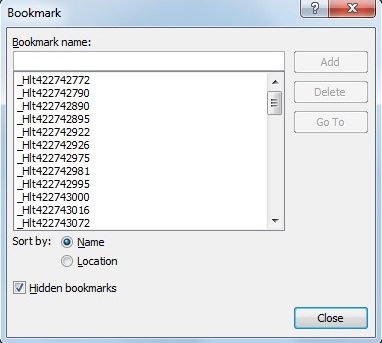
Remove all hidden bookmarks by clicking on Insert > Bookmarks to open the box. Click the “Hidden Bookmarks” box and find any bookmarks that you haven’t added yourself and get rid of all of those by clicking on them and pushing the Delete button in the box.

TOC Hidden Bookmarks

Now save your manuscript and make a copy – just in case, and then use the Save As – Webpage, filtered to get your HTML copy. Don’t worry about the warning that pops up. Save it anyway.

Open Calibre and select Add Book from the top left. Download it for free if you haven’t yet. Find and click on your HTML file. Then click on Convert Book, also in the top ribbon. Fill in the title and your name at the top – this makes it easier to find later. Load up the book’s cover. Don’t load your cover as in the screenshot. You don’t need to for this ePub, and you will upload it on it’s own on Amazon..

Calibre.jpgconvert

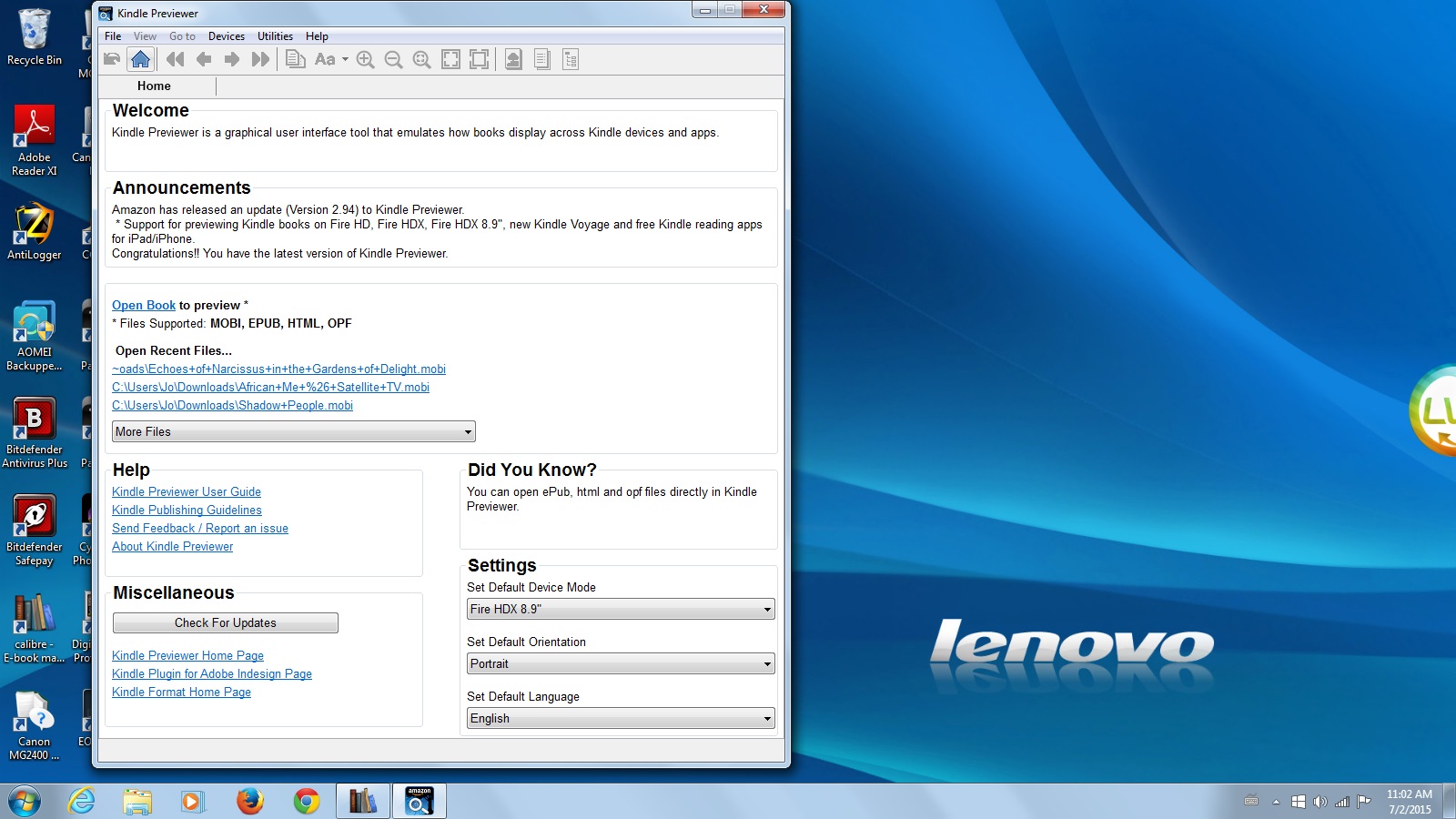
UPDATE:  Amazon will no longer be accepting MOBI files that have not been created using their own software.  I will leave the screenshots as they are below, but the procedure will be slightly different.  This is how to do this now. Select ePub output in Calibre.  Select Force Table of Contents.  Click OK.  Open your Kindle Previewer.  Click Add Book.  Browse for the ePub by going to your Calibre Library situated in the My Documents folder, and select the ePub book you will find there.  The previewer will tell you that it has created the file using KindleGen.  You will find this MOBI file in the same folder that Calibre created with the ePub in it.  Use this MOBI file to load directly on to Amazon.

Go and have a look in each of the boxes down the left of your screen, mainly to familiarise yourself with all options. There’s no reason to be wary of playing around – just delete and start again. Select ePub as OUTPUT in the top right of the page.  Go to the Table of Contents and select Force Table of Contents.  Push OK and wait for the conversion to finish.

Calibre force

When Click to Open appears under the cover picture, click on that, and it will take you to the ePub copy in your Calibre library. When you create a MOBI file for your own purposes, clicking on it and it will open in your Kindle for PC.

Calibre TOC in Kindle PC

Open the Amazon Previewer.

Calibre Previewer

Have a look how it will appear on the three devices there, and check that both your table of contents and also your NCX table of contents are there from the buttons at the top. Then go to the MOBI file that the previewer has created situated in the folder in your Calibre library and that will be what you load up to Amazon when you start the publishing process. Do a double check by downloading the preview MOBI from Amazon after that, as well as using their online previewer to be a hundred percent sure that all the formatting and breaks in your book are looking good, as well as your NCX table of contents.

Calibre Previewer tocCalibre Previewer ncx view

Last but not least. Typing in the correct code and splitting a book up to generate a NCX table of contents is obviously the correct way to go, but not for people who don’t understand HTML much better than most intrepid Indies. You can happily load the Calibre and Previewer MOBI up this way, because you are following their guidelines properly. The way I understand the NCX TOC is that it’s some sort of hidden “spine” in the metadata of a book. Calibre does all that magical stuff for us. and the previewer does the rest without us having to learn computer coding at all..

Is Kindle Unlimited Hurting New Indies?

I was planning on posting the new TOC how to using Calibre this week, but I’m afraid that I haven’t been able to get to my computer to get the screenshots together this week – so next week it will be – promise. Getting back here today though, it seems that the whole writing world is up in arms about Amazon’s announcement that authors will earn by the page read, rather than by the percentage of a book read when a book is borrowed with Kindle Unlimited. Having vivid memories of starting out as a newbie to self-publishing of how easy it was to get totally confused and thrown off course by announcements from some established authors, I’m really glad that this didn’t happen back then.

It’s a fact that any Indie author out there right now with one, or maybe two books published, is not going to be laughing all the way to the bank. It’s also a fact that readers buy from sources other than Amazon, especially in places like Canada where Kobo is popular, so if your book is Amazon exclusive those would be readers who wouldn’t have the opportunity to buy it. Then again, even if your book is available at all of these other outlets, that doesn’t mean that anyone will buy them there. Two of my books were on all of those sites for quite some time, and I have to risk being shot down in flames here, and truthfully say that since they’ve been taken down from them a very short while ago, they’ve earned more from KU downloads than they ever did there.

I’m not being an Amazon groupie here – I’m well aware that there are authors who truly hate them. I don’t hate them. I just think that we, as self-published writers, need to get things a little more in perspective. We aren’t obliged to put our books on KDP Select. All it means if we don’t is that we don’t have any Amazon free days and a couple of other perks. We can still make our books free regardless by putting a free price on them at Smashwords, and asking Amazon to match the price – this is how we get to having permafree books. Before, when a reader downloaded a book using KU, all that was required for the author of a twelve page book to get the same payout as an author of a two hundred page book, was for the reader to read ten percent of the book. Now authors will be paid for pages read. I don’t see what all the fuss is about – page for page sounds fair to me. As writers I would have thought that we’d be more concerned about readers reading our entire books because they love them, rather than getting cross with Amazon for evening out the playing field.

When I’ve been asked, I’ve always advised newbies publishing their first book to start out the gates with three months on KDP Select, and I stand by that. The authors feeling this particular crunch in their pockets are authors who are already earning minimum four digit monthly incomes from their books, mainly because of loss of actual sales. When it comes to the newly published author, would you rather get a share of the KU pot for a borrow of your book, and the potential of new readers who might not otherwise have been prepared to actually pay for it, or dig your heels in on principle and sell none at all? If Amazon were to close its doors to Indie publishers tomorrow, how well would we all be doing sales-wise? The angry comments about Amazon giving better promotion to Select books also confuse me a little. On the one hand there are the questions of what the benefits are to being Amazon exclusive, while at the same time complaining that those who are Amazon exclusive are getting preferential treatment. That question seems to answer itself right there.

UPDATE: I’m moving this very helpful information up from the comments section. It’s from bestselling author and self-publishing expert Chris Mc Mullen. Click on his name here to go to go and read a great related article on the difference between borrowing and lending on Amazon.

“ I don’t think Amazon specifically favors Select books. However, every KU and Prime borrow helps the sales rank, even if not read to 10%, and there are many borrows not read to 10% that don’t show in the sales reports. That means Select has a larger impact on sales rank than the shown borrows + sales would suggest. That sales rank boost really helps visibility.

But that’s not the only thing. Select books will earn over $100M in royalties in 2015; that’s a huge market. Which lessens the market outside of Select. But that huge KU customer base clicks on the Kindle Unlimited filter in search results, which eliminates all the books that aren’t in Select. Obviously, that helps Select books with visibility, too.

Amazon doesn’t need to do anything special to favor Select books. The reward is built-in. ”
Thanks Chris!

Amazon is what it is – the biggest and best way for self-published writers to have the opportunity to sell our wares, with the added possibility of eventually earning enough from our writing to quit our day jobs – with quite a bit of hard work to come and more books, I hasten to add. Most of us aren’t anywhere near that point yet, so yelling about this and taking our books off KU because of this honestly sounds counterproductive to me. So to any brand new Indies out there about to boycott Amazon because of this, please think twice before you do, and consider what is best for your own book right now, rather than any cash you could potentially be losing if you’re currently making less than fifty dollars or so a month. KDP Select isn’t a life plus seventy year contract holding you down – it’s three months – test it for yourself first.

Owl Holding Kindle

Can you Make and Sell an Audiobook if your Book is on KDP Select?

Yes you can. Short books and audiobooks are the in thing right now. Lots of Indies are working with ACX to have their books made into audio to sell with Amazon’s Audible. You can either pay a narrator and keep all your royalties, or you can opt to share the audiobook’s royalties with the narrator, in which case you pay nothing upfront. Unfortunately this service isn’t available to authors anywhere other than the United States and the United Kingdom. I would definitely use this service if it was available to me, and if any of you scribblers haven’t yet explored the possibilities of audio, it looks to be well worth the effort to have a look.

I have seen a few authors who refuse to have any part of Audible, because of their seven year exclusive distribution rights and insistence on the use of DRM though, so not everyone thinks that this is a great opportunity. Either way, the good thing to know when your book is published with Amazon KDP Select, is that while you may only distribute the digital eBook through them, this doesn’t apply to paper books or audiobooks, both of which you can sell and distribute anywhere you like. Only the eBook has to be Amazon exclusive, and even though the audio book is also digital, it’s not part of the deal. So if you can’t use ACX because of where you live, or if you don’t want to for some other reason, you could be losing potential readers – or listeners as the case may be – without having your book available in all possible formats. All is not lost though.

If you’re brave enough, you could narrate your own books. You could use an online service, such as Podiobooks who actually assist you through the whole process for free, as well as offering paid services, or you can go it totally alone, using free software such as Audacity. Another really fabulous freebie in the Indie author’s toolbox. In fact, I suggest downloading it purely for the fun of playing with it. It’s incredibly easy to use, and as with Calibre, there are loads of helpful tutorials available. It is recommended that you buy a decent USB microphone, but to begin with you’re going to need a lot of practice, so using your laptop to record will be good enough until you’re ready to begin reading your actual book.

As well as using it to make audiobooks, it’s perfect for creating your own podcasts. I’ve been preparing a few of my own, ready to share in a few weeks time when I release my next book. So scribblers, download it and see how you like the world of audio, and the possibility of a totally new format for your stories to reach the world. Once it’s installed simply hit the red record button and say something. Play around with it and look at their tutorials and forums. If you have any short stories or flash fiction lurking on your computer, they would be ideal to use to practise, and your readers will get to hear your words in your own gorgeous voice.

Microphone

The honesty in poetry @FTThum

My love for poetry grows… Why? The honesty to be found in each pause, the depth of emotion in each word… insight through the spoken and the unspoken.  The freedom and space for the reader to imagine a world.

Listen.

May you find your words,
– FlorenceT

@FTThum
MeaningsAndMusings

Florence 2

Amazon’s Logical TOC and Author Review Rules

I’ve posted about reviews and inserting a table of contents into your eBooks before, but I wanted to discuss them again, with special emphasis on Amazon KDP rules.

First, just a quick word about the table of contents. I’m editing a non-fiction book that I want a proper NCX table of contents for, that shows up in the little Go To menu itself, so I’ve been exploring Amazon’s guidelines. I wasn’t aware before that fiction had to have a logical table of contents, but it is now actually a requirement, and authors are starting to get notices from them to put them in their eBooks if they haven’t already. The HTML table of contents that we did here previously is Strongly Recommended by Amazon as well, but the Logical one is a requirement. This table of contents according to Amazon “Lets the reader easily find parts, sections, and chapters of your book from the Kindle Go To menu. Lets the reader see how far along they are in the book. Especially important for books longer than 20 pages.”

This is not an easy process to find out about. I dug around for weeks finding all sorts of conflicting – and mindblowingly confusing – instructions, that seemed to me only a computer programmer would understand. At the end of all that I found that if you convert your HTML manuscript with HTML table of contents in it to an ePub using Calibre, and then load the ePub on to Amazon, the NCX Logical table of contents appears in the Go To menu. Later, after I’ve finished successfully converting all of my own books, I’ll do a proper post with screenshots of the whole process. In the meantime, it’s something for you to start looking into if you haven’t already got these in your eBooks.

Then the reviews. Amazon is on the warpath right now as far as paid for and dishonest reviews are concerned, and us innocent Indies could get hurt as a result of being uninformed. Whether we agree with them or not, we have to follow the rules of any publisher we use, so getting to know Amazon’s policy on this is important. As authors we are allowed to review books by other authors there, unless we have a personal relationship with them, or had a part in creating their book. So, if you’ve designed a cover for a book or edited it, or had any other part in getting it made, you are not allowed to review it on Amazon. Friends and family are only allowed to chat about your book as part of an editorial review which will have to be vetted via Author Central first, or on the Discussions feature – where it says “Start a Discussion” at the bottom of your book’s landing page. They are not allowed to review it on Amazon. Obviously, no paid for reviews other than paid for editorial reviews, for example from an expert in your book’s genre.

By paid for, Amazon also means that if you receive a gift certificate for a book in exchange for a book review this is a paid for incentive, as is asking for a review as a condition for entry into a competition, among other incentives. Swopping reviews with other authors is also not a fabulous idea. As Indies we want to support each other, and we are so grateful when we do get a wonderful review, that we buy and read the reviewer’s books, and leave our honest reviews for them too, but I think that doing that now would be dangerous – for both of you. Amazon may frown on the author whose book you reviewed as well as you if it looks like a “review for a review”. So, if you really want to review a fellow author’s book if they have already reviewed any of yours, rather do so by posting it on sites other than Amazon, such as Goodreads and your blog. At the end of the day, if we want to carry on publishing with Amazon, we must abide by their rules. Even though we know that we truly are posting one hundred percent honest reviews, there are quite a lot of people who don’t, and getting your books booted off Amazon – which is a possibility here – would be an absolute disaster for any new Indie author out there in today’s publishing environment.

1197107206400036309metalmarious_Laptop.svg.hi

An @COLLEENCHESEBRO INTERVIEW WITH @SARAHMALLERY1

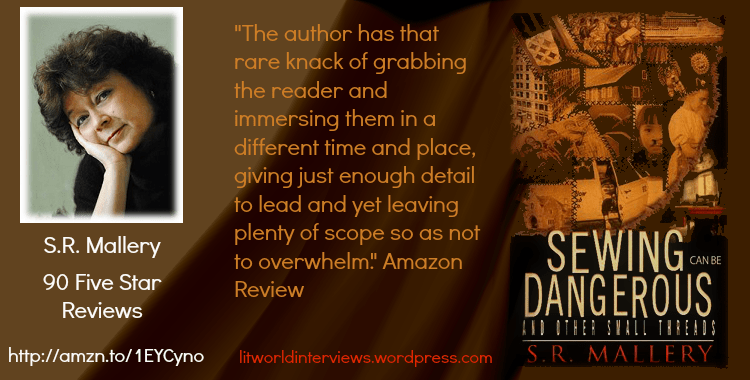
I am excited to introduce you to author, Sarah (S. R.) Mallery who shared with me that she has worn various hats in her life. Sarah also shares that she was, “First, a classical/pop singer/composer, she moved on to the professional world of production art and calligraphy.Next came a long career as an award-winning quilt artist/teacher and an ESL/Reading instructor. Her short stories have been published in descant 2008, Snowy Egret, Transcendent Visions, The Storyteller, and Down in the Dirt.”

Author S. R. Mallery

I actually met Sarah on Twitter. I was immediately intrigued because she was such an engaging personality, something that you don’t always find on Twitter. In no time at all, I was reading her novel, “Sewing Can Be Dangerous and Other Small Threads.” You can read my review here, and below is the synopsis for this excellent book:

These eleven long short stories range from drug trafficking using Guatemalan hand-woven wallets to an Antebellum U.S. slave using codes in her quilts as a message system to freedom; from an ex-journalist and her Hopi Indian maid solving a cold case together involving Katchina spirits to a couple hiding Christian passports in a comforter in Nazi Germany; from a wedding quilt curse dating back to the Salem Witchcraft Trials to a mystery involving a young seamstress in the infamous Triangle Shirtwaist Factory fire; from a 1980’s Romeo and Juliet romance between a rising Wall Street financial ‘star’ and an eclectic fiber artist to a Haight-Asbury love affair between a professor and a beautiful macramé artist gone horribly askew, just to name a few.

What was really amazing was that Sarah likes to do interviews! So here you have it. My interview with Sarah (S. R.) Mallery:

Colleen: Sarah, tell me something about yourself. Where do you live? Are you a full-time writer?

I live in Southern California, where the weather is basically so much tamer than the rest of the U.S. and Europe I have survivor guilt! And no, I would say I am only a two-thirds of the time writer. One-third of my time is spent teaching English to people from other countries and I have learned over the years that it is that balance of being inside my head––both creatively and promotion-wise––and helping others is what works best for me.

Colleen: What inspired you to write Sewing Can Be Dangerous and Other Small Threads? Have you written other books?

When my father told me about the infamous Triangle Shirtwaist Factory fire of 1911, I had already been a quilt designer/teacher for over twenty years. So, in doing my research on that horrific event, I was particularly drawn to those hapless immigrant seamstresses who, in spite of their overworked hours and low pay, were often the only ones in their families that could find work in the U.S. I also enjoyed thinking about the sewing aspect, surrounded as I was by so many quilts and fabrics in my studio. I therefore decided to continue writing short stories, connected only by one element of sewing/craft. That actually helped focus me on future stories. In other words, no matter what time period I was reading about, that context kept me asking questions like how would sewing/crafting ‘fit’ into a story that takes place in this time frame? Who would be the likely characters?

Yes, I’ve written two other books: TALES TO COUNT ON (http://amzn.to/1x8QqyD) and UNEXPECTED GIFTS (Currently set to be re-released in late June 2015).

Colleen: What message do you want your readers to get from SEWING CAN BE DANGEROUS?

By interweaving a ‘thread’ of sewing/crafts throughout each of my stories, I wanted to emphasize how in life as well as history, the ‘little things’ are what loom large. In other words, these quilts, necklaces, crafts, etc. stay with us no matter what events revolve around them.

That idea extends to when I do research for my writing. I am always fascinated by some small fact that most people might pass over but for me, pops out from the page. Soon, that fact starts to percolate in my brain until it becomes a major plot device and/or character development.

Colleen: Who is your favorite author and explain what really inspires you about their work.

Although there are several authors I admire, I would have to choose Harper Lee, who taught me that being simple yet lyrical, presenting appealing characters and touching subjects, and ‘showing not telling’ is more powerful than the most flowery, magnificent prose which can after a while, for me at least, go in one ear and out the other.

Colleen: What was the hardest part about writing this particular book?

I would say perhaps looking for a ‘sewing element’ in my research process that I could authentically use in a story. Originally, there were a couple more stories, but I decided to scrap them because their sewing component seemed too manufactured.

Colleen: Do you have any works in progress you will tell us about?

Yes. I am currently working on an historical fiction western and enjoying not only that time period, but also the colorful lingo that was used. Here’s the synopsis:

The
Dolan Girls by S. R. Mallery has it all. Set in Nebraska during the 1800s, whorehouse madams, ladies of the night, a schoolmarm, a Pinkerton detective, a Shakespeare-quoting old coot, brutal outlaws, and a horse-wrangler fill out the cast of characters. Add to the mix are colorful descriptions of an 1856 land rush, Buffalo Bill and his Wild West Show, Annie Oakley, bank/train robberies, small town local politics, and of course, romance. It’s not only a taste of America’s past, it’s also about people overcoming insurmountable odds.

Thank you, Sarah, for spending some time with us and sharing about your book, “Sewing Can be Dangerous & Other Small Threads.” I look forward to reading your other books too!

***

Here is An Excerpt from Sewing Can Be Dangerous & Other Small Threads

From “A Drunkard’s Path”

“…Are you kidding me?” Deborah exploded. “My life is falling apart! C’mon, curses don’t really happen, do they? I mean, what can I do? You tell me now!” She segued into a screech.

“Come over to my place tomorrow and I’ll try to relate it all to you, I promise…”

….”Do you know anything about the Salem Witchcraft trials?” The older woman leaned in toward her niece, as if casting a spell herself.

“No, not much, why?”

“You remember Martha Stinson from my quilt group? Well after the wedding, she showed me a journal written by a relative of hers and frankly, I am very concerned about you. It seems one of the accused witches from the original Salem trials might have actually had a connection with a real witch, an ancestor of Martha’s…”

* * * *

Inside the packed meetinghouse, dust particles from mud-caked boots floated throughout the air, rendering it dense, murky. That year, April had been an unkind month to Salem Village. Rain-drenched meadows produced a sludge that clung to the edges of women’s dresses, creating odors so foul that in such tight quarters, it became difficult to breathe. But people weren’t concerned with such matters on this day. They had gathered for a higher purpose: the Devil was in Salem, and they wished him thwarted at all costs. Even the constant threat of Indian attacks and surviving harsh winters paled in comparison to what was happening now, in that room, swelling with apprehension.

Crammed into high-walled pews, dark wooden benches, or simply shoved up against walls, spectators filled every conceivable space in the meetinghouse. Donning black hats, cloaks, and breeches, the men angled forward, their eyes boring holes into the five men sitting up front, yet it was the women who carried the greatest burden that day; their hooded coats and muffs covering their recently unkempt hair and unwashed fingernails, couldn’t disguise the uncertainty they felt about their community’s loyalty to them and how it would all end.

Sitting at the head of the counsel table, amongst other magistrates in the newly appointed Court of Oyer and Terminer, John Hathorne and Jonathan Corwin quietly conferred with each other before beginning their first round of questioning. Arrogant, self-important, the black-robed magistrates assumed their positions on the political totem pole, and having been brought to Salem for such a specific purpose, they dared not disappoint. They were on a mission to deliver souls. Hathorne, displaying the greatest exhibition of self-aggrandizement, seemed the most severe. With no real legal experience, and having only glanced at Sir Mathew Hale’s Trial of Witches, and Joseph Granvill’s Collection of Sundry Trials in England, Ireland the week before, he nonetheless believed he was more than competent to interrogate the accused.

At the front of the room facing the magistrates, sat all the accusers, the “afflicted” girls: Abigail Williams, her cousin Betty Parris, Ann Putnam, Sarah Bibber, Sarah Churchill, Elizabeth Booth, Mercy Lewis, Susanna Sheldon, Jemima Rea, Mary Warren, Mary Walcott and Elizabeth Hubbard. With downcast eyes and folded hands, they appeared demure; inwardly they were experiencing emotions quite different from anything they had ever known. Childhoods stocked with adult repression and fear now served as a springboard to the frenzy of accusations they had created, because on this day, along with their catharsis and even exhilaration, came the most important emotion of all: a sense of empowerment. At last, they were getting adults to listen to them, and it was intoxicating.

John Hathorne commenced with the proceedings. “Bring in the accused, Bridget Bishop….”

Here’s what they’re saying about SEWING CAN BE DANGEROUS And Other Small Threads:

“S. R. Mallery is quite simply a master story-teller.”

“This is a box of bonbons, every story an eye-opening surprise. Eat one and you’ll want to devour the whole box.”

“An exquisitely crafted, impressive portrayal of life’s journey!”

Women, sewing, history, and storytelling. A quilt of wonderful stories.”

“Rich and beautiful stories that will captivate you.”

“These stories will stay with you long after you’ve finished the book…”

“I was amazed by the variety of stories that took place in various locations, and at different historical times.”

Here’s where you can find Sarah:

Website/Blog: http://www.srmallery.com

Twitter: @SarahMallery1

FB: http://facebook.com/pages/SR-Mallery-Sarah-Mallery/356495387768574

Google+:
https://plus.google.com/u/0/107388739382996104658/posts

Goodreads: https://www.goodreads.com/author/show/7067421.S_R_Mallery

Pinterest: (I have some good history boards that are getting a lot of attention—history, vintage clothing, older films) http://www.pinterest.com/sarahmallery1/

Amazon Author page:
http://www.amazon.com/S.-R.-Mallery/e/B00CIUW3W8/ref=ntt_athr_dp_pel_1

Amazon link to SEWING CAN BE DANGEROUS: http://amzn.to/1P8OTyo

Audible.com link for SEWING CAN BE DANGEROUS: http://bit.ly/1uyFUuF

B&N: http://www.barnesandnoble.com/s/sewing-can-be-dangerous-and-other-small-threads?keyword=sewing+can+be+dangerous+and+other+small+threads&store=ebook

Kobo: https://store.kobobooks.com/en-US/ebook/sewing-can-be-dangerous-and-other-small-threads

Skribd: https://www.scribd.com/book/260906999/Sewing-Can-Be-Dangerous-and-Other-Small-Threads

iBooks: https://itunes.apple.com/us/book/sewing-can-be-dangerous-other/id982813512?mt=11

How to Make an eBook Using Calibre

On the subject of selling eBooks from your website, in addition to offering them in PDF format, it’s nice to be able to offer your readers books in the formats of their choice, including Mobi and ePub. Apart from the sales point of view, you might simply want to put a book together for your own pleasure – to send to your friends and family just for fun. The way to do this quickly is with the free Calibre software, so I want to show you how easy it is.

I’ve often mentioned what a great little tool Calibre is for us Indie writers. Together with Amazon’s free Kindle for PC downloadable app, Calibre can be a major help in spotting those typos and grammar gremlins in the editing process. Apart from that though, it’s a library in itself, where you can store any digital books that you like. Like those books you’re sent when you win online Rafflecopter giveaways, or books emailed to you by author friends. It’s useful to have them all in one place so that you don’t lose them in the pile of “stuff” that we scribblers tend to build up on our computers, and commit the sin of forgetting to read something you should.

I won’t go into all the fun stuff you can do with Calibre before we make our little book except to mention one fairly important thing, because the manual is very easy to follow, and the programme is easy to use. The one thing is the ease with which calibre converts book formats if they are DRM free. My preferred reading platform is Mobi, so I generally use Calibre to convert ePub books so I can read them the way I like on my Kindle. Even though I do have an ePub reader, I just don’t like it. But I do know that there are others who go the opposite route. That’s readers for you, so it’s nice to have this option. Simply add and select the book you want to change, and convert it from the input format by selecting your chosen output format.

Once you’ve downloaded and installed your Calibre software, you’re ready to start making your eBook. When you open it, it will look like this – obviously without any books in the library other than the quick start manual, which you should have a quick look at – it’s not long. If you really want to explore all Calibre’s capabilities at a later stage there are loads of tutorials online.

CLICK ON IMAGES TO ENLARGE.

Calibre1

We’re going to make a Mobi book now, but you’ll see that there are quite a few output book formats for you to choose from. Before you begin, you’ll need your book cover file, the same size and quality that you would use to load on to Amazon, as well as your Manuscript file, also formatted the way we did for Amazon, and saved as a HTML file to use here as well.

Calibre Save As

Ready? Click on Add Books in the top left hand corner, browse for your manuscript HTML file and load it up. You’ll see the new title in your library now. On the right of the page you’ll see that the current formats are ZIP – this is fine.

Calibre2

Next click on the third button from the left at the top – Convert Books. Here is where you’ll select your output file in the top right hand corner, and browse for and load your cover, as well as fill in Title and Author on the top right hand side.

Calibre3

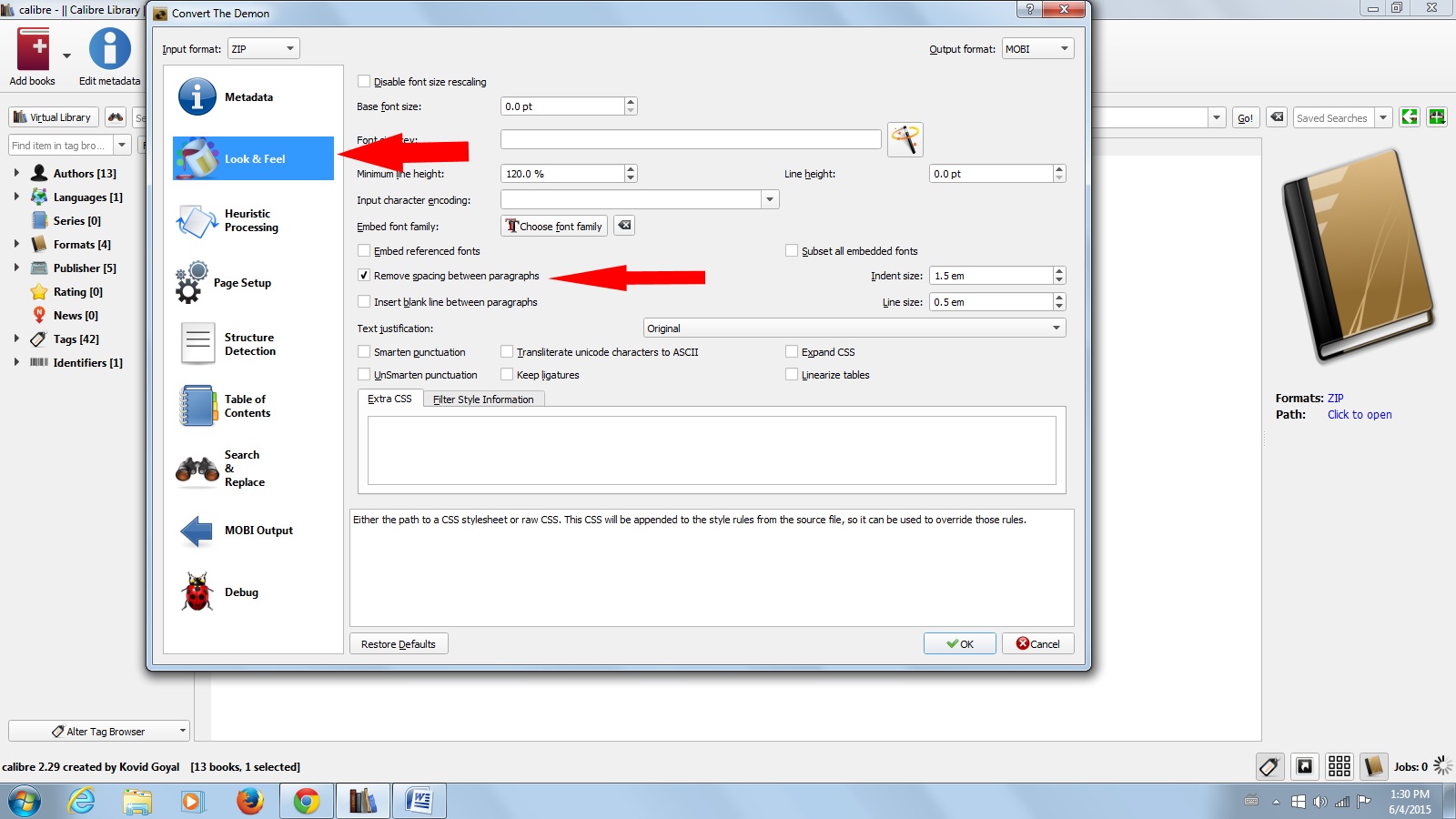
Next, click on Look and Feel to the left of the page, and decide whether or not you’d like to remove the space between paragraphs, and check or uncheck as you choose. You can play as much as you like with this, generate and delete as many copies as necessary so you end up with an eBook that you’re happy with. You can check out all the other choices with Page Setup and Table of Contents later – this is generally as far as I go because all of my formatting is already in place in my manuscript.

Calibre4

Click the OK button, and you will see a turning circle in the bottom right hand corner of the page. Shortly thereafter, you will see the Mobi format added to ZIP under your book cover image to the right. Click to open, and there you have it! You can open it on your Kindle for PC, or send it to your Kindle, and you have the Mobi file to email to anyone you like.

Calibre5

Play with the various output formats, and with books with images in them. You can publish loads of perfect eBooks straight from your computer, all by yourself.

An @COLLEENCHESEBRO INTERVIEW WITH @READEANDWRITE

Grab a cup of coffee or tea, and come on in and get comfortable. I am excited to share that I have Amy M. Reade, the author of, “Secrets of Hallstead House,” here with us this morning. First, let me share a bit about Amy so that you can get to know her. Amy reveals:

“I am an author of women’s fiction with strong elements of suspense and setting. A former lawyer, I now write in New Jersey. I have a husband and three kids, as well as two cats and a great Bouvier des Flandres (that’s a dog, for those of you who may be unfamiliar).

When I’m not writing, you will find me in the kitchen or the laundry room, but I much prefer the kitchen. I love to cook and share the things I make. I blog about writing and wine at http://amreade.wordpress.com. My website is http://www.amymreade.com.”

As many of you know, I love looking for free books on Amazon. Not to save money, but instead because many times the author is brand new and undiscovered. I love to read debut novels, and that is exactly how I found Amy Reade, through a free download on BookBub. She volunteered to write a guest post for me a few weeks back and I shared with her that I had just started reading her book. One thing led to another and here you have it, my interview with Amy Reade! Click here to read my book review of, “Secrets of Hallstead House.”

Author, Amy M. Reade

Colleen: Amy, please give us the title and genre of your book and a 30-word or less tagline.

Amy:
Secrets of Hallstead House is women’s fiction with a gothic feel to it.

Tagline: After moving to a private island in upstate New York to provide nursing care for an elderly widow, Macy must uncover secrets from her past before they destroy her future.

Colleen: How did you come up with the title of your book?

Amy: The working title was The Leaning Tree, and my editor and I felt the book needed a spookier feel to it. We discussed several options and decided that Secrets of Hallstead House had just the right amount of mystery.

Colleen: Amy, tell us about your cover art. Who designed it? Why did you go with that particular image/artwork?

Amy: The cover art came from the Kensington Art Department. I like it because it contains elements of several of the homes in the Thousand Islands. It also has a darkness to it, and the churning water looks just like the Saint Lawrence River on a stormy day.

Colleen: So, what else have you written?

Amy:
The Ghosts of Peppernell Manor, which is also women’s fiction in a gothic style, was released in April, 2015. It is the story of Carleigh Warner, a restoration specialist who moves from Chicago to South Carolina when she is hired to restore an antebellum manor house, the family home of an old friend. The family disagrees over the future of the property and Carleigh is quickly swept into the tensions, which escalate to violence that threatens Carleigh and her young daughter.

I am also in the edits stage of my third novel, which is in the same genre, this time set on the Island of Hawaii (sometimes called the Big Island). Kailani, a sous chef, leaves Washington, D.C., to return to the Big Island, where she grew up. She lands a job working as a personal chef and is soon called on to deal with more than the job description called for, with a family in desperate turmoil and an unexpected and unwanted visitor from her past. Before long the secrets and the tensions in the home begin to build and Kailani must find the courage to stay and follow her heart.

In addition, I blog most Tuesdays at
http://amreade.wordpress.com.

Colleen: Where can we buy or see your books?

Amy: Readers can find both my books on amazon.com, barnesandnoble.com, books.google.com, kensingtonbooks.com, amazon.co.uk, amazon.ca, and kobobooks.com.

Colleen: Please give us an insight into your main character. What does she do that is so special?

Amy: Macy Stoddard, the main character in Secrets of Hallstead House, is quite young when the story begins. She has suffered a personal tragedy that leads her to seek employment away from New York City. She has her own demons to face as she tries to help her patient come to grips with the deaths of her husband and daughter.

Colleen: What are you working on at the minute?

Amy: I’m plotting out a new series right now, and I’m working on the research for that.

Amy, thank you so much for letting us into the workings of your books. I always feel like I get to know an author better after learning more about the motivations behind their work. It has been a pleasure getting to know you.

Don’t forget, I love a good book! Oh yeah, guess what?

Amy loves to connect with readers!

Website: http://www.amymreade.com

Blog: http://amreade.wordpress.com

Facebook: http://www.facebook.com/amreadeauthor

Can You Give Away Free Digital Copies of your eBook When Enrolled in KDP Select? @JoRobinson176

No actually, as it turns out. Only via Amazon, and almost never via email attachment. The road to getting most things right as an Indie publisher is a steep learning curve. Knowledge is unlikely to magically appear if you can’t even imagine what questions to ask, and haven’t much of a clue what knowledge is required anyway. Most of us learn from mistakes, both large and small, along the way, and what with the continually changing and growing world of self-publishing, we really are learning all the time.

Having up to now had some of my books published for sale on Apple and Smashwords and all the rest, I wasn’t concerned about Amazon KDP Select rules as they didn’t apply. Now though, after MONTHS of working really hard to get them off Smashwords supplier sites, I’m being as careful as possible not to break any of them. I’ve decided that for this year at least, my current books will be published exclusively with Amazon and CreateSpace. With CreateSpace extended distribution my paper books are still sold by Barnes & Noble, and with the perks of KDP Select, I’m very happy with the status quo.

One rule that many of us might not have known before, is that with KDP Select you can only distribute your eBooks through Amazon. You can send copies to “professional reviewers”, but not to anyone else. This appears to include not being allowed to send out digital books as prizes in competitions. You can only distribute free books via Select’s five free book promotion days every three months. Any eBooks distributed BEFORE you sign up for KDP Select are alright, so don’t panic if you did that while not signed up for Select. You can send your paper books to anyone you like though as prizes – you’ve bought and paid for them after all.

You are not allowed to gift any eBook in exchange for a review, and if you do ever review a gifted eBook, make very sure to add a disclaimer to your review on Amazon. You are not allowed to swop reviews. I do review the books of some authors who have already reviewed some of my books, but only when I’ve bought the book, read it, and honestly liked it. I think you’re safe doing this if you don’t do it often, and are also reviewing the books of mostly unknown to you authors, but certainly don’t make review swopping part of your Indie trip, or you could find your book booted out, and your reviews taken down. If you write books on grammar, writing a scathing review of another author’s book about grammar might be taken as breaking Amazon’s rule of reviewing the books in your own field. All in all, with reviews, authors should definitely tread lightly – and certainly read Amazon’s policy on them so as to be safe, rather than sorry.

In fact, reading Amazon’s terms before we all zoomed off to publish would probably have saved some of us intrepid Indies a bruised knee or two. I’ve figured out that the two US dollars extra I pay for any eBook I buy from Amazon is for the privilege of having an account there as a non-US citizen, and this is fine with me, because it is a privilege. Buying eBooks from Amazon is a lot simpler (and mostly cheaper even with the surcharge) than buying them around here. I could never figure out why my royalty payments were different for my novels when they had the same prices though, until I got stuck into that old fine print. Turns out that your royalty at the higher rate is X minus relevant VAT minus cost per megabyte book file size. Authors pay for the delivery of their books every time a reader buys them. It’s only cents per MB, but it is a good thing to know when you’re planning on publishing a book chock full of images. One of the biggest lessons I’ve learned along the Indie path, is to always read the fine print, and the best advice I could ever give to a new self-publishing author just starting out on this road, would definitely be to figure out the rules first. Happy scribbling fellow Indies.

owl-with-tablet-hi