#BookReviews ‘The Mysterious Death of Miss Austen’ by Lindsay Ashford (@LindsayAshfordA). Faction and death in the Austen Family

he Mysterious Death of Miss Austen by Lindsay Ashford
The Mysterious Death of Miss Austen by Lindsay Ashford

Title:  The Mysterious Death of Miss Austen
Author:   Lindsay Ashford
ISBN13:  978-0753190227
ASIN:  B007BTHCIQ
Published:  October 2011
Pages:  336
Genre:  
Historical fiction. Mystery, thriller and suspense

Description:

When Jane Austen dies at the age of just 41, Anne, governess to her brother, Edward Austen, is devastated and begins to suspect that someone might have wanted her out of the way. Now, 20 years on, she hopes that medical science might have progressed sufficiently to assess the one piece of evidence she has – a tainted lock of Jane’s hair. Natural causes or murder? Even 20 years down the line, Anne is determined to get to the bottom of the mysterious death of the acclaimed Miss Austen. A compelling speculative fictional account of the circumstances surrounding Jane Austen’s mysterious death from established crime writer Lindsay Ashford, based on her own and relatives correspondence.

Review:

Thanks to Honno Welsh Women’s Press for sending me a paperback copy of this novel in exchange for an honest review.

I do like Jane Austen’s novels. Some more than others (Pride and Prejudice is my favourite at the moment, although there are some that I can’t even remember if and when I read them, so this could change), but I am not an expert on the subject or her number one fan. Still, when I was offered a copy of this book, I was intrigued. I had written a post about Jane Austen for my series of guest classical authors and it proved one of the most popular in my blog, and I remembered from checking her biography that she’d died quite young after a somewhat unclear illness. So a book exploring her death, and backed up with research into the archives at Chawton House, in other libraries, and also by careful perusal of some of her best known biographies was intriguing. (I’m also a doctor, but not in internal Medicine, and no Dr House either).

The book is narrated in the first person by Miss Anne Sharp, a governess who goes to work for one of Jane’s brothers, Edward, and his wife, Elizabeth, at Godmersham. Her personal circumstances are difficult, and not that different from those of Jane herself, a single woman, educated but of no independent means. In Miss Sharp’s case, she does not have a family to rely on and she considers herself lucky obtaining a position with a wealthy family, even if her standing is unclear (she is neither a servant to share the world of downstairs, nor a member of the family who can participate in all their social gatherings). She meets Jane when she visits and they are kindred spirits, well-read and less interested in fashion and finding a husband than in cultivating their minds and observing the world and the society around them. They soon become friends, and correspond and see each other often over the years, despite changes in circumstances, until Jane’s death.

The novel mixes well-researched data with some flights of fancy (the intricacies and complexities of the Austen’s family relationships are rendered much more interesting by suggestions of illicit affairs involving several family members, which then become one of the backbones of the hypothesis that Jane was poisoned with arsenic, providing a possible motivation). I’ve read reviews stating that if this novel had been published within 50 years of Jane’s death it could have been considered slander. This is probably true (I won’t go into detail, as I don’t want to give the plot away) but hardly the point. Yes, there are suppositions that would be virtually impossible to prove, but they help move the story along and serve to highlight the nature of the society of the time.

I liked the portrayal of Jane, indirect as it is and from the point of view of a fairly unreliable narrator. She is presented as a bright, humorous and fiercely intelligent woman, devout of her family but fully aware of their shortcomings. She is a keen observer of human nature and a good amateur psychologist, producing wonderful portraits of the people and the types they come across. There isn’t much detail about the process of getting her novels into publication, other than what the narrator conjectures, as she is no longer in the Austen’s circle at that point.

In the novel, Anne Sharp has feelings for Jane that go beyond friendship, but she never reveals them to Jane, and three is no suggestion that Jane reciprocates her feelings. One of the keys to the novel is the narrator. Although I thought the observational part of the novel was well achieved (I’m not an expert on the literature of the period, though, but I felt there was enough detail without getting to the point of overburdening the story), I was not so sure about how rounded Miss Sharp’s character was. She can be self-restrained one minute (in her relationship with Jane) and then throw all caution to the wind and risk her position with no solid basis for her accusations. And some of the theories she works with and then rejects felt a bit forced (yes, I had worked out who the guilty party was going to be well before she gets there). I didn’t dislike her, but wasn’t fully convinced either.

I enjoyed the book. The story moves along at good pace and it made me want to read more about Jane Austen’s life, and, especially, revisit some of her novels. As a murder mystery of the period, it is perhaps closer to a cosy mystery than to a police procedural (for evident reasons), with the beauty that the background and the period are well researched and fascinating in their own right. I would recommend it to readers in general, particularly to people who enjoy or are curious about Austen’s work, although I suspect that to real scholars of the subject it might appear too little and too fanciful. But if you want a good read, go for it.

What the book is about: The possibility that Jane Austen might not have died of natural causes. The story is told from the point of view of one of Jane’s friends who pieces together what she believes was the reasons and the guilty party to Jane’s murder. And not only hers…

Book Highlights: The inside information about Jane Austen and her family (although I don’t think there’s evidence of some of the fancier aspects of the story, but see above). It makes us want to go away and read more.

 Challenges of the book: Our level of engagement with the narrator.

 What do you get from it: A renewed interest in Jane Austen and her historical period.

Ratings:
Realistic Characterization: 4/5
Made Me Think: 3.5/5
Overall enjoyment: 4.5/5
Readability: 4.5/5
Recommended: 4.4/5
Overall Rating: 4/5
 

Buy it at:  
Format & Pricing:
Paperback:  $29.99 (Cheaper copies available on the site)
Kindle: $ 3.05

Hardcover: $ 27.84

Thanks to Honno for sending me a copy of the book and to Lindsay Ashford for this fascinating novel, thanks to all of you for reading, and if you’ve enjoyed it, like, share, comment and CLICK!

Olga Núñez Miret

@OlgaNM7
http://OlgaNM.wordpress.com

http://www.OlgaNM.com

#Writingtips Summary of wisdom from Jerry Jenkins (@JerryBJenkins). With thanks to Jane Friedman (@JaneFriedman)

Hi all:

I don’t know you, but I have recently been attending many webinars, on different topics. Recently (22nd October) I attended a free webinar organised by Jane Friedman that had Jerry Jenkins (21 times New York Times best selling author) as guest, on the Secrets of Storytelling.

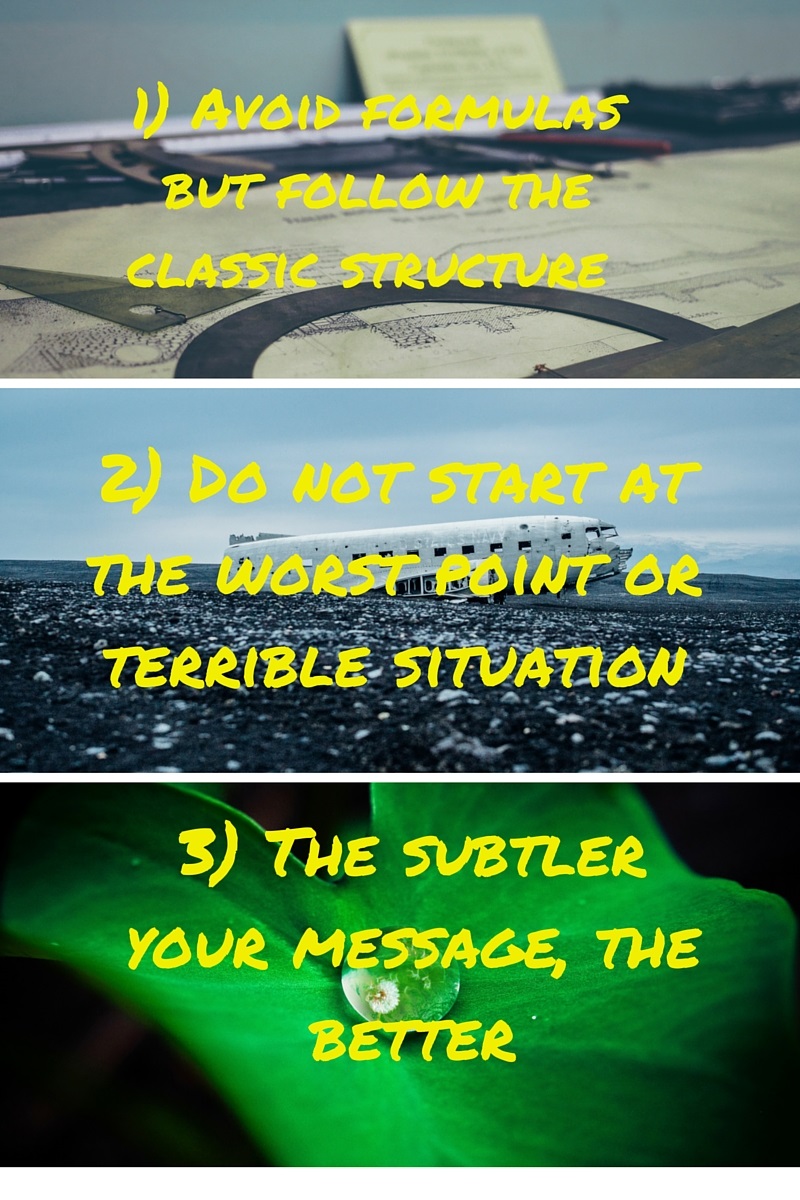
I’ve read, listened to, and attended courses, lectures and seminars, on writing. And like all advice, some will resonate more with some people than others. Although the seminar seemed geared towards people who were trying to find their confidence writing (if there ever comes such a time) rather than seasoned scribblers, I enjoyed the personal wisdom and Jerry’s style of delivery, and I thought I’d try and bring you some nuggets from it, especially as I know that quite a few people are going for NaNoWriMo. I decided to try and make it less boring with images, but we shall see if it works…

1Eng

2Eng3Eng4Eng5Eng

Although most are self-explanatory, I thought I’d give a few pointers on some.

  1. Jerry Jenkins said that formulas don’t really work, as they make the story seem… well, formulaic, I guess. He referred to Dean Koontz How to Write Best Selling Fiction when talking about the classic structure. His brief summary was: Plunge your character into a terrible situation; everything he tries to do makes the situation worse; things look hopeless, and hero saves the day (by doing what he’s learned on the way).
  2. In reference to his previous point, he said that although you have to put your characters in extreme situations, it’s best not to start the novel at that point, because it’s better to build up the character so that the reader gets to care for him or her (or them).
  3. I think it’s self-explanatory. Don’t hit the readers in the head with a hammer, although for him, there’s always a message, otherwise there’s no novel.
  4. There isn’t always romance in all novels (or movies, it might depend on genre) but it’s very common. He gave many examples of not very original ways of introducing the love interest (although referring to movies, characters bumping into each other, blind date…), but it all depends on how it’s done.
  5. His advice, that I’ve seen in many places, is that it’s best to get the story down once you get writing, and not try to edit at the same time. He said that he’d edit first thing the next day what he’d written the previous day. In the case of NaNoWriMo, unless your brain goes completely blank and can’t remember what you’ve written, it’s probably best to keep going…
  6. Nothing to add (unless it’s a peculiarity of a character).
  7. I couldn’t find a colour that would show well, so I’m transcribing: Writers are readers. Read in your genre, but also read about the craft of writing. He mentioned quite a few of his favourite books, but the world (or the library) is your oyster.
  8. In discussing point of view of the character he reminded the audience that it’s like the camera we see the action through. He mentioned the most common (first person narrated in past tense, or third person limited), and noted that perhaps for somebody starting to write, first person might be easier. He talked about his own experience of struggling with one of his stories and how he heard a particular character talking in the first person in his head, and that was it.
  9. This is a very personal take on the matter, but he observed that sometimes other characters in the story might take over and run with it.
  10. He didn’t seem to be a big lover of flashbacks explaining the background story, as he felt they slowed down the action. In real life we get to know people gradually.
  11. This one sounds a bit zen, but he referred to himself as a pantser, and said that sometimes you might get to a certain ending through writing the story, and that’s a perfect way to make sure that it’s surprising to the reader, because it’s a surprise to you too.
  12. If you’re worried, you’re on the right track. He referred to this as the ‘Exponential multiplication of emotions’ equation. If you feel sad at some point in your story, the reader will feel the same but magnified. And if you feel bored… well, you get the gist.
  13. You’re not alone. His message was that if you get stuck, there are many places where you can get help, be it virtual or real writers’ groups (his comments were invaluable but…), coaches, books, other writers…

You can check Jerry Jenkins’s page here

http://www.jerryjenkins.com/

He offers courses, including one he was promoting, later in October, but you can check his page and that of Jane for more information if you’re an interested (I have no connection with them other than attending the webinar, that was free).

Thanks to Jane Friedman and Jerry Jenkins for the the webinar and thanks to you all for reading. Do take care, and good writing. 

Olga Núñez Miret

@OlgaNM7

http://OlgaNM.wordpress.com

http://www.OlgaNM.com

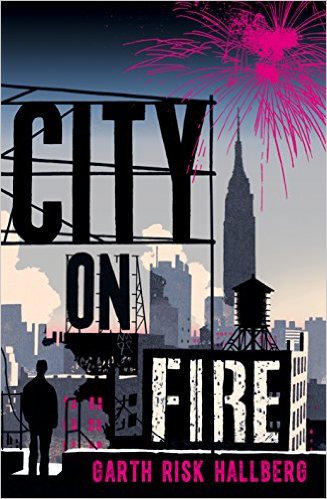
#BookReview ‘City on Fire’ by Garth Risk Hallberg. How Long Was My Novel.

City on Fire, Kindle by Gareth Risk Hallberg
City on Fire, Kindle by Garth Risk Hallberg

Title:  City on Fire
Author:   Garth Risk Hallberg
ISBN:  0385353774

ASIN:  B0104WXPR8
Published:  E-book version due on 22nd October, although available in paperback
Pages:  944
Genre:  Contemporary Fiction, urban

Body of review: 

City on Fire by Garth Risk Hallberg. How Long Was My Novel.

Thanks to the publishers (Vintage/Penguin Random House) and to Net Galley for offering me a complimentary copy in exchange for a review.

I must confess to feeling curious after reading about all the attention the novel was getting and the advance praise. Although I read a variety of authors and genres, I studied American Literature and have an affinity for it and an interest in new American writers, so I was intrigued. But, I didn’t investigate the matter further and didn’t quite realise how long this novel was.

Don’t get me wrong, I’ve read, and loved, many long novels (I love Moby Dick, although it is not quite this long, but I’ve also read War and Peace, several of Jonathan Franzen’s novels, and have never felt the length). And I’m sure I’ll read many more. Although perhaps since I’ve been dedicating more time to reviewing and reading about writing, I’ve become more impatient.

City on Fire is 944 pages long. There are many stories, all entangled into one (sort of), told from different characters’ point of view (using the third person), with some interludes that include (fictitious) documentation, like the article on Fireworkers (experts on firework or pyrotechnics) written by Richard, a reporter and writer, or the Fanzines that Sam (a young girl, fan of Punk music) writes. The novel doesn’t follow a chronological order either, and you have episodes set before New Year’s Eve, when one of the central plot events takes place —the shooting of a young girl (Sam)—, some set after, and some set many years later, with flashbacks to years before, in seemingly no particular order, although not difficult to follow (but somewhat exhausting if one is reading for long periods of time. And I wonder if it could be confusing if people read the book in short chunks). The book, set in New York, in the Seventies, refers also to a number of issues, like the financial crisis, the musical movements of the time, riots, the big blackout, art, and all those worlds are illustrated by characters from different genres, social classes, walks of life, ethnicities, sexuality and origins. Ambitious is an adjective that has been used to describe this novel, and there’s no denying that. There are cops with physical ailments nearing retirement, artist, musicians, youngsters exploring and discovering themselves, rich and unhappy families, conspiracies and financial entanglements, an anarchist group setting up fires and bombs, adultery, love, a shooting, drugs, alcohol, writing, radio… And always New York.

The author has a beautiful turn of phrase, and you can’t but admire some of his sentences, although they can have the effect of throwing you out of the story. I kept thinking of the indictment for writers, ‘Kill your darlings’, don’t let those pieces that seem like beautiful paintings decorating the book just hang there. Remove anything that has nothing to do with the story or does not contribute to its progress. But perhaps the story is not the aim of this novel. I wasn’t so sure about the characters, either. Most of them were interesting, but perhaps there was something generic about them, and despite the length of the book I didn’t get the sense that I really knew a lot of them (not the same time is dedicated to the inner thoughts of all the characters, and some of the secondary characters that are potentially interesting, like Amory, are not given a voice), and the ones I felt I knew were familiar types. The rhythm is leisurely and although at times it seems about to pick up the pace (during the blackout), the changes in time-frame and point of view slow it down again. I was somewhat puzzled at finding the interludes about the fireworks more engrossing than some parts of the novel (although I’ve always loved fireworks, but it could be the journalistic style).

Having read some of the comments, I have to agree that much of what contributes to the vastness of the novel does not necessarily add to the experience of the reader or the story (at least for me). City on Fire is a huge canvas, with some very beautiful splashes and sublime moments, but perhaps the sum does not live up to the promise of the parts. I felt it aspired to be like one of the fireworks it describes, that have several layers and fuses, and go up, and down, and then back up again, before exploding in a wonder of colours and shapes. For me it didn’t manage, but it’s impressive nonetheless.

City on Fire by Garth Risk Hollberg Paperback
City on Fire by Garth Risk Hallberg Paperback

Ratings:
Realistic Characterization: 3.5/5
Made Me Think: 4/5
Overall enjoyment: 3.5/5
Readability: 3/5
Recommended: 3/5
Overall Rating: 3.5/5
 

Buy it at:  Amazon
Format & Pricing:
Paperback:  $13.40 

Hardback: $18 
Kindle: $11.47 

Audio: $16.93 

 Olga Núñez Miret

@OlgaNM7

http://OlgaNM.wordpress.com

http://www.OlgaNM.com


#Bookreview. Conditions by Christoph Fischer (@CFFBooks). Because Normality Is Overvalued. And ‘Conditioned’ is coming soon.

Hi all:

I’m organising more interviews and in the meantime, I thought I’d share some reviews of book by independent authors that I’ve read while  I was away. I have plenty to choose from, but I chose to talk about Conditions today, not only because I’ve enjoyed Christoph Fischer’s writing in the past, and he is always hard at work promoting other writers, but because I saw that his new book, Conditioned, the continuation of the adventures of those characters will be on the 16th October and is already available in pre-order. So, what better?

Title:   Conditions
Author:   Christoph Fischer
ASIN: B00NZ1VTBU
Published:  16th October 2014
Pages:  224
Genre:  Family life

Body of review:

Conditions by Christoph Fischer

Conditions by Christoph Fischer

When Charles and Tony’s mother dies the estranged brothers must struggle to pick up the pieces, particularly so given that one of them is mentally challenged and the other bitter about his place within the family.

The conflict is drawn out over materialistic issues, but there are other underlying problems which go to the heart of what it means to be part of a family which, in one way or another. has cast one aside.

Prejudice, misconceptions and the human condition in all forms feature in this contemporary drama revolving around a group of people who attend the subsequent funeral at the British South Coast.

Meet flamboyant gardener Charles, loner Simon, selfless psychic Elaine, narcissistic body-builder Edgar, Martha and her version of unconditional love and many others as they try to deal with the event and its aftermath.


Here is my review:

I’m a psychiatrist, and what is normal and how we define normality are questions that the more one works in the field, the more one wonders about. Absence of a diagnosable mental illness is not the same as what society might think as “normal behaviour”. And each individual’s opinion on the matter is even more varied. Culture shock, for instance, results from differences in what is accepted behaviour in countries far apart (although not necessarily as far as we might think). Being transplanted into a culture or a situation brand new for us might make us question if our version of normal is the correct one. Even what might be normal for our neighbours we might consider utterly bizarre.

The author of this novel explores the reactions to a character, Charles, who has a psychiatric condition (a mental disorder unspecified in the book), by a number of people, including relatives (his brother and sister-in-law), close friends and acquaintances, complete strangers and previous employers. Charles’s diagnosis is left intentionally vague (we can speculate, based on the description of his behaviours, but that is not the point of the story. Charles’s behaviour is peculiar and bizarre at times, but he does not appear to be a danger to others and most of the time remains capable of making his own decisions and explaining himself, although not always) probably to avoid the temptation of turning the book into an apologia or a treatise to defend the sufferers of a particular illness or disorder. It is not about one set of symptoms or even one character, but it reflects back to us some of the standard reactions to people who might be affected by such a disorder. Are they really unable to do a day’s work, or is it all an excuse? Are they telling the truth or are they making up stories to get attention? Why should they be treated differently and given special privileges when they aren’t pulling their weight? Are they just exploiting the system? Should they just be locked up?

The novel is written in the third person, at times by an omniscient narrator that shares the internal thoughts of some of the many characters, at times the third person narrator simply shares what is happening, without taking any specific point of view, but rather that of an objective observer. That contrast allows us to get a better understanding of the psychological make-up and reasons behind some of the characters’ reactions, and we can compare those reactions to the facts.

Although we never get to see things from Charles’s perspective, we hear the stories of his friends (some closer than other) who are gathered, at the beginning of the book, to help him and accompany him on the occasion of his mother’s funeral. There are a number of works of fiction where a funeral brings people together to discuss the deceased, and in the process discover the true selves of those in attendance, although here, there is less discussion of Rose, the mother, and more of Charles. And also of the rest of the guests. We get to learn about them, their relationships (or lack of them), their sexuality, their weaknesses, their beliefs and interests, mostly through their conversations. All the characters have interesting backgrounds, lives and stories, and we become as curious about them as they are about each other. And we want to learn more. There is plenty of dialogue and not much description or narration. It struck me that this book would make a great play with many juicy parts for talented actors and actresses.

When we get to know both his friends and those who aren’t that close to Charles, we come to understand that all of them (and by extension, also us) have their own conditions, and we shouldn’t be so quick to judge. Even the most enlightened of us can have prejudices and misjudge others if we are not open and  refuse to take them on their own terms.

Conditions has a fascinating array of characters and is a book that will make all readers think. I believe there is or will be a second part that will follow some of the characters’ stories. I’m looking forward to it. This is the second book I’ve read by this writer and I’m happy that he has so many books available and of varied styles and genres. I’ll keep reading him, enjoying his stories and watching his career.

Ratings:
Realistic Characterization: 4.5/5
Made Me Think: 5/5
Overall enjoyment: 4.5/5
Readability: 4.5/5
Recommended: 5/5
Overall Rating: 5/5
 

Buy it at:  Amazon 
Format & Pricing: 
Paperback: $8.99
Kindle:  $3.71

And now, here is a link to the cover reveal of Conditioned where you can get more information from the horse’s mouth:

condiotioned-twitterv2

https://writerchristophfischer.wordpress.com/2015/09/16/cover-reveal-conditioned/

CONDITIONED dives back into the world of gardener Charles, his friends and the state of his mental health – one year on. We meet loner Simon and his battle with the outside world, co-dependent Martha and her abusive husband Clive, neurotic poet Catherine on the verge of getting married, Tony, who finds his strange brother Charles a challenge, psychic Elaine looking for a new direction in life and quirky widow Sarah Roseberg who has a go at sorting out all of their problems.

CONDITIONS aimed to sensitise readers and make them think about tolerance and acceptance. CONDITIONED wants readers to look beyond their attitude towards Conditions and examine what we all do and what we can do to overcome our challenges. The sequel is another snapshot of this circle of friends. Some will have improved their lives, others will not.

I can’t wait!

You can also follow news about Christoph’s books, here.

And check out his blog, where he writes about the characters and also about why he decided to write about mental health issues.

Thanks to Christoph for your book, thanks to you all for reading, and if you’ve enjoyed it, you know what to do, like, share, comment and CLICK! And I’ll keep you updated!

Olga Núñez Miret

@OlgaNM7

http://OlgaNM.wordpress.com

http://www.OlgaNM.com

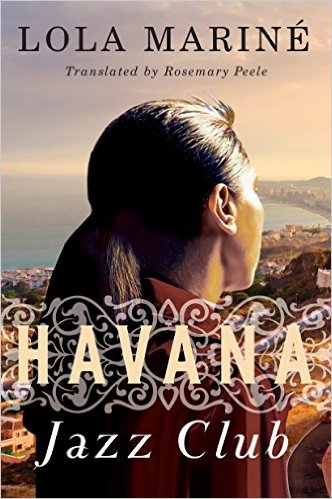
#InterviewsinTranslation ‘Havana Jazz Club’ by Lola Mariné (@bcnlola). A love story with plenty of music and a touch of Billie Holliday

Hi all:

As promised, today I bring you an interview. If you remember, I brought you Lola Mariné’s book, Havana Jazz Club when it was in pre-order and being shared in Net Galley for early reviews. Now that it has been published, it’s a great chance to have a chat with the author. First, a little information about her:

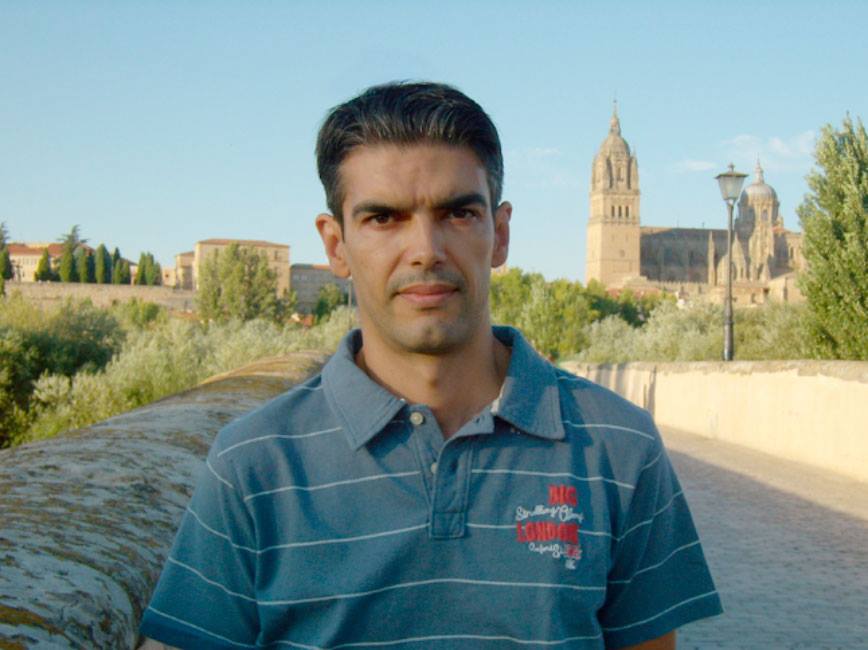
Author Lola Mariné
Author Lola Mariné

Lola Mariné is a writer and has a degree in Psychology.

She has taken part in four anthologies of short-stories: Tiempo de Recreo (2008), Dejad que os cuenta algo (2009), Atmósferas (2009) in aid of the Foundation Vicente Ferrer, and Tardes del Laberinto (2011).

Nunca fuimos a Katmandú (We Never Went to Katmandú), her first novel, was published by Viceversa in 2010. Two years later, the author published the e-book herself in Amazon and it became one of the bestselling books in Amazon Spain in 2012.

Gatos por los tejados (Cats on the roof), a book of short stories on varied subjects, was published in 2012 through Amazon.

Habana Jazz Club (Havana Jazz Club) , her second novel, was published in Amazon in 2013 and has been recently translated by AmazonCrossing to English and German.

In 2014 Parnass Publishers launched her book on travel Nepal, cerca de las estrellas (Nepal, close to the stars), also translated to English.

And in 2015 she published a children’s book called Aburrilandia, el país sin libros (Boredomland, the country with no books). She has also recently entered the second Amazon contest for independent books written in Spanish with a thriller El caparazón de la tortuga (The tortoiseshell) that is one of the five finalists. The winner will be announced on the 15th of October.

She is hard at work on a new novel and teaches courses on Creative Writing.

She is the creator of a cultural blog: http://gatosporlostejados.blogspot.com, and has a prominent and active presence in social networking sites like Facebook and Twitter.

And now, the interview:

When did you start writing?

I started writing when I was eight years old, more or less. Before that I would always tell stories out loud that I would invent them as I went along according to the requests of my listeners: love stories, horror, adventures… My audience used to be my friends and the other girls in the same class in school. The nuns (it was a religious school) would always ask me to tell stories to keep the class under control and quiet when we were doing sewing, crafts and those kinds of things.

I wrote my first novel when I was 12.

How have you found your experience as an independent writer?

The truth is that my first novel, Nunca fuimos a Katmandú, was first published in paper through a traditional publishing company (Viceversa). Luckily I hadn’t sold them the digital rights, and a year after its publication I decided to upload it to Amazon. It became a bestseller and it was one of the books that sold more copies in Spain in 2012. That encouraged me to carry on writing and publishing books and up to now I’ve already published seven. The last one, El caparazón de la tortuga, is a finalist in the 2015 Contest for Independent Writers in Spanish organised by Amazon.

Is there a moment you remember with special affection from your experience as a writer?

Without a doubt when I saw my first novel, Nunca fuimos a Katmandú, published. The day when it reached the bookshops we celebrated it with cava, and afterwards we went to visit the biggest bookshops in Barcelona to enjoy seeing it among the new books in the shelves and take pictures. It was one of the happiest days of my life: a dream come true.

There have also been wonderful moments in my interaction with readers: letters, comments, messages that moved me, where they explained to me their thoughts after reading the novel, their feelings and they also told me they admired my work. Writing is a lonely and uncertain job and obtaining that feedback from the readers is the best reward.

What’s your favourite genre (both as a reader and as a writer)?

I like to write the types of books I enjoy reading: basically stories about women, actual, real, what is called Women’s Fiction. Although in fact, among the seven books I’ve read there have appeared other genres; I have written a travel book (also translated to English), a children’s book and even an erotic novel, and now my last novel is a psychological thriller.

What made you decide to translate your book? And how did you find a translator?

Well, in my case it wasn’t my own decision but Amazon’s. They offered (as a publishing company) to translate Habana Jazz Club to English and German. And with that I also reply to your second question: they found me and they took care of everything.

Tell us something about your book

Havana Jazz Club by Lola Mariné

Habana Jazz Club (Havana Jazz Club, in English) is a love story, but it’s not a romantic novel. Love is force that drive the protagonist throughout her life, but it’s not only romantic love, it’s also the love she feels for her family, for her parents, her son, and her friends, and even for somebody who cannot return her love in the same way. It’s a story of fighting against the odds and courage and a little homage to the great Billie Holliday, whose name is shared by the protagonist.

Any advice for your peer writers (especially for new writers)?

The best advice I can give them is that they should be self-critical and humble. A lot has been said about the ego of the writers and probably there’s some truth in that. We all believe we have written the great work of art the world had been waiting for. But there are many and very good writers. If a publishing company (or several) rejects you, it isn’t because they know nothing about literature or they don’t like you; probably your work isn’t as good as it should be. Carry on working and never give up.

Links:

Havana Jazz Club in English: http://mybook.to/Havana

Her bloghttp://gatosporlostejados.blogspot.com.es/

Her books in Amazonhttp://xurl.es/hvsjr

Author page in Amazon: https://www.facebook.com/Lola-Marin%C3%A9-escritora-310677882289530/timeline/?ref=hl

Twitterhttps://twitter.com/bcnlola

I’ve had the pleasure of reading Havana Jazz Club and I leave you my review:

Love doesn’t conquer everything but art is a great consolation

The novel Havana Jazz Club by Lola Mariné narrates the adventures of Billie, a Cuban girl, daughter of a woman who adores jazz and decides to call her Billie as an homage to Billie Holiday, despite everybody telling her that ‘it’s a boy’s name’. Billie inherits her mother’s love for music, particularly jazz music, and luckily for her, that love never disappoints her. Unfortunately, the rest…

I’ve never been to Cuba and I only know about it what I’ve read in books or watched in movies. I wouldn’t dare to comment on how realistic or not the description of Billie’s life before leaving Cuba is, but her home life is endearing and loving and shows us a close and happy family. Although we all know mothers’ are always right, unfortunately Billie ignores her mother’s advice and her mistrust, and marries a boy, who isn’t only handsome but also knows it, Orlando. Billie leaves Cuba and a big chunk of her heart there, and follows her husband, and things don’t work well for them. Billie’s story once they arrive in Spain becomes one of domestic violence and exploitation. And things only go from bad to worse, to the point when she ends up living in the streets of Barcelona, where she is rescued by her guardian angel, Armando. And when things start to look up, the men in her life continue making her miserable. And I won’t tell you anything else because you must read the novel.

Lola Mariné has written a masterful melodrama. There are irredeemable baddies, goodies as sweet as sugar, terrible suffering, and talent and music, plenty of music. There were moments when I couldn’t help reading ahead convinced of what would happen, and that it would be bad, but the same as when we’re dragged by a fast current, I couldn’t do anything else but let myself go and see if I came up, unscathed, at the other side. And despite her trials and tribulations, and the disasters that pepper her journey, or perhaps because of them, the protagonist makes her dreams come true (in a small-scale but…), and creates a family made up of people who love her because she is who she is, and not because she’s been born here or there, or because it is their duty.

The part I enjoyed the most (and I loved it all) was when towards the end, the author, first through Gerardo and later through Billie herself, reflects upon the nature of creativity, about what the really important things in life are, and the tranquillity of feeling happy and comfortable in one’s own skin, without pretending or having to worry about appearances. I hope we can all reach such a state at some point in our lives.

If you enjoy novels with a heart, with unforgettable protagonists, and the stories about self-improvement and personal achievement, I wholeheartedly recommend it to you.

Thanks so much to Lola Mariné for bringing us her novel and answering our questions. Thanks to all for you for reading, and remember to like, share, comment and CLICK!

Olga Núñez Miret

@OlgaNM7

http://OlgaNM.wordpress.com

http://www.OlgaNM.com


#BookReview. Echoes of Narcissus in the Gardens of Delight by Jo Robinson (@jorobinson176). Creativity and Friendship as Weapons of Liberation

Hi all:

I’ve been catching on some of the books I had pending, and as I’ve finally got around to reading one by our fantastic Jo Robinson, I had to share. Here it is:

Echoes of Narcissus in the Gardens of Delight by Jo Robinson

Title:  Echoes of Narcissus in the Gardens of Delight

Author:  Jo Robinson


ASIN:  B00RBRYMD6

Published:  21st December 2014

Pages:  230

Genre:  Spirituality, Personal development, genre fiction

Donna, the protagonist of this novel, has been married for over thirty years to Marco, a horrible man who has made her believe she’s unstable and unworthy of anybody’s love or attention. Their daughter, Shelley, was packed to boarding school and has avoided the family home ever since. Donna has managed to survive thanks to a huge garden (partly the land of an old farmhouse) and her renewed interest in Horticulture. Researching heritage tomatoes she stumbles upon information that makes her believe perhaps her disastrous and unhappy marriage (at least for her. Her husband seems to get all he needs from the relationship and other relationships) is not her fault. And her husband’s behaviour might not be unique either. She discovers malignant narcissistic personality disorder.

Jo Robinson creates a unique set of characters and a beautifully nuanced novel of sensations and feelings out of a story that might sound familiar (I think many people who read the novel will perceive similarities between the couple in the book and some people they know, if not in the detail, at least in the essence). Despite that familiarity, the immediacy of the story (although it is told in the third person, we see everything that happens from Donna’s point of view, live her anxieties, panic, feel her frustrations, and finally, her hopes and achievements), the elements of surprise (Donna keeps some cards under her sleeve), the sympathetic and likeable characters (except for Marco), and the overall optimism of a book that shows the positive effects of creativity (gardening in this instance) and friendship make it highly recommended.

The pace of the book changes from slow and meditative at the beginning (when, like the character, we live inside of her head, in fear of what might happen if we dare to tread outside of Donna’s house and insular life) to fast-paced and full of adventures, danger and varied characters at the end. The novel flows well and we engage and root for the main character. The ending is satisfying and the novel is a pleasurable read.

Although this is a work of fiction, it reminded me of Alice Walker’s In Search of Our Mothers’ Gardens in its love for alternative ways of finding one’s calling and life-affirming creativity.

Having read the author’s blog and now one of her novels, I can’t wait to read more of her writing. I expect more fascinating topics and engrossing stories.

As a side note, I’m a psychiatrist, and narcissistic personality disorder is one of the well-described personality disorders in several psychiatric classifications. Most psychiatrists would distinguish between mental disorders and mental illnesses. Personality disorders manifest themselves as a series of traits of an individual’s personality (as such they appear from a young age, and continue to manifest themselves, in most cases, throughout the person’s life). They are considered disorders when they have a negative impact on the life of either the person, others who relate to them or often both, and in most cases are extreme manifestations of characteristics that a lot of people might share. Among other personality disorders are: borderline personality disorder, paranoid, obsessive, depressive, anxious, antisocial…Mental illnesses are mental disorders too, although those appear at a certain point in life and like other illnesses can last for a period of time and get better (with treatment in most cases, although some mental illnesses run a chronic course and it’s more difficult to be specific as to when they are “cured”. It is usually possible to recall a time before the illness became manifest). People suffering from personality disorders might present with short-lived pseudo-psychotic symptoms (delusions or hallucinations), although in the case of Marco there doesn’t seem to be any evidence of that (or at least Donna does not describe delusions or hallucinations). It is likely though that if we scored Marco using the PCL-R (Psychopathy Checklist-Revised) he would score above the cut-off point for psychopathy, although this is not a specific psychiatric diagnosis.

Ratings:
Realistic Characterization: 4/5
Made Me Think: 5/5
Overall enjoyment: 4.5/5
Readability: 5/5
Recommended: 5/5
Overall Rating: 5/5
 

Buy it at:  Amazon
Format & Pricing:
Paperback:  $8.99 

Kindle: $ 3.91

Thanks for reading and if you ‘ve enjoyed it, like, share, comment and click!

Olga Núñez Miret

@OlgaNM7

http://OlgaNM.wordpress.com

http://www.OlgaNM.com


#InterviewsinTranslation. ‘Color of Evil’ by @ArmandoRodera. Not your usual thriller.

Armando Rodera Color of Evil

Hi all:

As you know I’ve been sharing interviews with writers who usually publish their books in Spanish but who have now had one or several or their novels translated to English. Today I have as a guest Armando Rodera one of the authors who first discovered the possibilities of self-publishing his work, and who has lived through many changes in publishing. But I’ll let him tell us all about it.

Author Armando Rodera

I was born in Madrid in 1972, and I became a voracious reader from a very young age. I studied Telecommunications and IT, and worked for a decade in the technological sector until I decided to go into literature.

Pioneer of digital publishing in Spain, I landed in Amazon in 2011. Since then and in the last four years, I’ve become the published author of El color de la maldad (Color of Evil), a bestseller police-thriller that was my first publication, La rebeldía del alma (The Rebellion of the Soul), an intimate thriller that has been global number 1 in Amazon Spain, Juego de Identidades (Game of Identities), novel of action and adventures, and Caos absoluto (Absolute Chaos), a dystopian police thriller. I also have a non-fiction work, La llave del éxito (The Key to Success). I’ve published all these titles independently in Amazon.

My first traditionally published work was El enigma de los vencidos (The enigma of the defeated), a mystery novel with a historical background that was published by Ediciones B in 2012. In 2014 Thomas & Mercer published the English version of El color de la maldad, which has been very successful in the USA, UK and Canada.

I’m also editorial reader, manager of content and freelance consultor in projects of marketing online and new technologies applied to the publishing sector.

When and how did you start writing?

I’ve been writing since I was a small child, either handwritten letters or short tales. When I was 11 or 12 I won a writing competition at school. After that, once at college, I dared to write some nonsense that was soon forgotten. It wasn’t until the end of 2003, a period with numerous changes in my life, not only personal, but also with regards to my family and my profession, that I decided to take the plunge and I started on my first novel, El enigma de los vencidos. An inflection point that was also greatly influenced by my reading the fantastic La sombra del viento (The Shadow of the Wind), by Carlos Ruiz Zafón. I told myself that someday I also wanted to write a great work and if I could ever managed to make one of my possible future readers feel even a tenth of what I had felt when reading that novel I’d be more than satisfied.

Describe your experience as an independent writer.

I wrote my first two novels between 2004 and 2007. After that I went through all the stages that any new writer has tried in order to get his works published: submit to book awards, send the manuscripts to agencies and publishing companies, etc. I even had a contract signed with a company that self-published books in paper, but finally that was rescinded for a variety of reasons. Finally I gave up trying to follow the usual routes of the sector and decided to publish in Amazon in July 2011, when a lot of people didn’t even know of the existence of the KDP platform for authors.

In a few months my life changed completely. El color de la maldad very soon became a bestseller in America and El enigma de los vencidos did the same in the Brand-new Kindle store in Spain. That novel was then taken up by Ediciones B, but I continued to publish on my own, and I even manage to reach the global number one in Amazon.es with La rebeldía del alma and many successes with my other works.

Then came the launching in the Anglo-Saxon market of Color of Evil and that was the fulfilment of another dream of any writer. Digital technology and Amazon Kindle Store have allowed me to reach dozens of thousands of readers all over the world and this is something that I could never have imagined when I started writing my first book.

What has been the best moment of your career as a writer so far?

At the beginning of 2012, Ediciones B and B de Books pushed for a new model, and trusted authors that were practically unknown to the great public, but who had been successful with their digital novels. That group of authors that I was a part of appeared in several national newspapers and magazines in Spain (El País, El Mundo, El Periódico de Cataluña, Tiempo, Interviú, etc) and we had great media repercusion.

Shortly after that, our novels were presented in an incomparable setting, the Feria del Libro de Madrid (The Book Fair of Madrid), in the well-known Parque del Retiro (Retiro Park) of Madrid. In my case I was lucky enough to be signing books for two days at that Book Fair, some memorable afternoons I’ll remember forever. Also, the book was distributed throughout the whole of Spain and some American countries with a great reception. Of course, it’s a wonderful feeling to find your own novel on the new books exhibits in the bookshops. I’ll always have a wonderful memory of that experience and I hope to repeat it again in the near future.

What’s your favourite genre (both as reader and as writer).

When I was a young child I fell in love with the novels of Alexandre Dumas and Jules Verne, adventures that have marked me forever. After that, already at high school, I became familiar with the works of Stephen King, who has become one of my favourite authors. Among the writers of detective stories I can’t forget Conan Doyle and his wonderful Sherlock Holmes. And much later I lost myself in Daniel Sempere’s stories, and his Cementerio de los libros olvidados (Cemetery of Forgotten Books), a crucial moment in deciding to dedicate myself to writing.

In general I enjoy thrillers, detective and police stories, adventures, intrigue and also historical novels or even horror novels. I’m an avid reader and I devour between 60 and 80 books per year. I love to read. I can mention many names: John Grisham, F. Forsyth, Ken Follet, Preston & Child, S. King, David Baldacci or Dean Koontz, among others. And of course, Spanish authors as popular as: Pérez Reverte, Almudena Grandes or Matilde Asensi, although in the last few years I’ve had the pleasure of personally meeting and enjoying the books of a new batch of Spanish writers creating new works today, in paper as well as in digital formats, that perhaps aren’t quite as well known to the big public.

That as a reader. As a writer I also tend to write in the same genres. Definitely, action and intrigue novels, thrillers, if we want to define them that way, but always with something else: drama, mystery, police procedural elements, some romance, a historical or suspenseful background. I like to fuse genres.

What made you decide to translate your work? And how did you find a translator?

My novels have been very well received in the States from the moment I started on my digital adventure, and that was why I wanted to reach the Anglo-Saxon market. I studied the possibility of getting one of my books translated independently, but the costs were prohibitive for me or the quality of the work offered for me to sample did not convince me, and I parked the project for a while.

Then I heard about the possibility of sending a proposal to Amazon Publishing, the editorial arm of Amazon. That’s what I did with my novel El color de la maldad, and to my surprise, in less than two months they decided to send me a contract for the book. They got it translated and published it in 2014 under Thomas & Mercer’s company, the publisher of the group specialising in thrillers and mystery novels.

Color of Evil has been number 1 for several weeks in the Police procedural category in the Canada Kindle Store, and also Top 20 in the category of International thrillers in the United Kingdom. It was also a prominent thriller in that category in Amazon.com, staying in the podium of ‘Mystery and International Crimes’ for several weeks.

Tell us something about your book

Color of Evil by Armando Rodera. Transl. Simon Bruni

The genesis of this novel came in the spring of 2007, when after visiting as an occasional tourist several rural areas in our country; I had the inspiration that they could be the perfect opening point for an unconventional police procedural novel. From then on I began to build up a plot that became more and more similar to the Anglo-Saxon thriller, becoming somewhat detached from the usual canons of the classical noir Spanish crime novel.

What I found more difficult to create was the character of Jason, the psychopath around whom the whole plot revolves. He was the most complex of all the protagonists, due to the complexity of his psyche. I wanted to narrate what the psychopath felt and thought from his own point of view, and it was hard work, and that was why I also explained his childhood and adolescence, the main triggers, but not the only ones that lead him to become a blood-thirsty assassin.

When I started writing I knew the novel would revolve around a serial killer that leaves a trail of crimes throughout the whole of the Spanish geography, but I didn’t have his leitmotif. I had in mind the film Seven or Harris’s novels with Doctor Hannibal Lecter as protagonist, but I had no idea which path the novel would lead me into until I started writing. Later I found a solution that might surprise readers quite a lot.

In the first draft I didn’t name the assassin and the narration became quite complicated at times, especially during his interactions with other characters. I wanted to give him a name he chose himself, Jason, although we don’t get to know the real one until the end, to help with the plot building and to embody on someone concrete the brutality of those criminal acts.

I would never have imagined the reception my novel got, especially in America. “El color de la maldad” was published on Amazon.com in July 2011 and for over three years it has been the best-selling police procedural in Spanish in the American continent, becoming a longseller in América. The reviews and comments about this novel, in both sides of the Atlantic, have been almost unanimous throughout its trajectory, something I’m very proud of. The icing on the cake was a joint reading organised on the net, where 16 blogs agreed to write very positive reviews about this book.

Any advice for your colleague writers (especially new writers)

I don’t feel qualified to give advice; I’m still fighting and learning every day. But to any new writer I would tell him or her that this is a long-distance race, that one must fight for the things one believes in, but also make sacrifices. Read and write every day, learn from those who know more than us and try and improve every day. And above all, to have a polished and as perfect as possible manuscript if they want to publish it through Amazon, with the right formatting and an attractive cover. After that one can do as much promotion as one likes but the readers have the final word and if they don’t like a work, it will all be in vain. We are all different and so are our challenges, but we have the right to fight for our dreams.

Links:

Universal link to the book in Amazon: http://mybook.to/ColorofEvil

Author webpage: www.armandorodera.com

Author profile in Amazon:  http://Author.to/ArmandoRodera

Book trailer (in Spanish): https://www.youtube.com/watch?v=m5w455O909U

Book review in a blog, in English:

http://gabixlerreviews-bookreadersheaven.blogspot.com.es/2014/07/color-of-evil-by-armando-rodera-would.html

Thanks so much to Armando Rodera for his interview and for sharing his book with us, thanks to all of you for reading, and you know what to do, like, share, comment and CLICK!

#BookReview @OlgaNM7 ‘To the Survivors’ by @robert_uttaro. . Helping Survivors of Sexual Abuse and What It Means

Hi all:

I’m back after my few weeks away and I hope to be contributing fairly regularly again. I am waiting on some interviews in translation and I’ve been reading a fair bit, so I hope to keep the reviews coming. But first, this book was submitted for review a while back and for a variety of reasons it took me some time to get around to reading it, but finally, it’s here.

To the Survivors: One Man's Journey as a Rape Crisis Counselor with True Stories of Sexual Violence by Robert Uttaro
To the Survivors: One Man’s Journey as a Rape Crisis Counselor with True Stories of Sexual Violence by Robert Uttaro

Title:   To the Survivors: One Man’s Journey as a Rape Crisis Counselor with True Stories of Sexual Violence
Author:   Robert Uttaro
ISBN:  149093166X

ISBN13: 978-1490931661
ASIN:  
Published:  October 23rd 2013
Pages:  268
Genre:  Non-fiction, social issues, sexual abuse

Thanks to the author and to Lit World Interviews for offering me a copy of this book in exchange for an honest review.

Robert Uttaro’s book is part memoir, part manual, part collection of testimonies, part panegyric, and part call to action.

It is undeniable that Mr Uttaro, a volunteer with an organisation that helps survivors of sexual assault, is dedicated, enthusiastic, well-informed and keen to spread the word and give a voice to those who have suffered this most horrible of attacks.

The book is a combination of the narration of how he became involved with the organisation (that is never directly named. I’m not clear if it is due to a wish for keeping the focus on the issue at hand rather than on one organisation in particular or due to confidentiality, or both), his training, the different roles he has partaken in throughout his years of work, and his attempts at collecting a number of testimonies of survivors.

By the nature of the material and the experiences of those who agreed to take part, there is some repetition of points (issues like blaming the victim, blocking memories, the devastating consequences of such abuse) that is totally understandable. The testimonies don’t seem to have been heavily edited, although interestingly enough sometimes we get different versions of the stories (and one of the survivors contributing to the book explains that part of the training of those survivors who agree to share their experience is advising them on how to bring the main points home and how to keep the attention of listeners) and more detailed explanations, not so much of the abuse (this is not a scarily graphic book or even one that could cause easy titillation and reproduce the abuse in hands of certain individuals), but of the feelings it engendered on the survivors.

Even with that, there are editorial decisions that could be questioned. Would a different ordering of materials be more effective? Would illustrating specific points with testimonies work better? Would it be best to give the voice directly to the survivors rather than have an intermediary? There are quite a few memoirs and direct accounts of survivors, is this book different enough? The combination of both, the experience of a volunteer who has not himself suffered abuse (or at least he is not aware of it, although he and others have questioned that possibility) and the testimonies of survivors, is perhaps the most distinctive aspect of the project. In a way, the book is personal for Mr Uttaro, and his level of involvement and emotional investment is clear. At the same time, the book is not personal enough, and I wasn’t sure I got to know Mr Uttaro other than through his involvement in the cause and some comments by the survivors (but these might have been minimised). As happens in documentaries, a decision is usually made of either including the person doing the documentary in the story, or letting events talk for themselves, trying to make narration invisible. I did not feel we fully get to understand Mr Uttaro’s journey or where he is coming from. He and the book have the heart in the right place and offer information and useful points, but I am not sure this is a book for general reading. It might benefit from adding links to organisations helping people who have suffered sexual abuse/assaults, including a section on general advice that could be used no matter the location, and perhaps, if the focus was going to be the methods and the ethos of the organisation (or others working on similar topics), adding a section about the history of the project, how it came about, and interviewing other people who are also part of the project: therapists, organisers, etc. I feel there might be the makings of several books here that could further deepen people’s understanding of the issues at hand, but perhaps that is a project for the future, and this book is a great start.

(I have not included the usual rating system as it didn’t seem appropriate to the book and it is not always relevant to non-fiction projects).

Buy it at: 
Format & Pricing:
Paperback:  $11.66 http://www.amazon.com/dp/149093166X/

Kindle: $ 1.54  http://www.amazon.com/dp/B00GENS6ZI/

 Thanks to the author for bringing us his book, thanks to all of you for reading, and if you’ve enjoyed it, like, share, comment and CLICK!

Olga Núñez Miret

@OlgaNM7
http://OlgaNM.wordpress.com

http://www.OlgaNM.com

Bye, Bye for now @OlgaNM7

Hi all:

Today just a short post to let you know that from later this week I’ll be away and going to a place where I don’t expect to have regular access to internet. My Dad passed away earlier this year and my Mom and I are going to the little hamlet where he was born to take his ashes, visit relatives and try to sort a few things out. I’m not sure when I’ll be back, but I hope it will be some time in early September.

I hope I’ll have some time to catch up on some reading, writing, and will come back full of ideas, and definitely reviews. And a few more interviews that are coming my way soon.

I thought I’d leave you a present, if you don’t mind. I’ve been quite busy recently with the publication of my new YA series, Angelic Business. By the time you read this post, the three books will have been published already, and to give people a bit of an incentive, I decided to make the first book in the series, Angelic Business 1. Pink Matters free.

Here I leave you the description and links. And if you know anybody who might be interested, please, pass it on:

Angelic Business 1. Pink Matter by Olga Núñez Miret

You are Pink, not the prettiest girl, but smart and with plenty of resources. What do you do when your best male friend offers to have sex with you, because he thinks you’re a lost cause? You plot your revenge with your two best female friends, of course!

It seems you’re in luck when a new and mysterious student appears. And, to top it all, he seems interested in you too. He could take part in the plan. But then, he seems to have a plan of his own… He insists he’s not just an ordinary boy. And what seemed so easy to begin with, gets more and more complicated when Heaven and Hell come knocking at Pink’s door.

Pink Matters is the story of Pink, a 17-year-old girl, a good student, articulate and smart. But she has never been the centre of attention or made the top ten of the most popular and attractive girls at school. When two guys, both claiming to be angels, insist that she is, indeed, ‘special’, fight for her attention and help, and tell her she is the key to the future of the universe, she can’t help but ask: Why me?

Amazon:

http://rxe.me/YIHTW96

Apple:

http://apple.co/1Kuzdl8

Kobo:

http://bit.ly/1LU77jt

Nook:

http://bit.ly/1eLMTOG

Page Foundry:

http://bit.ly/1eMLfN9

Scribd:

http://bit.ly/1eOkmZ5

Book launch:

http://bit.ly/1KcPtI6

Oyster:

http://bit.ly/1OqgMQ6

Thanks so much for reading, see you soon, and don’t forget to CLICK! Ah, and just in case, the book is also available in the Spanish version. 

#Bookreview ‘The Man Who Watched Women’ (A Sebastian Bergman Thriller) by Michael Hjorth and Hans Rosenfeldt. Sometimes expectations can be a killer

The Man Who Watched Women

Title:   The Man Who Watched Women (A Sebastian Bergman Thriller) 
Author:   Michael HjorthHans Rosenfeldt 
ASIN:  B00TQDWIHK
Published:  June 18th 2015
Pages:  528
Genre:  Psychological thriller

Sometimes expectations can be a killer

Thanks to NetGalley and the publishers for the ARC copy of The Man Who Watched Women.

Like most people in the planet (particularly readers) I’m well aware of the phenomenal boom Scandinavian thrillers have experienced in the last few years. I must confess I haven’t read that many of the novels (I have read some Wallander novels and a few others), but I’m a big fan of the TV series. I stumbled upon The Killing, then after watching the BBC version of Wallander I watched the Swedish version (well, there seem to be several), and then The Bridge blew me over, and I recommended it to everybody I met (near enough).

So when I read about this novel and the fact that one of the writers had written The Bridge, I had to get it.

And then, expectations can be a killer.

This is, evidently, the first in a series of novels with Sebastian Bergman, a psychologist expert in serial killers who has experienced a terrible personal loss, as the protagonist. The novel takes on the points of view of most of the characters, including the killers, all the members of the investigative team, and some minor characters (although it is written in the third person). And that was my first issue. I’m not sure if it’s a problem with the formatting of the draft copy I received, or it is intentional, but there is no way of distinguishing when there is a change of point of view. Sometimes within the same paragraph there will be two different characters (or rather, it will pass from one to another), creating confusion, especially at the beginning when you don’t know who anybody is or what is happening. So you need to be on your toes, and not only due to the nature of the story.

Then, the characters. The case itself is interesting, although I’m not sure it’s the most interesting novel with a serial killer (or more than one, but I don’t want to spoil the story) that I’ve read. But I did not find any of the characters likeable enough. Most of them were interesting, but I found it difficult to connect with them. Sebastian is a complicated man, with an awful tragedy in his past, but he is a dislikeable human being, and other than intelligence (and he’s not at his sharpest throughout the novel) there are no redeeming qualities I could find. I also thought there were inconsistencies, like his reaction to a woman who comes into his life during the book (and there were many women in his life, and that’s the central issue, although I found it difficult to see why…), his lack of insight, and his proclaimed love for somebody but total inability to reveal a crucial bit of information that would have made everything easier and possibly mark the difference between life and death for the said person. Egotistical, and as personality disordered as the criminals he studies, he lacks the charm that might make understandable the attraction others seem to feel towards him. Yes, he’s at a low moment, but there is no evidence that he’s ever been any different, apart from possibly with his family, and we only have his memories to rely on. The ending might have been intended as some sort of redemption for Sebastian, but I thought it was too little, too late.

The rest of the characters didn’t fare any better for me. Again some were interesting, but either we didn’t get to know enough about them, or they were presented in such a single-minded fashion that it was not easy to make a connection. I thought Billy and Torkel might have some potential, but there was not enough about them to know. I was not sure about the female character who invades Sebastian’s life. She appears disturbed, and considering he’s a psychologist he should notice, even in the circumstances, and the authors add a twist at the end regarding her character that felt a bit tagged on to ensure a second part. Ursula has potential but I wasn’t sure the snippets of information we were given hang together and the surprise at the end… Well, maybe she’ll be developed further. Vanja… other than being a good police woman, and easily irritated, there was nothing else. Hinde, the baddy, is a psychopath, intelligent, with his own traumas, but no particular appealing characteristics.

There were things in the plot that I wasn’t so sure about. The psychologist Sebastian is visiting at the beginning, who was a promising character, disappears suddenly, and he’s never even questioned, despite one of the victims being his patient. When they are trying to track several people throughout the book, they never try to find them through their mobiles, even when they get phone messages sent to them from the said individuals. Although they know about one of Hinde’s associates, and they know he’s somehow involved, he disappears and it’s not clear what efforts, if any, are being made to track him down. And they should have paid attention.

All in all, maybe somebody who comes to the book without my expectations will find it more satisfying. I suspect I was expecting far too much. It is an interesting book, for sure, but I won’t be coming back for the second part. (And if the commercial edition is better formatted and a paragraph given to each character, that would definitely help).

Ratings:
Realistic Characterization: 3/5
Made Me Think: 4/5
Overall enjoyment: 3/5
Readability: 2/5
Recommended: 3/5
Overall Rating: 3.5/5
 

Buy it at: 
Format & Pricing:
Hardback: $19.00 http://www.amazon.com/Man-Who-Watched-Women/dp/1780894554/
Kindle: $10.91 http://www.amazon.com/Man-Who-Watched-Women-ebook/dp/B00TQDWIHK/

Olga Núñez Miret

@OlgaNM7

http://OlgaNM.wordpress.com

http://www.OlgaNM.com

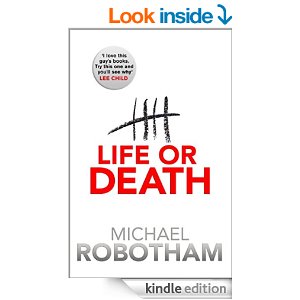
#BookReview ‘Life or Death’ by Michael Robotham. A escape from prison and conspiracy novel rolled in one. And a main character you won’t forget

Title:   Life or Death
Author:  Michael Robotham
ISBN13: 978-0316252034
ASIN:  B00HP4HABG
Published:  July 2014
Pages:  449
Genre:  Mystery, Thriller

Life of Death by Michael Robotham


Thanks to the publishers for providing me a free copy through Net Galley.

This novel’s tagline is The Shawshank Redemption meets No Country for Old Men and it is fairly accurate.

Audey Palmer escapes prison the day before he was due to be released, and everybody, including the inmates of the prison, wonder, why? This question propels the novel where Robottam makes a skilful use of third person point of view that alternates between a large cast of characters, but they are all so distinct that the reader never loses track.

From Audey, whose memories are slowly uncovered, to a diminutive but feisty FBI female agent, Moss, the prisoner of the next cell and a deeper character than at first appears, a sheriff hell bent on revenge, we get to see things from their perspective, whilst at the same time we’re not shown the whole story until the very end. The pieces fall into place eventually, and although we might have our suspicions, everything fits in beautifully. Considering the times and the stories in the news, unfortunately the truth behind the case does not feel like a huge stretch of the imagination.

Audey is a survivor against all odds but at the same time has an uncanny talent for being in the wrong place at the wrong time. When asked about it, he comments that he must have broken a mirror and found a horseshoe in the same day. There are many coincidences throughout the plot, but then life is full of them and there is an internal logic to the characters and the story that pulls it all together. Audey has something of the tragic hero as fate seems heavily stacked against him but he never gives up. And those on his side seem to grow in stature by coming into contact with him.

The style of the novel is easy to read, well-paced and at the same time beautifully written, with some gems of insight and style. I also loved the dry sense of humour and the pathos. The plot and the story keep us engaged, but the level of writing and the skill lift it above the humdrum standard thriller. This novel will work equally for people who enjoy complex characters and those who prefer an action filled adventure. A great book.

Life or Death in audiobook format

Here I leave you the description and some editorial reviews:

Why would a man serving a long prison sentence escape the day before he’s due to be released?

Audie Palmer has spent ten years in a Texas prison after pleading guilty to a robbery in which four people died and seven million dollars went missing. During that time he has suffered repeated beatings, stabbings and threats by inmates and guards, all desperate to answer the same question: where’s the money?

On the day before Audie is due to be released, he suddenly vanishes. Now everybody is searching for him – the police, FBI, gangsters and other powerful figures – but Audie isn’t running to save his own life. Instead, he’s trying to save someone else’s.

Michael Robotham has created the ultimate underdog hero, an honorable criminal shrouded in mystery and ready to lead readers on a remarkable chase.

Editorial Reviews

Review

“Life or Death is a nerve-shredding thriller with the heart and soul so often missing from lesser crime and suspense novels. I couldn’t stop reading, yet I didn’t want Audie’s story to end. Robotham is an absolute master.”―Stephen King

“A pitch perfect plot with a stunning twist that involves a sheep in wolf’s clothing. Talk about topsy turvy — but it works — big time.”―Steve Berry, author of The Lincoln Myth and The Jefferson Key

“Robotham has a talent for creating fascinating and complex characters, and Audie Palmer may be his best yet.”―Booklist (starred review)

[A] prison-break tale with a twist . . . The writing is top-notch . . . Plenty of edge-of-the-seat excitement, forcing readers to frantically turn the pages to find out how all these different strands intersect. Robotham’s skill as a writer remains undeniable: He offers memorable characters caught up in an irresistible story.”―Kirkus Reviews

“Michael Robotham is the real deal.”―David Baldacci

“Robotham is a first-class storyteller.”―Associated Press

About the Author

Michael Robotham is author of Watching You, Say You’re Sorry, Bleed for Me, Shatter, and other novels of suspense. A former investigative journalist who has worked in Britain, Australia and the US, Robotham is one of the world’s most acclaimed authors of thriller fiction. He lives in Sydney with his wife and three daughters.

Ratings:
Realistic Characterization: 4.5/5
Made Me Think: 5/5
Overall enjoyment: 5/5
Readability: 5/5
Recommended: 5/5
Overall Rating: 5/5
 

Buy it at: 
Format & Pricing:
Paperback:  $15.99 (http://www.amazon.com/Life-Death-Novel-Michael-Robotham/dp/0316252034/)
Kindle: $17.15 (http://www.amazon.com/Life-Death-Michael-Robotham-ebook/dp/B00HP4HABG/)

Audiobook: $22.08 (http://www.amazon.com/Life-or-Death/dp/B00LU0RCVO/)

Thanks so much for reading and you know what to do, like, share, comment, and CLICK!

Olga Núñez Miret

@OlgaNM7

http://OlgaNM.wordpress.com

http://www.OlgaNM.com


#Bookreview ‘Havana Jazz Club’ by LolaMariné (@bcnlola) Love doesn’t conquer everything but art is a great consolation. And an opportunity

Hi all:

I have quite a few reviews that I have accumulated and I plan on sharing some in the coming weeks, but I saw an opportunity for other people who love to review books, and also a chance to help a Spanish author whose books I enjoy.

Lola Mariné (here her Amazon page) is from Barcelona too, and although I haven’t met her personally, I’ve had the pleasure of interacting with her on a variety of occasions, mostly in Facebook. Yesterday, through Twitter, she sent me a message to let me know that one of her novels ‘Havana Jazz Club’ that I read a while back and thoroughly enjoyed (although when you read the review you’ll see that enjoy is not perhaps the best word to use, as the book really pulls at one’s heartstrings) had been translated to English (it was chosen by Amazon and they’ve managed the translation) and was now available to reviewers in Net Galley, FREE. I am signed to Net Galley and it’s a great way to get a flavour for new books (both from independent authors and publishing companies, big and small) and yes, it gives one access to books before they are published. Not all the books (some have copyright restrictions and it might depend on where you live if you have access to it or not).

As the book is not going to be officially published until late in August, I thought I’d take the chance to leave you my review for the Spanish version (translated, don’t worry), and would see if any of you who might be signed onto Net Galley could be interested in reviewing it too. I didn’t see any restrictions on the page that is this one:

https://s2.netgalley.com/catalog/book/69985

First I leave you some information about the book and the author.

Havana Jazz Club by Lola Mariné

Description

Translated from Spanish by Rosemary Peele

Like Lady Day, Billie is young when she falls in love for the first time. Lured by her new playboy husband, the beautiful, trusting woman leaves her close-knit and caring family in Cuba to follow him to Spain. Once there, he reveals his true—and violent—nature, and Billie chooses the dangers of the street over the abuses of the man she once loved. Soon she finds herself with trouble to spare and nowhere to turn, but when her voice lands her a spot at the Havana Jazz Club, she discovers a new, unconventional family in a city far from the one she left behind. And with every high note and heartbreak, Billie skirts destiny to write her own song.

A Note From the Publisher

Lola Mariné is a writer, licensed psychologist, and actress. Born in Barcelona, she worked in show business in Madrid for twenty years before returning to her hometown. There, she earned a degree in psychology while teaching theater workshops to children. She has contributed to four anthologies, Tiempo de recreo (Playtime), Dejad que os cuente algo (Let Me Tell You Something), Atmósferas (Atmospheres), and Tardes del laberinto (Evening of the Labyrinth), and wrote Gatos por los tejados (Cats on the Roofs), a collection of short stories. Her first novel, Nunca fuimos a Katmandú (We Never Went to Kathmandu), was published in 2010.
And here, my review (a word of warning. As explained this is a review of the original Spanish book, although considering Amazon has handled the translation I assume it will be good, but I’ve downloaded the book and will try and check as soon as  I can).

Havana Jazz Club by Lola Mariné. Love doesn’t conquer everything but art is a great consolation

The novel Habana Jazz Club by Lola Mariné narrates the adventures of Billie, a Cuban girl, daughter of a woman who adores jazz and decides to call her Billie as an homage to Billie Holiday, despite everybody telling her that ‘it’s a boy’s name’. Billie inherits her mother’s love for music, particularly jazz music, and luckily for her, that love never disappoints her. Unfortunately, the rest…

I’ve never been to Cuba and I only know about it what I’ve read in books or watched in movies. I wouldn’t dare to comment on how realistic or not the description of Billie’s life before leaving Cuba is, but her home life is endearing and loving and shows us a close and happy family. Although we all know mothers’ are always right, unfortunately Billie ignores her mother’s advice and her mistrust, and marries a boy, who isn’t only handsome but also knows it, Orlando. Billie leaves Cuba and a big chunk of her heart there, and follows her husband, and things don’t work well for them. Billie’s story once they arrive in Spain becomes one of domestic violence and exploitation. And things only go from bad to worse, to the point when she ends up living in the streets of Barcelona, where she is rescued by her guardian angel, Armando. And when things start to look up, the men in her life continue making her miserable. And I won’t tell you anything else because you must read the novel.

Lola Mariné has written a masterful melodrama. There are irredeemable baddies, goodies as sweet as sugar, terrible suffering, and talent and music, plenty of music. There were moments when I couldn’t help reading ahead convinced of what would happen, and that it would be bad, but the same as when we’re dragged by a fast current, I couldn’t do anything else but let myself go and see if I came up, unscathed, at the other side. And despite her trials and tribulations, and the disasters that pepper her journey, or perhaps because of them, the protagonist makes her dreams come true (in a small-scale but…), and creates a family made up of people who love her because she is who she is, and not because she’s been born here or there, or because it is their duty.

The part I enjoyed the most (and I loved it all) was when towards the end, the author, first through Gerardo and later through Billie herself, reflects upon the nature of creativity, about what the really important things in life are, and the tranquillity of feeling happy and comfortable in one’s own skin, without pretending or having to worry about appearances. I hope we can all reach such a state at some point in our lives.

If you enjoy novels with a heart, with unforgettable protagonists, and the stories about self-improvement and personal achievement, I wholeheartedly recommend it to you.

Here is the link to the novel in Amazon, but as I said, it’s not published  yet. Although you can pre-order it.

http://www.amazon.com/dp/B00U2ZMTZC/

Sorry for not following the usual format but it’s a bit of a novelty. And once the book is out and the author has had a chance to recover, I’ll try to bring her here for an interview. She’s a fascinating woman.

Thanks so much for reading, and you know, if you’re interested, like, share, comment, and CLIC! And if you do, don’t forget to leave a review!


Olga Núñez Miret

@OlgaNM7

http://OlgaNM.wordpress.com

http://www.OlgaNM.com

Do you need help with Twitter? Try #TweetJukebox. And come and share some Tweets!

Hi all:

Today I’m sharing a post that I published in my own blog last week. Sorry to those of you who might have read it already, but people seemed quite interested, so I thought I’d share it with you too.
I know we’ve all been told we should use social media to promote ourselves, our businesses, blogs, books, painting, whatever we do. And I know we all have our preferences, or sites that we understand better, or we find more useful, or that don’t give us a headache.

I must confess I quite liked Twitter to begin with, when I joined a few months before I published my first book. I would follow people I found interesting, read their Tweets, and be excited if somebody decided to follow me. I read about the subject, I tweeted quotations, ideas, suggestions, retweeted interesting things…

I’ve met many interesting people through Twitter, especially many authors, and we tend to share content and RT. Then I had problems with hackers, suspensions and got tired of it.

I’ve tried a variety of things to manage Twitter. I still use Hootsuite, as it allows me to see several streams at the same time, but although I tried the paid version that allows to upload big lists of Tweets, I didn’t find it flexible or varied enough, and it still required me to upload a new list every day, and that is not always possible.

I’ve tried automated follows, but that risks following porn sites, some of those fake sites that only promote sales of followers, and eggs (some eggs might be genuine people who don’t know or care about having a picture, but some, many, are fake accounts). Although when the followers start rolling in (when you have a certain number of followers it seems to work by inertia and people follow you no matter what) it’s difficult to keep up and I suspect I’ll have to go back to one of the automated systems soon.

Following people who follow you takes time (if you check who they are and share some of their content). And then there’s the social aspect of it. Interacting with people, etc., that’s the interesting bit, but some days we might not be able to dedicate it as long as we’d like. Yes, it all takes time.

Unfollow the unfollowers… I usually do a run with Tweepi every so often (you’re not limited in the numbers you can unfollow).

But then, what about advertising and sharing interesting content that will make other people follow and spread your message?

That’s where Tweet Jukebox might be of interest to you.

Tweet Jukebox
Tweet Jukebox

I discovered it through one of the author groups (actually, a Twitter group where we share our Tweets). Thanks Regina Puckett!

http://www.tweetjukebox.com/

This is Tim Fargo‘s baby. The idea is that you can have several boxes, that send Tweets you have pre-programmed before, and they send them out randomly. You can adjust the days of the week and the intervals for each one of these boxes. But once they are on (you can use CVS or txt only document to upload tweets, although I haven’t been very lucky with that, or you can insert individual Tweets, and pictures too), if you turn that box on, they keep going day in and day out. So you can try, there are a couple of boxes pre-set, one with quotations and one with pictures, that allow you to see how it works.

You can sign in just using Twitter,and if you have any problems, you can contact them and they kindly reply very quickly.

Ah, yes, it is FREE. It’s still in beta stage and the likelihood is that there will be a paid version, but he’s very insistent that it will not affect the free settings.

There are also a number of videos sharing the process and how it works. I share a few here, but if you decide to give it a go, you can watch them all:
What is Tweet Jukebox


Why use Tweet Jukebox?

Best Practices for Tweet Jukebox by Tim Fargo

And now, I have a few boxes going (oh, there is a limit to the number although I hadn’t realised, but when I queried that I was granted more boxes so…), including one where I’m sharing other people’s contents, books, blogposts, whatever I find interesting. So, I’m happy to add more Tweets to this box. Who knows? It might help! So, if you have any favourite Tweets you’d like me to add to my repertoire, please, do add them here in the comments or send them to me. And if other people want to share them too, why not? Let’s share!

Thanks to Regina for pointing it out, to Tim Fargo for the creation, and thanks to all of you for reading. And you know, like, share, watch, CLICK and leave your Tweets!


Olga Núñez Miret

@OlgaNM7

http://OlgaNM.wordpress.com

http://www.OlgaNM.com


#Review ‘Deadly Secrets’ by @AngelSefer ‘Oh, to be young and in love’

Title:   Deadly Secrets
Author:   Angel Sefer
ASIN:  B00K6PQW9M
Published: 13th May 2014
Pages:  226
Genre:  Romance and intrigue

Deadly Secrets by Angel Sefer


Oh, to be young and in love!

I must confess that although I’ve been reading more romantic books of recent (partly in my role as reviewer) it is not a genre I’m an expert in. I’ve probably watched more movies that fall under that label than read books, but it is rare to find books, movies and TV series, whatever the subject, where there isn’t a hint of a romance, even if that’s not the main driving force of the plot.

Deadly Secrets is the first book in The Greek Isles Series that I read, so I cannot compare it to the first one in the series (Spellbound in His Arms), that I’m aware has proven very popular and it is a favourite with many romance readers. This is a romance were the setting plays a very important part in the story. I’d say it’s a secondary character. Helena, the protagonist, is a girl whose father was Greek and she spent her early childhood in Mikonos. When her father disappeared under mysterious circumstances, her mother took her to the UK with her and her links with Greece and the island were severed. But she’d always felt the pull of her birthplace and had wished to go back. Helena, who is young and impulsive, when her mother dies, makes the decision to go back to the island, despite her mother’s warning.

Helena is presented as a passionate girl, a woman of strong intuition (not always right) and a particular sensibility. She is quick to like or dislike people and her judgement is not always the best. This is a case of a story where you want to grab the protagonists by the neck and shake them. Can’t you see what’s going on? Both her and Dimitris (there’s a story about them that goes many years back, although she is not aware of it. Poor Helena has been kept in the dark about many things) are blinded by their emotions and keep making the wrong assumptions and judgements. Yes, if this were a TV show, you’d be shouting at them.

There are mysteries that are eventually resolved, likeable and very dislikeable characters, confusion and misunderstandings, danger, and magic. Although there is a touch of the paranormal, when I refer to magic I’m talking about the islands. You feel as if you were there and it’s difficult not to go straight and book a ticket when you finish reading the book.

As in many romantic stories, the characters and their life-story and circumstances were completely alien to me and I can’t say I identified with anybody (although some of the self-doubts and hesitations are easily recognisable) but that is precisely the beauty of it. It allows us to escape into a life that’s completely different and live other adventures vicariously. It’s an easy read perfect for a holiday, or for a very cold and cloudy day.

Ratings:
Realistic Characterization: 3/5
Made Me Think: 3.5/5
Overall enjoyment: 4/5
Readability: 4.5/5
Recommended: 4/5
Overall Rating: 4/5 

Buy it at:  
Format & Pricing:
Paperback:  $11.71 
Kindle: $4.08 

Olga Núñez Miret

@OlgaNM7

http://OlgaNM.wordpress.com

http://www.OlgaNM.com

#Interviews-in-Translation Today Fernando Gamboa @Gamboaescritor A real life adventurer and a gripping mystery

Hi all:

As you know, for the last few weeks I’ve been bringing you the work of some authors who although well known to Spanish-speaking (and reading) audiences, you might not be very familiar with. And I’ve taken the chance to ask them a few questions so you can know them better. Today I’m pleased to bring you a writer from my home city, but who is a citizen of the world. Fernando Gamboa.

fernando-gamboa

Biography

Fernando Gamboa (Barcelona, Spain, 1970) has devoted most of his adult life to traveling through Africa, Asia and Latin America. He has lived in several countries and worked as a scuba diver, Spanish teacher, entrepreneur, poker player and adventure guide. In the year 2007 he published his first novel La última cripta (The Last Crypt) and since then he has published five more novels: Ciudad Negra (Black City), La historia de Luz (The Story of Luz), Guinea, Capitán Riley (Captain Riley), and Tierra de nadie (Nobody’s Land) just over a month ago. Thanks to the hundreds of thousands of books he has sold in Amazon, it could be said that he is the independent Spanish author most read in the world.

When and how did you start writing?

I began to write in 2005 as a result of serious back injury that left me practically unable to move for two years and as I had to stop traveling during that time, I had no other option but to travel using my imagination. The Last Crypt was born from that time, and as a consequence, what has become my literary career.

Could you tell us something about your experience as an independent writer?

My first two novels were published by a traditional publishing company but the experience wasn’t a good one, so when Amazon appeared in Spain, I jumped on the train of the self-publishing and I carry on like that, very happy to have taken that step. I strongly believe that self-publishing is the present and will be the future of the literature of the world and I recommend all authors to join that revolution, so beneficial to those of us who want to turn writing into our way of life.

Do you have a moment you remember especially of your experience as writer?

For me the best has always been the affection the readers have shown me. I know it may sound trite but when hundreds of readers write to you to congratulate you personally on a novel and to thank you for making them dream through four hundred pages, it’s very touching.

Do you have a favourite genre (both as a reader and as a writer)?

As a reader, any novel that makes my heart beat faster and fires up the imagination, from sci-fiction to adventure or mystery.

As an author, I’m less worried about the genre than about being able to awaken the same emotions I look for as a reader. I imagine that is part of the trick to “hook” the readers: put yourself in their place and do not write ‘the end’ in a novel until, when you read with the eyes of an anonymous reader, you enjoy it as much as if you were a pig in a pigsty.


What made you get your work translated? And what process did you follow to find a translator?

The big world market of literature is dominated by books in English. According to the figures we are 500 million of people who speak Spanish, but what nobody says is that not many read. Very few people in Spain and even fewer in Latin America, so I think that translating one’s books is the best way to make a living out of writing, on the long term.

My current translator is a friendly woman from the States who lives in Cantabria (Spain) whom I met through the friend, of a friend, of a friend. She has translated two of my books to English (The Last Crypt and Black City, which is still being edited and I hope will be on sale before the end of the year) and the truth is that we have become very good friends.

Tell us something about your book:

The Last Crypt is an adventure novel that has sold over 200000 copies in the world in Spanish, Russian and Italian, as well as being the bestselling book (to date) in Amazon Spain, ahead even of such mega-bestsellers as Fifty Shades of Grey. That made me chose it as the one to get translated to English first, hoping that English readers will also enjoy it.

Any advice to your writer colleagues:

To never give up and to persevere if they want to become professional writers. Tenacity does not guarantee success, but without tenacity it is impossible to achieve it.

Links:

Mi web page:  http://www.gamboaescritor.com/

Author page in Amazon:  http://www.relinks.me/FernandoGamboaGonzalez

And his novel The Last Crypt:

The Last Crypt by Fernando Gamboa

MORE THAN 200,000 COPIES SOLD IN EUROPE
– #1 Bestseller in Spanish & Russian
– “Best Action and Adventure novel of 2012 for Kindle” According Amazon Spain
– LAUNCH OFFER -75% OFF

«I could not stop reading it!.»
«I understand why this novel has been so successful.»
«An impressive and surprising ending, which gives you goosebumps.»
«You can´t stop reading. It’s great, spectacular & lots of fun.»
«It is one of the best novels I’ve read in a while.»
«The truth is that I did not imagine this book could make me enjoy as much as it has.»
«A stunning setting, believable characters, a great story and an unexpected ending.»
«Amazing!!!»

Diver Ulysses Vidal finds a fourteenth-century bronze bell of Templar origin buried under a reef off the Honduras coast. It turns out it’s been lying there for more than one century, prior to Christopher Columbus’s discovery of America. Driven by curiosity and a sense of adventure, he begins the search for the legendary treasure of the Order of The Temple. Together with a medieval history professor and a daring Mexican archeologist they travel through Spain, the Mali desert, the Caribbean Sea and the Mexican jungle. They face innumerable riddles and dangers, but in the end this search will uncover a much more important mystery. A secret, kept hidden for centuries, which could transform the history of humankind, and the way we understand the universe.
The Last Crypt in Amazon:  http://www.relinks.me/1500749303

Thanks so much to Fernando for the interview and for bringing us his book, thanks to all of you for reading, and if you’ve enjoyed it, like, share, comment and CLICK! And I’ll make sure I keep you informed when his next book, Black City become available in English too!

Olga Núñez Miret

@OlgaNM7

http://OlgaNM.wordpress.com

http://www.OlgaNM.com

#Interviews-in-Translation. @ElExpecial (Roberto López-Herrero). Nothing Normal about ‘Normal’ and a humorous take on Twitter and murders

Hi all:

As you know I’ve been bringing you authors who write mostly in Spanish but who’ve been exploring other markets through getting their works translated. They’ve all been special in their own way, and Roberto follows suit, as you’ll see when you read his biography. Here he is, Roberto López-Herrero.

roberto-lopez-herrero

Biography

According to Wikipedia: Roberto López-Herrero (born in Madrid in 1970) is a Spanish writer, screenwriter, actor, director and presenter of TV and radio programs.

He has worked in a variety of programs at national and autonomic level amongst the most important Pecado Original (Original Sin), Saturday Night Live, El Método Gonzo (The Gonzo Method), En Antena (On the air), Un paseo por las nubes (A walk in the clouds) and A 3 Bandas (Three Way) on TV. But the piece of work that has brought him public recognition has been the narration of Ninja Warrior, the mythical Japanese programme. He’s working on the new episodes of the programme.

As an actor he has played in some episodes of TV series such as Maneras de Sobrevivir (Ways to survive) or Saturday Night Live.

On the radio he has worked in Te doy mi palabra (I give you my word, Onda Cero), El Jardín de los Bonsais (The garden of the bonsais. Protagonistas – Punto Radio), La Mirada Cítrica (The citric look. En días como hoy – RNE), and he has collaborated in Queremos Hablar (We want to talk, Punto Radio).

In the nineties, Roberto López-Herrero co-founded Ediciones Cronópolis, a publishing company of role games active between 1993 and 1997. Some of the role games published by Ediciones Cronópolis were created by López Herrero himself, for example Superhéroes Inc.1 o Jurasia.

He is the founder of the humor website El Expecial.

He is the author of two humor novels: “Antonio mató a Luis en la cocina con un hacha porque le debía dinero” (Antonio killed Luís in the kitchen with an axe because he owed him money) and “Una conspiración mundial secuestró a mi perro para que yo no contara todo lo que sabía” (A world conspiracy abducted my dog to stop me from telling everything I knew) and of the noir novel “Normal”, but personally, says Roberto, I’m Rober.

When and how did you start writing?

“I’ve always written, in fact in 1993 I created a micro-publishing company with two friends and we published some adventure books, but it was a pre-technological era and it was impossible for us to make it work.

I wrote my first novel, «Antonio mató a Luis en la cocina con un hacha porque le debía dinero» in 2013. How did I start writing? I imagine it came from reading a lot since I was a child and wanting to tell my own stories.

What could you tell us about your experience as an indie writer:

“It has been a fabulous school. I’ve done and learned to do everything: from formatting to marketing, but it is exhausting.

What’s been the best moment (until now) in your experience as a writer?

“When my wife read my first novel and she encouraged me to publish it. Closely followed by the day when I reached number 1 in Amazon.

What are your favourite genres?

“For entertainment, my favourite genre is science-fiction, in its hardest version, the farthest away from the space opera. For my formative reading I choose a bit of everything, from the classics to the latest books as one can learn from everything.”

What made you decide to translate your novel? And how did you go about getting a translator?

“A friend of mine told me that my third novel, Normal was like a film script and Hollywood should become aware of it. That’s how I discovered babelcube.com and I decided to put my books there. The rest just seemed to happen by itself, interested translators started to appear and today they read me in English, Italian, French…”

Normal by Roberto López Herrero

Tell us something about your book.

Normal is a police procedural novel where the murderer is absolutely “normal” according to demographics, and the members of the police who are chasing after him are also “normal”, and that makes me think that we don’t really know what being “normal” means.

Any advice for your writer colleagues (especially those starting up)?

Work every day, hard, as if you were working in an office. You must be rigorous with your timetable and at least, produce two thousand words per day. (It isn’t mine, it’s Stephen King’s and I’d say it has served him well.)

I understand that ‘Normal’ should be available in English version shortly, but in the meantime, you can check all his books here:

http://www.amazon.com/s/ref=dp_byline_sr_ebooks_1?ie=UTF8&field-author=Roberto+L%C3%B3pez-Herrero&search-alias=digital-text&text=Roberto+L%C3%B3pez-Herrero&sort=relevancerank

Personally, I’m fascinated by the title of this one (actually, the dog one too, but this one is a murder in Twitter) so…

Antonio killed Luís in the kitchen...
Antonio killed Luís in the kitchen…

Antonio killed Luis in the kitchen with an ax because he owed him money by Roberto López-Herrero (Author), Anca Dora Costa (Translator)

Police officer Pepe Gómez little imagined the troubles he’d get involved in when he was assigned the investigation of Luis`s murder. At first it seemed very simple but as the clever researcher enters the curious world of Twitter to investigate, an international conspiracy comes to light.

Psychopaths with multiple personalities, TV presenters addicted to alternative therapies, beautiful and sexy hackers and a lot of different characters are part of this novel`s author`s universe, Roberto López-Herrero, who, to prove his healthy mental state, made his debut with a plot of intrigue and passion, emulating Agatha Christie herself.

Or what do I know.

http://www.amazon.com/dp/B00ZBCS69O/

http://www.amazon.co.uk/dp/B00ZBCS69O/

Just in case you read in Spanish, here is the link to «Normal» (I’ll keep you posted when it becomes available in English).

http://www.amazon.com/dp/B00JZ4S4JG/

http://www.amazon.co.uk/dp/B00JZ4S4JG/

Thanks to Roberto López Herrero for being my guest, thank you to all of you for reading, and if you’ve found it interesting, like, share, comment and CLICK!

Olga Núñez Miret

@OlgaNM7

http://OlgaNM.wordpress.com

http://www.OlgaNM.com


#Interviews-in-Translation today @FrankSpoiler and his not so serial murdered.

Hi all:

As you know, recently I’ve been bringing you interviews with some writers who publish mainly in Spanish, but who’ve had some of their books translated to English (and in some cases many other languages) as a way of sharing their journey and their experiences with you. Today I’m very pleased to bring one of the first Spanish authors I came into contact with a few years back. Frank is generous to a fault, always happy to help others, and as you’ll see, modest and very honest about his career and his creative process.

Author Frank Spoiler

Frank Spoiler (real name: Francisco Javier Sánchez Mira) is a poetry writer born in Badajoz, Spain, in 1961. His parents moved to Catalonia in 1973. His father was a bricklayer and his mother a housewife. He started writing in his teens, thanks to one of his brother’s enthusiasm (he’s a great admirer of poet Gustavo Adolfo Bécquer, a romantic poet from Sevilla). He has published ten books so far: “Sucede a diario: micros de terror urbano,” “Puntas de lanza al corazón, poemas directos al alma”, “El Celador de tus Poemas”, “Poesías desde las entrañas,” “Soy un asesino… sin serie,” “Alas rotas, el muchacho que perdió su sonrisa,” “Poemas: Del amor, el dolor y otras pasiones,”  “Irrealidades a doble espacio”, Buscando la luz. Poemas al alba, con alma” y “La marca de un iluso de la pluma: antología de relatos”. He has also published a book of fairy tales “Cuentos con sabor a chocolate” (PG) in collaboration with nineteen great writers. All his books have been published in digital and paperback versions. He has also collaborated in a number of anthologies, both of short-stories and poetry. Those include:

Diversidad literaria
“Inspiraciones nocturnas”.
I concurso de microrrelatos nocturnos
I Concurso de microrrelatos de terror “Microterrores”
Versos desde el corazón I
I Concurso de microrrelatos épicos “Breves heroicidades”
and
I Concurso de microrrelatos solidarios diversidad literaria “Asociación Isekin”
En ArtGerust
III Concurso de Terror ArtGerust
With the micros: “Almas inocentes”, “una muñeca rota” y “me nace de dentro”
Poemas. Homenaje a Pablo Neruda
agosto 25, 2014
and with
Libros Mablaz
“III antología poética de libros Mablaz”, “POEMAS DE AMOR”
II Premio de Relatos, titulado
“Gritos contra la
violencia de género”
And also in
Fans de Bad One
“Los hijos de Allan Poe”.
All of them in 2014

How and when did you start writing?

I started writing when I was eleven or twelve, mainly poetry, because I saw my brother write. After writing his poems, he would read them to me, and that made me want to try to imitate him and follow his example. I also started reading the classics, like Gustavo Adolfo Bécquer, Antonio Machado, Juan Ramón Jiménez, among poets, and also fiction writers like Gabriel García Márquez, Jules Verne or John Le Carré (to give some examples).

Could you describe your experience as an independent writer?

It is both a very gratifying and also a very difficult experience. In my case it’s necessary to understand that my difficulty is multiplied by two or perhaps three, as I don’t have much formal education, and the little I’ve learned has been through hard work and spending many hours in front of a computer screen, making mistakes and learning precisely from those mistakes. It’s true though, that the results are excellent. I’m improving and learning a lot.

What’s the moment that you remember more fondly from your experience (up to now) as a writer?

The moment I saw my first book of poems (“Poemas para componer una vida” [Poems to Compose a Life] was its title) published in Amazon and when a few days later I had it in my hands. That fabulous sensation of finally truly believing in yourself as a writer because you have self-published your first book, it’s something you never forget.

What made you decide to have your work translated? And how did you go about finding a translator?

It was a writer friend of mine, Roberto López Herrero, who sent me a message letting me know that through the platform Babelcube.com he had found a translator for his book. He convinced me and I took his advice, I uploaded (following the instructions) some chapters of my novel “Soy un asesino… sin serie”, I added the data they required, the chosen language for the translation and voilà, six months later I got an offer from Rafael (the translator).

Tell us something about your book

Mi novel is the result of my experience as a carer for an elderly lady suffering from Alzheimer, my mother. I looked after her for three years… It was very hard, her heart-wrenching screams and her crying had me disturbed and anguished, although the doctors insisted it was normal, that patients suffering from Alzheimer sometimes might shout and cry, whilst others might laugh or sing. The fact was that I never got over it… (at night I have nightmares and I feel guilty still, thinking that I should have done more to improve her quality of life those last few years, but that’s another story). The desperation (or frustration) was what made me fantasize about an atypical murderer, a killer…that despite killing many cannot be classed as ‘serial’ because he’s such a ‘weirdo’

Andy advice for you fellow writers?

Oh no, no, never. Each person should try and live according to his or her own experience and learn for the successes and mistakes in his own personal way.

And the book:

I am (not) a serial killer by Frank Spoiler

I’m (not) a serial killer Frank Spoiler (Author), Rafael E. Martínez (Translator)

A twisted tale of murderous imagination.

Gabriel is a killer, but not the kind you’re familiar with. His story is one of unfathomable cruelty and senseless logic.

The story behind the book, as you’ve read, is fascinating, and Frank shared the book (the Spanish version) in Wattpad, with great success. Gabriel is a great character and the story has a very interesting twist. The book has just been published, so there are no reviews in English yet, but I thought I’d translate one of the five star reviews for you, to give you some idea.

‘I had the pleasure of reading it as it was being created. It is a book that gets you hooked from the beginning: the idea of seeing the events from the point of view of the murderer, that character between conceited and arrogant, the way he narrates, without any regrets, his activities, to the point of causing you revulsion at some points, and the twist at the end, suggesting that the murderer rather than being in control might have been just responding to events that go beyond his imagining…everything makes this a novel that you can’t stop reading once you’ve started, and you’ll read in one go until the end.’

Here the links:

Amazon: http://www.amazon.com/dp/B00YSWWL5I/

In Kobo: http://ln.is/store.kobobooks.com/5XumG ….

In Scribd,  https://es.scribd.com/book/266562438/I-m-not-a-serial-killer …

In Barnes & Noble: http://www.barnesandnoble.com/w/im-frank-spoiler/1121998365?ean=2940152142396&itm=1&usri=2940152142396

Thanks to Frank for being my guest, thanks to all of you for reading, and if you’ve enjoyed it, don’t forget to like, share, comment and CLICK!

Olga Núñez Miret

@OlgaNM7

http://OlgaNM.wordpress.com

http://www.OlgaNM.com

#Interview-in-translation by @OlganNM7 With Mario Escobar @EscobarGolderos ‘The Circle’

the-circle-mario-escobar

Hi all:

For the last few weeks I’ve brought you some writers whose main work is in Spanish but who have had some of their novels translated to English. I thought it would be interesting to get a different perspective on the business of writing, and it would be an opportunity to meet across the borders of language.

Today  I bring you a writer whom I’ve also met in a variety of social media platforms and when I got to check his writing, I was impressed by his background and the variety and number of publications, some more directly related to his studies and profession but others not so much.

And without further ado:

Mario Escobar

Author Mario Escobar

Mini biography

Mario Escobar Golderos (Madrid, Spain) has a degree in History, with an advanced studies diploma in Modern History. He has written numerous books and articles about the Inquisition, the Protestant Reformation, and religious sects. He is the executive director of an NGO and directs the magazine Nueva historia para el debate, in addition to being a contributing columnist in various publications. Passionate about history and its mysteries, Escobar has delved into the depths of church history, the different sectarian groups that have struggled therein, and the discovery and colonization of the Americas. He specializes in the lives of unorthodox Spaniards and Americans. Books:

The Circle an Amazon Bestseller Europe in the category of suspense.

When and how did you start writing?

The truth is that I’ve always enjoyed writing. When I was a child I started writing plays for my school and writing fairy tales to submit to competitions. When I was a teenager I carried on writing. For me, becoming a writer was a dream, but I never thought I would manage.

Describe your experience as an independent writer.

The truth is that I consider myself a mixed writer (or hybrid as others call them), as I still publish some of my books with publishing companies such as HarperCollins, Stella Maris or Edelvives. Publishing independently has allowed me to have more control over the process and more economic stability.

What’s the moment that has had more significance for you (up to date) of your career as a writer:

When two of my readers told me they had become writers after reading my books. Such is the magic of writing and books.

What made you think about getting your books translated?

I’ve always liked to play hard and bet big. I prefer to take risks and make mistakes than never try. I found a great translator, my book in English is better than the Spanish version, and I thought I should give it a try.

So far things have been going well, although it is a bit soon to know what the overall result will be.

What was the process like, when trying to find a translator?

The most difficult think is looking for and finding a good translator. We shouldn’t forget that it is a big investment. To look for a good translator is not cheap. I’ve found one of the best ones. And then you must have a lot of faith in your book.

In my case, the same person had translated one of my books ‘Francisco’ (Francis, his book about the new Pope) for the publishing company Harper Collins, and I was so happy with the results that I offered her to translate what would become The Circle.

Could you tell us what your books mean to you?

My books are a gift I love to give to my readers. I enjoy them whilst I’m writing them, but what I wish for the most is that the readers will enjoy them too. Especially those who are away from their family, country or community; I hope my books will keep them company in the hard journey of life.

Any advice for your fellow writers (especially new writers)?

That you have to do a good job, believe in yourself and not pull any punches. The most important thing is to never give up, to be constant and persevere and to keep improving little by little.

Here are a few links so you can find out even more about Mario.

Amazon:

http://www.amazon.com/Mario-Escobar/e/B002IU5K82/

Goodreads:

https://www.goodreads.com/author/show/5609032.Mario_Escobar

Website:

www.marioescobar.es

And now, his book:

The Circle by Mario Escobar. Translation by Gretchen Abernathy

The Circle

From Amazon’s Top 100 Books sold in the USA, France, Germany, United Kingdom, Canada, Australia, Mexico and Spain.
(Full Book)
Soon to be adapted for the big screen.
A debut psychological thriller that will forever change the way you look at other people’s lives.

“After the hit saga Misión Verne and The Cloud, Mario Escobar sweeps us up in a riveting adventure set against the backdrop of the financial crisis, the dark nooks and crannies of power, and the city of London.”

Comments from readers on Amazon:
“This is an entertaining read, a really interesting story full of intrigue. When I got to the ‘To Be Continued’ spot, I was on the edge of my seat waiting for the second part… Good thing it’s ready now so I can keep reading.”
Claudine Bernardes

“This one grabs you from the very beginning. It’s enjoyable and light but captivating. It’s an easy read, and you learn history as you go. I highly recommend it. It really draws you in.”
Dancas

“It’s got a dynamic, well-constructed plot. I totally recommend it. It’s so current day. It’s a quick read, and you don’t feel the time going by. It draws you in right away.”
Rrivas

“One breathless night to save his family and discover the mystery locked inside his patient”

The plot of the novel The Circle:
Famous psychiatrist Solomon Lewin has left his humanitarian work in India to serve as the chief psychiatrist at the Center for Psychological Illnesses located in London’s Square Mile financial district. Though well paid, the job is monotonous, and Solomon is also going through a rough patch in his marriage with Margaret. He begins scrutinizing the more mysterious cases of the center’s long-term residents hoping to find something worth his time. When he comes across the chart of Maryam Batool, a young broker from London who has lived in the center for seven years, his life will change forever.
Maryam Batool is an orphan from Pakistan who became one of the most promising female employees of the financial institution General Society, but in the summer of 2007, at the start of the financial crisis, the young broker loses her mind and tries to kill herself. Since then she has been stuck, able only to draw circles yet unable to understand their meaning.
A snowstorm looms over the city at the start of the Christmas holidays. Before Christmas Eve dinner, Solomon receives an urgent call from the center to come at once: Maryam has attacked a nurse and seems to be awakening from her long stupor.
Solomon heads downtown in the snow, clueless that this will be the most difficult night of his life. The psychiatrist does not trust his patient, the police are after them, and his family seems to be in danger. The only way to protect himself and those he loves is to discover what “The Circle” is and why everyone seems to want his patient dead. It’s a surprise ending and a mystery you won’t believe.

What is hiding in the City of London? Who is behind the biggest business center in the world? What is the truth behind “The Circle”? Can Solomon save his family?

El círculo

Here Mario replies to a few questions about the book:

What did writing The Circle mean for you?
It was a delightful surprise. It was my first suspense novel. I’d already written several intrigue novels, and I thought suspense would be even more exciting.  In suspense, the readers suffer almost as much as the characters themselves. The Circle has all the marks of a detective story. The reader doesn’t know the truth until right at the end.
Why did you set the book in London’s Square Mile? 
Tax havens are one protagonist in our current worldwide financial crisis. London is the world’s largest financial center, and it holds a lot of secrets, just like the protagonist of my novel.
What should the reader expect from this new book? 
An avalanche of suspense. A major dose of intrigue and action but also the inner workings of a family struggling to fit in with their surroundings. A marriage that’s not working. Disdain for boring daily life that, after all, turns out to be the most important thing we’ve got. The personal demons of a world that has no idea where it’s headed. Solomon faces countless moral dilemmas, like judging people too quickly, recognizing he can’t defeat evil by himself, and understanding that Evil with a capital “E” has a name and a face.
Why does it take place in the middle of a snowstorm right on Christmas Eve?
The storm is another protagonist in the plot. In some ways it’s a symbol of the internal turmoil of the characters. This is not a novel of good guys vs. bad guys. It reflects the complexity of being human, our contradictions and how we face them. The Circle has reached tens of thousands of readers from Germany to Australia, Latin America to Spain, because, at our core, we’ve all got the same fears and hopes. We’re all part of this big family called Earth.

Here a video for ‘The Circle’


Here one of the reviews:

5Maryam’s case was more than just a challenge. It was a bright spot in a dull, gray city job…..

ByRichard and LizTOP 1000 REVIEWERon April 30, 2015

Format: Kindle EditionVerified Purchase

….Little did Solomon know what he was getting into!

It was the summer of 2007 in London. Maryam Batool, a Muslim orphan, was a very successful stockbroker. All she cared about was money. Upon turning on the TV she heard that three American banks had declared bankruptcy.

Fast forward a few years to the London Center for Psychological Illnesses, located in the Square Mile where we meet Solomon Lewin, the new chief psychiatrist of the center. Having spent ten years in Calcutta, him and his family just moved back five weeks ago. He is not expecting much excitement in the job, having the opinion that the wealthy prove boring. Most of his clients are white males aged 35-45, leading arrogant and almost insufferable empty lives.

In his attempt to free up some beds just five days before Christmas, his eyes catch a report on a patient who has been there the longest. Who is this patient? Maryam Batool! She was committed in August 2007 after several suicide attempts. She no longer communicates except to say one single phrase, “The Circle”. John the previous, now retired, chief psych tells Solomon to leave Maryam alone as there is no solution but Solomon is intrigued.

Frustrated with his home life and rambunctious kids even though he still loves his wife, Margaret, he decides to work from home on Christmas Eve. Totally surprised when he gets a call in the early evening from the center saying that Maryam has attempted suicide again! Apparently there was a visitor claiming to be her sister? This is the second visitor in a week! Returning to the center Solomon starts getting suspicious when the receptionist is not at her desk nor does there appear to be anyone else around. Why won’t the light switch on? What is going on? This is followed by a phone call from his house from someone claiming to be from Scotland Yard’s Fraud Squad?

Hopefully this is enough to whet your appetite. The above is truly only the beginning in this fast paced thriller. It gets a LOT more interesting and dangerous as Solomon tries to figure out the truth of who is telling the truth and who is lying. What does Maryam know/have that she cannot remember? Does she have both Post Traumatic Stress Disorder and Post Traumatic Amnesia?

VERY clever story. All I can say about the ending is “Oh my goodness!” I will say if you like books with happy endings then don’t read this one! It is a well-written story and just the right length for the time involved. It keeps you gripped and not wanting to put the book down.

Language – mild
Sexual content – none
Violence – plenty!

I was given a complimentary Kindle copy of this book in exchange for an honest review. That’s what’s above! Thanks, Liz

And Mario informed me that there is a special offer on The Circle available now

The Circle, special promo

Link:

http://www.amazon.com/Circle-Full-book-Psychological-Thriller-ebook/dp/B00RBTRE8O/

http://www.amazon.co.uk/Circle-Full-book-Psychological-Thriller-ebook/dp/B00RBTRE8O/

In case any of you speak Spanish, I leave you a link to a fascinating podcast where Blanca Miosi, another one of my guests, interviewed Mario Escobar. I leave you both the link and the interview direct. It’s a very interesting series where every week there’s a new author, so if you’re confident with your Spanish, it’s a great way to meet new people.

https://www.spreaker.com/user/emotionalhealth1/la-hora-amazonica-2


https://www.spreaker.com/embed/player/standard?episode_id=6066027&autoplay=false

Thanks so much to Mario Escobar for this great interview, thanks to all of you for reading, and you know, like, share, comment, and CLICK!

Olga Núñez Miret

Olga_Núñez_Miret_author.jpg


@OlgaNM7

http://OlgaNM.wordpress.com

http://www.OlgaNM.com

#Interviews-in-Translation. Today Jonás Cobos (@JonasCobos).

Hi all:

As you know, I’ve been introducing you to some authors who write in Spanish but whose work has become so popular that is now being translated to English and other languages. Today, I bring you somebody who loves adventures. Jonás Cobos. I’ve found his replies very inspiring and they highlight the wonders a books can achieve.

Author Jonás Cobos
Author Jonás Cobos

Biography:

Jonas Cobos (1967) was born in the Balearic Islands, Spain, grew up in Minorca. At 12 years old he discovered a book by Agatha Christie, and that turned him into a bookworm. In 2010 he studied Creative Writing with the writer Holly Lisle. In 2012 he published “Susurros en la Oscuridad” (Whispers in the Darkness) that quickly became a best seller in the terror genre in Amazon Spain. He is one of the first Spanish authors to write in the Steampunk genre. And his book LA CARACOLA DE NEPTUNO (KRAKEN, Steampunk) has become a best seller in that genre. Now his book has been translated to English and Italian.

What got you into writing?

I started writing when I was twelve years old, with the intention of creating new adventures for Hercules Poirot and Captain Hastings, the characters created by Agatha Christie that made me discover the world of books and writing. These were followed by the works of Poe, Verne and H.G. Wells.

Tell us about your experience as an indie writer:

I started to seriously consider the possibility of becoming an independent writer about five years ago. Following the death of my mother I understood that if I wanted to get into writing and become a writer I couldn’t postpone it any longer, or I would never do it.

If you had to choose a single moment from your experience as a writer, which one would it be?

During a chat with a reader who worked as a support teacher for children aged 11 and 12, she told me that she used my book ‘Kraken’ to help them read out loud. When I was their same age I also had the same problem and with the help of a teacher I practiced my reading. That was how I first discovered Agatha Christie’s novels. I think that has been my greatest satisfaction, knowing that one of my books is helping children with the same problem I had.

What made you think about getting your book translated?

Kraken (the previous title in Spanish was La Caracola de Neptuno, Neptune’s Conch Shell) falls within the genre of Steampunk and that genre is much more appreciated and followed in the Anglo-Saxon world than in the Spanish speaking market, so it seemed logical that it would be my first book translated to English.

Tell us something about your book:

Kraken is an adventure story in the purest Jules Verne and steampunk style. It takes place in an alternative Victorian era where historical events are different from our reality. The Spanish Armada was never defeated and the Spanish Empire spreads across both sides of the Atlantic Ocean. In the novel there are conspiracies, secret societies and submarine travels in search for lost civilizations.

Any advice for your fellow writers (in particular for new writers)?

It’s very important to take care of the final result. An eye-catching cover, a good description, and, especially regarding translations, it’s necessary to be very careful. I think it’s very important that afterwards the text is checked by native readers who can offer an opinion on the final result.

Links:

Author page:

http://www.amazon.co.uk/Jonas-Cobos/e/B009BTWC9I/

The Kraken (Chapters 1&2)   viewbook.at/B00PT1EQAK

The Kraken (Chapters 3&4)  viewBook.at/B00R3LS47U

The Kraken (Chapters 5&6)  Coming Soon

And to give you an idea of what readers think, an opinion of Kraken (Chapter 1 and 2).

Steampunk with a Spanish Twist 25 de diciembre de 2014

Por Ralph E. Vaughan – Published in Amazon.com

This book, originally published in the author’s native Spanish but now available in English, immerses the reader in a steampunk themed alternate history where the Spanish Armada was much more successful than it was in our timeline, and also raises the possibility that our timeline owes its existence to the interference of time saboteurs. Where other authors give us the trappings of steampunk without real substance, Jonas Cobos infuses his world thoroughly with the substance and spirit of the genre, 110% full of steampunk ideas and motivations. And he did something few other writers have done…made steampunk goggles actually functional tools rather than mere fashion statements.

The story follows the exploits of a Spanish secret service agent as he trails a group trying to change the past and destroy the timeline of his own world. Although the book sets up for a larger continuing story, the reader is treated to two self-contained episodes that are fun and satisfying in themselves, as well as an ending that raises expectations for more adventures to come while not leaving the reader dangling.

I am looking forward to reading more by this talented and imaginative writer, and in following the continuing adventures of this secret agent as he wends his way through a milieu that has an interesting non-Anglo twist.

Thanks so much to Jonás for being our guest today, thanks to all of you for reading, and please feel free to share, like, comment and click to learn more things about the author and his books.

Olga Núñez Miret

@OlgaNM7
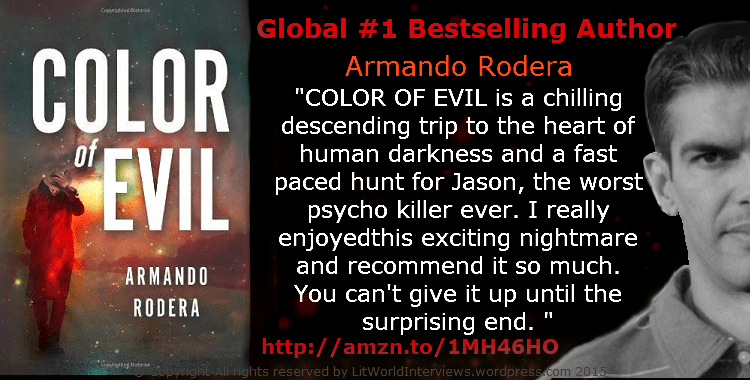
http://OlgaNM.wordpress.com

http://www.OlgaNM.com

#Interviews-in-translation. Today @EnriqueLaso and ‘The Blue Crimes’

Hi all:

I promised I’d bring you another interview with an author who’s well known for his books in Spanish. Although to tell you the truth, our guest today, Enrique Laso, is well-known everywhere, as he’ll explain himself. He’s a very driven author and when I met him I was sure he’d be a fascinating subject for an interview. I also asked him to talk to us about his most recent novel available in English. So here he is.

Author Enrique Laso
Author Enrique Laso

Mini biography

I was born in Badajoz in 1972.

I have lived in Badajoz, Murcia, Valencia, Barcelona and Madrid. Thanks to my profession and to an eagerness to travel that has been a part of me since my childhood I have had the chance to visit more than thirty countries in the five continents.

After a break of 10 years, having won several awards as a teenager and having published three books then, in 2005 I resumed my literary career. That year I published a novella ‘Desde el Infierno’ (From Hell), adapted for the cinema in 2014 by Luís Endera, I wrote some special collaborations sporadically for newspapers and several magazines, and I created my first blog (http://www.owachy.com/).

At the moment I’m busy with several projects, of which the most important are the novels, Cataclismo, The Tesla Mystery and Heaven of Happiness. My latest novels have been published under several pseudonyms, the majority unknown to the big public. The only one I’ve revealed to this date, and therefore I don’t mind mentioning, is Henry Osal, whose writing is focused on self-help manuals and personal development.

My most successful novel, El Rumor de los Muertos (The Rumour of the Dead), with more than 130000 digital copies sold, is available in paperback in all big bookshops since the autumn of 2014, published by MR (Planeta). It has been recommended by writers such as Juan Gómez Jurado, Bruno Nievas or Blanca Miosi (yes, our guest last week!).

I have sold, to this date, more than 300000 books, many of them available in Spanish, English, French, Italian and Portuguese (I’ve been translated to 12 languages, including the books written under pseudonym), I’ve won a large number of literary contests and I’ve published over fifty newspaper articles.

How and when did you start writing?

When I was eight years old. I was an avid reader, and a slightly introverted boy. I wrote a novella called ROCA (Rock) about a young lad who wasn’t able to communicate and ended up becoming a rock. It was a way of expressing myself and communicating my feelings better.

Describe briefly your experience as an independent writer.

Fantastic. The truth is that although I’ve published with four different publishing companies, I carry on publishing independently. I have received many offers to sign long-term writing contracts, but I think I’m better off free. Nowadays an author has many more possibilities and more strength when it comes to negotiating.

What’s the moment you remember more fondly (so far) of your experience as a writer?

There are many. But I think the day when I found myself number 1 in Amazon.com for the first time it was the most emotive, because of what it meant (and, in truth, from that moment on my life changed for the better).

What made you decide to get your work translated?

Amazon encouraged me, and also many of my readers from the USA did the same. They thought my novels would be very successful in other languages and they weren’t wrong. I’ve been N.1 in several categories in Amazon, iTunes, Google Books, and Barnes and Noble, in English, French, Italian, German and Greek!

Tell us something about your book

THE BLUE CRIMES is a thriller, police procedural story, full of intrigue. From its inception I thought about the American market, and in just a month I’ve sold hundreds of copies and it has received 7 reviews (all very positive), among them one by one of the TOP-100 reviewers. Set in the ‘deep America’ it tells the story of the investigation of the murders of two girls, who are found near a lakeside by a promising agent of the Unit of Behavioural Analysis of the FBI. It has been compared with successful TV series such as CSI, Criminal Minds, Twin Peaks or True Detective, and that’s fantastic.
Andy advice for your fellow writers (and especially for new writers)

They are very typical, but the truth is that they work.

-To trust in themselves

-To persist, persist, persist

-To never stop reading and learning

-To accept the help and advice of professionals

-To not dismiss marketing or think it is not part of the job.

Don’t forget to check his blog (see link above) and here I leave you his Amazon page:

http://www.amazon.com/Enrique-Laso/e/B004KCULSA/


The Blue Crimes by Enrique Laso

The Blue Crimes

A SUPERB CRIME NOVEL. GRIPPING FROM START TO FINISH.

‘And so proceeds Enrique’s THE BLUE CRIMES and the manner in which he places Ethan Bush and team in the resolution of crime is tense, suspenseful, and at all times involving. This is quality mystery writing by a voice new to most of us – a welcome addition to the thriller genre’

Grady Harp, TOP-100 Reviewer/ Hall of Fame/ Vine Voice

_________________________________________________________
Two bodies found in a lagoon.
A promising FBI special agent.
A crime that occurred almost twenty years ago.
A convoluted mystery novel that grabs you.

_________________________________________________________
If you enjoyed novels like ‘The Silence of the Lambs‘ or TV series as ‘Twin Peaks‘ or ‘True Detective‘… this is the story that you have been waiting for.
_________________________________________________________
FROM CHAPTER I
By the time they called me, a whole week had passed since the second body had been discovered. This was a setback as much of the evidence would have disappeared by now and I’d have to work with what little evidence the local police, unaccustomed to these types of crimes, would have been able to collect. Luckily I had been allocated a competent enough CSI unit and as we flew from Washington to Kansas City International Airport, we imagined, quite rightly as it turned out, that the crime scene will have been spoiled by dozens of well-meaning but clumsy Deputies.
Liz, who I already knew professionally from the only case that I’d worked on up to then, handed me a folder containing photos; the cyanotic bodies of two naked girls, abandoned in a lagoon, like the unimportant remnants of a quiet morning picnic. I was staring into the open eyes of one of the young girls, who could not have been more than twenty years old, when I was struck by her plea: “You must find who did this to me.”

Link to the novel: 

http://www.amazon.com/THE-BLUE-CRIMES-Enrique-Laso-ebook/dp/B00UQV3BYA 

http://www.amazon.co.uk/THE-BLUE-CRIMES-Enrique-Laso-ebook/dp/B00UQV3BYA


Enrique has also left me with one of the reviews, to give you some idea of the opinions about it.

`You must find who did this to me.’, March 28, 2015

By

Grady Harp

Verified Purchase(What’s this?)

This review is from: THE BLUE CRIMES (Kindle Edition)

Enrique Laso was born in Badajoz, the capital of the Province of Badajoz in the autonomous community of Extremadura, Spain, situated close to the Portuguese border, on the left bank of the river Guadiana, in 1972. Although professionally he has always been linked to the world of marketing and communication, literature is his true passion. He began writing in his teens and in 1994 won the Murcia youth national prize for his poetry collection ‘Lost children’. In 2005 he published the short novel ‘from hell’, adapted to film in 2014. He has published several novels under pseudonyms, the only one revealed by the author is Henry Osal who has signed several self-help manuals. ‘The sound of the dead’ is the novel with which he has had more success. It has sold more than 250,000 books and has been translated into 12 languages. He has won numerous literary competitions throughout his extensive literary career. For personal reasons, he did not write for almost ten years, until in 2005, when he revived his passion, and since then he has dedicated himself to writing whole-heartedly.

Enrique knows his way around mystery thrillers and of interest this Spanish author has placed his current story in the heartland of the American Midwest. He opens his story with a rather gruesome setting: `By the time they called me, a whole week had passed since the second body had been discovered. This was a setback as much of the evidence would have disappeared by now and I’d have to work with what little evidence the local police, unaccustomed to these types of crimes, would have been able to collect. Luckily I had been allocated a competent enough CSI unit and as we flew from Washington to Kansas City International Airport, we imagined, quite rightly as it turned out, that the crime scene will have been spoiled by dozens of well-meaning but clumsy Deputies. Liz, who I already knew professionally from the only case that I’d worked on up to then, handed me a folder containing photos; the cyanotic bodies of two naked girls, abandoned in a lagoon, like the unimportant remnants of a quiet morning picnic. I was staring into the open eyes of one of the young girls, who could not have been more than twenty years old, when I was struck by her plea: “You must find who did this to me.” Horrified, I turned the photos over and looked out the window of the small Gulfstream III; we were already over the state of Illinois.’

We meet Ethan Bush, and FBI agent, haunted by the fear that his initial success with the FBI may not be reproducible and that he may be destined to fail. But he is assigned a cold case – in addition to the two cyanotic girls mentioned earlier, there is Sharon Nichols who was not exactly killed yesterday. Her lifeless body appeared in the same place as the other two unfortunates, but in 1998, that is … almost 17 years ago. It was a case that went unsolved and was eventually shelved, like many others. This is the reason we needed you. We fear that we are facing a serial murderer who has returned to the area … Who can tell how many victims he might have claimed during the last nearly twenty years!’

And so proceeds Enrique’s THE BLUE CRIMES and the manner in which he places Ethan Bush and team in the resolution of crime is tense, suspenseful, and at all times involving. This is quality mystery writing by a voice new to most of us – a welcome addition to the thriller genre. Grady Harp, March 15


Thanks to Enrique for agreeing to come and be interviewed, thanks to all of you for reading, and you know what to do, like, share, comment and CLICK!