In Fire Feud, Thomas Roehlk frames a modern legal crisis as the gateway to a much older conflict. The novel traces how routine professional decisions can unravel long-concealed histories with dangerous consequences.
The discovery of a skeleton during construction work in Chicago draws attorney Mandy Doucette into a situation that quickly spirals beyond standard legal management. DNA evidence reveals that the remains are tied to her own company and to her boyfriend’s family, placing Mandy at the center of a growing storm.
Her twin sister Reggie, an FBI forensic pathologist, follows forensic clues that trace the crime back to the aftermath of the Great Chicago Fire of 1871. Together, the sisters uncover a feud between two powerful families that has persisted for over a century. As they expose fraud, betrayal, and hidden crimes, they become targets themselves. The deeper they investigate, the clearer it becomes that certain men will resort to violence to protect their reputations and preserve the power built on buried truths.
Q&A
What sets your book apart from others in your genre?
I consider my genre as thriller, with the sub-genre of legal thriller. I have much respect for women in the corporate law world, and I believe my work shines a light on this type of character in the crowded world of thrillers.
What’s your favorite compliment you’ve received as a writer?
My favorite was from a review I received on my first book, Red Deuce. It was “Red Deuce shows the author’s behind-the-scenes understanding of how corporations work, making it seem all too credible. The plot keeps you guessing until the very end. Just when you think you’ve figured it all out, he throws another curveball that leaves you eagerly flipping pages to uncover the truth.”
Why did you choose this setting/topic?
Choosing Chicago as a setting provides an amazing city with amazing history, and therefore amazing opportunities to build stories. My protagonist is a study in contrasts. She finds herself unable to poke the beast until it reveals its web of intrigue and illegality, and the story of intermingled crime and espionage allows the protagonist to push herself into solving the mystery.
Which author(s) most inspired you?
Michael Connelley, John Sandford and Steig Larsson.
Which three books would you bring to a desert island?
Caleb Carr’s The Alienist, Steig Larsson’s Girl With The Dragon Tattoo, and Erik Larson’s Devil In The White City.
THOMAS M.ROEHLK is a retired corporate attorney from St. Charles, Illinois, whose career spans major international corporations in the defense sector, consumer products, transportation equipment, and financial services. He spent more than 20 years serving as general counsel and chief compliance officer for a public company, bringing deep real-world legal and corporate insight to his fiction. A graduate of the University of Wisconsin and John Marshall Law School, Roehlk also holds a Master in Management degree from Northwestern University. A devoted endurance athlete, he has completed more than 100 marathons and ultramarathons worldwide, as well as ten Ironman triathlons. After 46 years in the Chicago metropolitan area, he and his wife now split their time between Florida and New York. Visit Thomas at his website.
Kadence, a new type of implanted defibrillator, misfires in a patient visiting University Hospital
for a routine medical procedure—causing the heart rhythm problem it’s meant to correct. Dr.
Kate Downey, an experienced anesthesiologist, resuscitates the patient, but she grows
concerned for a loved one who recently received the same device—her beloved Great-Aunt Irm.
When a second device misfires, Kate turns to Nikki Yarborough, her friend and Aunt Irm’s
cardiologist. Though Nikki helps protect Kate’s aunt, she is prevented from alerting other
patients by the corporate greed of her department chairman. As the inventor of the device and
part owner of MDI, the company he formed to commercialize it, he claims that the device
misfires are due to a soon-to-be-corrected software bug. Kate learns his claim is false.
The misfires continue as Christian O’Donnell, a friend and lawyer, comes to town to facilitate the
sale of MDI. Kate and Nikki are drawn into a race to find the source of the malfunctions, but
threats to Nikki and a mysterious murder complicate their progress. Are the seemingly random
shocks misfires, or are they attacks?
A jaw-dropping twist causes her to rethink everything she once thought she knew, but Kate will
stop at nothing to protect her aunt and the other patients whose life-saving devices could turn
on them at any moment..
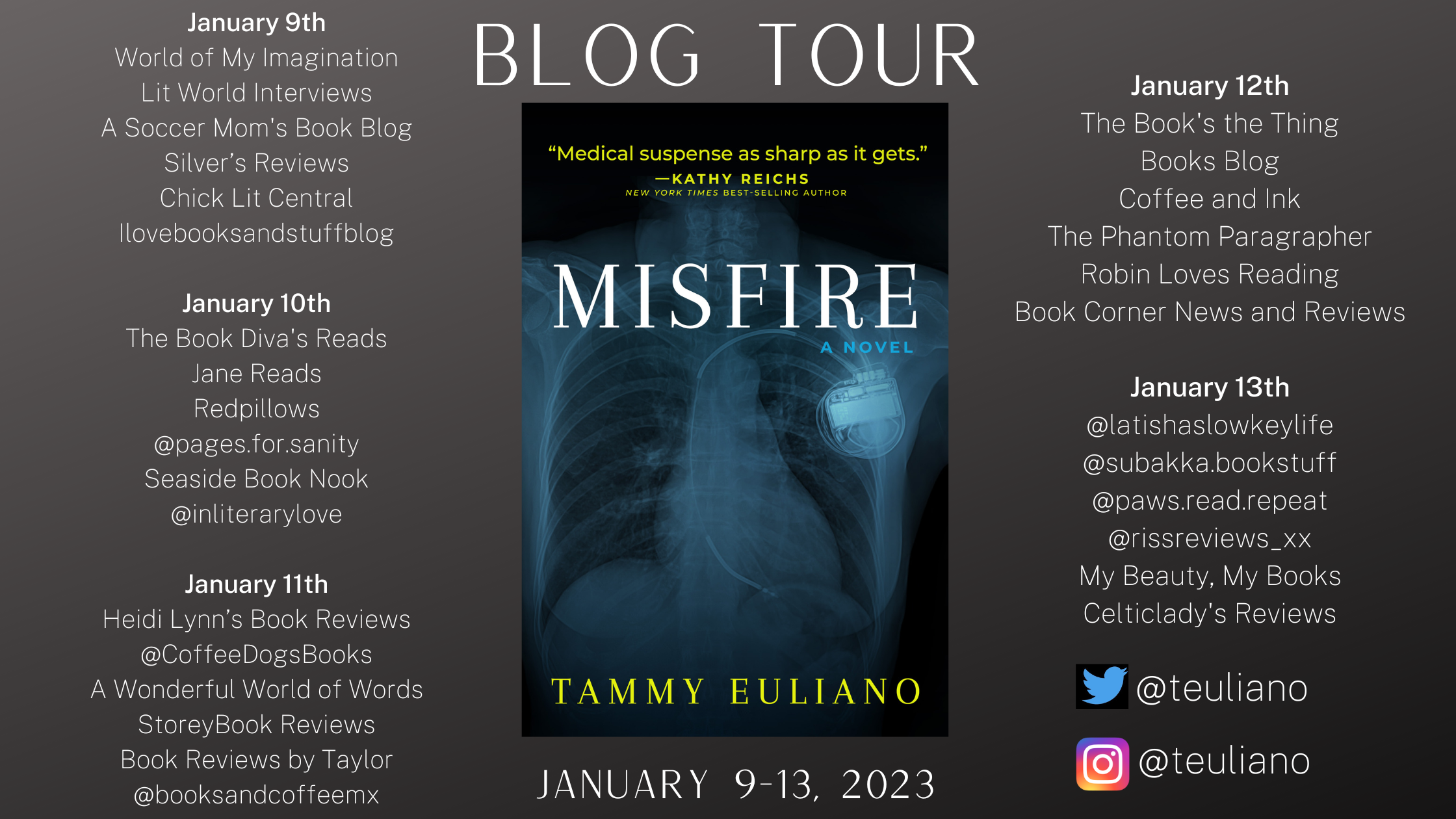
Misfire by Tammy Eliano
How did you do research for your book?
I’m fortunate to be a professor at an academic medical center and therefore have access to the
medical professionals to ask questions and gain ideas. Also, I co-developed some medical
devices over the years and have been through the patenting and licensure process so it was fun
to include some first-hand knowledge, and to pick the brains of other scientists with whom we’ve
crossed paths.
Where do you get inspiration for your stories?
My inspiration comes from life experiences—working in academic medicine, talking with people
in technology and healthcare industries, and reading both fiction and non-fiction, and of course
the news (preferably science news, not all the other stuff).
What advice would you give budding writers?
Find a supportive group of other early career writers, read, take classes that provide
professional feedback, attend a writers’ conference if at all possible, develop thick skin, write
what you love, consider writing some short fiction for an earlier win.
Your book is set in north central Florida. Have you ever been there?
It’s where I’ve lived since undergrad. Though not Gainesville by name, and certainly not the
University of Florida, the book is set in the area, including Paynes Prairie where we’ve gone on
long walks, and Jacksonville, which we visit on occasion. It’s a great place to live and raise a
family, with springs and beaches nearby and (often) excellent collegiate sports to cheer for.
Do you have another profession besides writing?
I’m a physician, an academic anesthesiologist specializing in obstetrics. For 20+ years I’ve
taught, performed research, and cared for patients at the University of Florida’s hospital system.
I’ve now backed down to 60% so I can focus on writing…it’s never enough!
What is your next project?
Besides finishing up the third in the Kate Downey series, I’m working on a stand-alone that links
the Salem Witch Trials to a modern medical mystery. It’s based on a short story I published a
few years ago and I’m having fun plotting it out.
What is the last great book you’ve read?
In non-fiction, 4000 Weeks: Time Management for Mortals by Oliver Burkeman. In fiction,
Desert Star by Michael Connelly. I’m currently reading A World of Curiosities by Louise Penny,
my favorite series!
How are you similar to or different from your lead character?
We started out quite alike as far as careers go, but she lacks my idyllic backstory with a
charmed childhood and parents and husband very much alive. She’s also way cooler than I am!
In one sentence, what was the road to publishing like?
For the first in the series it was long, full of rejections, self-doubt, learning, and more rejections,
and finally extremely rewarding! Misfire was the second in a two-book deal, so far more straight-
forward.
Which authors inspired you to write?
Harlan Coben, Louise Penny
Favorite travel spot?
I love the mountains (said the Florida girl), especially hiking and downhill skiing. We’ve been so
blessed with incredible travel opportunities to all the major national parks in the US, Costa Rica,
the Galapagos, Europe, even New Zealand. Probably my favorite would be hiking in Wengen,
Switzerland.
Favorite dessert?
Hmmm, my husband’s home-made fruit crumbles with ice cream. Cookies and cream ice cream
with my dad. Who am I kidding – most ice cream with most anyone.
If you were stuck on a deserted island, which 3 books would you want with you?
(1) the entire Louise Penny Gamache series squished into one book cover, (2) an encyclopedia,
(3) The famous double book: “How to Make a Boat out of Sand, Salt Water and Coconuts” and
“The Joy of Cooking Without Actually Cooking”
Any hobbies? or Name a quirky thing you like to do.
My husband and I met playing flag football in college, taking turns at quarterback due to the
rules for co-ed sports. Now we still enjoy sports, but also seeking active experiences while
traveling – via ferrata, canyoning, rappelling down waterfalls, etc. We also follow the Gator
football team, though they’re trying our patience lately.
If there is one thing you want readers to remember about you, what would it be?
That I’m a physician-turned-author who highly recommends reassessing your path and
goalposts at regular intervals. It’s not quitting, it’s pivoting to something better/different/more
suited to you today.
What is the oldest item of clothing you own?
Intramural sports championship t-shirts from undergrad. We were the geeky honors dorm kids
who crushed everyone else by planning ahead with football plays printed out using the earliest
version of drafting software…oh, and not being drunk at game time.
Tammy Euliano, author of Misfire.
Author Bio:
Tammy Euliano writes medical thrillers. She’s inspired by her day job as a physician, researcher and medical educator. She is a tenured professor at the University of Florida, where she’s been honored with numerous teaching awards, nearly 100,000 views of her YouTube teaching videos, and was featured in a calendar of women inventors (copies available wherever you buy your out-of-date calendars).
When she’s not writing or at the hospital, she enjoys traveling with her family, playing sports,
cheering on the Gators, and entertaining her two wonderful dogs.
DESCRIPTION of Columbus and Caonabó: 1493-1498 Retold by Andrew Rowen.
“Columbus and Caonabó: 1493–1498 Retold” dramatizes Columbus’s invasion of Española and the bitter resistance mounted by its Taíno peoples during the period and aftermath of Columbus’s second voyage. Based closely on primary sources, the story is told from both Taíno and European perspectives, including through the eyes of Caonabó—the conflict’s principal Taíno chieftain and leader—and Columbus.”
When you read a Historical Fiction novel you have a certain thought in mind of what to expect. Andrew Rowen gives you more than that, much more. The press release discusses the research he’s done through the years but many do the same. But I haven’t run across anyone who puts the detail of the people into their work as much as Rowen has. Given as much life to a people we know so little about but by the end know so much and gain a fuller picture of a part of the American foundational background. I’ve taken U.S., European, and Latin American studies at the University level and not been given any of the detail given here, nor even heard of the vast majority of the people given in this work.
Being a history person I of course loved the specifics pertaining to the events of the past but even more I enjoyed Rowen’s interpretation of the people involved, especially the Taíno peoples. Also the conflict between the crew of Columbus left behind and moving forward. There was no simple black and white, right and wrong to the story. I suppose overall you would say there is one, but as far as the actions of both peoples the ideas made a lot more sense than what we learn in school.
Rowen shows the use of the Europeans and Taíno forming alliances whether they be real or merely for appearances, the use of Christianity as a subjugation strategy as well as a tool by the Taíno. The Taíno religion is also a major issue in the progress of negotiations and relations. (I don’t want to say too much here.) The actions of Columbus are laid bare, warts and all. Even coming to be questioned by Isabella and Ferdinand. The presence of Spanish settlers in the islands is devastating in more ways than the disease we’ve so often read about.
Ultimately you feel what is happening as it happens. The anguish of the Taíno peoples, the settlers, and even the soldiers who didn’t sign up for what happens. This along with 42 historic and newly drawn maps and illustrations bring life to a part of history glossed over by the victors.
I’m not an anti-Columbus or anti-Western Exploration person. I like history. I am a historian. I want as many of the facts as possible. Unfortunately those who are the victors tend to suppress the ugly parts they played to achieve their victory. “Columbus and Caonabó: 1493–1498 Retold” provides more facts while being entertaining at the same time.
The author includes an interesting final chapter titled Agonies and Fates. We learn about just what the title says, Agonies and Fates. Plus many definitions are given for the Taíno language.
RATING
A solid 4 out of 5 Stars. A 4 because of all the great information and the life given to the historical figures. Also a 4 and not a 5 because it is a bit of a heavy read. This is not a read in one or two sittings. You will likely want to do so but take your time so you can absorb everything you’re being given.
I rate using:
Realistic Characters/Character Development based on genre,
World Building
Editing
Believability based on genre
Overall Enjoyment
Readability/Clarity
Flow
RECOMMEND?
I would read the previous book, Encounters Unforeseen: 1492 Retold, of which this book is the sequel.
504 pages with the reading portion ending with Agonies and Fates on page 417. The remaining pages are filled with great information for further understanding, including a Glossary.
Andrew Rowen has devoted 10 years to researching the history leading to the first encounters between Europeans and the Caribbean’s Taíno peoples, including visiting sites where Columbus and Taíno chieftains lived, met, and fought. His first novel, “Encounters Unforeseen: 1492 Retold” (released 2017), portrays the life stories of the chieftains and Columbus from youth through their encounters in 1492. Its sequel, “Columbus and Caonabó: 1493–1498 Retold” (to be released November 9, 2021), depicts the same protagonists’ bitter conflict during the period of Columbus’s second voyage. Andrew is a graduate of U.C. Berkeley and Harvard Law School and has long been interested in the roots of religious intolerance.






 Lit World Interviews