
Guest Post by author Samuel Marquis: The True Story of Captain Kidd: An American Hero and Antihero for the Ages


The True Story of Captain Kidd: An American
Hero and Antihero for the Ages
By Samuel Marquis

There comes a time in every rightly-constructed boy’s life when he has a raging desire to go somewhere and dig for hidden treasure.
—Mark Twain

My ninth-great-grandfather Captain William Kidd stands today as not only perhaps the most famous piratical plunderer of all time but the swashbuckler most responsible for the buried-treasure mythology that continues to fascinate historians, writers of all stripes, pirate aficionados, treasure hunters, and the general public. I have heard the passed-down family tales of my treasure-chest-burying-scoundrel of an ancestor since I first learned to walk, and although many of them have proven to be complete balderdash, they have made a lifelong impression on me. As Mark Twain understood, hidden treasure is a powerful allure for a young lad —and for that we can thank the “trusty and well-beloved Captain Kidd,” as he was celebrated by King William III of England in 1695 before being transformed into the “most notorious arch-Pyrate ever to sail the seven seas” a mere three years later. As British pirate scholar Patrick Pringle has written, it is unlikely that Captain Kidd “will ever be displaced as the Great Pirate.”

However, despite his villainous reputation, how much of an “arch-Pyrate” was Captain Kidd really and how much of our enduring fascination with both the man and myth can be chocked up to our love of roguish outlaw legends, deeply entrenched American folklore, and the supernatural? The answer is more surprising than one would imagine.

ΨΨΨ

A quick historical sketch tells us that Captain Kidd (1654-1701) was an educated man who could read and write and trace his roots to a common but respectable Protestant Christian family from Soham Parish, Cambridgeshire, England. Having gone away to sea at an early age as an apprentice or cabin boy from the port town of Dundee, Scotland, he possessed ample nautical skills developed from the hard experience of a life at sea and thorough training in mathematics and navigation. He also had a little salty roguishness in him from spending two decades in the Americas from the mid-1670s through the 1680s sailing, fighting, and drinking with rowdy, violent, and vulgar buccaneers and merchant seamen. Whether he did in fact serve under the most famous buccaneer of all time, Sir Henry Morgan (1635–1688), remains unknown, but there is no doubt that William Kidd was a patriotic English privateer during his twenties and early thirties, sticking it to imperial Spain with the fate of the two bellicose empires hanging in the balance.

In his era, the early Age of Enlightenment (1685-1815) and middle Golden Age of Piracy (1650-1730), Kidd was a respectable privateer not a pirate, meaning his activities were sanctioned by the English government through a “letter of marque,” a license authorizing him to legally attack, capture, and plunder enemy ships in wartime. Yet, like many sea rovers in his day, his ultimate fate, as well as his perch in history, would depend on the not always clear distinction between legal privateer and outlaw pirate. Privateering as a seafaring profession for both patriotism and profit has existed at least as far back as the Roman Republic, and privateering ships and the privateersmen who manned them (both are referred to as “privateers”) served the function of an auxiliary, cost-free navy that were recruited, commissioned, and unleashed upon the enemy when the resources of combatant European nations were overextended.

While the Anglo-American, Dutch, and French buccaneers of the seventeenth century Caribbean were most certainly ruffianly and profligate, they were licensed privateers not renegade pirates, and Kidd lawfully plundered the Spanish on land and by sea in the Gulf of Mexico and West Indies to weaken Spain’s grip in the New World. The buccaneers’ lifestyle was built upon a modern-like, egalitarian political framework. Their homegrown system of direct democracy resulted in a unique brotherhood defined by honor, trust, integrity, and lending a helping hand to those in need. It played a huge role in nurturing Kidd’s core democratic value system and generosity. During his seafaring career, he went out of his way to help the unfortunate and he employed African Americans, Native Americans, East Indians, and Jews as share-earning stakeholders aboard his privateering ships-of-force, making him rather progressive and tolerant compared to the vast majority of his contemporaries.

In 1688, Kidd made New York his home port and bought valuable waterfront property in the city, and from July 1689 through April 1698 he fought as a licensed privateer in King William’s War against France (1689-1697), following William and Mary’s seizure of the English throne in the Glorious Revolution to ensure a Protestant succession. By May of 1691, he was a bona fide New York war hero, gentleman, and man of affairs married to the most dazzling socialite in town: the twice-widowed, twenty-year-old Sarah Bradley Cox Oort. With his “lovely and accomplished” wife Sarah, the wealthy New York privateer and merchant ship captain, jury foreman, and model citizen would have two daughters, Elizabeth and little Sarah, and in 1695 he was recruited by a group of wealthy London investors to lead an expedition to the Indian Ocean to battle the French and hunt down freebooters as King William III’s lawfully licensed privateer.

The plan was for Kidd to hunt down the Euro-American pirates of Madagascar, legally seize their ill-gotten riches, and keep them for not only himself and his privateering crew but for the king and lordly sponsors from the powerful Whig party that dominated the English government. Among Kidd’s wealthy London financial backers was Lord Bellomont, a powerful Whig House of Commons member and soon-to-be royal governor of New York, Massachusetts, and New Hampshire. Kidd was to capture the “predators of the seas” and their freshly plundered riches after they had raided the royal treasure fleets of the Great Mughal and other East Indian shipping between the Malabar Coast of India and Mocha and Jeddah in the Red Sea. Based on the New York privateer’s sterling reputation, the investment group not only issued “the trusty and well-beloved Captain Kidd” two special government licenses but built a 34-gun warship, the Adventure Galley, to his specifications.

Unfortunately for Kidd, his nearly three-year-long voyage turned out to be an epic disaster and turned him overnight into one of the most notorious criminals of all time. His great misfortune was that he had followed in the wake of the English pirate Henry Every, who had pillaged the Great Mughal’s fleet and encouraged the mass rape of the Muslim women aboard one of the plundered ships. A year into the expedition to the far side of the world shortly after Every’s debauchery, Kidd and his crew had still not encountered a single enemy French or pirate ship that could be seized as a legitimate prize and they had suffered one disaster after another, including raging storms, a tropical disease outbreak, severe thirst and starvation, and repeated attacks by the East India Company, Portuguese, and Moors (Muslim East Indians). Increasingly desperate to earn some money under their standard “no prey, no pay” privateering contract, a large number of his New York and New England seamen wanted to become full-fledged pirates themselves and plunder the ships of all nations to garner the prodigious riches of the East. However, the law-abiding Captain Kidd would not allow any violations of his two legal Crown commissions, one to fight the French and the other to hunt down pirates.

During the grueling voyage, Kidd accidentally killed his unruly gunner, William Moore, a man with two prison sentences to his name, by smacking him in the head with a wooden bucket while quelling a mutiny; and he lawfully seized two Moorish ships, the Rouparelle and Quedagh Merchant, that presented authentic French passports and carried gold, silver, silks, opium, and other riches of the East. However, while these wartime seizures were 100% lawful and he never once himself committed piracy in India, he soon thereafter looked the other way during the capture of a Portuguese merchant galliot that presented official papers of a nation friendly to England. His seamen sailing separately from his 34-gun Adventure Galley in the captured Rouparelle seized from the Portuguese vessel two small chests of opium, four small bales of silk, 60 to 70 bags of rice, and some butter, wax, and iron. Though a measly haul, the act technically constituted piracy even though Kidd wasn’t directly involved in the capture. He only allowed the seizure to pacify his mutinous crew, who had by this time divided into “pirate” and “non-pirate” factions aboard his three separate privateering ships; and in reprisal for the damage inflicted upon the Adventure Galley and severe injuries sustained by a dozen of his crewmen from two Portuguese men-of-war that had attacked him without provocation months earlier.

Despite the countless challenges he faced during his perilous voyage and a second full-scale mutiny because he refused to go all-in on piracy, Kidd miraculously made it back to the American colonies from Madagascar with around £40,000 ($14,000,000 today) of treasure in his hold and the French passports that proved he had taken the Rouparelle and Quedagh Merchant legally in accordance with his commission. However, when he and his small band of loyalists reached Antigua on April 2, 1699, they received heartbreaking news. The Crown, at the urging of the East India Company, had sent an alarm to the colonies in late November 1698 declaring them pirates and ordering an all-out manhunt to capture and bring them to justice. With the Englishman Henry Every and most of his plundering, gang-raping outlaws still at large, Captain Kidd was now Public Enemy #1 in the world.

He decided to try to present his case for his innocence and obtain a pardon from his lead sponsor in the voyage, Lord Bellomont, who had by this time taken office as the royal governor of New York, Massachusetts, and New Hampshire. After burying a portion of his legally obtained treasure on Gardiner’s Island in Long Island Sound and distributing a number of goods to several trusted community leaders and seafaring friends as a precautionary measure, Kidd sailed into Boston on July 3, 1699, to meet with Bellomont, who had promised him a full pardon. But with Kidd now a wanted criminal and Every still at large, Bellomont and the other London backers, members of the once powerful Whig Junto that had fallen from power to the spiteful Tories, wanted nothing to do with the scandal. Having merely lured his business partner into Boston by dangling the possibility of clemency before him, Bellomont treated Kidd with suspicion and arrested him and his loyal seamen shortly after their arrival to port.

After being stripped of all his lawfully seized plunder and enduring six months of incarceration in Boston, Kidd was shipped to England to stand trial. Abandoned by his wealthy Whig sponsors who had been supplanted by the revitalized Tories, he was found guilty and hung in public shame on May 23, 1701, where he proclaimed his innocence before a drunken, jeering mob of Londoners. Days later, his corpse was coated with tar and hoisted in a gibbeted iron cage downriver at Tilbury Point near the mouth of the Thames, where it would remain for the next twenty years to serve as the English State’s grisly warning to other would-be pirates of the fate that awaited them if they dared threaten England’s valuable trade relations with India by pursuing the short but merry life of a pillaging freebooter.

ΨΨΨ

The question of Captain Kidd’s guilt or innocence has been hotly debated by historians and the reading public ever since his gruesome public hanging. However, it is important to bear in mind that Captain Kidd was not a 100% innocent man. Even by the sketchy standards of the early Age of Enlightenment, he was guilty of at least one act of piracy during his Indian Ocean expedition, or at least of failure to lift a finger to prevent his crew from committing piracy in the taking of the Portuguese galliot; and, possibly but not definitively, one count of manslaughter in a fit of passionate rage against his mutinous gunner William Moore, who had two prison sentences to his name, one for striking his captain, before sailing with Kidd.

At the same time, although Kidd was not a fully innocent man by the legal standards of his age, he was most certainly no pirate like Henry Every, which is an ironic twist that many people find hard to reconcile for the man who has been called “the most famous pirate of all time.” As one historian has put it, “His innate respect for order, his sense of duty and mission, his past life as an honest, successful seaman, as faithful husband and loving father, and above all, his ambition for the future—all these factors precluded Kidd from ever becoming a true pirate. If he committed piracies, they were acts of expediency, even acts of survival.” Thus, the most famous “arch-Pyrate” of all time was no outlaw pirate in temperament, inclination, or practice. Contrary to our embellished tropes over the centuries with characters like Long John Silver, Captain Hook, Captain Blood, Captain Jack Sparrow, and rocker Keith Richard’s as Captain Teague, the father of Sparrow, Captain Kidd never forced anyone to walk the plank, swilled rum with treasure chests overflowing with gold, silver, and jewels at his feet, or roared catchy pirate phrases like “Arrgh!” or “Shiver me timbers!” or “Dead men tell no tales!”

The real Captain Kidd was simply a bold adventurer at the wrong place at the precisely the wrong time in the wake of the Henry Every debacle. But even more critical to his ultimate fate, he was backed by the worst kind of sponsors imaginable. Not only did the Machiavellian Lord Bellomont coerce him into leading a virtually impossible expedition to the Indian Ocean to hunt down pirates, by threatening to seize his crew and ship in 1695 when Kidd initially turned down the command of the voyage, he and his fellow Whig noblemen dropped him as soon as he became a potential liability. Though these unspeakably powerful leaders gave the pirate-hunter firm, up-front assurances that they would stand by him in his difficult mission, they threw him overboard like ballast at the first whisper of trouble to protect their lordly reputations.

Unlike the largely unknown real pirate Henry Every, Captain Kidd’s story has been told and retold in thousands of accounts, from the heavily biased broadsheet newspapers and ballads of his day, to the countless books and journal articles produced over the past five centuries, to the Hollywood swashbuckler films of the silver screen during the past century. And yet, the tale of this humble-born New York privateer—who rose up by his own bootstraps to become the “trusty and well-beloved Captain William Kidd” of the King of England himself—has been lost to us in a foggy haze of legend, myth, and propaganda for the past four centuries.

“When the legend becomes fact, print the legend,” proclaimed fictional reporter Maxwell Scott in the classic 1962 Western film The Man Who Shot Liberty Valance, directed by John Ford. But when it comes to my ancestor Captain Kidd, such an approach cannot suffice. For the simple truth is there was an actual flesh-and-blood Captain Kidd, and the story of that Kidd, my real ninth-great-grandfather, is far more fascinating, nuanced, action-packed, and ultimately tragic than the caricature of mythology and pop culture.

Few historical figures have cropped up at so many important turning points on the global stage, come into contact with so many historically noteworthy individuals in such a short period of time, have seemed to be everywhere at once, had more lies spread about them in their own lifetime, or cast such a long shadow for five consecutive centuries and counting. Case in point: Kidd’s trial was the greatest courtroom drama of the eighteenth century, and one of the biggest political scandals in British-American history, rocking the New World and the Old and threatening “to tip the subcontinent of India to the Maharajahs.” But it was nothing but a sham proceeding to make sure Captain Kidd hung for the crimes of Henry Every and the other real Red Sea pirates of the 1690s.

But once we peel away the onion layers of mythology and propaganda to uncover and illuminate the real Captain Kidd, as judged by the moral standards of his era, we realize that he was a good, honest, and courageous man given an impossible mission and sponsored by dirty, rotten scoundrels who threw him to the wolves. Thus, at the end of the day, the supreme irony at the heart of Captain Kidd saga is that the man widely considered “the greatest pirate of all time” was no pirate at all. Behind the Kidd myth was a real man: a son, a husband, a father woven into the tapestry of early America, rendering him for all the ages a unique yet flawed colonial American hero (or perhaps better anti-hero), whose life story by a simple twist of fate happened to be fascinating, exciting, bizarre, and heart-rending enough that Washington Irving, Edgar Allan Poe, Nathaniel Hawthorne, and Robert Louis Stevenson have all made him immortal in their most celebrated works.

It is for this reason that the legendary Captain Kidd has had the last laugh on us all.
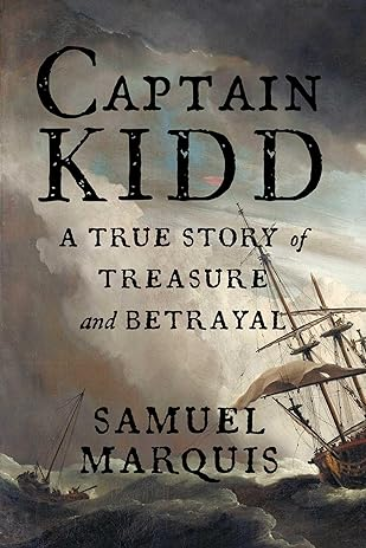
Captain Kidd: A True Story of Treasure and Betrayal

amazon logo


Samuel Marquis photo
Samuel Marquis

About Sam:

The ninth-great-grandson of legendary privateer Captain William Kidd, Samuel Marquis, M.S., P.G., is a professional hydrogeologist, expert witness, and bestselling, award-winning author of twelve American non-fiction-history, historical-fiction, and suspense books, covering primarily the period from colonial America through WWII. His American history and historical fiction books have been #1 Denver Post bestsellers and received multiple national book awards in both fiction and non-fiction categories (Kirkus Reviews and Foreword Reviews Book of the Year, American Book Fest and USA Best Book, Readers’ Favorite, Beverly Hills, Independent Publisher, Colorado Book Awards, and others). His historical titles have garnered glowing reviews from bestselling authors, colonial American history and maritime historians, U.S. military veterans, Kirkus Reviews, and Foreword Reviews (5 Stars).
You can get Captain Kidd: A True Story of Treasure and Betrayal at Amazon.

© 2025- Ronovan Hester Copyright reserved. The author asserts his moral and legal rights over this work.

Who’s the Real Criminal: Blackbeard the Pirate or Governor Spotswood Who Hunted Him Down?

Who’s the Real Criminal: Blackbeard the Pirate or Governor Spotswood Who Hunted Him Down?

By Samuel Marquis

In Blackbeard: The Birth of America, Historical Fiction Author Samuel Marquis, the ninth great-grandson of Captain William Kidd, chronicles the legendary Edward Thache—former British Navy seaman and notorious privateer-turned-pirate, who lorded over the Atlantic seaboard and Caribbean during the Golden Age of Piracy. A Robin-Hood-like American patriot and the most famous freebooter of all time, Blackbeard was illegally hunted down by Virginia Governor Alexander Spotswood, the British Crown’s man in Williamsburg obsessed with his capture. This year marks the 300th anniversary of Blackbeard’s death.

On February 14, 1719, Virginia Lieutenant Governor Spotswood wrote a letter to Lord Cartwright, a proprietor of North Carolina, in which he attempted to explain his justification for authorizing the invasion of his lordship’s colony and killing of Blackbeard the pirate and nine of his crew members at Ocracoke Island on November 22, 1718. The pirate, whose real name was Edward Thache of Spanish Town, Jamaica, and his men had recently been pardoned by Governor Eden of the colony, and Spotswood wanted to make sure that he was not accused of exceeding his authority and committing murder in North Carolina waters. His deliberately misleading letter was one of the British governor’s usual interminable fussy letters, and in it he falsely boasted to have rescued “the trade of North Carolina from the insults of pirates upon the earnest solicitations of the inhabitants there,” even though only one complaint involving a single minor incident had been filed. He further expressed his hope that his actions would “not be unacceptable to your lordships.” He admitted that he had not informed either the proprietors or Eden about his invasion plan, which was required by law, but chose not to mention that this was because he believed Eden to be conspiring with Blackbeard.

When Spotswood invaded the proprietary colony of North Carolina to the south, neither he nor the seventy Royal Navy officers and crew members he commanded to hunt down Blackbeard and his pirates had the authority to invade another colony. In the fall of 1718 at the time of the attack, Blackbeard was, legally speaking, a citizen who had broken no laws and was in good standing. He had been pardoned by Governor Eden for his previous piracies, had paid the appropriate fees to the governor and customs collector Tobias Knight in the form of casks of sugar, had applied for and received legal approval to salvage a French vessel captured near Bermuda from that same governor, and had yet to be indicted for any crime. Spotswood had, in effect, authorized the kidnapping or killing of the resident of another colony—depending on whether Blackbeard resisted or not.

But the governor was not bothered by the overt illegality of his scheme. He had already made up in his mind months earlier that he was going to go after Edward Thache without reservation, by taking action first and seeking approval from the British Board of Trade and lords proprietors later. He wanted the notorious Blackbeard—and Governor Eden and Tobias Knight too—so badly that he could taste it. He had long been intent on extending his control and influence over Virginia’s southern border, which he never considered to be far enough south, and he was intent on acquiring the fledgling proprietary colony and folding it into his own powerful royal colony of Virginia. By finding damning evidence that Eden and Blackbeard were in collusion and that Eden and Knight were receiving bribes for looking the other way, he hoped to make a Virginia takeover a reality.

The aggressive overreach of Spotswood begs the question: who is the criminal in this case, the lawfully pardoned and likely retired pirate or the colonial governor who knowingly broke the law to hunt him down, killed him and his crew, and then put the survivors on trial?

Between January 1716 and November 22, 1718, when he was killed at Ocracoke at the hands of Lieutenant Maynard and the Royal Navy, Edward Thache captured more than thirty merchant vessels along the Atlantic seaboard, Caribbean, and Spanish Main, and one 200-ton slaver, which he converted into his flagship, the Queen Anne’s Revenge. At the peak of his freebooting career in April 1718, he served as commodore of a 700-man, five-ship, 60-plus-gun pirate flotilla that rivaled the strength of any pirate fleet in history. According to one researcher, Blackbeard and the other pirates of his short-lived era had at their zenith “disrupted the trans-Atlantic commerce of three empires and even had the warships of the Royal Navy on the run.” And yet, during the course of his career, he never physically harmed anyone until the day he was battling for his life (he was reportedly shot five times and stabbed more than twenty times before he finally fell from being decapitated by a seaman’s cutlass). In fact, Thache typically showed his victims respect and let them down easily after taking their ships as prizes, giving them vessels in trade, food and provisions, and even receipts for merchandise.

In an age when violence was commonplace, he did no more harm to captured ship captains than to detain them for a brief period of time. As pirate historian Arne Bialuschewski states: “I haven’t seen one single piece of evidence that Blackbeard ever used violence against anyone.” Colin Woodard, author of The Republic of Pirates, echoes this sentiment: “Blackbeard was remarkably judicious in his use of force. In the dozens of eyewitness accounts of his victims, there is not a single instance in which he killed anyone prior to his final, fatal battle with the Royal Navy. “

The son of a wealthy plantation-owner from Jamaica and a former Royal Navy officer and privateer on behalf of the British Crown, by 1716 Thache became a no-holds-barred outlaw taking the vessels of all nations. But he and his men did not view themselves as outlaws, but rather as Robin-Hood-like figures and American patriots fighting against British domination and the Atlantic mercantile system that favored the 1% of their day. And that was how the American people largely viewed them, too. While the upper-middle-class Jamaican was portrayed as a “barbarous” monster by the pro-British newspapers, merchant elite, and Alexander Spotswood, he was known as a Robin-Hood-like folk hero defying the British Crown among his fellow American colonists. The image of Blackbeard as a cruel and ruthless villain imbued with almost supernatural powers was largely created by propagandist newspaper accounts of the era (particularly the pro-British Boston News-Letter) and Captain Charles Johnson’s (Nathanial Mist’s) A General History of the Robberies and Murders of the Most Notorious Pirates, first published in 1724 six years after Blackbeard’s death. As Bialuschewski states about the latter: “This book has been plundered by generations of historians, despite the fact that it is riddled with errors, exaggerations, and misunderstandings.” More than any published work, Captain Johnson’s propogandist tome created the notorious but unrealistic Blackbeard image that we know today and celebrate in movies like Pirates of the Caribbean and TV shows like Black Sails and Crossbones.

And what about Spotswood? While Blackbeard was playing out the role of Robin Hood of the high seas, the governor of Virginia was getting rich and fat at the colonists’ expense and showing open contempt for the colony’s lower house of elected representatives and the colonial democratic process. The governor’s many critics claimed he employed heavy-handed tactics to control tobacco exports through his Tobacco Inspection Act, rewarded his loyal friends with patronage positions, and acquired large tracts of valuable land through shady practices. With his Indian Trade Act, he granted the Virginia Indian Company that he created a twenty-year monopoly over American Indian trade, and charged the company with maintaining Fort Christanna, a settlement in the southern tidewater region for smaller Indian tribes. Establishing the company was Spotswood’s attempt to circumvent political opposition by shifting the financial burden of defense against Indians from the colonial government to private enterprise, but in doing so, he angered those who had invested in private trade. All in all, his policies were unpopular with Virginia tobacco planters, landholders, and commoners alike since all sought to maintain their independence from the British Crown. By 1722, he was toppled from government due to “an accumulation of grievances” from Virginia’s House of Burgesses and his own Governor’s Council, but by then Spotswood had made so much money from questionable land deals that his governorship had become immaterial. He would remain the wealthiest man in Virginia until his death in 1740.

One of his more disgraceful actions was to deny payment of the promised reward money to Lieutenant Maynard and the other Royal Navy seamen who had battled Thache at Ocracoke until four years after the battle—even though Spotswood had, by binding decree, promised prompt payment upon the capture of the pirate and his crew. After four years of delay, many of those who had fought valiantly and spilled blood upon the decks of the two naval sloops had died or retired from the service, and so never received a penny.

For Spotswood, the judgement of history has been severe, particularly when it comes to Blackbeard. He knowingly launched an illegal expedition in violation of the King’s and governor of North Carolina’s pardons to destroy the freebooter (who was likely retired from piracy) and his crew, all in an effort to gather evidence to be used to undermine Eden and his second-in-command and thereby further his own career and financial gain. In the eyes of history, it is Spotswood who is far more criminal, immoral, and unethical than Blackbeard, Eden, or Knight. Not only did he knowingly and illicitly violate the sovereignty of a neighboring colony, he conspired with and was closely associated with the ethically suspect Edward Moseley, Colonel Maurice Moore, and Captain Vail. In December 1718, the Moseley gang broke into the house of North Carolina Secretary John Lovick in an attempt to examine Council records for incriminating evidence against Eden and Knight. When Spotswood’s North Carolina conspirators Moseley and Moore were tried the following year, the event was a sensation and Moseley was fined and barred from public office for three years. Spotswood did his best to distance himself from Moseley and Moore, but his critics knew better.

In the end, he is remembered as a slave-owning British elitist, stodgy bureaucrat, hypocrite, and profiteer who used the governor’s office to lord over “the people” in the name of the Crown, promote his own self-interests at the public expense, and destroy his political enemies or those, like Blackbeard, that he disapproved of.

He will always be Inspector Javert to Blackbeard’s Jean Valjean from Victor Hugo’s Les Misérables.

Biography


The ninth great-grandson of legendary privateer Captain William Kidd, Samuel Marquis is the bestselling, award-winning author of historical pirate fiction, a World War Two Series, and the Nick Lassiter-Skyler International Espionage Series. His novels have been #1 Denver Post bestsellers, received multiple national book awards (Foreword Reviews Book of the Year, American Book Fest Best Book, USA Best Book, Beverly Hills, Next Generation Indie, Colorado Book Awards), and garnered glowing reviews from #1 bestseller James Patterson, Kirkus, and Foreword Reviews (5 Stars). Book reviewers have compared Marquis’s WWII thrillers Bodyguard of Deception and Altar of Resistance to the epic historical novels of Tom Clancy, John le Carré, Ken Follett, Herman Wouk, Daniel Silva, and Alan Furst. Mr. Marquis’s newest historical fiction novel, Blackbeard: The Birth of America, commemorates the 300th anniversary of Blackbeard’s death. His website is www.samuelmarquisbooks.com and for publicity inquiries, please contact JKS Communications at info@jkscommunications.com.

#BOOK REVIEW BY @COLLEENCHESEBRO OF “The Hunter’s Moon,” BY AUTHOR @BETHTRISSEL

The Hunters Moon

  • Title:  The Hunter’s Moon, Book One of the “Secret Warrior Series”
  • Author: Beth Trissel
  • File Size: 420 KB
  • Print Length: 133 pages
  • Page Numbers Source ISBN:
  •  Publisher: The Wild Rose Press
  • Publication Date: December 14, 2015
  • Sold by: Amazon Digital Services, LLC
  •  Language: English
  • ASIN: B017OCROM8
  • Formats:  Kindle
  • Goodreads
  • Genres: Fantasy, YA Fantasy, Paranormal, Mystery

*The author provided me with a copy of the book in exchange for a candid review which follows*

Running for their Lives!

Sixteen-year-old Morgan Daniel and her younger brother Jimmy are forced into hiding as members in a witness protection program while concealing themselves from a gang called the Panteras. Witnesses to a gang-style murder, Morgan and Jimmy attempt to live under the radar with the help of their aunt.

When the Panteras hunt them down once again, Morgan and Jimmy flee while Morgan drives her decrepit vehicle into the mountains of Virginia. Following the detailed instructions their aunt has given them in the event they are forced to run once again, their escape route leads them into unknown territory.

Desperate to survive and protect Jimmy, Morgan feels an overpowering urge to pull off the road at a specific gap in the forest even though the Panteras are in hot pursuit. Morgan crashes her ancient vehicle as the Panteras give chase with assault rifles at the ready. The kids run from their burning vehicle and hide in the woods.

Morgan Meets her True Destiny

Suddenly a black wolf emerges from the trees. Soon, another wolf appears. Morgan and Jimmy hear the sounds of fighting deep in the woods. Finally, all is silent.

When a young Native American man named Jackson appears, Morgan and Jimmy are plunged into solving the mystery surrounding an ancient prophecy that Morgan finds she is bound to. Her destiny is clear. On her seventeenth birthday, Morgan is forced to come to grips with her ancient blood curse as a she-werewolf!

Recommendation:

If you love fantasy and paranormal activity this book has it all. Mysterious ghostly beings, shape-shifters, witchcraft, ancient Native American creatures, including aliens from other planets all coalesce around a story steeped in age-old American history and primeval folklore. I was in reading heaven!

I am a huge fan of stories about werewolves and this was by far one of the best written and most interesting young adult tales I have ever read. The writing was sharp and clear with descriptions that you could see and feel.

Be prepared to slip into another world as you are introduced to the Warrior Clan of the Wapicoli, a group of Native American shape-shifters who live under the control of an old warrior and mystical being called Okema. It is then that Morgan learns the Wapicoli have a special connection to wolves. I especially loved the blending of Native American lore and mythology which was liberally sprinkled throughout the novel which gave the story a distinct link to the past.

I enjoyed all of the characters and could envision Morgan grappling with the reality of her blood heritage. The little brother Jimmy is a fascinating study of a young boy. Jimmy is in many ways gifted in all the things that Morgan is not. At times, I wondered if he was taking care of his sister instead of the other way around. Morgan is the typical teenage girl who is forced to accept her destiny. I loved the banter between the siblings.

All in all, this was a page-turner I did not want to end. Beth Trissel weaves her love of history, paranormal activity, and YA fantasy into a storyline that will haunt your thoughts every full moon. From what I could tell, I found a bit of the author between these pages as she shares her knowledge of gardening and her love for animals which she skillfully wove between the pages of this book.

For Beth Trissel, The Hunter’s Moon is the first in her series of YA paranormal suspense thrillers under the subtitle of the “Secret Warrior Series.” The next in the series is called, “Curse of the Moon,” which has a publication date of May 4, 2016. The book is available for pre-order now. It’s not quick enough for me!

Curse of the Hunter's Moon

Sorry, I have to run! These pre-order copies run out fast! There’s no time to lose!

My Rating:

Character Believability: 5
Flow and Pace: 5
Reader Engagement: 5
Reader Enrichment: 4.5
Reader Enjoyment: 5
Overall Rate: 4.5 out of 5 stars

4.5 stars
Beth Tissel

Meet Beth Trissel:

Married to my high school sweetheart, I live on a farm in the Shenandoah Valley of Virginia surrounded by my children, grandbabies, and assorted animals. An avid gardener, my love of herbs and heirloom plants figures into my work.

The rich history of Virginia, the Native Americans and the people who journeyed here from far beyond her borders are at the heart of my inspiration. In addition to American settings, I also write historical and time travel romances set in the British Isles, YA fantasy romance, and nonfiction about gardening, herbal lore, and country life.

From the Author:

“The Secret Warrior Series was inspired by my love of history, fantasy, and fascination with the mountain people and Native Americans.  Living in the Shenandoah Valley of Virginia surrounded by mountains veiled in mist and mystery lends itself well to creating the characters and setting for The Hunter’s Moon, and the stories that will follow as the series unfolds. Some of the characters and creatures are based on lore I’ve learned over the years. Others appeared to me, as characters have a way of doing.  A great deal of research and intuition went into writing The Hunter’s Moon. I hope you will enjoy it and the stories yet to come. Next in the series, Curse of the Moon.”

My blog is the happening place at https://bethtrissel.wordpress.com/ or her author website at BethTrissel.com

You can find Beth through her Twitter @BethTrissel or on Facebook at Author Beth Trissel.

Book Review by @ColleenChesebro of silverthreading.com

Colleen 1122016