I am a language teacher, writer, bookworm, and collaborator at Sants 3 Ràdio (a local radio station in Barcelona, where I returned in 2018), who lived in the UK for 25 years and worked for many years as a forensic psychiatrist there. I also have a Ph.D. in American Literature and an MSc in Criminology. I started publishing my stories, in English and Spanish, in 2012 and now have over twenty books available in a variety of genres, a blog (in English and Spanish), and translate books for other authors (English-Spanish and vice versa). In 2020 obtained the CELTA certificate as a language teacher, and offer Spanish and English classes. Writers and readers both in English and Spanish are my friends, colleagues, and allies, and after living in the UK for over twenty-five years, have returned home, to Barcelona, Spain, searching for inspiration for my stories. I also love owls and try to keep fit following fitness YouTube videos.
Do feel free to connect with me. Here are:
My website/blog:
http://OlgaNM.wordpress.com
Cured Meat: Memoirs of a Psychiatric Runaway by Polly Thorpe
Title: Cured Meat: Memoirs of a Psychiatric Runaway
Author: Polly Trope
Print Length: 232 pages
Sold by: Amazon Digital Services, Inc.
Language: English
ASIN: B00JUCH6DS
Published: April 21st 2014
Genre: Memoir
I am a psychiatrist and therefore you’ll understand I would be interested in a book with such a title. I didn’t expect what I got, though. This is an extraordinary book. Extraordinary both, in the sense of not your normal type of book (whatever that might be) and also because it is one of a kind and exceptional.
I’ve read some of the reviews comparing it to Sylvia Plath, Derek Jarman…I understand. This is a book that is told as a memoir, narrated in stream-of-consciousness, with poetic interludes and fragments that come slightly closer to a diary narrative, but vague, uninterested in places and times as such, and much more focused on sensations and feelings. The wandering nature of the narrative (we travel from Berlin, to London, New England, and back in and out again, and also travel inwards, into the inner bowels of the city, particularly London) reminded me of the Beat Generation, particularly On The Road. If Jack Kerouac’s book was so much more than a travel book, this is also a memoir of not only a person, but a place, a time, and extreme experiences.
The problems with mental health (or with the mental health services, although I’m not particularly familiar, other than what I’ve read and watched, with how they function in the US) of the protagonist, her difficulties with drugs, her fall into a bottomless pit of prostitution and drugs aren’t told as a news item or a call to action. Sometimes in the middle of the most abject experience or ugliness, there is such beauty in the language that it’s difficult to reconcile the content and the tone. But it is, after all, art.
Lyrical, full of brilliant lines, breath-taking description, but also harrowing passages, it is not a book for everybody, and it is not an easy read (both from the point of view of the language and of the emotional impact). But it is a very rewarding one for those who dare.
Here a brief example…
So here I am sitting before the pyre of an awful
past, a king in purple gown, a crown weighs me into my
throne, with golden fork and golden knife, and on the table
before me a high piled heap, the rusty pieces that on my
battles with the sea, when I was wielding my powers —my
magic sword, yeah— those rusty pieces I saw along the
side, never knew what they were, the arms of dead dolls,
perhaps the tusks of a mammoth?
This is not a book for everybody, but if you like a challenging read, that will make you think and will transport to places and experiences outside your comfort-zone, I recommend it to you. Be brave!
Buy it at: Amazon Format & Pricing: Kindle e-book: $4.78 Paperback: $16.82 Ratings: Realistic Characterization: 5/5 Made Me Think: 5/5 Overall enjoyment: 5/5 Readability: 3/5 Recommended: 4/5 Overall Rating: 5/5
Thanks for reading, thanks to Polly for her outstanding book, and you know, if you’ve enjoyed it, like, comment, share…and CLICK
Title: The Manuscript 1. The Secret Author: Blanca Miosi ASIN: B0141S2FOA Published: New version 16th August 2015 Pages: 255 Genre: Suspense, thriller
As a writer, a book titled ‘The Manuscript’ will always be intriguing to me, and Blanca Miosi’s book did not disappoint me. From the very beginning you are thrown in at the deep end and have many questions that make you keep reading.
The writer protagonist of the book, Nicholas, is having trouble writing. And right in cue, a strange man gives him a magical manuscript of sorts. It is unclear what the magic is, but Nicholas becomes fascinated by the content of the manuscript to the point that he has to go and pursue the story, no matter at what cost.
The novel flows well, and the changes in point of view narration add layers of complexity to the book, and make us feel closer to the characters, a complex array of people, from all walks of life and different corners of the world. Business corporations, Mafia, Colombia cartels, Nazi concentration camps’ experiments, writers block, love triangles, genetics…all have a part to play in this novel that’s deceptively simple. Fictional situations mix with well-known historical characters and create a compelling narrative that will leave you wanting more.
I’ve read many books and one can’t help but guess what will come next. Believe me, I tried, but the book kept going in unexpected directions.
Well-paced, with a great story, likeable main characters and some fantastic minor ones, a great dose of intrigue (and some magic) it is not surprising it was a best-seller in its Spanish version. I’d be surprised if the English version doesn’t do even better.
Ratings: Realistic Characterization: 3/5 Made Me Think: 4/5 Overall enjoyment: 5/5 Readability: 5/5 Recommended: 5/5 Overall Rating: 5/5
Buy it at: Amazon Format & Pricing: Paperback: Kindle: Free at time of writing the review
Thanks all for reading, thanks to Blanca for her book and you know, if you’ve enjoyed it, like, comment, share and CLICK
While we wait to see if any queries will come to the desk of the psychiatrist regarding characters or plot twists (we don’t really use divans), I thought I’d write about something else that I’ve been pondering about for a while.
The Imitation Game. Poster. imdb.com
I went to watch The Imitation Game (that I really enjoyed. I’m not sure how accurate this biopic is to the life of Alan Turing, but the story is fascinating and Benedict Cumberbatch’s performance is extraordinary) and it got me thinking about how many characters in TV series (Sherlock himself, or the female Swedish detective in The Bridge, Sheldon in The Big Bang Theory), films and books are…different. One of the readers who left a comment in my post also observed the same. He noted that characters like Raskolnikov in Dostoyevsky’s Crime and Punishment are by no means your normal Joe, but it would difficult to make them fit into a standard psychiatric diagnostic category. Many of the psychopaths (that by the way, is not a psychiatric diagnostic category, although used to be a legal one in the UK before changes to the Mental Health Act) that grace our books and screens are also (hopefully) not quite the picture we have of our friendly neighbour. One possible explanation —apart from the fact that we’re always interested in people and places that are far from our usual environment— would be that some of them are shown as engaging in extremes of behaviour and going to the dark side, that maybe we have theoretically thought about, but would not cross over to.
But I think with some of those characters, there might be something else at work. Of course, Alan Turing is not a character in a book (well, it is, but based on a real person), but if we are to go by his depiction in the film, he appears to have likely suffered from Asperger’s Syndrome (part of the Autism Spectrum Disorders), very high functioning. He is very single minded and obsesses over his work, with no evidence of any other interests, has very few social graces, and although we do not know much about his childhood, from his conversations with the only friend he is shown to have when he was a teenager, Christopher, he’d always been “different”, as he quotes his mother remarking on it at times.
There is a fairly illustrative scene, when he is talking to his friend, and Christopher gives him a book on cryptography and code breaking. When young Alan asks what that is and Christopher explains, Alan asks how is that different from normal human interaction because (and I’m paraphrasing here): “People never say what they mean and one has to try and decipher what code they are using and what they are really trying to say.” Can you even imagine what it must be like to try and navigate a social situation without being able to read people’s expressions, and taking literally everything you’re told? If you’ve ever experienced extreme cultural shock on finding yourself in an environment that was completely alien, imagine that multiplied by…many. Maybe, just maybe, these characters put into context, or highlight, how our social interactions work, and how we take for granted and natural, codes of behaviour and speech that are nothing but. They might help us reflect on the true nature of our prejudices and the moral compass of a place, a time, and a society. Perhaps they might make us realise that we are the truly weird ones.
The facts of Alan Turing’s life, his tragic death and his terrible treatment at the hands of the justice system of the time (being a homosexual in the post-war era wasn’t easy) only highlight that the “normal” society, the one that’s supposed to be flexible and easily adapt, makes no such efforts most of the time.
If we can sometimes look around and appreciate something different after reading a science fiction book in which pages we recognise a distorted image of our world, we might do the same by offering a different perspective on our social world through some of our characters. Just saying.
By the way, I leave you a link to the UK Royal College of Psychiatrists’ page on Autistic Spectrum Disorder information page:
From that page, a summary of some of the behavioural manifestations of the disorder:
Overall, the problems and behaviours can be divided into three main areas:
Difficulties with communication
Children and young people with ASD have difficulties with both verbal communication (speaking) and non-verbal communication (eye contact, expressions and gestures). Some children may not be able to talk at all or have very limited speech.
Some have good speech and language skills, but still have difficulty using their speech socially or to sustain a conversation. Their use of language may be overly formal or ‘adult-like’. They may talk at length about their own topics of interest, but find it hard to understand the back and forth nature of two-way conversations.
Difficulties with social interaction
Children and young people with ASD have difficulty understanding the ‘social world’, for example, they often have difficulty recognising and understanding their feelings and those of people around them. This in turn can make it difficult for them to make friends. They may prefer to spend time alone, or appear insensitive to others because of their difficulties understanding social rules and expectations.
Difficulties with behaviour, interests and activities
Children and young people with ASD often prefer familiar routines (e.g. taking the same route to school every day, putting their clothes on in a particular order), and tend to have difficulties dealing with change, which they find difficult and distressing.
They may also have unusual intense and specific interests, such as in electronic gadgets or lists of dates. They might use toys more like ‘objects’ to line up, for example. They may have unusual responses to particular experiences from their environment such as tastes, smells, sounds and textures. For example, they could be very sensitive to the sound of a hair dryer, or the feel of certain materials against their skin.
Some children show unusual repetitive movements such as hand or finger flapping or twisting, or complicated whole body movements.
If you are in the UK, this is the link to the National Autistic Society:
I’d been having a chat with Ronovan about the possibility of writing something regular for the blog, apart from the reviews that I do as often as I can, and we’d discussed some ideas. As I’m a psychiatrist and had until recently been working in forensic psychiatry, I thought about the possibility of offering a serviceto authors who are considering either writing about mental disorders in their books, or would like a psychiatrist’s point of view or opinion on some conundrum they find themselves in (well, they find their writing in).
The idea at the moment, if you think that could be of use, would be to create a form where you might have a bit more space than in the comments, to describe the issue (you could also share a short sample of the writing…) and then I would discuss it by way of a post. You can be as specific or as vague as you like, although I might ask for more details if I think it could help.
When discussing what to do to present the idea for the future posts we briefly had a discussion about character profiles. As a psychiatrist, I’m a medical doctor who went on to study psychiatry. Although we do study psychology as part of the degree, that’s not our specialty. I’ve attended courses on Personality Disorders and how to diagnose them (and they are a mine of information, believe me) but it was never part of my job to produce anything like a profile for the police. Although we had to give an opinion as to the mental state of the person, we did not get involved in the trial, other than recommending if they needed to be in hospital to treat their illness or condition.
Thinking about what to write about brought to mind some curiosities, not all psychiatric in origin, but that tend to come to the attention of psychiatrists. I found two superb slideshow that I leave you the links for, illustrating some of these syndromes that seem straight out from a fiction novel. Only, they do happen. Yes, I have met some people suffering some of them, although thanks to the DSM V (Diagnostic and Statistical Manual of Mental Disorders, Fifth Edition) there are some new ones, like the Paris Syndrome, that I’d never heard about.
The culture-bound syndromes, that tend to affect people from certain areas exclusively, I have never experienced, but I have noticed in my practice that different cultures deal with mental health difficulties, and manifest mental illnesses in different ways.
Have a look at the links, although I leave you descriptions of some of the classic ones:
-Capgras delusion. The idea that somebody close to the sufferer has been replaced by a double. (Yes, I know you’ve watched the movie…but hey, it happens!). I’ve known patients that presented with this. (It can happen in a variety of conditions although the ones I’ve known were suffering from schizophrenia).
-Fregoli delusion. Here the patient believes that a single individual is disguising himself or herself as a variety of people (Fregoli was an Italian actor who could change clothing and take on many identities in his stage show very quickly, therefore the name). It is rarer than the previous one.
-De Clérambault’s Syndrome. A person (more common in females but not exclusive) believes they are loved by somebody very important, and this can cause all kind of problems (following that person, harassment, scenes…). If you’ve read Ian McEwan’s ‘Enduring Love’, I think it’s a pretty good example. Of course, who’s very important is a bit relative, but important in relation to the subject’s social standing or position.
-Othello Syndrome (‘morbid jealousy’). Here the classifiers borrow from literature. I think you can guess. This is not as uncommon as some of the others and sometimes is seen more in people with a history of alcoholism. It is irrelevant to the diagnosis if the partner might or not have been unfaithful; it is the way the patient reaches such conclusions and their reaction to it that causes the description.
-Ekbom’s Syndrome (delusion of infestation). Pretty self-explanatory too. This can occur in people with a history of substance misuse (cocaine is a big culprit), but also a variety of neurological and psychiatric conditions.
-Cotard’s Syndrome (delire de negation). The person believes that their body has disappeared or they have no entrails, etc.
-Induced delusional disorders. There are different types, but you’ll all have heard about folie à deux. Several people (or two in that case) seem to suffer a contagion of the delusions of somebody else, in many cases people with no diagnosis of mental health difficulties. Not very common unless in special circumstances (people who live in close proximity and very isolated). Yes, I remember a very peculiar case…
As a matter of clarification, these syndromes are descriptions of symptoms, not a diagnosis. The underlying diagnoses can be varied. (The same symptoms might correspond to very different illnesses).
I won’t go on, but do have a look at the links. And remember to let us know if you’d be interested in an ‘ask the psychiatrist’ weekly (or thereabouts) post.
If there is such a thing as your “standard novel” and I’m not sure there is, Atonement, Tennessee is definitely not it. Although some aspects of the story might seem familiar to readers (we have a newcomer to a small and seemingly fairly quirky town, a catalogue of slightly odd characters, hidden and dark stories behind perfect surfaces…), others definitely will not. Although we spend most of the time in Ralda’s head (her given name is Esmeralda and that plays quite an important part in the book), we also see things from the point of view of Lilith, her cat, and that allows us to gain more knowledge than Ralda has, but from a peculiar viewpoint that means we are observes and what we see is unfiltered by either reason or prejudice.
Other novel and original aspects are its mixing of the everyday and the magical/paranormal. There are dogs barking, cats sneaking out, moving companies that keep getting delayed, but also strange and eerie mirrors, a cemetery that is part of the property and hides many secrets, attractive but strangely bizarre men, unknown magical birds, and fairly unusual dreams.
Ralda is self-reflective and we not only see things from her point of view (for the most part) but her internal dialogue works as a narrator who accompanies us. But how reliable a narrator is she? The many everyday worries that surround her (will the cat get out of the house? Will she finally get her possessions back? How much will it cost to repair the house?) keep pulling her attention away from the many strange and fantastic things that are also happening. She doubts herself, but she’s shown as dealing well with other people’s problems and being highly effective. When it comes to herself, though, things are more complicated and she does not want to accept that she can be at the centre of unknown powers and events. It is not so much that she’s trying to misguide us; it is that she does not even want to allow herself to think about certain things (like what she might feel for the male characters).
Although something mysterious happens early in the book (that seems connected to one of the objects), this is by no means the main mystery. Why Ralda is there and who she is are at the heart of the book and by the end we might have our suspicions, but like the protagonist, we lack information to come to any conclusions. We have the answer to some of our questions, but can only speculate about others. But this leaves room for the sequel, on which I understand the author has begun work.
The writing style is engaging and accessible, there is enough description to fire the imagination without being overly detailed and doing all the work for the reader, and the chosen point of view offers fascinating psychological insights into the main character.
What did I love about the book? The setting, the fabulously strange house, the cemetery, Lilith, the sheriff (not as onedimensional as everybody thinks), the friendship between the four women, the locket, the bed, the dreams…It reminded me of Edgar Allan Poe but not as dark.
What didn’t I like? That there isn’t a second part to tell me more about the mysteries that are suggested but we don’t get to know enough of.
Who do I recommend it to? If you like spooky tales, old houses, mystery, cats, legends, magic and stories about women I’m sure you’ll enjoy it. Ah, let’s not forget unusual birds and cemeteries…Is there anybody not included?
I encourage the author to bring us part two very soon. We want to know more!
Here the book trailer, in case you want to get in the mood for the story.
Seumas Gallacher is a writer with a large on-line following. In this book, Mr. Gallacher shares his experiences of self-publishing. From his discovery that this was indeed a possibility, to now having thousands of books sold to his name.
This is not a detailed manual on how to format your book, or how to create you cover. There are plenty of posts, books, etc, that share that type of information. This book offers general advice on the topic, and it is concise and to the point. Moreover, it emphasises the author’s personal experience, that is, of course not fully replicable by anybody else. If you have not read Mr Gallacher’s posts in the various social media, you don’t know how personal his style is. His advice is sound and has to be adapted and transformed by every author. One of the points Mr Gallacher emphasises is the business aspect of writing. Although you might see it as an expression of your inner being or as a need to inform people of something, or as a deep felt vocation, if you plan on making a living out of writing, or trying to, you must approach it professionally as a business, the same you would any other. Of course, your reasons for writing could be others than to make money out of it. In that case you would be well advised to create your own definition of success and not worry too much about rankings or sales, although this book would still provide a useful general guide.
Personally, I found the book clear, easy to follow and a quick read. Mr Seumas’s personal style shines through. I particularly enjoyed the non-internet part of his experience that demonstrates the importance of making connections, knowing the area you work in, and not being shy. Try it. If they say no, you’re no further back that when you started, but if they say yes…the sky could be the limit.
I recommend this book to new authors and also to those who have a number of publications to their name. You might be reassured you’re doing the right things, you might wonder about a change of strategy, and you will enjoy the style of writing and discover plenty about the business. And also a few things about this great and generous author.
Ratings: Realistic Characterization: NA Made Me Think: 5/5 Overall enjoyment: 5/5 Readability: 5/5 Recommended: 5/5 Overall Rating: 5/5
When I read the description of this novel in Net Galley (I obtained a free copy there) the premise sounded interesting. I enjoy mystery, suspense and crime thrillers. For me, the best are a combination of a gripping story and unforgettable characters. With regards to the story, it could be a fascinating and well described setting, or it might take place at an interesting historical moment, or in a peculiar background… And the characters…Real human beings with quirks, conflicts, lives, and voices. A P.I. who gets a job checking a possible case of embezzlement in a huge corporation (that as you can imagine quickly become far more complicated than that) and who also teaches Philosophy sounded promising on both counts.
Apart from all that, Dead Drop (the meaning of the name is explained in the novel) has elements also of the spy thriller. Jack Salvo, the detective, is in quite a few ways, your typical P.I. The novel is written in the first person and therefore we don’t get much on the way of other people’s point of view as to how Jack comes across to others. He seems popular with the women (although in some cases it is unclear if that might not be due to the attempts of the female characters at getting inside information from him), he knows about everything, he is well conversant with L.A. (I’ve never been there but to my untrained eye, the details seemed convincing), he is self-assured…and he teaches Philosophy and seems to enjoy it. But other than that little detail about him (and a very late brief discussion about his life with one of the female characters who becomes his love interest, Lily) I didn’t get the sense that I learned very much about the character or that he was much more than a collection of all his characteristics (that were neither offensive not particularly endearing, other than his interest in his teaching).
The plot is well developed and combines research, intrigue, action and mystery. Nobody is who they seem to be, and the story takes Jack from the corporate world, through veterans of the French foreign legion (and Philosophy experts to boot), bit actresses, luxury car garages, good old fashioned surveillance, breaking and entering, Swiss bank accounts, murder and bluff and double bluff.
The style of writing is clean, direct, easy to read, and fast-paced and fits in with the story. In summary I enjoyed the book but thought it could gain by developing the main character a bit more. Some of his reactions towards the end of the novel and his love story seem a bit sudden and not completely in keeping with the persona developed throughout the rest. As this is the first of a series of novels it might well be that the background will come more into play in later novels and it might allow the character to grow and become more multidimensional.
A solid story, a good and interesting read, just a notch below the unmissable category.
Ratings:
Realistic Characterization: 3.5/5
Made Me Think: 4/5
Overall enjoyment: 4.5/5
Readability: 4.5/5
Recommended: 4/5
Overall Rating: 4/5
Buy it at: Amazon (currently only available as e-book)
Thanks for reading, and if you’ve enjoyed it, please like, share, comment, and CLICK! And if you’re a reader, remember to review the books you read. Many thanks!
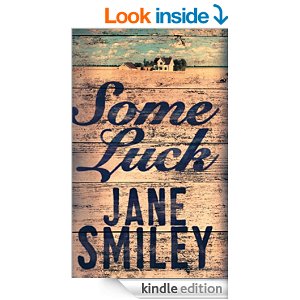
Published: 9th October 2014 (Mantle) In paper 7th October 2014 (Knopf)
Pages: 416
Genre: Historical Fiction
There is something very attractive about settling down to read the story of a family and getting to know them for a lengthy period of time, as if they were family friends. In the case of Last Hundred Years Trilogy, of which Some Luck is the first novel, a hundred years, no less.
In an era when people don’t seem to have time for anything and everything must be shorter and faster today than it was yesterday, the promise of space and time to see characters and situations develop feels like a welcome luxury.
Jane Smiley’s new novel that starts with the kernel of a young family living in an Iowan farm, has been described as an epic and it is, not only for its large cast of characters (no big figures, no huge names, just people like you and me), but for its breadth, spread and ambition. Some Luck follows several generations of the same family (and they keep coming) through their lives and that of their country and the world. The novel is marvellously democratic, with no hierarchy of voices or experiences, and the same space is given to a toddler trying to understand the world around him and the functioning of his own body than to somebody drawing their last breath.
Readers get to know the many characters from inside, in a non-judgemental way, as you accompany them through their lives in their own heads, and you might like them and agree with them more or less, but you come to accept them as they are.
The book reminded me of a recent and wonderful movie Boyhood although the novel’s reach is greater but the feeling of peace and reflexivity you experience is similar.
The author’s ability to use brief but descriptive language, and combine it with extremely subjective, stream-of-consciousness passages, and quasi poetic everyday wisdom (and philosophy) creates a beautifully textured patchwork of a novel. If maybe the dimensions of the canvas are smaller, this could be the War and Peace of this generation.
This is a novel that moves at a sedate and calm pace, made of little moments and small steps; in summary, a novel about the things that really make life what it is. Extraordinary in its everydayness. I hope to meet the family (that has become mine as well) again very soon.
If you’ve enjoyed the review, remember to like, share, comment and click. And of course, if you’re a reader, remember to review the books you read. Thanks!





 Lit World Interviews