
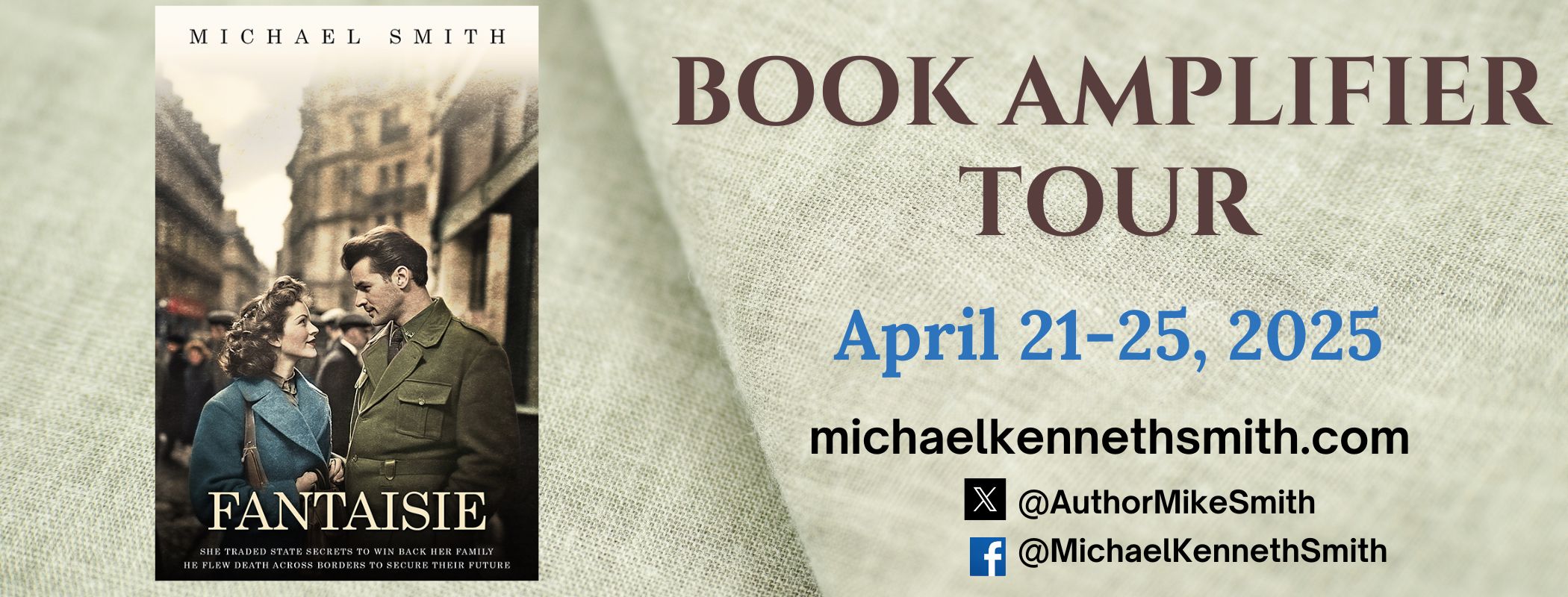
Fantaisie by Michael Kenneth Smith is a historical novel set in the volatile years after World War II. Former Polish RAF pilot Jan Orlinski accepts a job flying cargo from Paris to the Belgian Congo, only to discover that his missions may involve more than he’s been told. Meanwhile, Sophie Gordon—banished from Britain due to her father’s past—takes on a covert role misleading Soviet spies, until she is captured and imprisoned.
Michael Kenneth Smith is the author of six historical novels, including The Postwoman, an international Amazon bestseller based on the true story of WWII resistance fighter Andrée De Jongh.

While researching for Fantaisie, I hit a roadblock trying to accurately portray the mechanics of the two-seater Messerschmitt Bf-109G-12 that plays such a crucial role in Jan and Sophie’s escape. Aviation forums and history books offered conflicting information, and I was struggling to visualize how a fighter pilot accustomed to a Hurricane would adapt to German controls.
My breakthrough came at a small aviation museum outside Paris where they had a partially restored cockpit section. The curator, noticing my intense interest, introduced me to an elderly aviation engineer who had worked on restoring various WWII aircraft. Though he’d never flown them in combat, he understood their mechanical differences intimately.
He spent an afternoon explaining the quirks of the Bf-109’s control systems, even sketching diagrams of the cockpit layout and explaining how the handling would differ from Allied planes. His technical knowledge paired with his storyteller’s ability to convey the sensory experience of these machines transformed what would have been generic flying scenes into something much more authentic.
When the book was nearly finished, I sent him the chapter featuring Jan’s escape flight. His note back simply said, “I could feel the wind through those bullet holes in the wing fabric.” That validation from someone who truly understood these machines meant everything.

© 2014- Ronovan Hester Copyright reserved. The author asserts his moral and legal rights over this work.

 Lit World Interviews