
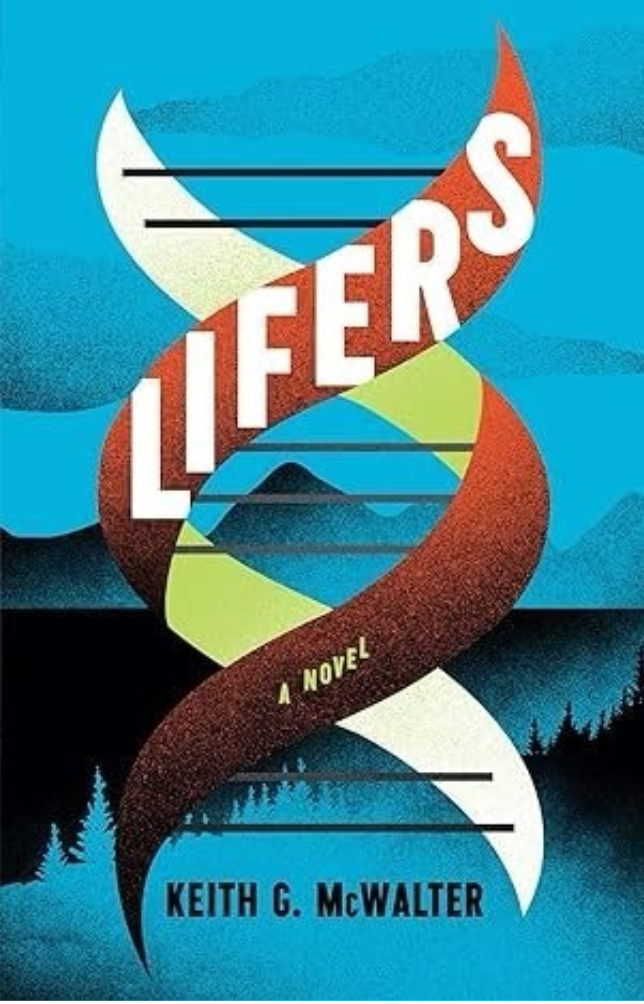
“If Ann Patchett wrote sci-fi, this is what it might look like. What does it mean to live forever? To you? To your loved ones? To your country? To the world? A great read with a thought-provoking premise, and a sure-fire conversation starter for that dinner party you’re dreading.”
-Arlene Dillon, journalist and former President of the White House Correspondents’ Association
You can get Lifers at Amazon.
You have only a brief moment to tell someone about your book. Can you tell us, in two sentences or less, what Lifers is about and and make us want to read it?
When a rogue scientist’s longevity gene goes viral, the boomer generation suddenly stops dying, and a multigenerational family must confront the personal, social, and political consequences of potential immortality.
Lifers blends grounded science with near-future imaginings to examine ageism and the quest for longevity in a startling new light.
Why did you need to write this story?
Like so many of us, I’m attracted to the idea of living a long and healthy life, so I’ve read fairly widely in nonfiction accounts of longevity science and its practical applications.
Two things struck me about most discussions of longevity enhancement: increased longevity tends to be viewed as a luxury product for the rich and the few; and no one discusses the economic and social stresses that a radically longer (even if healthy) lifespan would impose on individuals, on families, and on society at large.
I wrote Lifers to dramatize those unspoken implications, and to examine ageism from a different perspective in which extreme longevity becomes commonplace and there are so many super-aged individuals that they become a problem — and a force — that must be reckoned with.
Why did you choose strong females as the protagonists who move the plot of the story?
For whatever reason, perhaps having to do with the influence of my super-competent mother and my independently-minded spouse, I find that writing from a female point of view comes easily. The challenge, of course, is not to presume too much understanding of women’s unique experience, and to maintain a stance of humble empathy as a writer.
The women protagonists in Lifers are of different generations, and I wanted to use female relationships to illustrate both how conflicts happen across generational lines, and how those conflicts can be resolved through uniquely female skills.
There are multiple settings/locations in Lifers, what research did you do to create that world for the reader to immerse into?
I’m fortunate to have traveled broadly and lived in multiple urban settings, so the locations in Lifers are all drawn from real places that I know well and love, and I had to do very little research about them.
With limited resources on the planet, what would be the solutions to the problems extended life would bring and just how far do we go?
Lifers is an attempt to imagine answers to this very question, but in the novel longevity accelerates very suddenly, and I can only hope that in real life we’d have more time to adapt to the challenges of having billions more humans on the planet, and millions more people in their second century of living. Overpopulation and strains on the medical system would be the most pressing problems, with the effects cascading into personal and national finances. Economies would have to find ways of putting able-bodied super-centenarians back to productive work, and housing would have to become much more communal and less age-stratified. At some point options for living off-earth (some of which are depicted in the book) would hopefully become available. This all assumes that government remains democratic and rational, and doesn’t descend into even worse divisiveness than we’re witnessing today.
What will connect the reader to the story and make them want to keep reading the story?
The characters. No matter how interesting the premise — and I think the premise in Lifers is very compelling — it’s the connection to the characters that keeps a reader engaged. I’m proud of the cast of characters in the book, and think they’re varied and sympathetic — and realistic — enough to pull the reader along to find out what happens to each of them.
How long did it take to complete Lifers?
About a year and a half.
You’ve said you would be a ‘Lifer’, a long-lived person if you had the choice. What would you do with that time?
I would write and travel, and perhaps work on a second career in politics, to try to bring some rationality back into our civil discourse.
Did you have difficulty deciding your book was ready to publish?
Not really, though “ready” is a relative term, and there were many, many revisions. Probably 90% of my editing occurs while writing. The most significant form of revision for me is, once all or most of the book is finished, to review the scene sequence to try to improve it to make sure the reader is drawn forward in the narrative at the right pace, and that characters have been fleshed out enough. On Lifers I ended up adding quite a few chapters and scenes. But in a sense no book is ever really finished. There are still things I would change or add to it.
What is your next project idea?
I’m beginning to think about a sequel to Lifers that would take off from the book’s conclusion, where a very specific form of time travel — actually, collective memory travel — becomes possible. I want to depart from the current fabulistic trend where time travel just “is” — it’s an unexamined premise, not a plausible process (I’m thinking of The Ministry of Time and Sea of Tranquility). The whole trope of time travel has become a rather tedious cliché and needs some new life injected into it. So that’s my next mission: make time travel believable again.
You can get Lifers at Amazon.

Author Bio:
Keith McWalter’s first novel, When We Were All Still Alive, was published in 2021. His essays have appeared in The New York Times, The New York Times Magazine, and the San Francisco Chronicle. He’s the author of two blogs, Mortal Coil and Spoiled Guest, which present his essays and travel pieces to a loyal online following. A collection of his essays, No One Else Will Tell You: Letters from a Bi-Coastal Father, won a Writer’s Digest Award for nonfiction.
Keith is a graduate of Columbia Law School and earned a BA in English Literature from Denison University. He lives with his wife, Courtney, in Granville, Ohio, and Sanibel, Florida.
Find out more: https://keithmcwalterwrites.com/
Facebook: @keith.mcwalter
Twitter: @kgmcwalter
Instagram: @kmcwalter
© 2014-2024- Ronovan Hester Copyright reserved. The author asserts his moral and legal rights over this work.
 Lit World Interviews