
Book Description
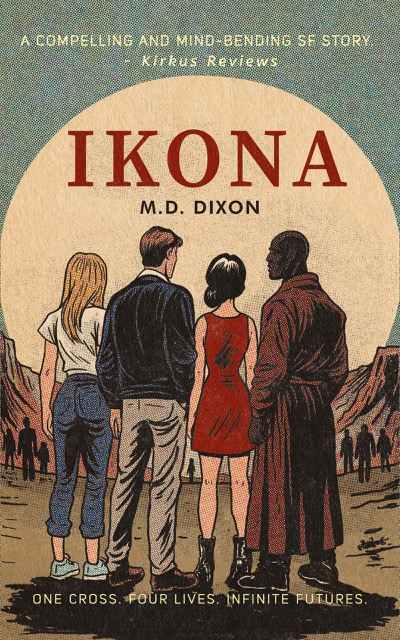
A fluid medium where the past and future frequently intersect through a mysterious icon is presented in M.D. Dixon’s IKONA. The narrative follows four individuals who are drawn toward an ancient healing cross, leading them on a journey of inner reckoning and collective discovery. It is an observational look at how the choices of the few can resonate across multiple dimensions of existence.
Across various cities and fractured timelines, a mysterious Russian Orthodox cross with inexplicable healing power begins to emerge. Four strangers find themselves drawn into its resonance—from the busy streets of Sydney, Hong Kong, Atlanta, and Berlin to the stark quiet of a post-apocalyptic Siberian tundra. Kate Davies witnesses the icon’s power in Atlanta, while in Sydney, Finley Minor deals with the weight of prophetic visions. Jia Li MacPherson, a former thief, holds secrets that powerful forces are willing to kill for. One hundred years in the future, Wallace Deng Moroz, a monk in a world ravaged by a genetic engineering catastrophe, clings to visions of a cure.
In a dangerously polarized world, the convergence of these four heroes feels destined, yet it is ultimately shaped by their own decisions. As they move further into the cross’s field, they must decide which version of the future they will inhabit and what price they must pay to reach it.
Q&A
What’s a detail, theme, or clue in your book that most readers might miss on the first read—but you secretly hope someone notices?
I hope someone notices that whilst the present-day chapters and future chapters are chronologically ordered forward in time, the chapters set in the past (early 20th century Siberia) move backwards in time, so that the earliest chapter timeline-wise for the past chapters reaches a climax at the latest period time-wise for the other chapters. Truthfully, there are many other details that might be missed but which astute readers will catch: recurring motifs, the recursive nature of the story, how Gutov’s chapter 26 is also IKONA’s chapter 26, for example.
When did this story or idea “click” into place for you—was there a single moment you knew you had to write it?
This story first came to me in 2012. I planned the structure and journeys for years before I sat down to write it. I knew from the moment I got the first few pages and the title that it would be my most mature work. It is my fourth novel, but my first published novel. It was a persistent inner voice which never left me no matter how many twists and turns my life took in the interim. I wrote it in 2022.
Which character or real-life person surprised you the most while writing this book, and why?
Finley Minor’s journey evolved in a way I didn’t expect. No spoilers so I will just say that his arc deeply moved me, and I was unprepared for my own emotional reaction.
If your book had a soundtrack, what three songs would be on it and what scenes or moments would they pair with?
Jimi Hendrix’s All Along the Watchtower was a song that appeared in my mind the moment the title and first chapter appeared, as if guiding me with its revolutionary message – I feel that this song is the musical equivalent of IKONA’s message.
The song You Are a Memory by Message to Bears accompanied Part Three of the novel and always brings me back, emotionally, to Finley’s and Wallace’s final chapters.
Saeglopur by Sigur Ros takes me to the narrative’s climax and particularly Jia Li during one of her Shibari performances.
Music was a salve for the entire writing of IKONA and I created a public Spotify playlist for the novel called IKONA the Playlist.
https://open.spotify.com/playlist/7BbP05jUU3tJm28IfEy4E6?si=w4HVUAmGRui8WkflIg7AYw&pi=VOEyJ7igQqOg0
What’s one belief, question, or emotional truth you hope readers carry with them long after they finish your book?
Hope. I want readers to experience hope and a sense of personal agency in the long road of societal change we currently find ourselves navigating.
Tell us about a moment during the writing process when the story (or message) took an unexpected turn.
Honestly, writing this felt like an experience of transmission. There was no unexpected turn – the consistency in message, tone and narrative arc was set and unwavering. There was always a sense of consistency, as if the river of words flowed, and I was merely the faithful witness. From a craft point of view, there was a fair bit of planning. It felt like a giant puzzle I had to arrange in precisely the correct order. Like sacred geometry. Which chapters went where, and in what order, and so on. But the narrative itself flowed without deviation.
If your protagonist (or the central figure in your nonfiction) could give the reader one piece of advice, what would it be?
Well, as my character Gutov says regarding his chapter the Bridge, “Read it again, this time with your heart.”
What real-world place, object, or memory helped shape a key element in your book?
I am a Russophile by training, albeit 30 years ago. I lived in St. Petersburg, did my doctoral research in Crimea, travelled a lot in Russia and Ukraine…
My experience speaking Russian with friends, speaking of the soul, of life, of destiny, on -35 degree nights in friends’ apartments, with vodka or strong coffee, has certainly shaped me, and by extension, my vision and prose. This was in the 1990s, a time of that society’s collapse – the atmosphere and weight of it permeates my marrow. So this definitely has shaped a certain ‘vibe’ of IKONA.
What’s something you had to research, learn, or experience to write this book that genuinely shocked you?
I can’t speak to shock; I don’t think anything shocked me! But I did a deep dive on the process of creating a metal crucifix –the how tos – and this led me to researching the life of iconographers in early 20th century Russia, and that was fascinating. I found a wonderful academic book on the subject matter with loads of photos, and it just really touched me. Iconographers were like monks, and lived as such and were part of the monastic community. I loved how when they created icons, it was a holy occasion accompanied by fasting and prayer.
SPOILER ALERT: I was surprised (and also not surprised as I know Russians and Russian history) that one of the chief investigators of the Tunguska Event was a famous (at the time) science fantasy author. The government actually invited this person to research and comment, because conventional science had found no answers, but they thought this author had some kind of insight into the field of reality beyond hard science. It always makes me chuckle when I remember this.
If your book were invited to join a shelf with three other titles, which ones would make you happiest—and what would that shelf say about your story?
I would place it alongside Cloud Atlas by David Mitchell, The Teachings of Don Juan by Carlos Castaneda, and The Overstory by Richard Powers. I think because it signals to the reader that while the story is a high-concept, multi-timeline puzzle, it is grounded in the visceral, feet-on-the-ground reality of a spiritual initiation. This shelf tells the reader that IKONA is an invitation to look beyond the shadows of our current reality and contemplate how consciousness itself can heal the future.
M.D. Dixon is a novelist, somatic therapist, and explorer of the intersections between the psyche and the sacred, science and mysticism, trauma and transformation. Holding a Ph.D. in the social sciences with a focus on Russia and Ukraine, Dixon has spent nearly fifteen years in therapeutic practice in Sydney, Australia. Dixon’s debut novel, IKONA, weaves visionary fiction, myth, and metaphysics to illuminate the evolution of consciousness. Dixon also hosts The Shattering Place, a podcast on multidimensional healing and the awakening human story, launching in early 2026.
Visit M.D. Dixon online.
Amazon: https://bit.ly/3ZdHSXy
Goodreads: https://www.goodreads.com/book/show/243253546-ikona
 Lit World Interviews