
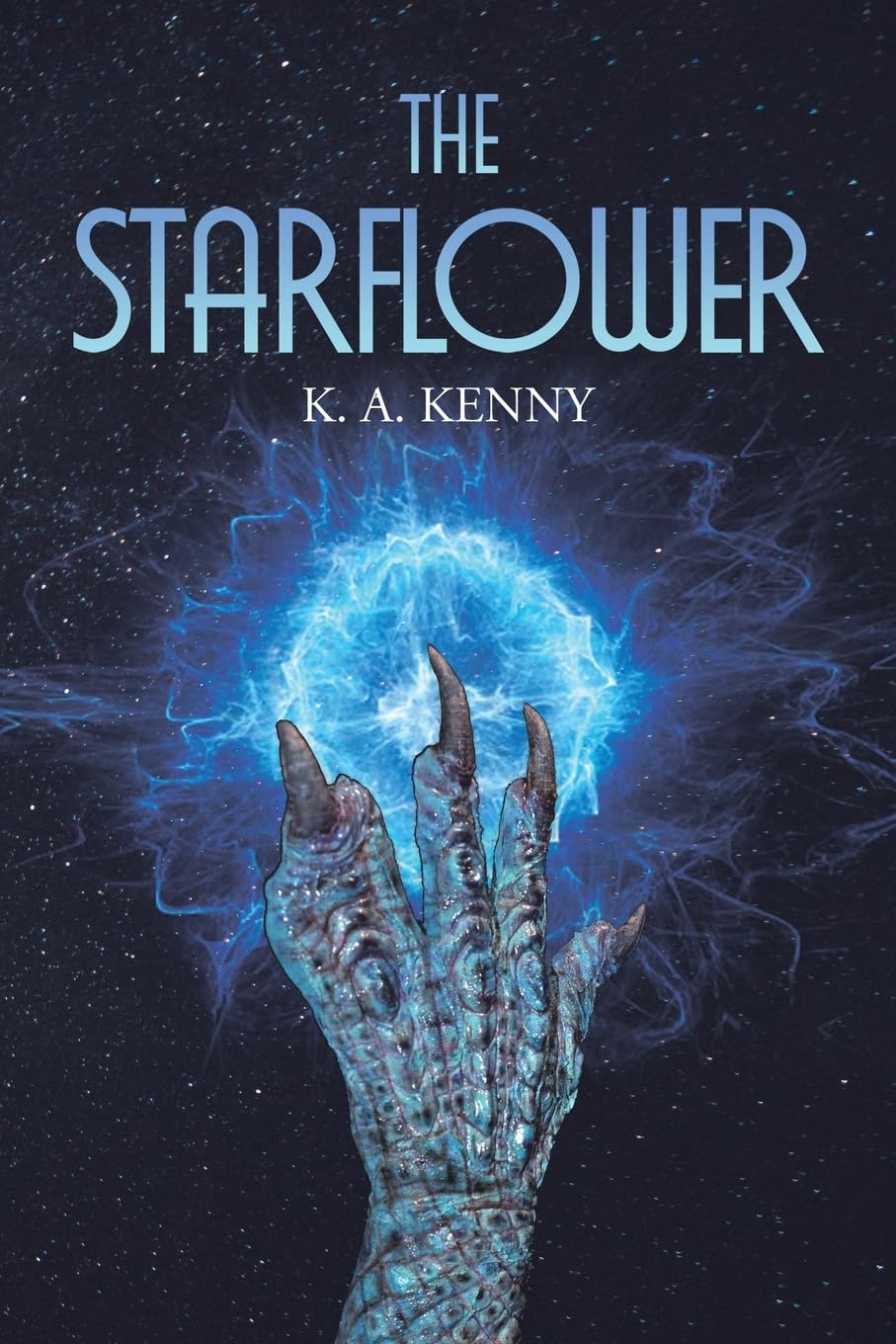
Step into a vast universe teeming with life, romance, heroism, and treachery as experienced and seen through the eyes of Gayle Zimmon. ‘Zim’, a young woman successful in war but naive to the machinations of the greater universe, returns from combat to confront genetically engineered humans and discover that she was sent to war not to win but to die.
While fighting the Aldrakin, Zim learns of a prophecy foretelling that the “Starflower,” her military call sign, will bloom “in the dark of the darkest night” but never know peace. Not one to accept ancient prophecy, after securing victory, she hopes to rekindle her romance with Mac and return to the peaceful life they left on the frontier.
But she is a major player in a galaxy-spanning intrigue she barely understands. Forces alien and cybernetic hold the stakes and align on both sides. Between dodging assassins, hostile planets, deadly robots, mystical aliens, and ancient relics, she must decide whether to continue running from her prophesied destiny-or try to live up to it.
Get The Starflower at Amazon.
What genre do you write and why?
Science Fiction has unlimited possibilities for imagination and metaphor. It taps imagination well beyond other genres. It also challenges the writer to create realistic, unknown worlds.
There are many sci fi books out there. What makes yours different?
To my mind, SF is about dreaming the impossible dream. If we do that, nothing is beyond us. Much SF today is simplistic, pessimistic, and dystopian, i.e., unworthy of creative minds seeking to fly.
Which authors inspired you to write?
The old SF masters from H.G. Well to Arthur C. Clarke to Larry Niven, Phillip K. Dick, and Frank Herbert
How did you do research for your book?
I feel I’ve been researching my book all my life: wide experiences, meeting characters, reading everything, making contacts to touch base with, e.g., scientists and engineers, SF&F writers, medical techs, officers and enlisted from all the military services.
Which was the hardest character to write? The easiest?
My main character Zim was the hardest. I know and love her very much, so testing and hurting her brought me to tears a few times.
The easiest was probably Abramyan, the character I love to hate.
How are you similar to or different from your lead character?
My lead character manifests many of my daughter’s confrontational traits, my wife too, which may be why I instantly loved her. We are all in sync.
If you could put yourself as a character in your book, who would you be?
Probably Roland ‘Mac’ Mackenzie—loyal, intelligent, fearless, humble, Zim’s love from childhood.
In your book you make a reference to The Prophecy. How did you come up with this idea?
The Prophecy is central to the plot, as it was in DUNE, but here it is a much more personal and threatening experience. I have a feeling we all live prophetic lives and, like Zim, may wish to escape them.
If your book were made into a movie, what songs would be on the soundtrack?
A lot of Irish instrumentals match the mood. I listen to them when I write. Think the movie Last of the Mohicans with Daniel Day-Lewis.
In one sentence, what was the road to publishing like?
Agents want something completely original just like what they last read and with a well-established market, i.e., no risks. Originality may be a hard sell.
Where do you write?
I have a writing loft and a wide-screen station beside a picture window overlooking the Rockfish Valley. Away from my station, I may take notes but do no serious writing.
In today’s tech savvy world, most writers use a computer or laptop. Have you ever written parts of your book on paper?
I understand that pen-and-paper writing draws differently on the mind than typing on a computer. That seems to be the case with me. If I’m having a problem with a scene or character, switching to my paper tablet takes care of the problem. Usually in seconds.
What is your next project?
I promised my readers a trilogy and am almost finished with the second book, Agent of Blue Star. Beyond that, I have two first-draft novels on hold: The Looalee and Facing Nabua.
What is the last great book you’ve read?
I read a lot of nonfiction to help understand human and inhuman societies as well as technology. In SF, Edward Lerner’s book InterstellarNet Enigma had a fascinating premise about human development. A very creative, SF thriller.
Get The Starflower at Amazon.

Author Bio: (in his own words)
© 2014-2024- Ronovan Hester Copyright reserved. The author asserts his moral and legal rights over this work.
 Lit World Interviews