

Book Description
What is the inspiration for Following Jimmy Valentine?
For years I tried to balance two identities — mathematical and musical — until a layoff from my day job made me decide I needed to “grow up,” set music aside, and build what I thought a stable adult life should look like. So I stopped writing music — for ten years. In 2017, when I finally felt ready to try again, I went to the Metropolitan Museum of Art looking for inspiration for a song—any song. That’s where I found Asher B. Durand’s The Beeches, a painting in which a shepherd walks from shadow into light — a perfect metaphor for emerging from my own creative dark ages into a personal renaissance.
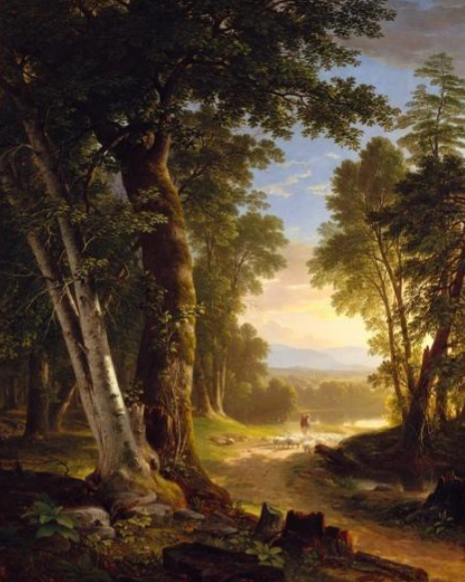 Standing in front of it, a melody came to me, and I began writing a song then and there. That moment became the foundation for Following Jimmy Valentine. The painting still captures, for me, the feeling of stepping out of darkness and into possibility — the emotional journey at the heart of the story.
That same year, I reread O. Henry’s A Retrieved Reformation, whose theme of reinvention sparked a very different song — an early version of the song now called “Surrounded,” which tried to tell the entire story in three minutes. When my wife heard what I now refer to as the “Great Balls of Fire and Rain” version of “Surrounded,” she said, “You’ve got a whole musical there.” I thought about it and said, “Nah.” But she persisted, and she was right. I eventually reworked “Surrounded” to focus on the moment in the story when Jimmy Valentine falls in love.
Why a musical audiobook?
An audiobook musical is a musical stripped down to its two essential elements: story and song. Everyone can listen to it in their own way, for a fraction of the cost of a theatre ticket, and no travel necessary. From the side of the actors, no memorization, no blocking, no rehearsing—fit the recording dates into your touring schedule. And unlike live theatre, a book can last a thousand years.
What is your background to make this project happen?
Both my public persona and my secret identity contributed. Before I learned arithmetic, I was secretly writing music, in the privacy of my own mind. When I became a mild-mannered math major, I tried to keep math and music in separate compartments: calculus by day, singing at night. But my brain had its own ideas, noticing the aesthetics in the equations and the math in the melodies. From my “day job”–software engineering–I developed an approach to writing music that isn’t taught in any music school.
Jimmy Valentine’s change in occupations—from running from the law to running a shoe store—resonates with my own pivot in day-job careers, which took me from Boston to New York. In New York I found the cabaret scene, where I met an actuary who wrote songs at night, an Equity actress who worked in finance, and an HR professional who sang at Birdland—fifty years after her family had lived next to mine and taken my family in when our house burned down. Being around people whose identities were larger than their résumés helped me give Jimmy and Jen the freedom to be more than the roles life hands them.
And unconventional though it sounds, my corporate career proved invaluable when it came time to produce an audiobook musical with a team spread across eight time zones. Thanks to technology, our cast and creative partners were quite literally all over the map—from Seattle to London—which meant someone on the team was awake at any hour. Suddenly I was back in a world of milestones, meetings, communication threads, and above all, file integrity (“No, not the Wednesday version—the Thursday version”). My professional experience with technology became an unexpected asset, because the final expression of everything we built came down to a set of audio files I could carry in my pocket—a far cry from the basement-sized computers I once worked with, or the vinyl LPs I helped produce in 1985 that weighed almost as much as my piano.
You were able to bring great talent to be involved with Following Jimmy Valentine. What was that process like?
It was like reaching for the stars — and actually catching them. Kerry Ellis was the original West End Elphaba. Hadley Fraser played Raoul in the 2011 version of Phantom. Both these stories, like Following Jimmy Valentine, focus on characters who are not so much wicked as misunderstood. I selected my cast primarily based on their recorded music. In Kerry’s albums, I heard the soul of someone who’d seen her way through tough times. In Hadley’s Things that Come and Go, I heard his daring and versatility as he brought the Great American Songbook into the 21st century.
When I heard jazz legend Jacqui Dankworth sing the title track from Windmills, I heard the noir I needed for Collette. The first time I heard Jacqui sing in the studio, I felt as if I’d just fulfilled my life’s ambition. With David Hunter, I heard in his Time Traveller’s Wife album the willingness to take the desperate chance Jimmy’s Reflection would need to take when wooing Annabel, played by Celinde Schoenmaker, who won me over with her quack in “If I were a Bell”—a serious young woman coming unglued—temporarily—after her first drink.
The five above I selected primarily for their singing. For Jimmy’s buddy Emil, I needed a different skill set–a comic actor who could also sing. George Blagden made me laugh. I remember asking him in the studio to sing like a French Elvis, “Le Roi”, and he did. My ensemble actors Simon Shorten and Alison Arnopp amazed me in being able to both speak and sing in multiple voices to portray a variety of different characters. I can still hardly believe that all these people agreed to work with me. They must have seen something in the material, and in the efficiency, because with a couple of days work in a studio, they have a chance at creating art that lasts forever.
Why did you choose the music you did?
While looking at The Beeches in the Met, I came up with a fragment of melody.
 In the first four notes, I heard a musical mirror — an F♯ in the middle with a G on either side, but in different octaves, like a reflection that isn’t quite symmetric. The notes for “war is over” develop the idea of an asymmetric mirror as well: the G sits closer to the repeated center than the D does on its opposite side. Soon after, I began writing the scene in which Jimmy talks to his Reflection and his Reflection talks back.
That asymmetric mirror became the seed of the entire score, because I realized that the central question isn’t who you are — it’s what you can be. As Jimmy’s Reflection sings, “What do you hear when you look in the mirror?” If the answer isn’t a satisfied yes, is it — as with Jimmy — because you want to rise to something better, or — as with Jen — because you fear you’re falling to something worse?
What themes run through your story and why those in particular?
The main theme is reinvention, because I’ve had to learn it myself. Both Jimmy and I have PTSD, and through years of work in therapy I’ve discovered that I can redefine who I am, especially in how I respond to things that once would have overwhelmed me. That idea — that we’re not cured, but we can change our patterns and rebuild our lives — is at the heart of both Jimmy’s journey and my own.
This leads to the second theme: our greatest battles are within. To quote Walt Kelly, “we has met the enemy, and they is us.” This means two things. First, you can root for both the cop and the robber. Second, although there is romance in the story, the primary drama is watching the characters decide what they’re going to be.
Because the primary conflict is internal, another theme is that external conflict can help clarify it. That matters to me because when I struggle internally, I sometimes want to retreat from other people — yet it’s often those interactions that bring my own patterns into focus. In the story, the same thing happens to Jimmy and Jen: although they seem to be out to destroy each other, their collision helps each of them heal by revealing the internal battles they’ve been avoiding. They don’t heal each other on purpose, but by forcing the truth to the surface.
You’ve updated characters from the O. Henry story. What or who inspired those changes?
Jen’s character draws deeply from my wife’s resilience — the kind of persistence that once led her to keep a newspaper clipping on her wall that read “I’m a fighter.” If there were one person I’d trust to stand her ground when everything is on the line, it would be her. That steadiness became central to Jen, who finds another gear and sings “I’m a fighter” at a moment when anyone else would have given up.
Collette was inspired by the real-life person for whom I named her: NYC cabaret legend Collette Black, who directed the 2018 stage reading of this musical, while, unbeknownst to the cast and me, dying from breast cancer. In the 2018 version, Annabel’s single parent was close to what O. Henry described: a “typical, plodding, country banker”. When I reinvented the character in 2024 and named her after Collette, I knew I needed to give her the indomitable drive I felt from the real Collette.
Jimmy’s relationship to his friend Emil is informed by my relationship to my brother Mike. One day in the 1990’s, Mike and his wife challenged my wife Helen and me to 2-on-2 basketball in our parents’ driveway. Mike probably figured he had an edge, since he played basketball and I really did not. But I “forgot” to tell him that Helen was on her varsity team in high school. Jimmy and Emil are always trying to get something over on each other — a dynamic I recognized immediately from my relationship with Mike.
Why should people want to buy and listen to Following Jimmy Valentine?
What other story pits a cop against a robber and has you rooting for both? Disillusioned Detective Jen Price wants a clean victory. Notorious jewel thief Jimmy Valentine wants an honest chance. Both are haunted by a memory they can’t make peace with. Each is trying to outrun a shadow only the other can illuminate. It’s the story of two wounded souls who can only heal by colliding. But the road to that collision is a dramedy, with laughs, charm, and warmth.
Jen feels trapped in a downward spiral by a regret she can’t apologize her way out of. Jimmy longs to fly into an upward spiral, but a wartime memory keeps pulling him back down. Neither is broken beyond repair, and neither finds a magic cure. What they discover instead is the first step toward healing, as their conflict forces each to confront the memory they’ve been running from.
The music mirrors their inner lives, using variations and reversals that make the listening experience feel both familiar and surprising. Its developing ideas of spirals and mirrors echo the characters’ hopes that broken patterns can be reshaped and fractured identities can be rebuilt. The story lingers because it’s not just about what happens — it’s about what becomes possible.
Find the Following Jimmy Valentine Audiobook on Amazon: https://www.amazon.com/Following-Jimmy-Valentine
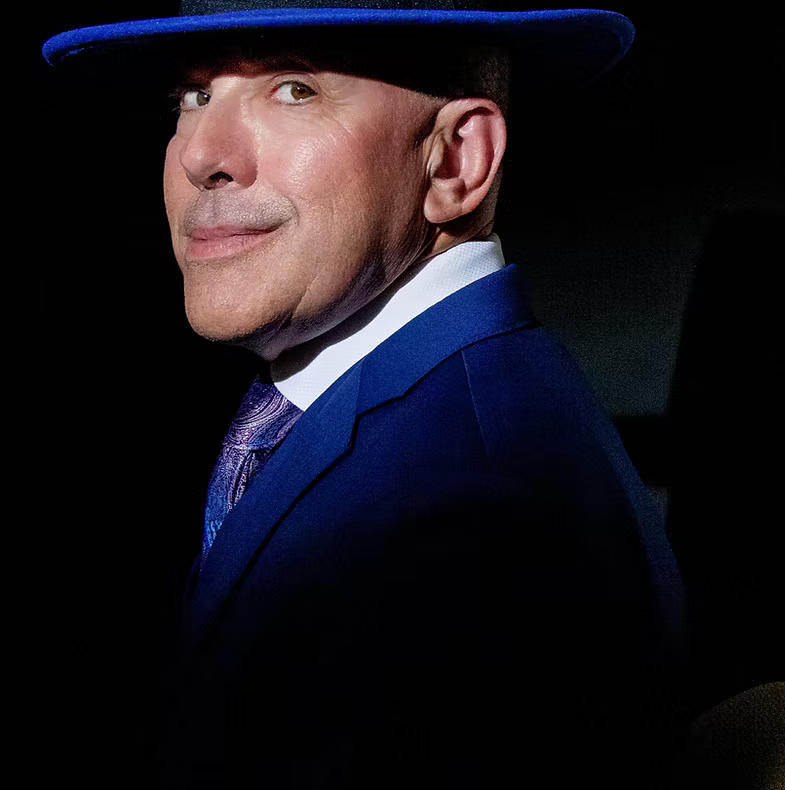
JEFF FLASTER is a New Yorker by birth whose parents were both mathematicians. They had saved since Flaster was born so that they could send him to MIT, and were not pleased when college-aged Flaster asked if he could major in music instead of math. So Flaster made music a minor, but it remained a major in his life. The fact that he is a tenor gave him easy entrée into choirs and ensembles, and he performed regularly in a group at MIT, The Chorallaries. He has also performed at The Kennedy Center with the Choral Arts Society of Washington, and at Tanglewood with the Tanglewood Festival Chorus.
Flaster produced three recordings of his original compositions, available on Apple Music. Recently, inspired by O. Henry’s sunnier version of “Les Misérables,” Flaster wrote a full-length musical now called “Following Jimmy Valentine.” The 2021 version of this musical, called “Shell Shock,” was directed by Lennie Watts and can be seen on Melodic Music’s YouTube channel. Flaster’s interest in cabaret was sparked by his father, and by a course he took at 92Y with the late Collette Black. Find out more about him at https://www.melodic.com.
Follow Jeff Flaster on social media:
Facebook: @FlasterTunes | Instagram: @Flaster_Tunes | YouTube: Melodic Music
 Lit World Interviews