
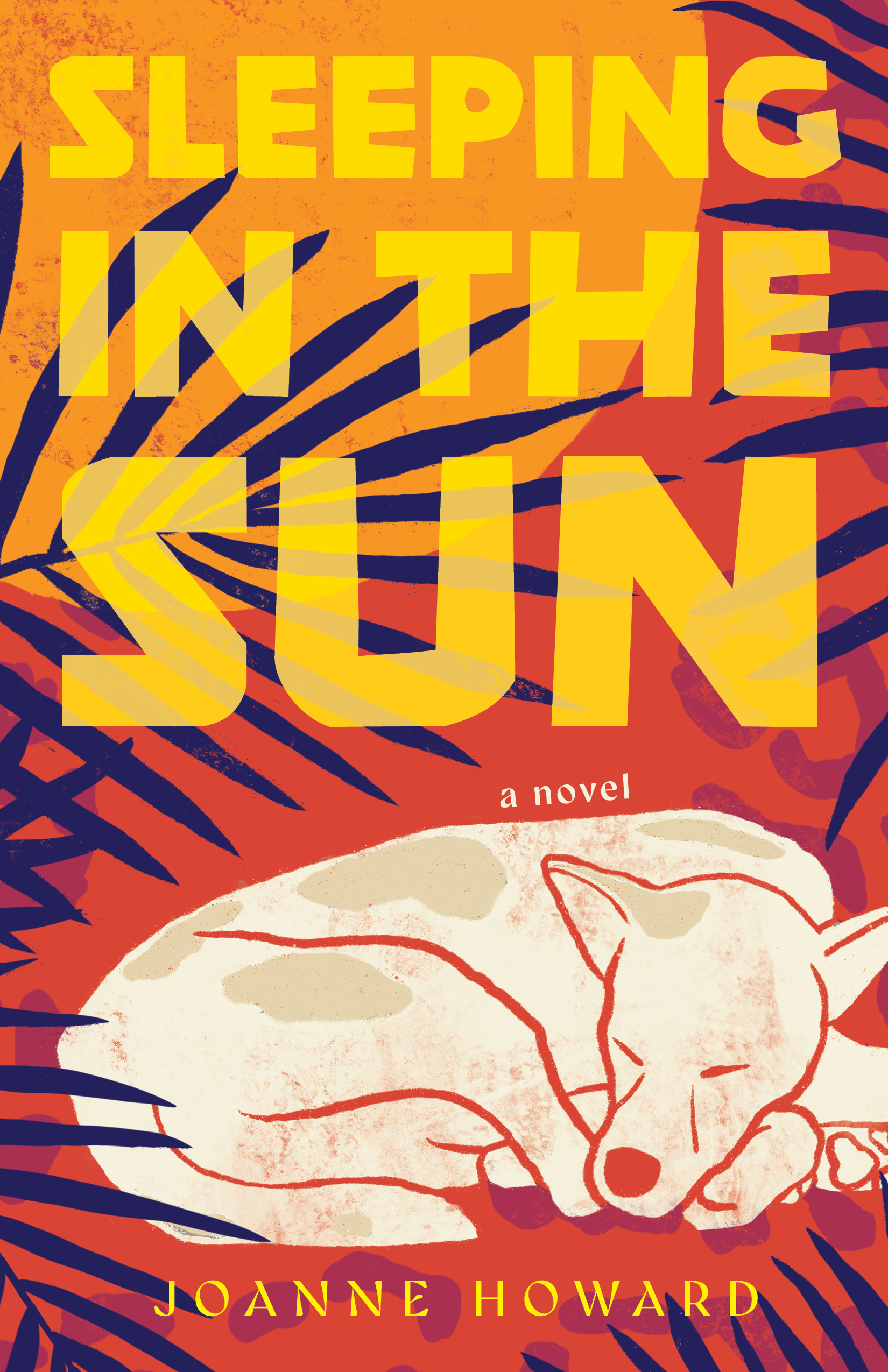
“Sleeping in the Sun is a novel impossible to put down. A cinematic study of imperialism and the scars it has left. An outstanding debut.”—Willy Vlautin, author of The Night Always Comes and The Motel Life
“This is at once a gripping page-turner and book to savor and admire. It will light up your imagination and endure in your mind alongside all the memories from your real life. I was sad to see it end but delighted to welcome this impressive new voice into American literature. Joanne Howard is a writer to watch.”—Valerie Laken, author of Dream House and Separate Kingdoms
You can get Sleeping in the Sun at Amazon.
Imagine you have only a brief minute to tell someone what your book is about. Can you tell us, in two sentences, what your book is about and make us want to read it?
An American boy comes of age in the last years of the British Raj. Little does he know in this turbulent time that his family’s long-standing Indian servant may have ambitions to serve himself for once—for better or worse.
Why did you need to write this story?
I would like to see more historical novels set in non-western countries. I have never seen a novel about Americans in India, so I wanted to explore what a story about that would mean. And of course, I like to think of it as a nice tribute to my grandfather.
Where is the setting for Sleeping in the Sun?
1930s Midnapore, India. Midnapore is a small city outside of Calcutta.
How did the Hinton’s purpose as Christian missionaries determine their place in the white society of British India?
As American missionaries, the Hintons occupy an unusual space in society. They are not well off, as can be seen by their humble living standards, and they aren’t particularly interested in climbing the ranks of British society. The boys are rowdy and rough around the edges, and the house is a bit out of town so they aren’t really included in social circles. The boys also go away to boarding school, which is yet another way they are considered outsiders in Midnapore. The book doesn’t show them interact with many British characters except of course for Judge Ellis, who takes an unusual liking to them.
How do the actual people of India see Christian missionaries in their society and culture during the time of Sleeping in the Sun?
It varied. In my family’s experience, they actually didn’t have much luck converting many people. Often times, if an Indian person converted on their own, they were ostracized by their community. So missionaries had more success if they converted an entire tribe or village. For this reason, my family mainly worked with indigenous tribes. In large urban areas like Calcutta, the attitude toward missionaries and white foreigners in general was less favorable. The Indian people had already pressured the Raj to move their capital out of Calcutta to New Delhi, and that anti-Raj sentiment carried over to missionaries too. However, my family was generally well liked and respected by Indian people in Midnapore, whether they were part of their church or not. Unlike the Hintons who stick to themselves through much of the novel, my family was very involved and did a lot of business with Indian people in the community.
If you were to be one character in your book, who would you choose and why?
I have a soft spot in my heart for Lee, the third Hinton brother. He acts as the voice of reason in the book. He has an easygoing, gentle demeanor and guides Gene as they try to make sense of the events that happen in the novel.
As a former history teacher and historian, I’m always interested in how an author researches to ensure the accuracy of culture and period. What was your process like?
My family is incredible at preserving everything, so I had a lot of firsthand accounts to inform me. My grandfather’s childhood diary, my great grandfather’s autobiography, and stacks of vintage photographs were of huge help, but of course it was up to me to imagine the characters in the way I wanted to and that would best serve the story. But for Arthur’s character, who is an Indian man and therefore outside my own lived experience or personal connection, I just tried to absorb as many works of Indian literature that matched his background and the time period, and two books especially inspired his character: The Autobiography of an Unknown Indian by Nirad C. Chaudhuri and Pather Panchali by Bibhutibhushan Bandyopadhyay. For setting, I traveled to India in 2018 for three weeks. I got to visit the street where my family lived, their mission’s church that is still standing, and other places that appear in the novel like Howrah Station and the Maidan in Calcutta. Lastly, I had a sensitivity reader who checked for blind spots.
What will connect the reader to the story and make them want to keep reading the story?
The multicultural and international aspect of the characters I hope will appeal to a variety of readers. My favorite historical novels are very immersive and escapist, so I hope that I have also brought the time and place to life well enough. I think I have because in fact, one of my early readers really asked me if this novel was based on my own life. I said, “Do you mean did I live in India in the 1930s?” And then lastly, I think that the novel explores the different definitions of identity, belonging, and spirituality. There is no one right way to be, and the novel offers many answers that can appeal to different readers.
What did you learn about yourself by the end of the book?
Early in my MFA program, a professor said that the story will take you where it wants to go. At first I sort of laughed at that idea, because surely as the author I’m in control of everything, right? But I really did experience the story going in different directions than I intended. I would just get this spark of an idea that was totally different than the outline I had so carefully plotted. So I learned that I’m not as in control as I thought.
Many first-time authors of a book have a problem letting their work enter the world for others to read. I know I did. Did you have difficulty deciding your book was ready to publish?
Not really. Although I did work on it for at least 6 years, I think I was always aware of some kind of finish line that I would come to eventually if I just checked off all these things. Every round of editing was correcting for a different fault, whether it was eliminating passive voice or clarifying character movements, so it did always feel like I had a plan. I guess I was very objective in that sense.
What’s your next project idea?
A contemporary novel that’s a bit closer to home.
You can get Sleeping in the Sun at Amazon.

Author Bio:
Joanne Howard is an Asian American writer from California. She holds an MFA in writing from Pacific University. Her poetry received an honorable mention from Stanford University’s 2019 Paul Kalanithi Writing Award. Her fiction has been published in The Catalyst by UC Santa Barbara, The Metaworker Literary Magazine and the Marin Independent Journal and her nonfiction has been published in Another New Calligraphy and The Santa Barbara Independent. She lives in Santa Rosa, CA. Find out more at her website.
Find out more: https://www.joannehowardwrites.com/
Facebook: @joanne-howard
Instagram: @joannesbooks
© 2014-2024- Ronovan Hester Copyright reserved. The author asserts his moral and legal rights over this work.




 Lit World Interviews