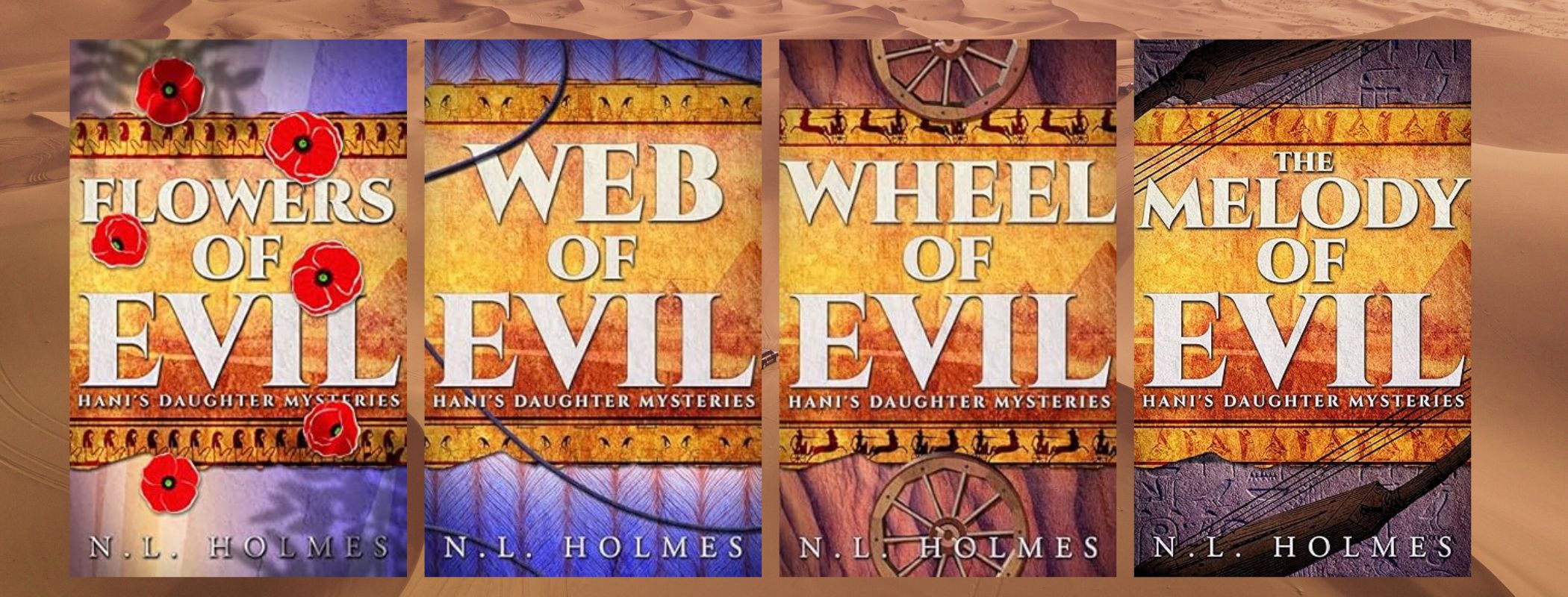
Welcome to ancient Thebes, where two women — Neferet and Bener-ib — are quietly changing their world one patient (and one murder investigation) at a time. In N.L. Holmes’s rich and addictive historical mystery series, a physician and her partner set out to run a neighborhood dispensary… only to be pulled into a series of bizarre and dangerous crimes that demand not just compassion, but cunning.
From Flowers of Evil’s cryptic last words of a dying florist, to Web of Evil’s tangled family secrets in a weaver’s village, Wheel of Evil’s deadly chariot investment scheme, and The Melody of Evil’s murdered musician at a family celebration — each book delivers a standalone mystery steeped in atmosphere and soul. It’s historical fiction with a sharp investigative edge.
You can get the Hani’s Daugther Mysteries at Amazon.
If you were stuck on a deserted island, which 3 books would you want with you?
Wind in the Willows and The Perelandra trilogy of C.S. Lewis to take my mind away to a beautiful place, and Germinal by Zola to make me realize things could be worse.
Which authors inspired you to write?
I couldn’t put names to them now, but all the wonderful books I read as a child made me think that writing was the coolest thing a person could do. What tipped me over the edge was the fact that my cousin published a young adult book. That seemed to make it sound doable.
How long have you been writing?
I’ve been writing fiction for eleven or twelve years. Before that, it was just poetry and, of course, academic articles. Poetry really adds to one’s fiction chops, but I’m afraid academic writing has to be unlearned – it’s all about not having a distinctive voice. It does help in terms of using the language skillfully and knowing grammar.
What genre do you write and why?
I write historical novels set in the Bronze Age, mostly Egypt or the Hittite Empire. As an archaeologist, that’s a no-brainer for me! For a long time, I’ve been concentrating on mysteries of one sort or another because I like to read them, and so do a lot of people who might not care about antiquity otherwise. I think a well-researched historical novel can teach readers a lot about the past while entertaining them.
How did you do research for your book?
I had a lot of general background from teaching a class on Ancient Egypt, but I hit my library again for specific knowledge about various professions, etc. I find names from ancient manuscripts about village life or lists of tomb owners.
In your book you make a reference to ancient Egyptian medicine. How did you come up with this idea? What made you write a book about medicine?
The Egyptians’ medical skills were world-renowned in their day. They had observed by trial and error over millennia and written down the results of their experiments, so that a young doctor like Neferet could look in a casebook and see what her elders had done to treat those symptoms. A lot of it was herbal, much like traditional medicine today. This was always one of the most popular lectures when I taught my Ancient Egypt class, and it gave me a certain forensic capability for my sleuths.
Where do you get inspiration for your stories?
I began the Lord Hani Mysteries, from which this series is spun off, when I met the real Hani in a set of ancient documents called the Amarna Letters. There were references to a lot of diplomatic missions carried out by this man, so I took him as my protagonist and gave him a personality and a family. When Hani’s arc was completed, I zeroed in on his youngest daughter, a headstrong, unconventional girl who seemed likely to follow in her father’s footsteps.
There are many books out there about ancient Egypt. What makes yours different?
There are even a lot of mysteries set in Egypt, but this series has a female protagonist who is a physician, so she’s automatically privy to a lot of mayhem. Her father is a diplomat, and that draws into her orbit various foreigners as well. Plus, for those who like cozy mysteries, this is one, with the addition of Egyptian “tea time” vibes and heroic pet animals.
What is your next project?
I’m working on another Neferet mystery that features the world of cooks (each of these books deals with a different profession). I also have in mind a prequel to the Lord Hani Mysteries, because there’s one more real historical adventure of Hani to make use of.
You can get the Hani’s Daugther Mysteries at Amazon.
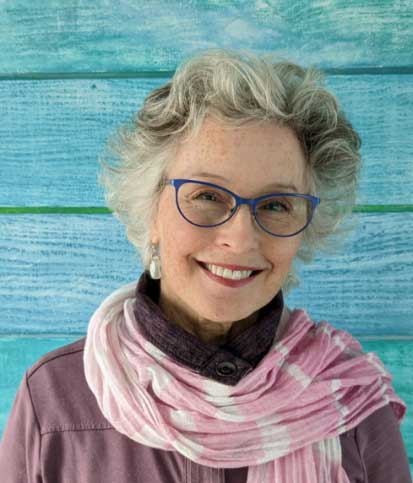
N.L. Holmes
Author Bio:
N.L. Holmes is an award-winning novelist and former archaeologist with a Ph.D. in Classical and Near Eastern Archaeology. She spent years excavating in Greece and Israel, teaching ancient history, and bringing the past to life. Her firsthand experience with ancient cultures adds a rare level of authenticity to her work — transporting readers deep into the heart of ancient Egypt with rich historical detail and compelling storytelling.
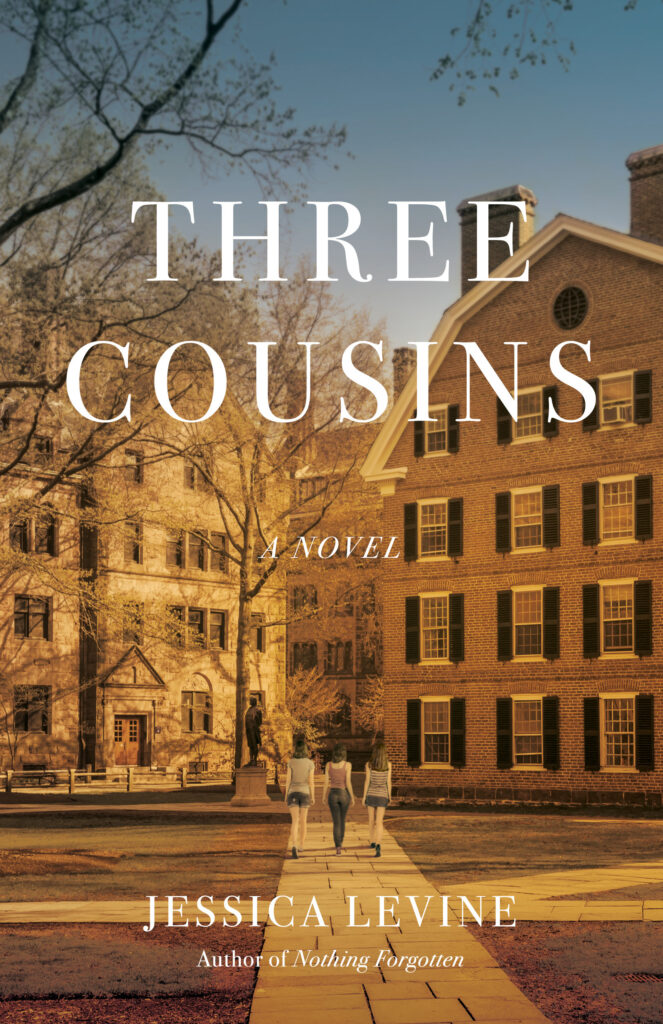
Set during the excitement and tumult of the second wave of feminism and the sexual revolution, this coming-of-age novel about female friendship in the 1970s will appeal to fans of Kristin Hannah’s Firefly Lane.
It’s 1976, the second wave of feminism is in full swing, and three cousins share an apartment at Yale. Two are seniors; the third is starting graduate school. Each is seeking her own path in both love and work—but all three women, not quite knowing how to use the new freedoms available to them, alternate between supporting and undermining each other in their efforts.
Julia, the most conventional of the three, wants the security of her monogamous relationship with Ben but is attracted to other men. Anna plans on traveling the world to escape her boyfriend and alcoholic mother. Robin, who is bisexual, has various partners as she dreams of open relationships. All fall under the spell of a charismatic musician, Michael, who is too wounded to be available. By the end of a year of experiments and necessary mistakes, the cousins will make crucial decisions that will determine the course of the rest of their lives.
This prequel to Levine’s first two critically acclaimed novels, The Geometry of Love and Nothing Forgotten, dramatizes the struggles that women have faced and continue to face while entering adulthood in a world not quite ready to accept them as equals.
Three Cousins
Pre-order Three Cousins at Amazon. Release date April 8, 2025.
Why did you choose the second wave of the women’s movement as the backdrop for Three Cousins?
The choice was dictated by the narrative structure of my series. Three Cousins is the prequel to two other novels I’ve written, The Geometry of Love and Nothing Forgotten, and takes place in the characters’ college years, which were also mine. I did my B.A. at Wellesley College in the mid 1970s when being in a women’s college meant being saturated with feminism. As I recreated that period (albeit I moved the action to Yale), I remembered how my thinking and my relationships were impacted by the emerging feminist voices of the time.
As I was reading I noticed that each cousin had a different type of relationship with her parents, with the mothers being somewhat the glaring ones. How important were they to the development of how the cousins end up as they are?
The three mothers form a foil for the protagonists. As a hinge generation between the social conservatism of their Jewish immigrant mothers and their more liberated daughters, the three mothers have had their share of frustrations and limitations. One of the book’s themes is the way in which daughters must liberate themselves from their mothers in order for their generation to progress beyond the previous. The moms also provide comic relief. They have hilarious responses to the vicissitudes of being female.
As important as the mothers are, I also saw the differences of the fathers and how they handled situations. What importance do you think they had in the cousins’ development? I am particularly thinking of Anna’s father.
The fathers are indeed important. Julia’s dad is generally present and supportive whereas Robin’s is absent. Anna’s father could be called irresponsible and disappointing: he clearly loves his daughter, but he chooses not to defend her against her alcoholic mother. Of course, it’s common in dysfunctional families that one parent is abusive and the other looks away.
How did you keep yourself honest about the ups and downs of the feminist movement while some authors like to show only the, I guess, positive impacts on the women involved? I wanted to point out some specific moments of honesty but that would be revealing too much. I was thinking of Robin and Julia for the most part.
The feminist movement extended hopes and ideals that were not always easy to enact. For example, Julia would like to be independent and successful, yet she also craves the security of a conventional monogamous relationship; she consequently loses some of her drive and self-direction when she settles down with her boyfriend. As for Robin, who is bisexual, she dreams of polyamory, but isn’t prepared for the internal and relational conflicts that accompany that lifestyle. And having ideals doesn’t protect you from the misogyny of parents or male friends and professors.
Readers of women’s fiction, especially those of a historical era, always like to ask the same question… How much did you pull from your own experiences, in this case with your cousins?
I was influenced by my mother’s side of the family: my mom and her sister grew up in Brooklyn next door to their two cousins. Three of them remained close throughout their lives; the fourth moved to Italy to be independent. Then, growing up, I myself had close relationships with my cousins. But if the family structure in Three Cousins was inspired by mine, the actual characters are amalgams of many people, including friends I had in college. And on a certain level they are also archetypes of different attitudes young people have as they come of age. Julia is Prudence, Anna is Adventure, and Robin is Experimentation.
With different ways of navigating the women’s movement, today as well, do you think it strengthens or weakens familial bonds between women?
Short of doing a sociological study, I’m not sure I can answer that. But I do think that women’s issues are generally more out in the open than they were in the 1970s. The movement is now more inclusive and intersectional, which in turn may make it easier for women in a family to discuss harsh experiences like sexual and domestic abuse, discrimination in the workplace, homophobia, and racism. And conversation leads to mutual support and strengthened relationships.
You mentioned two other books in the series about the cousins. Can you tell us a little about them and any future plans?
The overall plan is to create five novels that follow these three cousins over the span of their lifetimes. Three Cousins catches all three in college. The Geometry of Love centers on Julia in her 30s, then her 40s; it’s a love triangle story and a tale about artists and muses. Nothing Forgotten follows Anna’s adventures in Italy in her 20s then fast forwards to her 50s. The next novel will focus on Robin. She is the wildest of the three, polyamorous and a spiritual seeker, so I’ll have fun with it. A fifth and last novel will bring all three cousins back together in their 60s or later.
Are you a full time writer or do you have another way to nourish the body and soul?
I balance writing with my hypnotherapy practice. For relaxation and exercise, I hike and do nature photography, which I took up at the beginning of the pandemic. Mostly I take pictures of birds, documenting wildlife in the San Francisco Bay Area. You can see my photography on Instagram @jlcreativearts
How has being a hypnotherapist influenced your writing?
Hypnotherapy is a creative process: In hypnosis we use the visual imagination constantly. I have had a lot of practice visualizing memories, fantasies, and scenes. It is also a training in accessing and using the gifts of the subconscious. My creativity has certainly been enhanced by my profession. Additionally, I’ve had the privilege of being inspired and enriched by my clients’ struggles and resilience. Being human isn’t easy.
Who are the authors that have influenced you most?
The list is very long, but here are a few, all of them classics. American: Henry James and Edith Wharton (subjects of my Ph.D. dissertation and book, Delicate Pursuit: Discretion in Henry James and Edith Wharton). French: Stendhal, Flaubert, and Marcel Proust. British: Virginia Woolf, Lawrence Durrell, and E.M. Forster. Russian: Chekhov and Turgenev.
Julia’s story.2015 Top Ten Women’s Fiction Title — American Library Association’s Booklist
“Spanning 1987 to 2004, the novel’s scope and sweeping character arcs will appeal to fans of Meg Wolitzer’s The Interestings . . . Julia’s emotions, insecurities, and pleasures are laid bare and recall Isadora Wing in Erica Jong’s Fear of Flying . . . An outstanding first novel.”
— Booklist, starred review
“Jessica Levine has crafted a lyrical and realistic examination of the complications and exhilarations of romantic entanglements. . . . Julia is a compelling and relatable protagonist. “
— Foreword Reviews
Nothing Forgotten
Anna’s story.
Nothing Forgotten
A Booklist top-10 women’s fiction pick for 2019
Winner Next Generation Indie Book Award (Second Novel)
Finalist Next Generation Indie Book Award (General Fiction)
First Place, Northern California Publishers Association (General Fiction)
Merit, CIPA EVVY Book Award, (Women’s Fiction)
“A vivid travelogue . . . reminded me of the Italian television series . . . that proved compulsively engrossing, ‘The Best of My Youth,’ . . . delicious insights into Italian life.”
— San Francisco Chronicle
“Fans of Emma Straub, Anne Tyler, and Liane Moriarty will adore Levine’s treatment of domestic drama . . . . Immersing the reader in Roman decadence and San Francisco’s modernity, Nothing Forgotten is an intricately layered, deeply heartfelt, and bittersweet novel.”
— Booklist, Starred Review
“. . . an example of women’s fiction at its best. Its exploration of history, memory, family, and the particular struggles of women looking for experiences and love is enjoyable, memorable, and thought-provoking all at once.”
— Foreword Reviews
“A richly detailed story of passion and failure, deception and honesty, with anticipation and nostalgia. It is about making hard choices and living with those decisions, and the twisted ties that hold a family together.”
— Story Circle Book Review
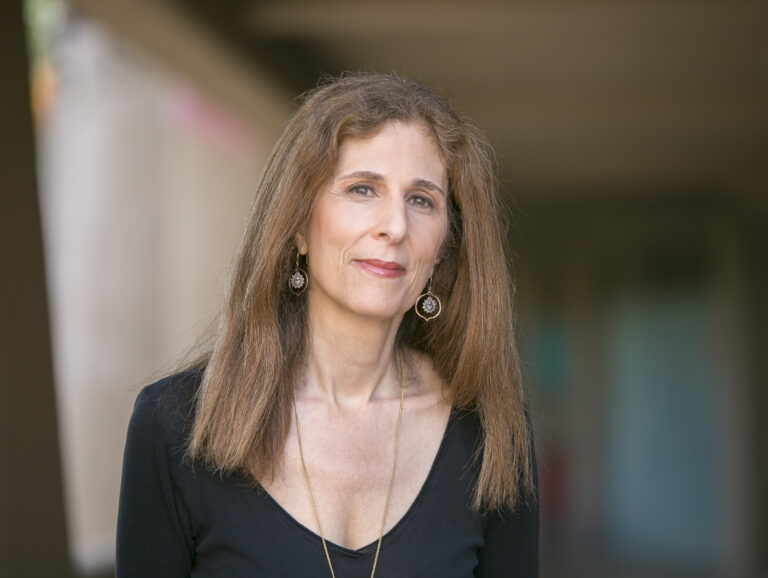
About Jessica:
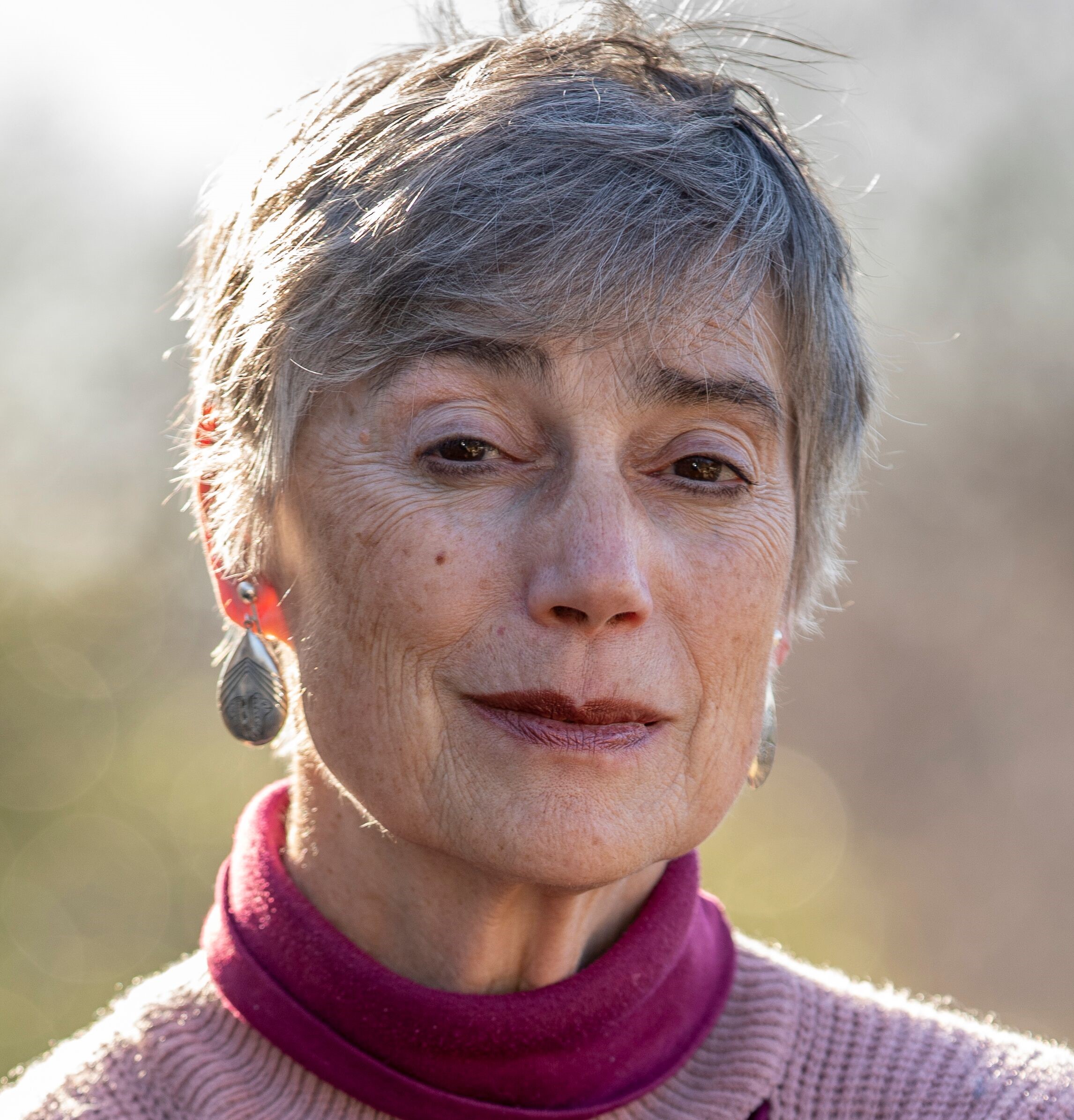
Jessica Levine
Jessica holds a B.A. from Wellesley College, an M.A. from Teachers College, Columbia University, and a Ph.D. in English Literature from the University of California at Berkeley, where she was a Mellon Fellow. After receiving her Ph.D., she decided not to pursue an academic teaching career, but to become a hypnotherapist. She trained at HTI (Hypnotherapy Training Institute) and has been practicing for 20 years. Jessica also has had a rich and varied experience teaching creative writing, composition, and literature in universities, high school, adult education, and the private sector. In 2014-15, Jessica held workshops on writing the novel at the American Library in Paris. Previously, she taught at the University of Toronto, New York University, and the University of California at Berkeley. She is the author not only of novels but also of a literary history, Delicate Pursuit: Discretion in Henry James and Edith Wharton. Visit her at her website.
Set during the excitement and tumult of the second wave of feminism and the sexual revolution, this coming-of-age novel about female friendship in the 1970s will appeal to fans of Kristin Hannah’s Firefly Lane.
It’s 1976, the second wave of feminism is in full swing, and three cousins share an apartment at Yale. Two are seniors; the third is starting graduate school. Each is seeking her own path in both love and work—but all three women, not quite knowing how to use the new freedoms available to them, alternate between supporting and undermining each other in their efforts.
Julia, the most conventional of the three, wants the security of her monogamous relationship with Ben but is attracted to other men. Anna plans on traveling the world to escape her boyfriend and alcoholic mother. Robin, who is bisexual, has various partners as she dreams of open relationships. All fall under the spell of a charismatic musician, Michael, who is too wounded to be available. By the end of a year of experiments and necessary mistakes, the cousins will make crucial decisions that will determine the course of the rest of their lives.
This prequel to Levine’s first two critically acclaimed novels, The Geometry of Love and Nothing Forgotten, dramatizes the struggles that women have faced and continue to face while entering adulthood in a world not quite ready to accept them as equals.
Pre-order Three Cousins at Amazon. Release date April 8, 2025.
About Jessica:
Jessica Levine
Jessica holds a B.A. from Wellesley College, an M.A. from Teachers College, Columbia University, and a Ph.D. in English Literature from the University of California at Berkeley, where she was a Mellon Fellow. After receiving her Ph.D., she decided not to pursue an academic teaching career, but to become a hypnotherapist. She trained at HTI (Hypnotherapy Training Institute) and has been practicing for 20 years. Jessica also has had a rich and varied experience teaching creative writing, composition, and literature in universities, high school, adult education, and the private sector. In 2014-15, Jessica held workshops on writing the novel at the American Library in Paris. Previously, she taught at the University of Toronto, New York University, and the University of California at Berkeley. She is the author not only of novels but also of a literary history, Delicate Pursuit: Discretion in Henry James and Edith Wharton. Visit her at her website.
Named Finalist in the American Fiction Awards 2024 (category Science Fiction: Cyberpunk), The Logoharp describes the extraordinary journey of a young American journalist who chooses to work as an AI-driven propagandist—aka “Reverse Journalist” who foresees and reports the future for 22nd century China. Naomi is surgically transplanted, giving her extraordinary powers of foresight and physical strength. She hears voices in her Logoharp, a universal translator of all world languages, allowing her to take the pulse of global crowds, predicting and broadcasting political and social events with deadly precision.
But Naomi also hears discordant voices coming from unidentified sources. She knows only that mysterious voices sing to her of other worlds, other freedoms. When she’s tasked with finding a flaw in a State system that balances births and deaths —a system devised by a Chinese architect, Naomi’s lover who abandoned her in youth—she experiences “unintentional contradiction.” Suppressed emotions resurface, compelling her to rebel. Her decision has unexpected consequences for the men and women she loves, for her own body, and for the global societies she’s vowed to protect.
The Logoharp
You can get The Logoharp: A Cyborg Novel of China and America in the Year 2121 at Amazon.
What genre do you write and why?
I guess I’m writing “literary” science fiction, but not the classic “alien invasion” or dystopic survivalist stuff. I write political and scientific extensions of our lives right now. Though I’m a great admirer of many classic science fiction writers—among them, Ray Bradbury, H.G. Wells, Edgar Rice Burroughs, Liu Cixin, William Gibson, Ursula LeGuin, Nnedi Okorafor, and many others—generally I write, or extrapolate from current scientific and social trends and developments.
There are many books out there about dystopic futures. What makes yours different?
My novel is cross-cultural, scientific, and political. It deals with a verboten topic of family racism, the “disposal” of talent in middle and elder years, and severe media dysfunction on both sides of the Pacific.
In the novel, Naomi, despite her cyborg transformation, retains memories of her parents’ instructions about right and wrong. She attempts to find a grain of truth in a world where there is no objective reality and media becomes a blunt instrument of mass illusion. Her job is to entertain and quell rebellion in the masses. As Andrew Singer, a China expert, wrote in this review:
“The Logoharp is a story of love and horror. It is relatable and disturbing. The grave issues facing us now remain potent: AI, drugs (fentanyl), and climate catastrophe to name a few….these all converge as the novel slides down the ice.”
– Andrew Singer Talks about China.
How did you do research for your book?
In the last decades I’ve taught and reported from Beijing, Hong Kong, Taipei, Jatinangor (Indonesia) and Nairobi, studying the Chinese influence on media, human rights, and local economies. Before that, I wrote a doctorate on the impact of news photography, measuring how images affect the minds of readers and viewers. In all, I spent about 12 years researching material for this book.
Which was the hardest character to write? The easiest?
Naomi, The Logoharp’s main character, was the most challenging. In this story, she starts as a vulnerable American journalist and morphs into an AI-driven media propagandist (aka “Reverse Journalist”) for China who eventually rebels. Why would she do this? She lives in a severely weakened “Ameriguo” in the 22nd century. Betrayed by a young lover, she believes that “Mother Country” (China), the dominant global power, will ensure peace and a harmonious existence for a troubled planet. She chooses to become an elite Reverse Journalist (RJ), someone who doesn’t write about current events. Instead, she “reports the future.” Surgically transformed, she’s equipped with a “Logoharp,” a neural instrument that doubles the size of her brain, enabling her to hear government instructions but also mysterious voices from sources she can’t identify. This sets up a conflict. Her human conscience never leaves her…and then she discovers a terrible secret in Harbin, Manchuria.
The easiest character to write was Lang Fei (Chinese for “waste of space”), based on an old Chinese doctor friend. He’s eccentric, lovable, possibly a spy, who tries to help Naomi and her friend Miranda discover the truth about a broken system. But all these characters have complexities and changes of mind.
In your book you make a reference to Reverse Journalism. How did you come up with this idea?
Attempts in the past to make journalism an independent monitor of power, to adhere to facts, to get multiple sides of a story, have morphed over the last decades into an obsession with prediction, partisan agenda and “winner-loser” celebrity. You can argue that journalists, in the service of media bosses, “write the future” by cherry picking facts, leaving out others, and predicting outcomes that reinforce the powerful. It wasn’t much of an extrapolation for me to create an AI-driven journalist, Naomi, whose job for China is to report the future as though it has already happened—and then it does. RJs, in effect, do not report current events. They are co-authors and guides to political and social events that have not yet come to pass.
In your book you state, “…the connection between corrupt and inept is very strong.” Why is that?
Naomi is speaking in her own voice to two of her bosses who become torturers, Dean Cheung and Dakota Sung. Both exploit the corrupt and incompetent actors around them to hoodwink the public. As Naomi says, “You are trained to exploit any gap in knowledge among the masses, leveraging their ignorance to mask the incompetence of officials all around you…”
Do you have another profession besides writing?
I’ve been a Fulbright scholar and researcher teaching at universities and law schools in the U.S., China, Hong Kong, Indonesia, and Africa.
What is your next project?
A sequel to The Logoharp. Naomi’s son grows up to be a pilot and later graduates as a military psychologist, refuting every value his mother stands for. Until he crashes, survives, and discovers the power of The Gyroscope.
What is the last great book you’ve read?
A toss-up between Liu Cixin’s The Three Body Problem and Charles Frazier’s Cold Mountain.
Which authors inspired you to write?
Joyce Carol Oates, Ernest Hemingway, E.B. White, Madeleine L’Engle, F. Scott Fitzgerald, William Styron, Han Su Yin, Ray Bradbury, John Hersey, Emily Bronte, Jane Austen, James Baldwin, H.G. Wells.
Any hobbies? Name a quirky thing you like to do.
I play piano, swim, lift weights, hike, plant trees and speak Mandarin, French and bad Spanish wherever I can.
If there is one thing you want readers to remember about you, what would it be?
That The Logoharp was both memorable and scary. As critic Andrew Singer described it:
“Emmett’s most biting social critique is not of the bland, authoritarian system that prevails a century from now. Rather, it is reproval of the America of today that let itself go and collapsed to such a system. The siren call of this lament is strong.”
You can get The Logoharp: A Cyborg Novel of China and America in the Year 2121 at Amazon.
Arielle Emmett
Author Bio:
Arielle Emmett, Ph.D., is a writer, visual journalist and traveling scholar specializing in East Asia, science writing and human interest. She has been a Contributing Editor to Smithsonian Air & Space magazine and a Fulbright Scholar and Specialist in Kenya (2018-2019) and Indonesia (2015).
Her work has appeared in Mother Jones, The Scientist, Ms., Parents, Saturday Review, Boston Globe, Washington Times, Philadelphia Inquirer, Detroit Free Press, Los Angeles Times Book Review and Globe & Mail (Canada), among others.
Arielle has taught at the International College Beijing, University of Hong Kong Media Studies Centre, Universitas Padjadjaran (West Java, Indonesia) and Strathmore University Law School (Nairobi). Her first science fiction novel, The Logoharp, about China and America a century from now, is part of a planned series on dystopian paths to utopian justice
“In Arielle Emmett’s fevered imaginings one great and ancient state is able to dominate the rest using an unbeatable secret weapon. Logoharps. Creatures able to see into the future, ensuring the state is always a step ahead. That is, until one rebels. Imagine Mona Lisa Overdrive meshed with The Wind-Up Girl. That’s the kind of sci-fi ride you’re in for with The Logoharp.”
– Kevin Sites, author of The Ocean Above Me
“The Logoharp offers a thought-provoking experience for those willing to confront unsettling truths. Some may find comfort in the familiar illusions of their own “Matrix,” while others may feel a revolutionary spark ignited within them. Ultimately, this novel serves as a mirror, reflecting each reader’s willingness to either accept the status quo or challenge it.”
– Literary Titan
“A hugely ambitious vision of a time in which America is a Chinese colony, almost anyone over 50 is sent off to die in a cozy ice-sled, and journalists are tasked with chronicling a future which then comes to pass. If you’re fascinated by technology and by glimpses of where we’ll be a hundred years from now, look to a new hero, Naomi. She’s the half-human cyborg reporter who believes in truth, foresees the future and, in desperation, rebels against it.”
–Beverly Gray (Executive Board Member, ASJA)
“In the world of The Logoharp, there is no security, not even an objective reality, only the reality created by journalism in reverse. Emmett’s’ novel creates a troubling vision of media that borders on propaganda in an AI-filled future.”
—Hamilton Bean, Ph.D., author of No More Secrets: Open Source Information and the Reshaping of US Intelligence (Praeger).
“Prepare to be swept away by an imperfect yet wildly relatable heroine. This ancient, futuristic world will make you angry, frustrated, hopeful, in love, and inspire an uprising within.”
—Grace Diida, L.L.M., Venture Capital Research
“Loved The Logoharp! It’s genuinely original, disturbing in a provocative way, occasionally funny and erotic, creative and well-paced — and I can’t get those ice sleighs out of my head! Naomi is one strange —and beguiling—heroine.”
—Laura Berman, feature writer, retired columnist, The Detroit News.
Elizabeth Tilton, a devout housewife, shares liberal ideals with her journalist husband, Theodore, and her pastor, Reverend Henry Ward Beecher, both influential reformers of the Reconstruction era. She is torn between admiration for her husband’s stand on women’s rights and resentment of his dominating ways. When Theodore justifies his extramarital affairs in terms of the “free love” doctrine that marriage should not restrict other genuine loves, she finds the courage to express her feelings for Reverend Beecher. The three partners in this triangle struggle with love, desire, jealousy, fear of public exposure, and legal battles. Once passion for her pastor undermines the moral certainties of her generation, Elizabeth enters uncharted territory. Telling the truth may cost her everything. Can a woman accustomed to following the lead of men find her own path and define her own truth?
Unruly Human Hearts
You can pre-order Unruly Human Hearts at Amazon. (January 28, 2025)
What drew you to become a professor of history?
My parents moved from New York to Hawaii when I was a teenager and I was fascinated with the multicultural society of the 50th state, including people of Hawaiian ancestry, descendants of white missionaries as well as people whose ancestors came from China or Japan to name only a few. When I entered the University of Hawaii, I was already very interested in Asian cultures, and the study of history seemed to be an ideal avenue to gaining an understanding of cultures so different from my own. I applied for an East-West Center scholarship for graduate work, which covered a year of research in India.
How did you end up teaching at the University of Puerto Rico?
My husband, who is an economist, was offered a job at the University of Puerto Rico. I had finished my course work at the University of Hawaii, but I was just starting to write my dissertation on the nationalist movement in India. After finishing my PhD, the Social Sciences Department at the University of Puerto Rico invited me to teach courses on Asia. Eventually I was offered a position as an Assistant Professor in the History Department.
Tell us more about your career as a historian and your work to highlight women’s struggles in both the United States and India.
At the University of Puerto Rico where I taught courses on both Asia and the United States with an emphasis on social history, it was a challenge to become fluent in Spanish and to interpret not only Asian culture but also American culture to my students. Although my dissertation was on the nationalist movement, my later research centered on the women’s movement in India. After receiving a Smithsonian Institute grant for research in India, I was able to complete my book on the struggle for women’s social and political rights in northeastern India titled The Women’s Movement and Colonial Politics in Bengal, 1921-1936. In addition to many academic articles on social themes in Indian history, I published a study of the impact of the gospel of love on the position of women in the United States as seen in the case of Elizabeth Tilton. I also wrote short stories exploring social conflicts set in India, the United States and Puerto Rico, mostly written from the perspectives of women and girls.
How did the views expressed by students in a graduate seminar you taught on the social history of the United States influence your decision to explore the Beecher-Tilton scandal more deeply?
At first my students didn’t seem interested in the famous 1875 trial, but once I mentioned the scandal had similarities to Bill Clinton’s impeachment for the alleged cover-up of sexual intimacies with Monica Lewinsky, they began to participate actively in the discussion. A young man pointed out that both the president and the reverend survived the scandal. Yeah, said a young woman but what about Monica and Elizabeth? My student’s suggestion that Elizabeth may have fared worse than her male lover inspired me to delve deeper into the social context of the scandal. As I immersed myself in the sources to understand the challenges Elizabeth faced because of gender inequality, I found that my own multicultural experiences, during the many years spent in Hawaii and Puerto Rico as well as the year doing research in India, were very helpful, enabling me to imagine how Elizabeth felt in an epoch with values very different from the present day.
What was the research process like to bring Elizabeth Tilton’s side of the story to life? I know that during the civil trial that she wasn’t allowed to speak, being that she was viewed as the damaged property of her husband in the case.
Many of the historical studies of the Beecher-Tilton scandal picture Elizabeth as a weak personality, a woman who gave in to both her husband and her lover and couldn’t keep her story straight. As I read more about the Victorian code of conduct for women, I felt that this version of her character was simplistic if not misogynistic. I attempted to come to grips with the challenges Elizabeth faced because of gender inequality in an article I wrote for a history journal, but I finally decided that the best way to do her justice would be to write a novel telling the story of the scandal from her perspective. Although Elizabeth was not called to the stand during the 1875 trial, there are three important primary sources that reveal her point of view: her personal letters, which her husband published in the press without her permission, her testimony at the church investigation, and the testimony of those who spoke of her at the trial. Once I decided to write a novel, I had to immerse myself once again in the historical sources. This second time, I was concentrating not only on understanding the social issues, but also submerging myself in the feelings and thoughts of Elizabeth and her two lovers, imagining scenes in which the main characters interacted.
Unruly Human Hearts is a work of fiction but based on a true story. How much of what we find in the book can be considered fact, or as fact as can be, considering the era and limited sources of coverage of events?
The novel covers the period from 1866, when Elizabeth, then in her early thirties, first developed romantic feelings for Henry until her death in 1897. There are many primary sources for the period from 1866 through the trial of 1875, including personal letters, trial records, and the press. The events and the people whose actions and personalities are revealed in these records function as the framework for my novel. However, the sources do not consistently tell the same story. The public testimony of the protagonists often provides conflicting narrations of what happened in what order, as well as conflicting interpretation of the motivations of those involved. Historians who have written books involving the Beecher-Tilton scandal also have different interpretations. As a writer of historical fiction, I had to make judgment calls. Elizabeth’s life after the 1875 trial, covered briefly in the final pages of the novel, was more difficult to envision. Although several historical sources are available, including obituaries and her letter of confession published in 1878, writing about her final years required greater creative effort.
Free love is somewhat of a key factor of the Beecher-Tilton scandal, a scandal perhaps in part because of Victoria Woodhull’s being the one to put it to print making it of greater public knowledge. Can you perhaps give our readers a little idea of what “free love” means in the context of the book and the movement at the time?
The basic idea of free love in the Reconstruction era was the freedom to choose whom to love and to express true love in a sexual relationship outside of marriage. Those who espoused free love believed that government should not interfere in matters of the heart, because the question of who loves whom cannot be legislated. Some feminist leaders supported free love because they believed that marriage and divorce laws unfavorable to women often imprisoned them in injurious abusive relationships. The radical feminist, Victoria Woodhull, denounced the hypocrisy of male leaders (including Reverend Beecher) who indulge in sexual affairs while publicly advocating conventional morality. Most supporters of free love in the nineteenth century did not advocate promiscuity; they couched their beliefs in terms of individual freedom to express true love. The concept of free love was similar in some respects to the concept of open marriage in the latter half of the twentieth century in which one’s spouse was viewed as the primary partner, but married couples were free to express love for others. Elizabeth viewed her husband, Theodore, as her primary partner, and Reverend Beecher as another love that enriched her life and deepened her love for her husband.
Each of the characters in the triangle’s relationship to free love comes from a different angle. We have the first prominent preacher in America, a newspaper editor and abolitionist, and an American suffragist. How did each reconcile the doctrine of free love with their religious beliefs and perhaps positions in society?
Reverend Beecher’s experiences as a young child, when his father instilled in him the fear of being a sinner predestined to go to hell, encouraged him to advocate replacing the Calvinist doctrine of retribution with the gospel of love. The gospel of love inspired him to preach against slavery and in favor of guiding children through love not corporal punishment. Henry’s sermons comparing God’s love with the tender care of a mother inspired Elizabeth and helped her see the feminine role as crucial not only within the family but also in building a better society. Her motivation to join the suffrage movement was the belief that women would vote to help those in need. Although the gospel of love and the concept of free love had separate origins, Henry and Elizabeth saw a connection between the two. True love of one human being for another could not be sinful. Whereas Elizabeth and Henry emphasized Love as the guiding spiritual and ethical principle, for Theodore, it was Truth. Conventional moral teachings restricting love outside of marriage led to lies and concealment that poisoned personal relations. Theodore believed that non-interference of the government in personal love lives was a necessary social reform, and thus advocated free love as well as suffrage for women and former slaves.
Elizabeth was involved in the suffrage movement, as was her husband, what did the scandal do for/to the movement?
The women’s suffrage movement was going through a difficult period in the eighteen seventies. Many suffragists had hoped that that the fifteenth amendment would include voting rights for women and former slaves, but the amendment only awarded suffrage to freedmen. The movement had to regroup and form new alliances. Initially Susan B. Anthony and Elizabeth Cady Stanton, both of whom were friends of Theodore and Elizabeth, were enthused when Victoria Woodhull, a charming and charismatic young woman of working-class origins, brought new energy into the suffrage movement. However, they later realized that her advocacy of radical social issues, including free love, was alienating supporters. Victoria had a key role in the exposure of the Beecher-Tilton scandal. She denounced Beecher as an ardent supporter of free love who concealed his true beliefs so as not to endanger his career and social position. Public fascination with the role played by prominent men with progressive views on women’s rights in the Beecher-Tilton scandal, was fodder for conservatives who painted the campaign for women’s suffrage as a movement associated with dangerous radicals whose aim was to destroy the social order.
Any good book based on historical facts can and should teach you something that has some relevance to current times. How is Unruly Human Hearts relevant today?
The story of Elizabeth is relevant to concerns about individual freedom and social ethics in modern times. The emergence of creeds of sexual liberation and open marriage in the second half of the twentieth century raised questions about whether free love is liberating for women. Many women were economically dependent on men, which made it difficult for them to insist that men grant their partners the same sexual freedom that they claimed for themselves. The MeToo movement that emerged in the early twenty-first century points to the problems implicit in a sexual relationship in which one partner enjoys the advantage of power and position. Elizabeth insisted that her tie with Reverend Beecher was based on true love, but her husband saw it as a pastor taking advantage of a deeply loyal member of his flock. On the other hand, Theodore was oblivious of the power dynamic in his marriage to Elizabeth. He justified his own extramarital affairs as a legitimate expression of free love but applied the double standard to his wife. If our society continues to make progress toward gender equality, we can hope that women involved in open marriages or polyamorous relationships do not undergo the same heartbreak that Elizabeth experienced.
What is your next project about?
I am reworking a historical novel set in New York in the roaring twenties, a period in which women enjoyed new freedom to pursue romance as well as a career of their own. The heroine, a young aspiring poet, suffers violent mood swings, which make it difficult for her to comprehend the new limits of acceptable behavior for women. Aggressive psychiatric treatments compound her problems. The transition from adolescence to adulthood appears to be a maze to the young protagonist who must make her way through a looking glass world in her struggle to achieve autonomy and commitment.
You can pre-order Unruly Human Hearts at Amazon. (January 28, 2025)
Barbara Southard
Author Bio:
Barbara Southard grew up in New York, earned a PhD from the University of Hawaii, and served as professor in the History Department of the University of Puerto Rico. In addition to academic publications on women’s history, she is the author of The Pinch of the Crab, a short story collection set in Puerto Rico, exploring social conflicts of island life, mostly from the perspective of women and girls. In her debut novel Unruly Human Hearts, Barbara once again explores social conflict from the point of view of the woman involved in a different place and epoch. She has also been active in raising funds for the Shonali Choudhury Fund of the Community Foundation of Puerto Rico, helping local community organizations working to protect women from domestic violence.
Attorney Kyra Gibson has a lot on her mind this Thanksgiving. She’s been working long hours on a multi-billion dollar corporate merger, her family is visiting from London, and her relationship with former police detective Tarek Collins is heating up. When she and her companions are invited by her aristocrat client to attend a formal gala at a historic mansion on Chappaquiddick, Kyra reluctantly agrees.
But Chappy is more than just a playground for the wealthy. It’s a wild, remote place cut off from civilization. When the first body is found, the occupants are worried. Was it an accident or murder? When a second guest is brutally killed and then a third, there’s no doubt and the guests fearfully turn on each other. They are locked in a house with a murderer picking them off one-by-one. Kyra, her best friend Chase Hawthorn, and Tarek must survive the night and find the killer, or one of them could be next.
Most of my plots are pulled from headlines, and then I add in the murder.
Your book is set in Martha’s Vineyard. Have you ever been there?
Yes, I’ve been visiting the island for years and this series is a sort of love letter to it. It’s one of my favorite places.
Do you have another profession besides writing?
I do. In my other much more boring life, I’m an IP lawyer, not unlike my protagonist.
What genre do you write and why?
I write mystery/thrillers. I simply prefer writing plot over emotional journeys and mystery and thriller lend themselves to plot focused stories.
Which was the hardest character to write? The easiest?
The hardest character is actually my FMC, Kyra. The book is told from her perspective and sometimes I have to remember to be in her head, to remember she’s not privy to everything I know, especially what the other characters are thinking. The easiest is a tie: between Cronkite and Ali, Kyra’s aunt. Cronkite is the epitome of “cat,” and Ali is the sister I’d want if I had one.
If you could put yourself as a character in your book, who would you be?
If I were to write myself in, I’d write myself as a victim who gets her revenge from the grave. I think I’d be a beloved, local writer who, after an ugly exchange with an unruly summer visitor at a popular Vineyard Haven diner, met a very bloody, untimely death at the hands of the unpleasant woman. As the murder investigation progresses the murderess’s world is destroyed. Obviously, I’ve never been bowled over by an aggressive tourist at The Black Dog Tavern. Nor am I petty. It’s complete fiction.
What’s the scariest thing that ever happened to you?
A few years ago, I trespassed (broke into) a deserted asylum for children. It looked like it’d been abandoned overnight. Toys were on the floors. Artwork hung on the walls. The library’s books were strewn about, beds pushed up against the walls haphazardly. The cherry on top, though, was someone had staged a huge clown doll on the roof of one of the buildings. I’ll have nightmares of that clown’s manic grin for life.
What is your favorite thing to do in the autumn?
My favorite thing to do in the autumn is tea, coffee, or a glass of wine by the fire with a book. I love a wood burning fire when it’s chilly out. It’s so comforting.
When the body of a celebrated journalist is fished from the Edgartown Harbor, the official report rules his death accidental. But why was he alone on a senator’s yacht during a nor’easter? That’s only the first question London-based lawyer Kyra Gibson has when she arrives on the idyllic island of Martha’s Vineyard to settle her estranged father’s affairs. AMAZON
The Wraith’s Return
London based lawyer Kyra Gibson returns to Martha’s Vineyard and the beach house she inherited for an extended summer holiday. Still reeling from her father’s brutal murder and the role she and the handsome detective, Tarek Collins played in uncovering it, Kyra is hopeful for some peace and quiet. But when a summer squall reveals the wreckage of the pirate ship, Keres, rich with rumored treasure, all hopes of peace are dashed. Conservationists and treasure hunters descend on the exclusive island to lay claim to the ship. When two of the salvagers are killed, Kyra and Tarek’s friend, pub owner and amateur historian, Gully Gould is arrested for murder. AMAZON
Raemi A. Ray
Author Bio:
Raemi A. Ray travels to Martha’s Vineyard and around the world inspire her stories. She lives outside Boston. When not writing or traveling she earns her keep as the personal assistant to the resident house demons, Otto and DolphLundgren.
When two visitors arrive to the boarding house in India where an American boy is coming of age during the British Raj, truths unravel, disrupting his life and challenging the family’s sense of home. A unique historical angle ideal for fans of The Poisonwood Bible and The Inheritance of Loss.
In the last years of the British Raj, an American missionary family stays on in Midnapore, India. Though the Hintons enjoy white privileges, they have never been accepted by British society and instead run a boarding house on the outskirts of town where wayward native Indians come to find relief.
Young Gene Hinton can’t get out from under the thumb of his three older brothers, and the only person he can really relate to is Arthur, his family’s Indian servant. But when Uncle Ellis, a high-ranking British judge, suddenly arrives and announces he’ll be staying indefinitely in their humble house, far from his prestigious post in Himalayan foothills, life as Gene knows it is interrupted. While his brothers are excited at the judge’s arrival, he is skeptical as to why this important man is hiding out with them in the backwaters of Bengal.
Also skeptical is Arthur. Then an Indian woman appears on their doorstep—and, after growing close to her, he learns the sinister truth about the judge. Torn between a family that has provided him shelter, work, and purpose his whole life and the escalating outrage of his countrymen, Arthur must decide where his loyalties lie—and the Hintons must decide if they can still call India home.
.
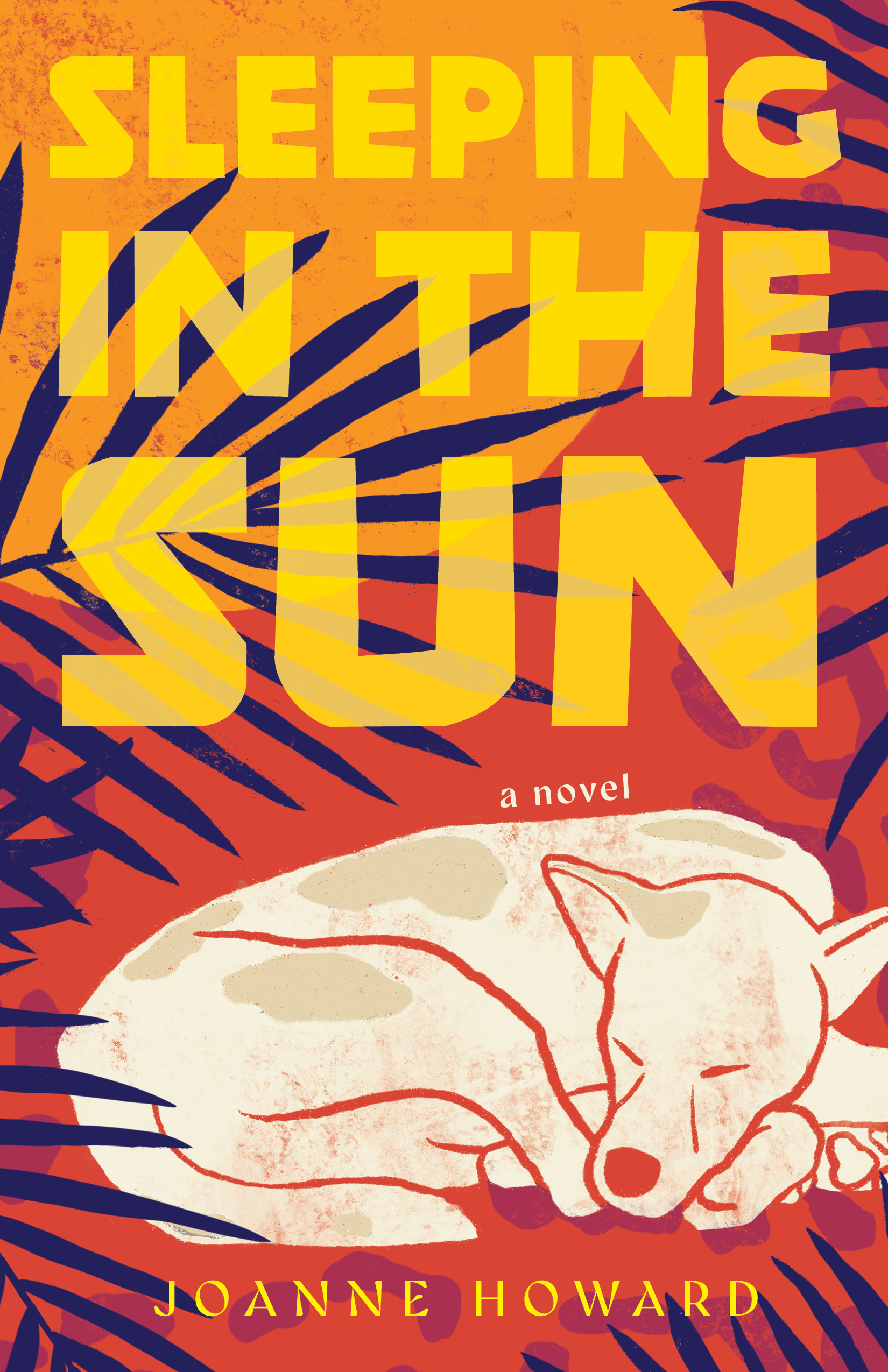
Sleeping in the Sun
“Sleeping in the Sun is a novel impossible to put down. A cinematic study of imperialism and the scars it has left. An outstanding debut.”—Willy Vlautin, author of The Night Always Comes and The Motel Life
“This is at once a gripping page-turner and book to savor and admire. It will light up your imagination and endure in your mind alongside all the memories from your real life. I was sad to see it end but delighted to welcome this impressive new voice into American literature. Joanne Howard is a writer to watch.”—Valerie Laken, author of Dream House and Separate Kingdoms
Imagine you have only a brief minute to tell someone what your book is about. Can you tell us, in two sentences, what your book is about and make us want to read it?
An American boy comes of age in the last years of the British Raj. Little does he know in this turbulent time that his family’s long-standing Indian servant may have ambitions to serve himself for once—for better or worse.
Why did you need to write this story?
I would like to see more historical novels set in non-western countries. I have never seen a novel about Americans in India, so I wanted to explore what a story about that would mean. And of course, I like to think of it as a nice tribute to my grandfather.
Where is the setting for Sleeping in the Sun?
1930s Midnapore, India. Midnapore is a small city outside of Calcutta.
How did the Hinton’s purpose as Christian missionaries determine their place in the white society of British India?
As American missionaries, the Hintons occupy an unusual space in society. They are not well off, as can be seen by their humble living standards, and they aren’t particularly interested in climbing the ranks of British society. The boys are rowdy and rough around the edges, and the house is a bit out of town so they aren’t really included in social circles. The boys also go away to boarding school, which is yet another way they are considered outsiders in Midnapore. The book doesn’t show them interact with many British characters except of course for Judge Ellis, who takes an unusual liking to them.
How do the actual people of India see Christian missionaries in their society and culture during the time of Sleeping in the Sun?
It varied. In my family’s experience, they actually didn’t have much luck converting many people. Often times, if an Indian person converted on their own, they were ostracized by their community. So missionaries had more success if they converted an entire tribe or village. For this reason, my family mainly worked with indigenous tribes. In large urban areas like Calcutta, the attitude toward missionaries and white foreigners in general was less favorable. The Indian people had already pressured the Raj to move their capital out of Calcutta to New Delhi, and that anti-Raj sentiment carried over to missionaries too. However, my family was generally well liked and respected by Indian people in Midnapore, whether they were part of their church or not. Unlike the Hintons who stick to themselves through much of the novel, my family was very involved and did a lot of business with Indian people in the community.
If you were to be one character in your book, who would you choose and why?
I have a soft spot in my heart for Lee, the third Hinton brother. He acts as the voice of reason in the book. He has an easygoing, gentle demeanor and guides Gene as they try to make sense of the events that happen in the novel.
As a former history teacher and historian, I’m always interested in how an author researches to ensure the accuracy of culture and period. What was your process like?
My family is incredible at preserving everything, so I had a lot of firsthand accounts to inform me. My grandfather’s childhood diary, my great grandfather’s autobiography, and stacks of vintage photographs were of huge help, but of course it was up to me to imagine the characters in the way I wanted to and that would best serve the story. But for Arthur’s character, who is an Indian man and therefore outside my own lived experience or personal connection, I just tried to absorb as many works of Indian literature that matched his background and the time period, and two books especially inspired his character: The Autobiography of an Unknown Indian by Nirad C. Chaudhuri and Pather Panchali by Bibhutibhushan Bandyopadhyay. For setting, I traveled to India in 2018 for three weeks. I got to visit the street where my family lived, their mission’s church that is still standing, and other places that appear in the novel like Howrah Station and the Maidan in Calcutta. Lastly, I had a sensitivity reader who checked for blind spots.
What will connect the reader to the story and make them want to keep reading the story?
The multicultural and international aspect of the characters I hope will appeal to a variety of readers. My favorite historical novels are very immersive and escapist, so I hope that I have also brought the time and place to life well enough. I think I have because in fact, one of my early readers really asked me if this novel was based on my own life. I said, “Do you mean did I live in India in the 1930s?” And then lastly, I think that the novel explores the different definitions of identity, belonging, and spirituality. There is no one right way to be, and the novel offers many answers that can appeal to different readers.
What did you learn about yourself by the end of the book?
Early in my MFA program, a professor said that the story will take you where it wants to go. At first I sort of laughed at that idea, because surely as the author I’m in control of everything, right? But I really did experience the story going in different directions than I intended. I would just get this spark of an idea that was totally different than the outline I had so carefully plotted. So I learned that I’m not as in control as I thought.
Many first-time authors of a book have a problem letting their work enter the world for others to read. I know I did. Did you have difficulty deciding your book was ready to publish?
Not really. Although I did work on it for at least 6 years, I think I was always aware of some kind of finish line that I would come to eventually if I just checked off all these things. Every round of editing was correcting for a different fault, whether it was eliminating passive voice or clarifying character movements, so it did always feel like I had a plan. I guess I was very objective in that sense.
Joanne Howard is an Asian American writer from California. She holds an MFA in writing from Pacific University. Her poetry received an honorable mention from Stanford University’s 2019 Paul Kalanithi Writing Award. Her fiction has been published in The Catalyst by UC Santa Barbara, The Metaworker Literary Magazine and the Marin Independent Journal and her nonfiction has been published in Another New Calligraphy and The Santa Barbara Independent. She lives in Santa Rosa, CA. Find out more at her website.
He took her innocence…She took his honor. But when danger unhinges their world, someone will have to fall on their sword.
The lust. The betrayal. The love. Sometimes the hardest battle…is seducing your enemy.
Alexandra wants one thing: to train with her sword, never mind the outraged public. But when the achingly handsome Monsieur Philippe kisses her, she finds herself willing to give up her heart and even her blade to be with him. That is, until she learns Philippe took another woman to bed after giving Alexandra her first kiss. Shattered and humiliated, Alexandra is done with etiquette. She’s done with skirts and ruffles. And men. Now, five years later, she’s a mercenary, known for her quick wits, expert blade, and dedication to protecting the people she guides through the uncharted forests of Provence. And if, by chance, she ever sees Philippe again, she’ll have no problem knocking that seductive smile right off his goddamned face.
Philippe never forgot the tender kiss he and Alexandra shared, and he never forgave himself for acting so badly. Years later, when he finds himself tracking a mysterious band of foes, the mercenary hired to lead him is none other than the enticing girl he unwittingly destroyed. But Alexandra is a woman now, a breathtaking and dangerous woman. Though he must balance his mounting desire for her with his duty to tame the venomous nest of criminals, Philippe soon realizes that winning Alexandra’s affection will mean he must strip his pride, lay his title on the line, and fight harder than ever before. And if dodging a few of her punches means he can maybe get another taste of her, then this adventure might be more explosive than he ever expected.
Taken by His Sword
Get Taken by His Sword (Swords of Chevalerie Book 1) at Amazon.
I have a soft spot for historical romance because those were my first romance books. I like the added social constraints of historicals, but I have some ideas for contemporary and sci-fi romances as well.
Where do you get inspiration for your stories?
I’ll be walking along and suddenly BOOM–story idea. Sometimes it will come from an interaction I see between two people. An exchange I hear, a portrait, a dream. For Taken by His Sword, I had a very vivid dream of a girl holding a sword while everyone around her was wearing fancy, historical clothes. I’m an introverted people watcher so I’m constantly imagining stories involving the strangers I see. Be careful about catching my eye–I might write about you one day…
How did you do research for your book?
Since my book is historical I spent a lot of time reading about French culture, history, and sword fighting in the 1600s. The nice thing about doing a historical is that there isn’t anyone alive that can confirm or deny what I say. If I have some obscure question (did they eat at parties? What type of feather did they use for quills?) and I don’t find the answer in one or two searches, then I just invoke creative license and make it up!
How long have you been writing?
I have been writing for over 20 years! I had a few little literary stories published years ago, but other than that I was struggling to find something to write about that really resonated for me. That’s when I started with romance because I loved romance novels so much growing up.
Do you have another profession besides writing?
Yes! I am a middle school English teacher! But don’t tell my students I wrote a romance novel because they will use it against me.
In today’s tech savvy world, most writers use a computer or laptop. Have you ever written parts of your book on paper?
The first step for me is handwriting the plot in a stream of consciousness style flood in a spiral, college-ruled notebook. This gives me the basic story structure to go off of. When I get stuck on a scene, I go back to the notebook and free write until I spark an idea.
What is something you had to cut from your book that you wish you could have kept?
Oh my goodness I cut about 40 thousand words from that sucker. In the director’s cut, I explored much more of how young Alex came to live with the Duchess and then fall in love with swordfighting and Philippe. I actually think the version that got published is much tighter, but those were really hard cuts at the time!
Do you snack while writing? Favorite snack?
Just coffee. So much coffee.
Get Taken by His Sword (Swords of Chevalerie Book 1) at Amazon.
Florence A. Bliss
Author Bio:
Florence A. Bliss is an author from Las Vegas, NV who has a keen eye for writing love stories full of drama, heartache, humor, and enough seduction to light the pages on fire. With an MFA in creative writing from UNLV, Florence loves to write across genres but has found her home in romance. She lives with her fancy Italian husband and two children. Together they love to travel, explore the ghost towns around Las Vegas, road trip up and down the Pacific coast, and of course drink coffee out of tiny cups (milk for the kids). Florence is an avid people watcher and strives to understand why people do what they do, and she never tires of imagining the stories of what couples have had to overcome in order to come together.
Maggie has always accepted life’s constraints: that is, until she witnesses a breathtaking moment of liberation as a butterfly breaks free from a spider’s web. And this small, defiant act sparks a fire within her soul.
That’s a dangerous thing for a field slave in 1850 Missouri.
As her daughter ascends to the coveted position of personal maid to the Mistress, Maggie’s family is thrust into the intricate dynamics of power and privilege within the House.
But in the shadows, a chance encounter between Maggie’s sons and Preacher, a burly, escaped slave, sets the stage for a risky alliance.
Meanwhile, Lucy, the Master’s lonely daughter, hungers for the warmth and kindness that Maggie effortlessly exudes. The boundaries that separate them are as rigid as the times they live in, but the desire for connection and understanding defies the odds.
Maggie, recognizing an opportunity for freedom, finds herself entwined in a perilous dance between liberation and the relentless pull of her current station.
Will she follow in the path of the butterfly?
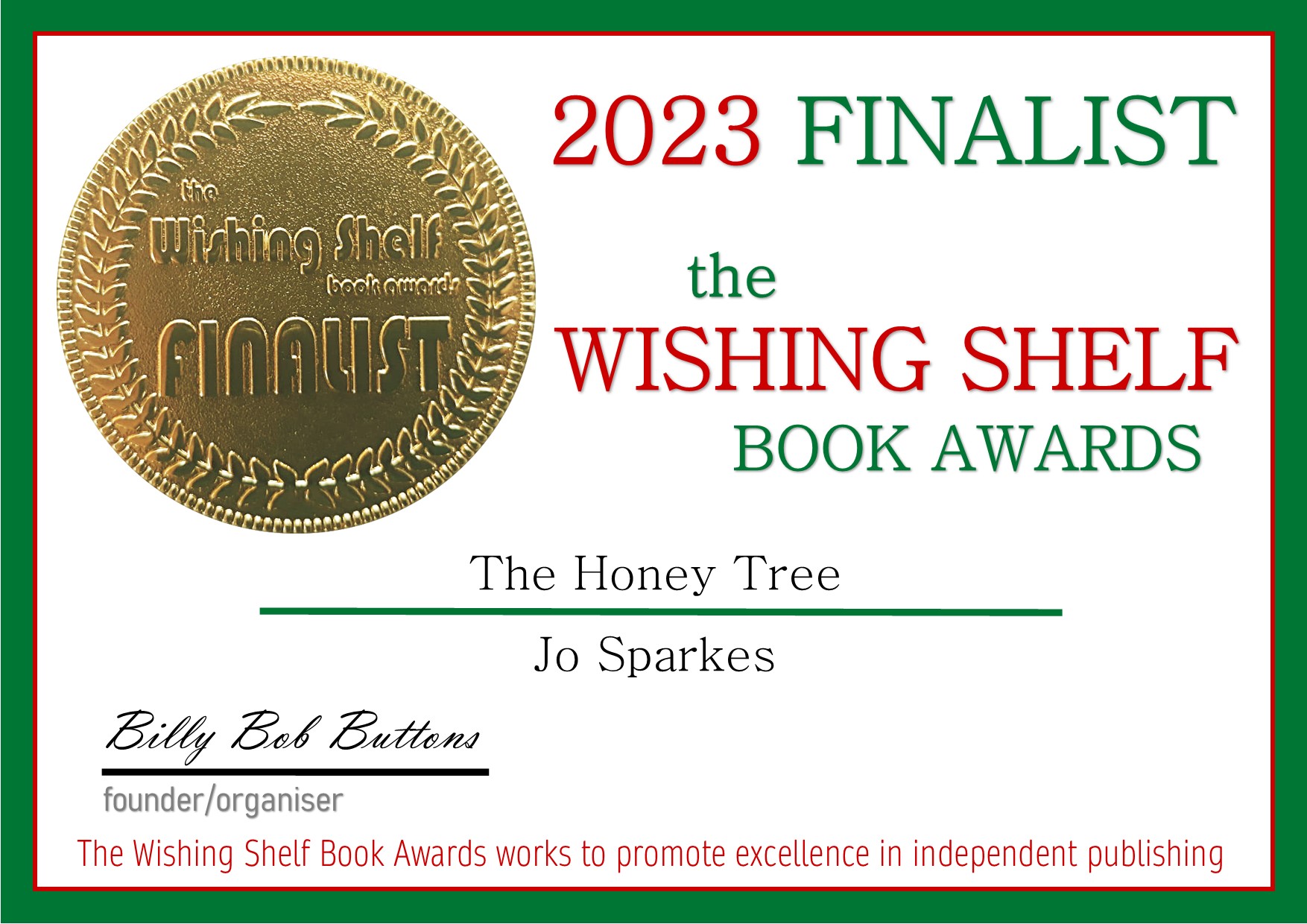
The Honey Tree
What would be your one sentence elevator pitch of what your book is about to get someone to want to read it?
This is the story of Maggie, a slave who excels at picking cotton, and Lucy, a nine year old whose mother believes she can’t excel at anything.
Why do you think Maggie was so persistent in wanting you to tell her story?
Honestly, I still don’t know.
She haunted me for years – years. I’d jot a few things down, toss them away. I kept telling myself it wasn’t a story for me to tell. The ideas would fade – only to come back stronger.
One full moon I dreamt – vividly – of that wild night on the Mississippi River. The next morning I wrote in earnest.
The Honey Tree is different from your ventures into fiction. What is your background to be able to write Maggie’s story? What research did you need to do?
There was a bit of a familiar echo from a few characters to some elders I remember as a child. And if you read Wake of the Sadico, you might see a connection. But I had a ton of research to do.
I disliked research before the internet. Spending hours in libraries trying to learn what 15th century seafaring was truly like is incredibly time consuming – and when you get home you always realize you missed some key details.
Now at least you can Google online, or use it to seek knowledgeable folk. Even then, as I’m doing my early morning writing, I’ll suddenly realize I have no idea if they drank tea or coffee in Missouri. What will connect the reader to the story and make them keep reading to the end? I see stories as carnival rides. The events are the track laid down and the characters are the vehicles you ride in. You have to believe in the characters – like them. You need to feel their drive, their desires, their goals.
You must want to take that journey beside them.
Did you have difficulty deciding your book was ready to publish? I always have trouble letting go. There’s another tweak here, a bit more polishing there.
These stories grow into friends, and it’s hard releasing them. Once they venture out into the world, they take on their own life. You can only watch from the side-line.
What age(s) of reader do you think would enjoy The Honey Tree?
I’ve had friends give it to twelve year olds, who loved it. I suppose it depends on the parent’s perspective.
What’s your next project idea?
I seem to have stumbled across a dead girl in the Arizona desert who wants to talk to her mother.
What led you to leave the sunshine of Arizona to the not-so-much sunshine of Plymouth, England?
My darling spouse is British, and had lived with me in the U.S. for thirty-six years. It was simply my turn to live abroad.
It’s a wonderful adventure.
What do you miss about the U.S.?
Mexican food, large parking lots, and central air. When we bought our place in the UK, I discovered that “A.C.” on this side of the Atlantic stands for an “Airing Cupboard.”
Finally, there are other historical fiction novels with similar subject matter, why should a reader choose The Honey Tree?
To me, this is not another story about slavery. It’s about people who wanted something better for themselves, their families. A man who fought and lost and gave up, then fell in love and fought all the more. About a woman struck by the idea that freedom might be possible after a lifetime of believing otherwise. A woman risking more and more for her children, and then someone else’s child.
In a nutshell, it is about that spiritual leap of faith – and Lucy’s literal leap of faith.
Find The Honey Tree at several outlets includingAmazon.
Visit Jo’sbooks2read.com/HoneyTree site for all of the vendors (12 in all) you can purchase The Honey Tree from.
Jo Sparkes
Jo Sparkes
From television shows to football articles, Jo Sparkes can’t put the pen down. She’s interviewed Emmit Smith and Anquan Boldin (as Arizona Cardinals), taught screenwriting at the Film School at SCC, and went on camera to make “Stepping Above Criticism”.
An award winning writer, she’s recently moved to Plymouth, England – and learning to speak the language.
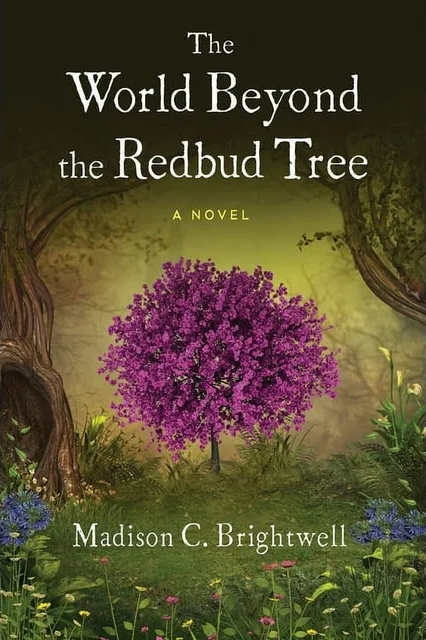
The world as we know it is built upon choices. If different choices had been made in the past, we might be living in an entirely different world. What if the so-called Lost Colony of settlers in North Carolina were in fact not lost at all but instead merged happily with the Native American tribes to create a new people and unique society?
Sixteen-year-old Charli is living in a pandemic-ravaged 2020 America when she stumbles upon the parallel world of the Q’ehazi. Drawn to these peaceful people, whose constant joy and optimism provides a stark contrast to the suffering and violence in her own life, Charli wants nothing more than to stay with them forever-but first, she must learn to attain a state of grace.
Can she forgive her mother’s abusive boyfriend? Can she learn empathy for her mother? In The World Beyond the Redbud Tree, Charli’s inward and outward struggles will lead her to a discovery she wasn’t even looking for: the beauty of her own world.
The World Beyond the Redbud Tree
You have only a few seconds to tell someone what your book is about, in two sentences tell them what your book is about? In other words, what would you say to interest them about The World Beyond the Redbud Tree?
OK, my elevator pitch: The novel is a utopian fantasy about a parallel universe in which different and more positive choices have been made.
“The World Beyond the Redbud Tree” is a gripping, coming-of-age narrative set in a pandemic-ravaged America, in which Charli, the sixteen-year-old protagonist, stumbles upon a parallel world where people co-exist peacefully, providing a stark contrast to her own troubled existence. The Q’ehazi society, with its emphasis on joy and optimism, serves as an uplifting contrast to the struggles faced by Charli in her own reality. Charli’s journey is not only an external exploration of this parallel world but also an internal quest for forgiveness and empathy. The narrative skillfully weaves together Charli’s personal struggles with larger societal issues, making the story both intimate and universal. The themes of forgiveness, empathy, and the pursuit of grace are handled with nuance and depth.
There are sensitive, but widely occurring, subjects you approach in the story. What led you to doing a book about those subjects?
I am a therapist and I help clients all the time who are dealing with these issues. These sensitive topics are based on the truth of my experiences and those of my clients, and they help to point up the contrast between our world and the mythical Q’ehazi world.
Forgiveness is a big part of The World Beyond the Redbud Tree. That’s a difficult thing to do in many situations, especially for a teen. For Charli, facing the prospect of forgiving Sean is something that would seem impossible. Failure is so easy to achieve in such a situation. Why choose this aspect of one’s character as a key theme of the story?
It’s not something that’s very often written about. In our culture, “revenge” is much more often the norm, and yet we discover that violence just leads to more violence. I wanted to show that a different choice was possible. Charli is young but she has an emotional maturity way beyond her years, and she is open to learning a different way of being. She doesn’t necessarily attain it in this book, but her journey towards wisdom and grace takes place over the course of the three books that make up the trilogy.
Where is the setting or settings for The World Beyond the Redbud Tree and is there a specific reason for its selection?
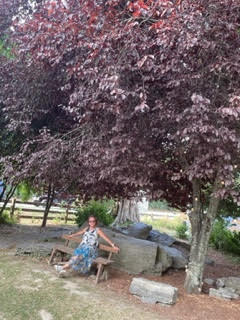
The setting is where I live, which is Weaverville, NC. I chose that area because it inspired me. We have a redbud tree on our property and I love the way it changes colors four times during the season (pink, red, green, yellow). I discovered later that it is one of the seven “sacred woods” of the Cherokee people. (See also below)
Early American history and the Cherokee people influenced your book, what research did you do to help with your book?
Ironically, I didn’t do much research before writing the book, as it’s a fantasy, other than reading books about the Lost Colony and finding out about the real history from that era. However, I visited the Cherokee Oconoluftee village in Cherokee NC a few months after writing my book, and was amazed and delighted to discover that many of the themes and ideas I had written about as being part of the Q’ehazi culture were in fact mirrored in the Cherokee culture.
The name you chose for the parallel world of Q’ehazi, I’ve found a similar word and the definition fits the world you’ve created, but how did you come up with it?
I literally made it up. I didn’t want it to be a real word in another language. So I flung together a few letters and my friend suggested the apostrophe.
If you had to be one character in The World Beyond the Redbud Tree, who would you choose and why?
I actually wrote the character of Maudina (Sovereign Aurora’s sister) for me to play, should there ever be a movie made! I resonate with her youthful spirit and her creativity.
What will connect the reader to the story and make them want to keep reading?
A variety of things. I would hope they would be intrigued by the unique and imaginative parallel world; some people have called the book a “page turner” because they want to find out what happens to Charli, as she’s a very sympathetic and multi-faceted protagonist; many people have described the book as “thought-provoking” because it’s not just a story but also a message about our world and how to make it better.
What’s the biggest difference between living in California and now in North Carolina?
Interesting question. I’m originally from England and I loved all the trees in NC, it’s like being in England before all the trees were cut down, many hundreds of years ago now. I enjoy both states, and they are very different. It’s also important to mention that I moved from Los Angeles to the tiny little rural town of Weaverville, and that experience contributes to the difference also. The people here are gentler and the pace is a lot slower. There isn’t so much diversity here, either in people or activities. I feel more connected to nature here, because we live on an acre of land. However, in LA I lived near the beach and I enjoyed that too. So there’s good things about both places.
What’s your next project idea?
Book Two in the series, called “The World of the Q’ehazi” (working title). I have just finished the first draft, will be refining it and hope to publish it later this year.
Find The World Beyond the Redbud Tree at several outlets includingAmazon.
Madison C. Brightwell
Author Bio:
Madison C. Brightwell is an author and a licensed MFT with a doctorate in psychology. She has been working as a therapist for fifteen years, before which she worked as a professional actress and in film and TV development. She has written four other novels and three self-help books in the field of psychology. Since moving to Asheville, North Carolina, from her native Britain, Madison has become inspired by the history of this land, originally inhabited by the Cherokee. She draws on many of her experiences helping clients with trauma, addiction, and chronic pain.
Having the ability to foretell events and connect with people in the afterlife is a unique gift. But can it also be a horrible curse!
Anna Mavrides has been burdened her whole life by the violent visions she had as a young girl. When she decides decades later to write a book about those visions and her family’s connection to the spirit world, it becomes an instant bestseller, but it ultimately triggers a chain of events that would have her charged with the brutal murder of her childhood friend.
As Anna wrestles with the fractured memories and tangled relationships of her youth from her prison cell, her determined supporters dig to expose the motives of the leader of a Spiritualist community featured in the book and the District Attorney who charged her with murder.
Their efforts could exonerate her and provide some answers about Anna’s distant past, but her reward will be a penultimate showdown at a seaside Maine amusement park, where the past and present fuse in a fiery conclusion.
All her life, people have asked Anna Mavrides, “How do you know?” Can she finally answer that question?
How Does She Know
If you only had two sentences to tell someone what your book is about, what would you say to excite them about the story?
Anna Mavries decides to tell the world her story about the extraordinary supernatural gifts and Greek legacy she possesses, but little did she know the ripple effect on the present day and the past it would conjure up. As she sits in jail, both friends, foes, and paranormal play tug of war with Anna’s life and as the rope unravels, Anna sees the truth.
How did you and DIane meet and decide to collaborate on a book?
We met at work and developed a deep friendship. Diane began to tell me about her gifts and the manuscript in which she detailed these events. And of course with my insatiable hunger to know more about paranormal, I could not resist the opportunity to bring it to life.
Why a murder mystery?
The pivotal vision is Christine so it felt right to develop a more profound story around it
Where is the setting for How Does She Know and is there a specific reason for its selection?
Portland Maine is Diane’s home and she is considered a Mainer. Since the majority is based on true events, it seemed fitting to keep it in her birth place plus it adds so much color to the story.
How have your own experiences influenced your characters in their personalities, characteristics, and little details? For example; do one of you have someone in your life that you put a little bit into Marjorie?
The story revolves around true events that Diane has and continues to experience as a medium- thus all those details built the main character Anna.
If you had to be one character in How Does She Know, who would you choose and why?
I really bond with Lori as I like her moxy and she has the traits of a Gemini which I am part of that club.
What will connect the reader to the story and make them want to keep reading the story?
I find that the layers of the past and present swirling around Anna’s paranormal experiences, the readers want to know how it all intersects at the end.
What was it like collaborating in creating How Does She Know?
Moving from Diane’s detail manuscript to a compelling story had its journey with stops, starts, tears and joy but in the end it is a passion project that came into reality at the right time!
Many first time authors have a problem with letting their work enter into the world for others to read. Did you have difficulty deciding your book was ready to publish?
I truly believe the universe decided when this passion project was ready and it came through with implacable timing. I am a believer of signs and throughout 2023 I was seeing multiple numerals in a row repeating – my sign was the number 1 and it was loud and clear!
What are the daytime secret identities of the authors of How Does She Know that help pay for the electricity to power your computers?
Diane and I both work I work in hospital reimbursement again being a Gemini I have 2 sides for sure!
What is your next project?
A sequel is currently in the works for Anna to continue to bring forth the intrigue of her gifts as they expand and grow – again based on true events!
Andrea Rubinowitz was born and raised in a suburb of Milwaukee, Wisconsin and from the age of 6 years old fascinated with the paranormal world. From chasing ghosts before impending thunderstorms, racing home after school to watch Dark Shadows, seeing every horror movie with Vincent Price, and finally as an adult, the urge of knowing more never ceased in fact it grew. Upon meeting Diane M. Sylvester, born into a generation of fortune tellers not by choice certainly cannot guarantee a life time of happiness.
Diane M Sylvester
Diane M. Sylvester was raised in Portland, Maine and continues to reside in this beautiful state known as Vacationland. Born into a generation of fortune tellers not by choice; this pedigree cannot guarantee a life time of happiness. She longed to tell her story of her lineage, physic abilities and paranormal experiences that she cannot ignore. How Does She Know is Diane’s first book regarding her amazing gifts.
The last witch on Earth takes on interdimensional invaders, tentacled overlords, and local politics in this fun, funny, and fast-paced urban fantasy series.
The witch of Tophet County has three primary preoccupations: Kentucky bourbon, Amish romance novels . . . and protecting her true identity from the chthonic monsters who rule humanity with an iron tentacle.
Despite her best efforts to get fired, the witch is trapped in a draconian, century-long contract that condemns her to work for the Archons of the Nether Realms in the banal misery of county government. But when she accidentally pleases her many-armed overlords, the Dread Lord of Human Resources curses her with an unwanted promotion. And it involves meetings.
As she enters a new bureaucratic hellscape, the witch is assigned to lead a task force investigating recent attacks on senior Archons. Fortunately, her boss has offered her a deal: if she solves the case, they’ll knock fifteen years off her sentence. And if that doesn’t work out, well, she just might have to find a way to help take down the tentaclarchy—or else be doomed to permanent civil servitude . . .
The Witch of Tophet County
The Witch of Tophet County was offered to me for an honest review. I like stories with magic. Check. Sarcasm. Check. Female leads. Check. (I do like stories with male leads as well.) And take-no-guff from anyone. Check. So I had to check this book out. See what I did there? And I didn’t even plan it. I’m just that cheesy. (Yes, Witch has taken me over and is writing this review.)
For fans of Jim Butcher when you hear about a witch who happens to do some detective type work and the like in an urban setting one might think of Butcher’s Harry Dresden, I think the sarcasm would be kind of comfortable, but the story is unique to J. H. Schiller. I think you will want to give it a read.
What I like about the story in The Witch of Tophet County is it’s about relationships. A lot of writers have a great idea for an adventure but they fail because they forget about the people in the story. WITCH, and yes, Witch is her name, has a difficult time with having relationships and friends. It’s a bit obvious right from the beginning. This book is the first in a new series and I think it does a great job of not only entertaining the reader but setting up Witch’s story and personality and those of her supporting cast. Some of her supporting cast are CHAD, her nerdy IT friendly torture victim, MAGNOLIA, the Archon but human loving assistant, and well her boss, the Archon Dread Lord of Human Resources. Could there be a better name for an HR head?
J. H. Schiller does a good job of getting the reader to visualize there being different types of beings in a scene. By ‘beings’ I mean humans, WITCH, and Archons. Archons are the ones who subjugated the humans years before the book’s story happens, and run the whole show now. The characters have normal conversations, mostly, but Schiller has somehow written the story in such a way you know if an Archon is speaking or a human is speaking. When WITCH is speaking… let’s just say there is no doubt. I’m a big fan of giving each character their own voice and Schiller does this so well.
One thing that might throw some readers is some of the language/wording used. Witch tends to use profanity. She was not raised by other witches or even a human family. So, I’m sure when she was first let out into the world as an adult she adapted as quickly as she was and with her personality, abrasive was her go to identity. The language fits her.
As every adventure and book about magic does, WITCH has a big choice to make. You think you know what’s going to happen, then what is happening. But when the one who WITCH prays to, or whatever, is named DISCORDIA, yes, as in chaos, never think you know what you know. And even when you finally do, you don’t.
If you thought that was confusing, try writing it and making sure it actually does make sense. CHAOS I TELL YOU! Oh, and then there’s the baby. I know. Now that’s madness that becomes chaos. (My chaos is 19 and in college and thinks he knows everything.)
If you want a fun read with more heart than a witch knew she had, character development and a story that does a great job of surprising you with details you forgot about, this is the one for you.
The Witch of Tophet County
Now get your digits working and click Amazon below to get the book or the Dread Lord of IT will find you. Read it. Love it. Amazon.
J. H. Schiller writes speculative fiction with a flair for the weird and a healthy dose of the absurd. In an earlier incarnation, she earned a graduate degree in international affairs and worked for the federal government in Washington, DC. She has since escaped to Ohio, where she writes full-time. Her short fiction has been featured in several anthologies and published by The Arcanist and Flame Tree Press. Her debut novel, The Witch of Tophet County, was published in January 2024 (Podium). She is a member of the SFWA. Check out her latest news at J.H. Schiller (jhschiller.com).
Marco did okay in math. He could follow the complex blueprints provided to him, navigate the steps, and arrive at the answers that earned him a shiny grade near the front of the alphabet. That is, until middle school. As new and confusing letters started creeping into every question, Marco developed a problem. When a new figure ‘pops’ into his life, he is introduced to a fantastical world where numbers rule, where they live together in villages, engage in duels, build stadiums and cheer for their favorite team as players are flung through the air. Marco’s imagination runs wild as he develops new powers and hungers for more.
But everything is not as it seems. Join Marco, his annoying little sister Maggie, and his best friends Oliver and Liam (a math whiz and a conspiracy nut), as they discover this magical world is more real than they ever could have dreamt. And find out… Will Marco master the Numberfolk before the Numberfolk, very literally, master him?
Marco the Great and the History of Numberville is the first installment in a fantastical adventure series that will have readers learning math and enjoying every minute of it. In addition, the text includes over 300 practice problems and solutions as well as access to an entire digital world allowing students to dive directly into Marco’s world with 40+ games to level-up their learning.
Marco the Great
See the tour–wide giveaway at the end.
How did you come up with the idea for Marco the Great?
I have always been an avid reader and a lover of stories. When my daughters were young, we would read The Magic Treehouse series and I was so impressed with how well my kids could pick up on facts from fiction much better than they could with standard textbooks. The idea to create a similar mathematical fantasy world rattled around in my brain for years. It wasn’t until my daughter hit 6th grade and was really struggling that gave me the push I needed to help her. I was substituting a class and the way I happened to explain solving equations had a fun and creepy vibe to it. At that moment I finally knew what the story would be. I started writing and honestly haven’t stopped since! As a bonus, my daughter no longer ‘hates’ math, she has this wonderful excitement when she talks about it, she is so proud and confident, and she went from being behind to being a leader in her honors course. This alone was well worth it, and I so hope that Marco the Great can have a similar impact on students across the world.
How did you do research for Marco the Great?
The math was the easy part. I feel like I have been researching not only the content but the best way to present it to students for my entire personal life and professional career. Every one of the 100+ math textbooks I own, every experience as an educator, and every ‘aha’ moment contributed to the scope, sequence, and presentation of the topics.
I, in some way, researched everything else that went into Marco the Great. Sometimes this was a deep dive into Google or the books I have at home, but often it was just throwing myself into the experience. In one scene, Marco and Mr. Pikake do math in the snow. My kids and I physically did this. I wanted everything to be just right and believable. For instance, I needed to know how it sounds when you are shivering and trying to speak the character’s words. So we played it out! We even wrote out all the equations with a stick and took pictures of them to aid me as I wrote the scene.
Marco the Great has unique page numbers, how did you come up with this idea?
One goal of the book was to help students see that numbers are everywhere. There are numbers we see and don’t ever really think about, and there are others we don’t see that are governing the natural world like friction or gravity. The page numbers were a great place to highlight this. By making them different mathematical equations and expressions, my goal was to show that no matter how difficult the math might look, it’s just a number.
Every book has page numbers that serve as a way to reference and communicate information. They are something we often ignore. In Marco the Great you can’t miss the strange mix of letters and numbers taking over the bottom of each page and they differ depending on the chapter and the concept we are talking about. This provided both a fun and novel way for students to check their understanding and an opportunity to normalize complicated notation and make it more approachable. It had the added benefit of highlighting the unseen numbers we take for granted.
What makes your book different from what’s out there?
One of the reasons I finally took the terrifying leap to publish was because there wasn’t anything on the market. I am certainly a bibliophile and I searched and searched and came up empty. There are books that are math adjacent, but I found these never dug deep enough into the actual concepts. Books that did dig deep were textbooks or technical writing that were hard to read and felt like I had to first translate them into English and then try to understand what they were attempting to explain. Marco the Great presents rigorous mathematics in a way that is fun to read and much easier to comprehend. It uses the power of storytelling to provide a fresh perspective that I believe is so needed in today’s classrooms.
Do you have another profession besides writing?
My technical profession is educator and instructional designer. I have spent years designing and developing courses and curricular material which made the transition to writing a bit easier. A huge part of my educational philosophy is that learning should be fun. Most of my days are spent coding math games. I think that learning through play is the absolute best way to master new concepts.
The norm is for instructional designers to stay out of the classroom. I always felt this was a huge mistake. How can I design a strong and engaging curriculum if I am so removed from the students using it? So, throughout the years I have always kept one foot in the classroom. Not only does this bring me so much joy, energy, and purpose, it helps me to continue to understand the demographics I am designing for and what is important to them.
What is your next project?
I am very excited for the next book in the Marco the Great series: Marco the Great and the Mystery of Phaseville. It focuses on Algebra concepts such as functions and graphing. I am in love with the story and can’t wait to get everything just right.
What are the biggest rewards and challenges with writing Marco the Great?
The biggest reward is helping students to not fear numbers; to see their importance, and to feel more confident in learning and doing mathematics. There is so much talk about how math is useless, we don’t use what we learn in our daily lives. But I see it differently, I see math everywhere I look. Learning math is the process of making sense of the world around us, optimization, logic, engineering, it’s everything. If I can help a student to see, understand, and appreciate math, it is all worth it.
As a mom, how do you balance your time?
My kids inspire me. I watch how my teenagers respond to situations, funny things they say, and all of that goes into the story in some way. They help me a lot. I’ll read a passage and watch their reaction. When they smile or can’t help but let out a chuckle it tells me ‘that’s a good line’.
My husband is also a huge help. We both work from home and homeschool. We split things up. The kids rotate coming out into my office (my son is here with me now working on his own math homework) and then back inside. Everything is a balancing act, and I am sure I fail at it. But that’s okay. I try to do better every day and am so thankful for all the time I get with my kids.
Marco the Great and the History of Numberville is a MathBait publication. The first installment in the series covers standards from 6th & 7th grade Prealgebra. The exact topics can be found at www.mathbait.com/marco-the-great.
Marco the Great has a 4th-6th grade reading level and was written for a middle school audience. However, it is a great option for younger students as well, either independently or read aloud. Throughout his journey, Marco encounters bullying which may be uncomfortable for younger readers. Parents may skip the related passages (pages 22, 60, and 112), if desired, for the given audience
Find Marco the Great an the History of Numberville at Amazon.
We are doing a tour–wide giveaway of a signed copy of the book and a MathBait T-shirt. SK has THREE sets available for US and/or Canada winners.
SK Bennett is an award-winning educator, instructional designer, mathematician, and homeschool mom of five. She spent years designing courses for top companies and institutions before deciding it was time to embrace her belief that learning should be fun and math should never be all about memorization and rote procedures. Inspired by her favorite stories, she set out to create Marco’s world – where learning is an adventure and math is never ever boring.
Michelle Alger flees when her secretly recorded tryst winds up on the internet. She has no option but to hide. Her one-night stand—the son of a powerful US senator—was murdered. Learning she’s the prime suspect is traumatizing. Already a member of witness protection thanks to a Colombian drug lord kidnapping her in college, she now has to run from the senator and law enforcement. To make matters worse, the drug lord finally knows her location and is hot on her trail. There’s only one man she trusts. He saved her once, can he do it again six years later?
Captain Jeremy Malone no longer wears a Green Beret. He’s traded in his fatigues for a new life leading Delta Squad, a covert unit within SweetBriar Group. His latest orders from the senator: find the unknown woman and bring her to me. But Jeremy knows her identity. He once rescued her from a Colombian cartel, and has never forgotten her. He assigns his squad a new mission: find Michelle first and learn the real story.
Michelle and Jeremy can’t deny their explosive chemistry. But, with every new piece of evidence, Jeremy’s faith in Michelle’s innocence is questioned. Is her plea for help a ruse…or a trap set by a beautiful woman determined to expose Jeremy’s own secrets…
This is the second book in the SweetBriar Group (SBG) series and can be read as a standalone.
Shadow of Doubt
See the tour–wide giveaway at the end.
Where do you get inspiration for your stories?
Inspirations for stories sometimes come from real-life situations in the world. I think in high concept when I see a news story or read an article (war, bioweapon, terrorist) and play the “what if” game. Example: What if a small terrorist cell gets their hands on a bioweapon, how would my black ops team stop them?
Other story ideas just hit me from nowhere. Characters start to introduce themselves and I try to “talk” to them to understand who they are.
How did you do research for your book?
For this book and series, I used a combination of hands-on, internet, and interviews. A few years ago, I attended The Writer’s Police Academy. It’s a hands-on, comprehensive conference given by police officers, first responders, and federal law enforcement. It was amazing and taught me so much. Especially when they let me shoot lasers from a real (but modified) gun. I also interviewed anybody and everybody that would talk to me about so many topics.
Which was the hardest character to write? The easiest?
Wraith was the hardest character to write. She’s complex. She’s a badass sniper who made a horrible mistake during a mission. I had to show her losing the ability to compartmentalize emotions to feeling everything. And make it so the readers still rooted for her.
Talon seems to be the easiest character to write because he hogs every scene and wants to be the center of attention. I’m constantly reining him in.
There are many books out there with black ops teams in romantic suspense. Why should you read mine?
The SBG series not only deals with life-and-death situations, but also with emotional complexities and dynamics within a team of people who’re closer than family. You’ll read both heavy-action and intricate emotional entanglements. These operators are badass, trained to save the day/world at all costs, but they’re also human with human emotions and responses.
Your book is set in a couple of US locations. Have you ever been there?
Most of my books have international settings. I like to hop around the world to keep the suspense engaging. That said, Shadow of Doubt has two main locations in the US: A fictional town in the North Carolina mountains, and Indianapolis. I’ll admit I chose these locations because I’ve been to both and could picture the places as I set the scenes.
How long have you been writing?
I started late in life. I’ve been an avid reader from the moment I sounded out “See Jane Run,” but it never occurred to me to write a book myself. That happened in 2009. Oy. Some days I wonder if the elevator got stuck on the bottom floor of my brain when I decided to “give it a shot.”
What advice would you give budding writers?
I have two pieces of advice. One is for those who’ve never attempted to write an entire book: Don’t angst and worry about story structure and trying to make it perfect. No matter if it becomes published or not, you will always have a story you want to read.
The second advice is for those who reached the end of their draft and are saying “now what?” Celebrate the victory. It’s tremendously hard to achieve this milestone. Revel in your success.
What is your next project?
I’m in the process of brainstorming an anti-hero. I’ve always written alpha characters and strong villains. Now, I want to see if I can write a villain worth rooting for.
We are doing a tour–wide giveaway of a signed print copy and some swag. P.A. has FIVE sets available for US winners. She also has FIVE ebooks to send to readers worldwide.
A. DePaul is a Publishers Weekly Bestselling and award-winning author.Her books are full of action, suspense, and romance.
As a hybrid author, she has books traditionally and independently published. Her traditional publishers include Berkley, a Penguin Random House imprint, and Harlequin Books.
When two murders strain the police force of a remote Alaskan fishing port, veterinarian Maureen McMurtry is tapped by Dutch Harbor’s police chief for forensic assistance. The doctor’s got a past she’d rather not discuss, a gun in her closet, and a retired police dog that hasn’t lost her chops. All come in handy as she deciphers the cause and time of death of a local drug addict washed ashore with dead sea lions and an environmentalist found in a crab pot hauled from the sea in the net of a fishing vessel.
When her romantic relationship with a boat captain is swamped by mounting evidence that he’s the prime suspect in one of the murders, McMurtry struggles with her own doubts to prove his innocence. But can she? McMurtry’s pals, a manager of the Bering Sea crab fishery and another who tends Alaska’s most dangerous bar assist in unraveling the sinister truth.
See the tour–wide giveaway at the end.
How did you research your book?
Research was not required. Write what you know, right? As a longtime participant in the Alaska fishing industry, I couldn’t pass up the opportunity to use my experience as the backdrop to this book. What could be more intriguing than creating a world where commercial fishing and murder meet? However, I knew nothing about police dogs and so made an inquiry with the Seattle Police K9 Unit. They invited me to their training site. I was so appreciative, I named the dog in the book after the K9 Unit shepherd, CoCo.
Which was the hardest character to write?
The arch villain. It was difficult for me to navigate how to leave clues without giving away the identity of the culprit. The protagonist was a bit of a struggle, a learning experience really. Because the book is written in third person, I wrote many revisions trying out ways to best express what was inside her head.
Which was the easiest?
The police chief was the easiest character to write. I have no idea why.
There are many crime mystery books out there. What makes yours different?
As a former fisherman married to a fishing boat captain, and with a career as a journalist, fisheries specialist for the State of Alaska and a seafood company executive, I’ve got the credentials to pull off authenticity. And along the way, the reader will learn a lot about Alaska and commercial fishing.
What’s your next project?
I’m currently writing the second book of the series. So if you like the characters that inhabit DEATH IN DUTCH HARBOR, you can revisit them.
What is the last great book you read?
I could not put down the book, HORSE, by Geraldine Brooks. Its historical fiction, based on a real racehorse that was trained by a slave. The mystery unravels through the point of view of different characters, some in the present and some in the past. It tackles racism in a unique and poignant manner.
What authors inspired you to write?
There were many authors that inspired me to write like Kurt Vonnegut, John Irving, Craig Johnson, Michael Connelly, John Grisham, Martin Cruz Smith, Raymond Chandler, Agatha Christie and Dashell Hammett but the book that lit a writing fire under me as a teenager was John Barth’s book, The Sot-Weed Factor. It’s a wild ride of historical fiction that showed me there was no limit to using your imagination when crafting a yarn.
What is something you had to cut from your book that you wish you could have kept?
There was a scene between Dr. Mo and her pal, Patsy, in a restaurant that was painful to cut. Patsy, one of my favorite characters, used salt and pepper shakers, hot sauce and catsup bottles and a fork to make a point about the doc’s messed-up personal life. It was near the end of the book where the pace had escalated. The scene slowed things down and, gulp, had to go. I hope to find a place for it in the second book!
D. MacNeill Parker and her family are long time participants in the Alaska fishing industry. In addition to fishing for halibut, salmon, crab, and cod, she’s been a journalist, a fisheries specialist for the State of Alaska, and a seafood company executive. She’s traveled to most ports in Alaska, trekked mountains in the Chugach range, rafted the Chulitna River, worked in hunting camps, andsurvived a boat that went down off the coast of Kodiak. Parker’s been to Dutch Harbor many times experiencing her share of white knuckler airplane landings and beer at the Elbow Room, famed as Alaska’s most dangerous bar. While the characters in this book leapt from her imagination, they thrive in this authentic setting. She loves Alaska, the sea, a good yarn and her amazing family.
Penny Crenshaw’s divorce and her husband’s swift remarriage to a much younger woman have been hot topics around Atlanta’s social circles. After a year of enduring the cruel gossip, Penny leaps from the frying pan into the fire by heading back to Kentucky to settle her grandmother’s estate.Reluctantly, Penny travels to her hometown of Camden, knowing she will be stirring up all the ghosts from her turbulent childhood. But not all her problems stem from a dysfunctional family. One of Penny’s greatest sources of pain lives just down the street: Bradley Hitchens, her childhood best friend, the keeper of her darkest secrets, and the boy who shattered her heart.As Penny struggles with sorting through her grandmother’s house and her own memories, a colorful group of friends drifts back into her life, reminding her of the unique warmth, fellowship, and romance that only the Bluegrass state can provide. Now that fate has forced Penny back, she must either let go of the scars of her past or risk losing a second chance at love..
I want to bring the charm of the South to a wider community of readers. It’s my goal to immerse them in the culture, food, and characters, so I look around my surroundings or dig back to my upbringing to find inspiration
Your book is set in Kentucky. Have you ever been there?
I was born and raised in the Bluegrass State. I still consider it home, though I’ve been gone for decades.
How did you do research for your book?
Where the Grass Grows Blue is set in Kentucky, where I was born and raised, so I was comfortable with most topics—food, dialogue, and setting. But I did write in flashbacks and had to study pop culture during those decades so as tonot get the year wrong. I also had to do some serious research into genetic diseases, as they are a plot point for my protagonist.
What is your next project?
I’m almost finished with my second book, Ashes to Ashes. It’s an upmarket fiction book, set in the South, of course, that focuses on a tight-knit group of women whose world is rocked after the unexpected death of their dear friend, Ellen, under mysterious circumstances. But before they can even process their grief, they stumble across a web of secrets and lies, unraveling Ellen’s perfect life—the one she tried so hard to project to the outside world. Now they must rely on each other to find out who the real Ellen Foster was while grappling with the idea that they never really knew her at all.
What genre do you write in?
Women’s fiction and contemporary romance. But my third book will be historical fiction because it’s set in the early 1970s. I don’t want to be boxed into one genre.
What is the last great book you’ve read?
On Gin Lane by Brooke Lea Foster. I can’t tell you how much I loved that book.
Which authors inspired you to write?
Elin Hilderbrand. She’s the reason I started writing in the first place. I adore her. I even traveled to Nantucket last fall with a group of girlfriends to have the Elin “experience.” It was an absolute blast, plus I met her! On my website, you can find a blog post I wrote about that trip.
Do you have another profession besides writing?
I was a stay-at-home mother of five for twenty-five years. A few years ago, I started re-evaluating my life. At that point, it hit me. My children would soon be leaving for college. So I started “journaling” on a laptop. That lasted about a week before I noticed I wasn’t writing aboutmyfeelings or goals—I was creating a character.Now that my children are grown, I’m writing full-time. But that’s only one part of my “writing life.” I’m also a tour guide for Bookish Road Trip, an upbeat community of book lovers, authors, and bibliophiles. You can find them on Facebook, Instagram, andon their website. I’m in charge of the Author Take the Wheel program.
Hope Gibbs grew up in rural Scottsville, Kentucky. As the daughter of an English teacher, she was raised to value the importance of good storytelling from an early age. Today, she’s an avid reader of women’s fiction. Drawn to multi-generational family sagas, relationship issues, and the complexities of being a woman, she translates those themes into her own writing. Hope lives in Tennessee with her husband and her persnickety Shih Tzu, Harley. She is also the mother of five. In her downtime, she loves playing tennis, poring over old church cookbooks, singing karaoke, curling up on her favorite chair with a book, and playing board games. Hope has a B.A. from Western Kentucky University and is a member of the Women’s Fiction Writers Association.
The bridge at Sagamore was closed when we got there that summer of 1956. We had to cross the canal at Buzzards Bay over the only other roadway that tethered Cape Cod to the mainland.
Thus twelve-year-old Lily Grainger, while safe from ‘communists and the Pope,’ finds her family suddenly adrift. That was the summer the Andrea Doria sank, pilot whales stranded, and Lily’s father built a house he couldn’t afford. Target practice on a nearby decommissioned Liberty Ship echoed not only the rancor in her parents’ marriage, a rancor stoked by Lily’s competitive uncle, but also Lily’s troubles with her sister, her cousins, and especially with her mother. In her increasingly desperate efforts to salvage her parents’ marriage, Lily discovers betrayals beyond her understanding as well as the small ways in which people try to rescue each other. She draws on her music lessons and her love of Cape Cod—from Sagamore and Monomoy to Nauset Spit and the Wellfleet Dunes, seeking safe passage from the limited world of her salt marsh to the larger, open ocean.
Water Music by Marcia Peck 12 QUESTIONS WITH Marcia peck
There are many books out there about complicated family dynamics…What makes yours different?
The difficulties Lily’s family grapple with are not only grounded in their own history, but are very much echoed in the landscape they inhabit. They are nourished by the bounty of the sea and salt air, but also threatened by storms and a changeable, often indifferent landscape.
Your book is set in Cape Cod. Have you ever been there?
My family spent our summers on Cape Cod all through my childhood and adolescence, and I’ve felt spiritually bonded to that remarkable bit of land and sea all my life.
In your book you make a reference to the sinking of the Andrea Doria….how did you come up with this idea? What made you write a book about…?
The sinking of that brand new, sleek ocean liner has always fascinated me. And when I learned that the Ile de France turned around, 40 miles out to sea to come to the princess ship’s aid and saved countless lives, I saw a parallel between the young ocean liner (Lily) and the older, reliable Ile de France (the steady mother Lily longed to have.)
Which was the hardest character to write? The easiest?
Hardest character to write was Lily’s mother. To understand her, I had to place myself in the shoes of a talented, smart, isolated mother of two daughters in the 1950’s who longed to find meaning in her role.
Easiest was Uncle George, the blow-hard.
How long have you been writing?
Forty-ish years. I loved reading to my daughter when she was little. In fact I began reading to her almost from the day she was born. (And kept it up until she cut me off!) I began to journal when she was born, and before I knew it, I was trying to write short stories.
In one sentence, what was the road to publishing like?
Fraught with signs of hope, rejection, learning new skills, a huge time drain, and
finally…euphoria.
Do you have another profession besides writing?
I’m a cellist with a symphony orchestra. For me, that has been a perfect combination. In WATER MUSIC I kept thinking about the little motifs that recur in Wagner or Rachmaninoff, those little echoes that invisibly tie a work together.
Is there a specific ritualistic thing you do during your writing time?
I try to empty my head. I meditate (with an app) for ten or twenty minutes before I begin to write.
If you were stuck on a deserted island, which 3 books would you want with you?
Hmmm… The God of Small Things by Arundhati Roy, A Gentleman in Moscow by Amor Towles, and Archie and Mehitabel by Don Marquis
What TV series are you currently binge watching?
Paris Murders, Modern Love
Any hobbies? or Name a quirky thing you like to do.
I consider myself a mycophile (mushroom hunter). But have gotten awfully rusty, so these days I confine myself to a couple of the choicest (and easiest to identify).
What’s the most courageous thing you’ve ever done?
Two things: Climb the Grand Teton and perform an unaccompanied Bach Suite
Marcia Peck’s writing has received a variety of awards, including New Millenium Writings (First prize for “Memento Mori”) and Lake Superior Writers’ Conference (First Prize for “Pride and Humility”). Her articles have appeared in Musical America, Strad Magazine, Strings Magazine, Senza Sordino, and the op-ed pages of the Minneapolis StarTribune. Marcia’s fiction has appeared in Chautauqua Journal, New Millenium Writings, Gemini Magazine, and Glimmer Train, among others.
Growing up in New Jersey with parents who were both musicians, Marcia set out to be the best cellist she could be. She spent two years studying in Germany in the Master Class of the renowned Italian cellist, Antonio Janigro. Since then she has spent her musical career with the Minnesota Orchestra, where she met and married the handsome fourth horn player.
Marcia has always been a cat person. But she has learned to love dogs—even the naughty ones, maybe especially the naughty ones.
Sylvia Wilson, a bar owner in St. Louis, Missouri, arrives at work to discover the body of an ex-police officer in her locked bar. The police focus on her as their primary suspect, so she decides to launch her own investigation into the dead man and his accomplices. But when the killer sends her clear messages that she and her loved ones are on his radar, she knows it’s just a matter of time before someone ends up dead.
On the Sly! by Wendy Koenig
11 Questions with Wendy Koenig
Where do you get inspiration for your stories?
Most people have great stories in their pasts. I borrow ideas from those and mix them up a bit. Also, the news fills in the blanks pretty well.
There are many mystery books out there. What makes yours different?
My main character is a kick-ass woman with no special education or training. She just doesn’t stop.
How did you do research for your book?
I grew up about an hour from St. Louis, so I just took a trip home. Kicked around the city a bit to let the feel of it flow through me.
If your book were made into a movie, who would star in the leading roles?
I think Karen Gillan would make a great Sylvia. She’s funny, uber smart, and tough as nails.
What were the biggest rewards and challenges with writing your book?
This book was completely different when I first wrote it. When I finished, I just didn’t like it, so I started cutting, rearranging and adding. Love the final edition. It took about a year longer than I like, though.
What advice would you give budding writers?
Don’t stop. Don’t even take a long break. Momentum is hard to pick up again. Write what your heart tells you, but make sure you finish what you start.
What genre do you write and why?
Mystery and some science fiction. I love mysteries, but I grew up on SF.
Which authors inspired you to write?
Lee Child, Robert A Heinlein, Anne McCaffrey, Michael Connelly, Vonda McIntyre, Brandon Sanderson, Kathy Reichs.
What’s the most courageous thing you’ve ever done?
I joined the US Air Force right out of high school.
Who was your childhood celebrity crush?
Neil Diamond. What a voice!!!
What is your next project?
I’m rewriting the next book in the series and scribbling occasional paragraphs for the third. I also have a science fiction book on the go.
You may purchase On The Sly: A Sylvia Wilson Mystery at Amazon.
Wendy Koenig
About the Author
Wendy Koenig is a published author living in New Brunswick, Canada. Her first piece to be printed was a short children’s fiction, Jet’s Stormy Adventure, serialized in The Illinois Horse Network. She attended University of Iowa, honing her craft in their famed summer workshops and writing programs. Since that time, she has published and co-authored numerous books and has won several international awards.
TALKS ABOUT HER FIRST NOVEL: BETRAYAL ON THE BAYOU
I want to welcome author Sheryl J. Bize-Boutte who has graciously agreed to a FOUR question interview. And I have to say this is one of the best and most timely answers to questions I’ve experienced.
Sheryl is a Pushcart Prize nominee and an Oakland, California-based multidisciplinary writer. Her autobiographical and fictional short story collections, along with her lyrical and stunning poetry have been described as “rich in vivid imagery,” “incredible,” and “great contributions to literature.” She is also a popular literary reader, presenter, storyteller, curator, and emcee for local events. Her first novel, “Betrayal on the Bayou,” was published in June 2020.
As a Southern white man, born in Florida, but raised in Mississippi, then living my entire adult life in Georgia, I am looking forward to reading Shery’s book Betrayal on the Bayou. Her descriptions in the following give one a different way of looking at the issue of “…the killing abuses of power, racism, incest, sexism, classism…”
R: Thank you for this interview, Sheryl.
S: Thank you, Ronovan, for inviting me.
R: Let’s get right into it. What was your research/inspiration for the Betrayal on the Bayou?
S: Well, Betrayal on the Bayou is a work of historical fiction, so my research was a combination of known family history heavily sprinkled with factual events from the time period I chose, along with more than a bit of my ever-active imagination. My inspiration came from my desire to tell pieces of my family history while trying to capture, even if infinitesimally, the relentlessness of racism and colorism and how it affected the everyday lives of people depicted in the book and how that is still the case today. After a recent coffee meeting with a White female writing club president, and her fervent use of the false equivalency of her blonde hair to indicate her deep understanding of segregation and bias, writing Betrayal on the Bayou, became even more urgent for me. In the book, I use strong, graphically described examples to depict the scourge and impacts of separation, colorism and racism.
R: How can today’s readers take lessons from the book and use them for today?
S: First of all, I do believe that reading promotes empathy and understanding and that those two things can lead to the promotion and hopefully implementation of change and correction of ill treatment and marginalization of Black people and people of color. It is important that people of today realize this is not a new phenomenon. That it did not just crop up when George Floyd was murdered, and more White people decided to pay some attention to it. People need to know how baked-in these beliefs are; how much work was put into separation in every facet of life; and, how there have always been Black people who lived in very different ways. We are not a monolithic people, and we all suffer some deep form of discrimination on a daily basis even to this day. I also tackle the impacts and outcomes of gender bias, economics, and other areas of everyday living in the early 1850’ s ripe for betrayal in a closed society where almost anything can happen, and let readers know that many things they may think are new, are not.
R: What else would you like readers to know about Betrayal on the Bayou?
S: That it is not the usual historical fiction fare with the characters one may look for from the 1800’s Southern U.S. Oh, they are there of course, because they are fundamental to the place and time, but they are not the center of the story. Readers will be intrigued while trying to determine what is fact and what is fiction within a dystopian yet very possibly real, isolated town. I want readers to know that the setting and the people are unusual, that the things that happen are stark and substantive, and that betrayals as well as the inhumanity and humanity will stay on your mind long after you have read the epilogue.
R: I encourage everyone to read Betrayal on the Bayou. I found it to be… It is available at Amazon, and other vendors. For a full list of the booksellers and their links for Betrayal on the Bayou, visit Goodreads. For more information on Sheryl and her writing, please go to www.sheryljbize-boutte.com. Thank you so much, Sheryl.
Genre/s: Urban Superhero Fiction (With a lot of mystery.)
Price: Kindle ($5.99) Paperback ($12.99)
In Elle Boca’s latest stand-alone book An American Weeia in Paris , the fourth entry in her The Weeia Marshals series, I was treated to a tale of mystery, suspense, surprise, intrigue, friendship, science fiction and urban fantasy all rolled into one so smoothly that I didn’t realize all of that until I started writing this review. There are at least five subplots going and all are clear, and I still didn’t think about there being that many until now. An American Weeia in Paris is simply put, a great read I got caught up in and read in one day. I could not put it down.
The Story
Marshal Danielle ‘Danni’ Metreaux, now the acting Head of the Paris branch of the Weeia Marshals, is tasked with the job of watching over a Texas Weeia Elder and his family. The book starts at the Eiffel Tower where the group is having dinner in one of the famed Eiffel Tower restaurants when a terrorist attack occurs. That’s when the mysteries begin. While I watch some suspenseful and thrilling moments in the tower above, a Weeia takes action against the terrorist on the ground, with the scene captured on social media threatening to reveal the existence of Weeia to Humans, who are not aware they have a gifted race living among them. Who is this good Samaritan the media dubs MGV? But that’s not the only mystery. Stalkers? Mystery Weeia? And there is a life changing shock I never saw coming.
My Thoughts
I am enjoying seeing the continued development of the main protagonist in the series, Marshal Danni Metreaux. She is no longer the unsure, self-conscious girl, who grew up on her aunt and uncles farm. Now she is comfortable enough in her position as acting head of the Paris branch of Marshals, to face off against elitist members of the Marshals. She traverses the streets of Paris, both the good and bad more and more like a native, which is a wonder considering the maze that is Paris. Her personal skills with others improves to a surprising degree, but she’s still the same plain speaking Danni.
There is more of Danni’s oldest friends from her Marshals Academy in Portland, Maine, with tech gifted Ernie Satuan and best friend Marla than in the recent books. Both have surprises in store for her. And then there is Danni’s friend Ceri…the Poodle, a match that could only be made in Paris.
I learn about Paris through Danni’s adventures as Elle Boca gives life to Paris by giving us Danni’s thoughts as she negotiates through the streets of Paris, following the street names and historic landmarks she sees. Bits of history only the Parisians know is shared. For this former History teacher and Historical Fiction author, through the words of Elle and the eyes of Danni, I can see vividly what it must have been like centuries ago and learn how the early intentional forward progress of Parisian society was formed. This is not done in a scholarly or boring fashion.
The supporting cast and fringe figures are well developed and as the series moves from one book to the next, I know the feelings each one brings to Danni. Plus, I remember the characters, as opposed to looking back to previous books to find out who they are. Great job!
Elle Boca has created a world where Weeia and Humans can co-exist, with the help of Marshal Danni Metreaux and her friends. Weeia, who Humans don’t know exist, are people gifted with abilities and can cloak or mask themselves to the eyes of others, make people ‘like’ you or seem charming, or even teleport across an entire continent and ocean with a friend in tow. Some might say Weeia have superpowers, but don’t think costumes, superhero names, or robot armor. Think more like Charles Xavier, who appears as normal as anyone else but just happens to have an incredible ability he uses when among Humans only when necessary.
What I liked about this book:
I enjoyed the overall easy flow of the book, making reading enjoyable.
There is a good balance of surprises with new characters and moments with recurring cast members that keep the protagonist grounded and happy.
I really liked the parts with the Poodle, Ceri, though simple for the most part, they showed some emotional development in Danni.
I think the handling of the supporting cast is well done, especially how they fit into the everyday life of Danni.
There are things/words used in the Weeia world that I had no problem with understanding. The author does well with her choices when it comes to language. Anyone can read this book and the previous three in the series with relative ease.
What I liked a little less bout this book:
There are a few scenes and a minor subplot that I stumbled over a bit and took me out of the story, but I can see how the author would have thought it helped show consistency in how a certain element in the Weeia world view her.
Staying with the scenes above, the editing during those particular areas broke up the flow.
What book/author would I compare this book to:
I liken this book to a less dark urban fantasy than say a Jim Butcher Dresden Files offering. I love Jim Butcher, but his books can be a tad intense at times. With Elle Boca’s The Weeia Marshals series does have the occasional dark moment, and twisted character, they are used in just the right amounts, so as not to desensitize the reader to dark themes, then you are truly disturbed by the rare moments and thus concerned for those involved.
You could also say with the secretive nature of the Weeia in the series, that J. K. Rowling’s Harry Potter shares some similarities, but not in the YA manner or in that magic sort of way. This series can be read by most any age.
Recommend:
I recommend this book to those who love Urban Fantasy, Mystery, Adventure, and a bit of Travel. And of course those who love learning more about Paris than you might have known was out there. For those expecting a superhero book in the vein of the Avengers or Watchmen, that’s not happening.
This is a 4.25 Stars Review.
Character Development
5
World Building
4
Editing
4.25
Believability
4
Enjoyment
4.5
Clarity
4
Flow
4
4.25
Purchase An American Weeia in Paris at one of the options below, or check your favorite book choice: