
An Interview with Nancy Bernhard, author of The Double Standard Sporting House.


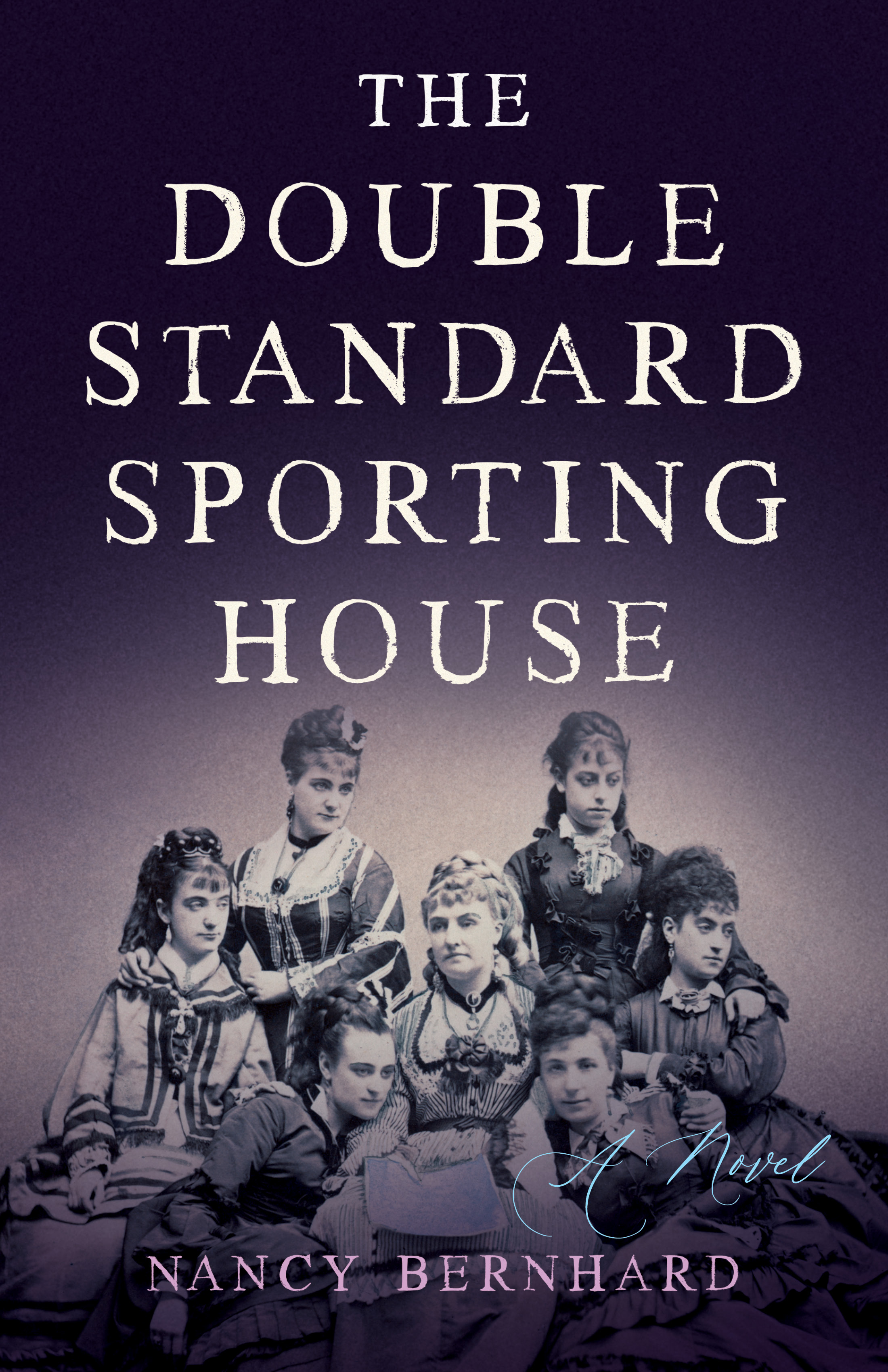
The Double Standard Sporting House cover
The Double Standard Sporting House

Book Description

A high-class brothel that entertains New York’s most powerful men, the Double Standard Sporting House funds a free clinic for women. When the Tammany Hall criminal syndicate takes over the city in 1868 and starts kidnapping girls, the house’s owner Nell “Doc” Hastings cannot stay quiet—especially after sixteen-year-old Vivie arrives at the clinic bruised and bleeding.

Resolving to seek justice for Vivie and girls like her, Doc builds an unlikely alliance with religious reformers, a rare honest ward cop, and an alluring newspaper publisher she can’t seem to keep away from. Even with their help, Doc will have to use her sharpest tools—secrets, guile, and a surgical blade—to prevent a dark turn in the sex trade.

Full of intrigue, friendship, and love, this timely story of a heroine erased from history by the sexual double standard reminds us that women help and heal one another, even when shameless criminals come to power.

Interview

As a former history teacher and historical fiction writer, I always like to find out how a historical fiction/nonfiction author gets from an idea to the actual book. With that, my first question is, what inspired you to write The Double Standard Sporting House?

My delightful, flamboyant grandmother once told me that her Aunt Beadie was a madam. It was a total fabrication, but before I sorted that out, I wondered how a smart middle-class girl with a large, supportive family could end up in prostitution. The answers are: rape and seduction.

I began to imagine a smart girl, skilled in medicine, finding herself in the demimonde, and making the best of the options left to her. She builds an elite brothel to finance her free clinic. When it’s threatened by predatory men, she has a strong community to help her fight back.

How did you go about researching your subject?

About six months into the 2020 lockdown facing a Massachusetts winter at home, I dug into research. I spent about a year reading on the history of prostitution, the Tammany Hall political syndicate, and 19th century medicine.

Your main character is Nell “Doc” Hastings. How and why did she become your protagonist?

Doc is excluded from the practice of medicine because she’s a woman, and then punished for having greater skill than mediocre men. Exclusion followed by insult is a fair summary of being a woman in the 19th century, and sometimes now. Doc embodies traditional feminine strengths in caregiving, compassion, and community.

What in your background helps you in writing a historical fiction book?

I have a doctorate in American history, and have been reading and researching for decades.

A brothel would obviously bring about certain health concerns for women, especially during the 1800s. How did you come to link Nell’s brothel to her funding a free clinic for women? Also, what was the health care system like for women in the lower-income parts of society?

Cast out of ‘respectable’ society as damaged goods, Doc finds surprising freedom and autonomy in the demimonde. Prostitution was far more widespread in the 19th century than in the 21st. In 1868 New York when women had very few ways to earn money, 30%  did sex work at some point in their lives, compared to 1-2% now. The only industry controlled by women, prostitution was also just about the only way for single women to accrue real wealth. Reduced to their sexual and reproductive functions, these women made the best of it. Owning the house allows Doc to run her clinic as she likes, serving the most vulnerable women without men telling her what to do. Ironically, she would have provided far better healthcare to prostitutes than respectable women received from fancy doctors.

Medicine in the 19th century was just beginning to professionalize. There were plenty of quacks with medical degrees, and plenty of skilled healers who’d never been to school. Women’s particular needs were little studied or prioritized, of course. Poor women would have had difficulty accessing care, and most likely would have seen midwives or traditional healers, especially in the country. Charity hospitals and free clinics served poor women in the cities, but often refused care to women they deemed morally undeserving.

How does society today resemble the time period and events in The Double Standard Sporting House?

Gangs of heedlessly corrupt, powerful men still prey on and abuse girls and women all the time, and cover it up, as we see in the news every day. Conservatives are torching women’s reproductive freedom, and endangering our health and our lives. They shame us for carrying the burden of childbearing, and punish us for demanding full agency and autonomy. Women have more rights now than they did 150 years ago, but fewer rights than we did a few years ago.

1 in 4 women in the US has been raped, and 50% have suffered active harassment. Misogyny is different but arguably as strong as it was in 1868.

It seems to me that historically, the achievement of power through corruption, or maybe even through honest methods, comes at the expense of women, at least historically. What are your thoughts?

Indeed. We live in a patriarchal society set up for the benefit of half the population, and our culture represents only half the experience of humanity, yet male dominance is so pervasive we often can’t see it. The hierarchical, competitive, acquisitive, individualistic drives associated with masculinity are anti-democratic, and are killing our planet. It leads men to treat women as less-than-human vessels for reproduction, and to demean and de-value everything associated with femininity, like empathy and compassion. Feminism does not seek to replace patriarchy with female domination, it seeks to promote democracy, equality, and an orientation to the common good.

Finally, why should people read The Double Standard Sporting House?

It’s a good story, one that may help readers to see prostitution, and women’s historical exclusion from most opportunities, in a new light.

Pre-order on Amazon:  https://www.amazon.com/Double-Standard-Sporting-House-Novel/

Nancy Bernhard author photo
Nancy Bernhard

Nancy Bernhard is a journalism historian and yoga teacher, fascinated by how survivors of sexual and political violence heal through storytelling and movement. Having earned a BA in religion at Dartmouth, a PhD in American History at the University of Pennsylvania, and taught at Harvard, Bernhard turned her indignation over the sexual double standard into an absorbing tale rooted in the 19th century history of Tammany Hall. She was born in Brooklyn, and lives with
her family in Somerville, Massachusetts. https://www.nancybernhard.com/


© 2025- Ronovan Hester Copyright reserved. The author asserts his moral and legal rights over this work.

Book Review of The Witch of Tophet County by author J. H. Schiller.

The last witch on Earth takes on interdimensional invaders, tentacled overlords, and local politics in this fun, funny, and fast-paced urban fantasy series.

The witch of Tophet County has three primary preoccupations: Kentucky bourbon, Amish romance novels . . . and protecting her true identity from the chthonic monsters who rule humanity with an iron tentacle.

Despite her best efforts to get fired, the witch is trapped in a draconian, century-long contract that condemns her to work for the Archons of the Nether Realms in the banal misery of county government. But when she accidentally pleases her many-armed overlords, the Dread Lord of Human Resources curses her with an unwanted promotion. And it involves meetings.

As she enters a new bureaucratic hellscape, the witch is assigned to lead a task force investigating recent attacks on senior Archons. Fortunately, her boss has offered her a deal: if she solves the case, they’ll knock fifteen years off her sentence. And if that doesn’t work out, well, she just might have to find a way to help take down the tentaclarchy—or else be doomed to permanent civil servitude . . .

The Witch of Tophet County Cover
The Witch of Tophet County

The Witch of Tophet County was offered to me for an honest review. I like stories with magic. Check. Sarcasm. Check. Female leads. Check. (I do like stories with male leads as well.) And take-no-guff from anyone. Check. So I had to check this book out. See what I did there? And I didn’t even plan it. I’m just that cheesy. (Yes, Witch has taken me over and is writing this review.)

For fans of Jim Butcher when you hear about a witch who happens to do some detective type work and the like in an urban setting one might think of Butcher’s Harry Dresden, I think the sarcasm would be kind of comfortable, but the story is unique to J. H. Schiller. I think you will want to give it a read.

What I like about the story in The Witch of Tophet County is it’s about relationships. A lot of writers have a great idea for an adventure but they fail because they forget about the people in the story. WITCH, and yes, Witch is her name, has a difficult time with having relationships and friends. It’s a bit obvious right from the beginning. This book is the first in a new series and I think it does a great job of not only entertaining the reader but setting up Witch’s story and personality and those of her supporting cast. Some of her supporting cast are CHAD, her nerdy IT friendly torture victim, MAGNOLIA, the Archon but human loving assistant, and well her boss, the Archon Dread Lord of Human Resources. Could there be a better name for an HR head?

J. H. Schiller does a good job of getting the reader to visualize there being different types of beings in a scene. By ‘beings’ I mean humans, WITCH, and Archons. Archons are the ones who subjugated the humans years before the book’s story happens, and run the whole show now. The characters have normal conversations, mostly, but Schiller has somehow written the story in such a way you know if an Archon is speaking or a human is speaking. When WITCH is speaking… let’s just say there is no doubt. I’m a big fan of giving each character their own voice and Schiller does this so well.

One thing that might throw some readers is some of the language/wording used. Witch tends to use profanity. She was not raised by other witches or even a human family. So, I’m sure when she was first let out into the world as an adult she adapted as quickly as she was and with her personality, abrasive was her go to identity. The language fits her.

As every adventure and book about magic does, WITCH has a big choice to make. You think you know what’s going to happen, then what is happening. But when the one who WITCH prays to, or whatever, is named DISCORDIA, yes, as in chaos, never think you know what you know. And even when you finally do, you don’t.

If you thought that was confusing, try writing it and making sure it actually does make sense. CHAOS I TELL YOU! Oh, and then there’s the baby. I know. Now that’s madness that becomes chaos. (My chaos is 19 and in college and thinks he knows everything.)

If you want a fun read with more heart than a witch knew she had, character development and a story that does a great job of surprising you with details you forgot about, this is the one for you.


The Witch of Tophet County Cover
The Witch of Tophet County

Now get your digits working and click Amazon below to get the book or the Dread Lord of IT will find you. Read it. Love it. Amazon.


Playing with fire cover.
Playing with Fire


THEN pre-order book 2 Playing with Fire: A Comedy of Horrors.


J. H. Schiller
J. H. Schiller

Bio:

J. H. Schiller writes speculative fiction with a flair for the weird and a healthy dose of the absurd. In an earlier incarnation, she earned a graduate degree in international affairs and worked for the federal government in Washington, DC. She has since escaped to Ohio, where she writes full-time. Her short fiction has been featured in several anthologies and published by The Arcanist and Flame Tree Press. Her debut novel, The Witch of Tophet County, was published in January 2024 (Podium). She is a member of the SFWA. Check out her latest news at J.H. Schiller (jhschiller.com).

GoodReads.com

8 Questions with D MacNeill Parker, author of Death in Dutch Harbor.

When two murders strain the police force of a remote Alaskan fishing port, veterinarian Maureen McMurtry is tapped by Dutch Harbor’s police chief for forensic assistance. The doctor’s got a past she’d rather not discuss, a gun in her closet, and a retired police dog that hasn’t lost her chops. All come in handy as she deciphers the cause and time of death of a local drug addict washed ashore with dead sea lions and an environmentalist found in a crab pot hauled from the sea in the net of a fishing vessel.

When her romantic relationship with a boat captain is swamped by mounting evidence that he’s the prime suspect in one of the murders, McMurtry struggles with her own doubts to prove his innocence. But can she? McMurtry’s pals, a manager of the Bering Sea crab fishery and another who tends Alaska’s most dangerous bar assist in unraveling the sinister truth.

Death in Dutch Harbor by D. McNeill ParkerSee the tour–wide giveaway at the end.

How did you research your book?

Research was not required. Write what you know, right? As a longtime participant in the Alaska fishing industry, I couldn’t pass up the opportunity to use my experience as the backdrop to this book. What could be more intriguing than creating a world where commercial fishing and murder meet? However, I knew nothing about police dogs and so made an inquiry with the Seattle Police K9 Unit. They invited me to their training site. I was so appreciative, I named the dog in the book after the K9 Unit shepherd, CoCo.

Which was the hardest character to write?

The arch villain. It was difficult for me to navigate how to leave clues without giving away the identity of the culprit. The protagonist was a bit of a struggle, a learning experience really. Because the book is written in third person, I wrote many revisions trying out ways to best express what was inside her head.

Which was the easiest?

The police chief was the easiest character to write. I have no idea why.

There are many crime mystery books out there. What makes yours different?

As a former fisherman married to a fishing boat captain, and with a career as a journalist, fisheries specialist for the State of Alaska and a seafood company executive, I’ve got the credentials to pull off authenticity. And along the way, the reader will learn a lot about Alaska and commercial fishing.

What’s your next project?

I’m currently writing the second book of the series. So if you like the characters that inhabit DEATH IN DUTCH HARBOR, you can revisit them.

What is the last great book you read?

I could not put down the book, HORSE, by Geraldine Brooks. Its historical fiction, based on a real racehorse that was trained by a slave. The mystery unravels through the point of view of different characters, some in the present and some in the past. It tackles racism in a unique and poignant manner.

What authors inspired you to write?

There were many authors that inspired me to write like Kurt Vonnegut, John Irving, Craig Johnson, Michael Connelly, John Grisham, Martin Cruz Smith, Raymond Chandler, Agatha Christie and Dashell Hammett but the book that lit a writing fire under me as a teenager was John Barth’s book, The Sot-Weed Factor. It’s a wild ride of historical fiction that showed me there was no limit to using your imagination when crafting a yarn.

What is something you had to cut from your book that you wish you could have kept?

There was a scene between Dr. Mo and her pal, Patsy, in a restaurant that was painful to cut. Patsy, one of my favorite characters, used salt and pepper shakers, hot sauce and catsup bottles and a fork to make a point about the doc’s messed-up personal life. It was near the end of the book where the pace had escalated. The scene slowed things down and, gulp, had to go. I hope to find a place for it in the second book!

Find Death in Dutch Harbor at Amazon.

We are doing a tour–wide giveaway of an ebook of DEATH IN DUTCH HARBOR. D. MacNeill has THREE to give away, open worldwide.

Just click below.

http://www.rafflecopter.com/rafl/display/463009dc6/

D. MacNeill Parker
D. MacNeill Parker

Author Bio:

D. MacNeill Parker and her family are long time participants in the Alaska fishing industry. In addition to fishing for halibut, salmon, crab, and cod, she’s been a journalist, a fisheries specialist for the State of Alaska, and a seafood company executive. She’s traveled to most ports in Alaska, trekked mountains in the Chugach range, rafted the Chulitna River, worked in hunting camps, andsurvived a boat that went down off the coast of Kodiak. Parker’s been to Dutch Harbor many times experiencing her share of white knuckler airplane landings and beer at the Elbow Room, famed as Alaska’s most dangerous bar. While the characters in this book leapt from her imagination, they thrive in this authentic setting. She loves Alaska, the sea, a good yarn and her amazing family.

Website: https://www.dmparkerauthor.com/

Amazon: http://amzn.to/46fPtGv

Goodreads: https://www.goodreads.com/book/show/198615907-death-in-dutch-harbor

D. MacNeill Parker Blog Tour


© 2014-2023- Ronovan Hester Copyright reserved. The author asserts his moral and legal rights over this work.